How much does custom management software cost?
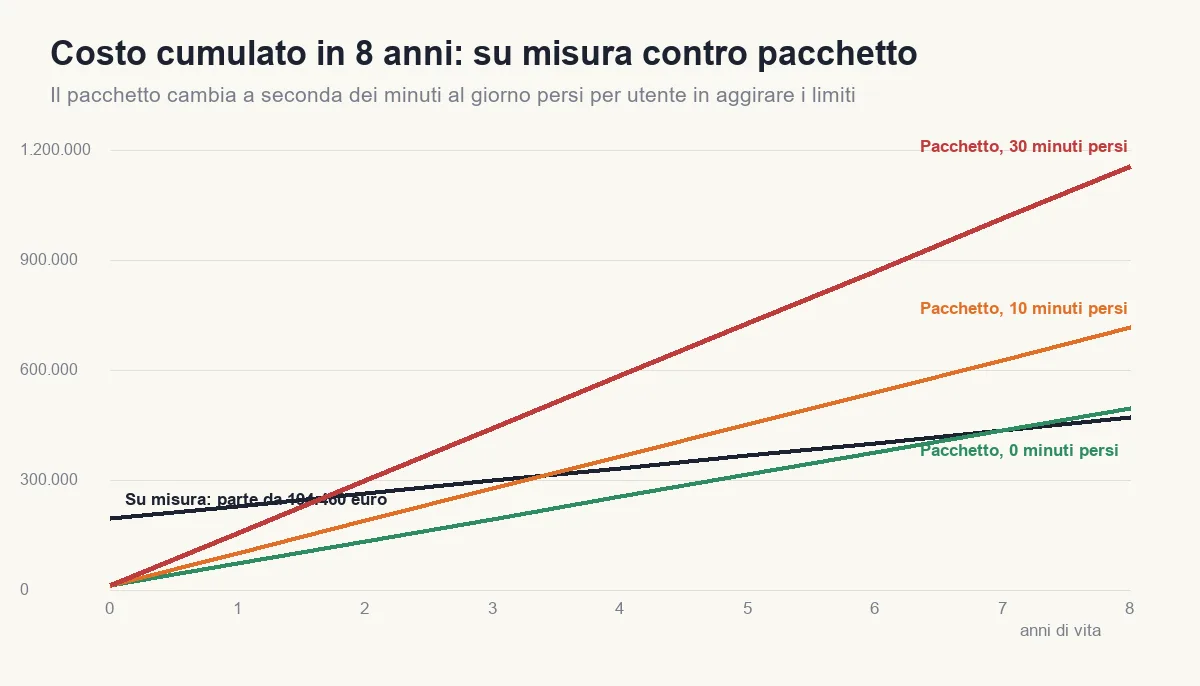
Keeping it alive costs 34,369 euros a year and the five-year bill is 366,306 euros, against 314,100 for the package at zero lost minutes and 451,600 at ten.

An industrial spare-parts distributor in Brescia, 35 employees, 18 million euros in revenue, runs orders and stock on a chain of Excel sheets and an old Access database. The owner asks for three quotes for a management system and gets three numbers: 38,000, 94,000 and 210,000 euros. Nobody explains why the gap is fivefold, and all three say they include "everything".
This article answers the question you are asking: how much does custom management software cost. For a company of that size, with 25 users and the modules it really needs, the bill is around 194,460 euros, that is 463 days at 420 euros. The number breaks down into items you can check, and each item can be moved.
But the figure alone decides nothing. What decides is the comparison with the alternative, an off-the-shelf package, and in that comparison appears a number almost no quote writes down: the minutes each user loses every day working around the limits of the package. In a realistic case, four minutes per person are enough for custom software to cost less over five years.
You will find the quote items and their weight, the three ways of paying for it, the cost of keeping it alive after release, the eight-year comparison with a package, the method to measure lost minutes, a C# model to redo the calculation with your data, and the signs of a quote to reject.
An honest premise. I have built custom software since 1999 and created and sold a multi-tenant legal management system, so I know which side my interest is on. That is why the Brescia case is composite and not a real client, every assumption is written down, and the result includes the cases where custom software does not pay off.
How much does custom management software cost for an SME, in one figure?
For a company with 25 users and nine modules, the case used throughout this article, the bill is this.
- Module development: 280 days.
- Analysis and design, testing, project management, training and go-live: 127 days.
- Base total: 407 days, that is 170,940 euros.
- Margin for the unexpected, 20% of development: 56 days, that is 23,520 euros.
- Total: 463 days, 194,460 euros.
I write it in days and not only in euros because days are the only unit that holds over time. If a quote does not say how many days it contains, ask for them in writing.
| Band | What it buys | Days | Euros at 420 a day |
|---|---|---|---|
| Small | 2-3 modules, few users, no integrations, clean data | 80-120 | 33,600-50,400 |
| Medium, the Brescia case | 9 modules, 25 users, e-invoicing, import from the old system | 380-470 | 159,600-197,400 |
| Large | Several sites, integrations with machinery or e-commerce, complex roles, mobile app | 800-1,500 | 336,000-630,000 |
The 38,000-euro quote is in the small band, the 210,000 one in the medium band. They were not three prices for the same job: they were three different jobs with the same name.
What is the cost made of, and how much does each item weigh?
The cost of custom software is not "the program". The module code is about 70% of the total, and the rest is work you do not see and that the cheapest quotes skip.
| Item | Days | Euros |
|---|---|---|
| Customers, suppliers, items master data | 25 | 10,500 |
| Quotes and customer orders | 45 | 18,900 |
| Stock and inventory | 50 | 21,000 |
| Purchasing and supplier orders | 35 | 14,700 |
| Electronic invoicing | 30 | 12,600 |
| Users, roles and action log | 20 | 8,400 |
| Reports and dashboards | 30 | 12,600 |
| Import from the old system | 25 | 10,500 |
| Export to accounting | 20 | 8,400 |
| Module development | 280 | 117,600 |
| Analysis and design (15%) | 42 | 17,640 |
| Testing and acceptance (15%) | 42 | 17,640 |
| Project management (10%) | 28 | 11,760 |
| Training and go-live | 15 | 6,300 |
| Base total | 407 | 170,940 |
| Margin for the unexpected (20%) | 56 | 23,520 |
| Total | 463 | 194,460 |
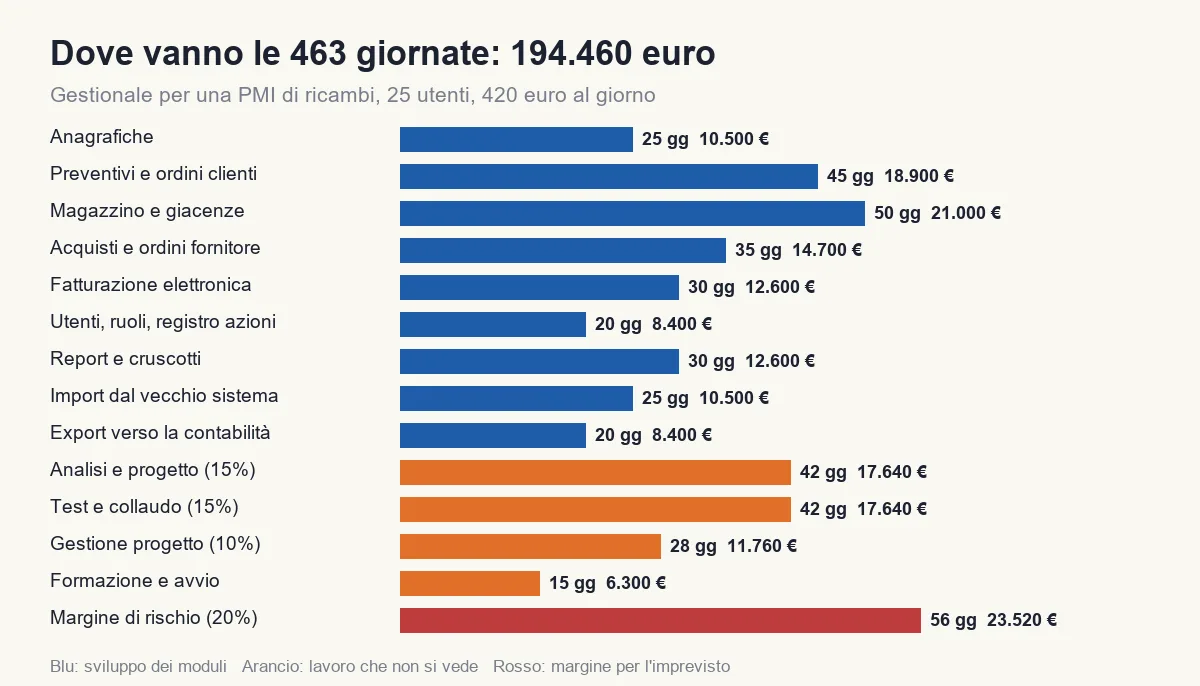
Analysis, testing and management add up to 112 days, 40% of development. A very low fixed-price quote squeezes exactly these, and they decide whether the software works with real data on delivery day and not only with the demo data.
The code is about 70% of the bill. The rest is what makes the code work on Monday morning.
Why do two quotes for the same system differ fivefold?
After twenty-six years of reading and writing quotes, differences come down to six variables.
- Scope. "Order management" can mean a ten-day module or a fifty-day one. The difference is in the special cases: discounts by customer and item family, partial deliveries, returns, open orders fulfilled in pieces.
- Integrations. Each link to an external system costs between 8 and 25 days. The cost is not in the call but in the failure cases: the rejected invoice, the courier that does not answer, the record that arrives twice.
- Starting data. The import is 25 days in Brescia, but with dirty data it takes 60. Cleaning requires decisions from the client.
- Users and roles. Two roles cost a few days. Eight roles with per-site rules and an action log cost ten times more, and security cannot be squeezed.
- Required quality. Automated tests, a separate test environment, a release procedure that does not stop users. What you do not build today you pay later with interest, as the guide on the cost of legacy software shows.
- The person who writes it. A junior at 200 euros a day does not cost half of a senior at 420: more days for the same result and more debt left behind. The guide to the cost of a .NET development team in 2026 puts rates and productivity side by side.
Put on the same list of items, the gap in Brescia shrinks from fivefold to twofold, and the discussion changes: it is no longer which costs less, but which item you actually need.
Fixed price, daily rate or phases: how should you pay for it?
| Formula | Who bears the risk | Works when | Breaks when |
|---|---|---|---|
| Fixed price | The supplier, who covers it with a price 25-40% higher | Small, well-defined scope | Every new request becomes a contract change |
| Daily rate with a cap | The client, up to the cap | Scope discovered while working | Without a client owner, days inflate |
| Phases, fixed price per phase | Shared | Medium and large projects | When phases do not release usable value |
For a project of around 190,000 euros I almost always recommend the third. In Brescia the phases are three, each producing a usable system.
- Phase 1, the core: master data, orders, stock, users. 231 days, 97,230 euros.
- Phase 2, the full cycle: purchasing, e-invoicing, import from the old system. 149 days, 62,496 euros.
- Phase 3, management: reports, dashboards, export to accounting. 83 days, 34,734 euros.
The phases add up to 194,460 euros, but the client has signed only the first. At the end of phase 1 there is a product in use, a real cost per day, and a free choice. That freedom is worth more than the discount a single contract might offer. On contract clauses, the guide on how to choose a software house lists the ones that matter: code ownership, delivery of the sources, handover if the supplier disappears.
How much does it cost to keep it alive after release?
The 194,460 euros is the cost of birth. In Brescia the yearly items are these.
- Maintenance and fixes: 18% of the base cost every year, 30,769 euros.
- Hosting and backups: 3,600 euros a year. A good use of the cloud keeps it low: the analysis of multi-tenant architecture in .NET shows what infrastructure weighs when a system is designed not to waste it.
- Yearly total: 34,369 euros, 17.7% of the initial investment.
If the application does not need always-on servers, serverless architecture lowers the hosting line further, because you pay only for use. To see how software goes from the first meeting to release, there is the guide to software development.
The simple rule: five years cost about twice the initial quote. 194,460 euros plus five years at 34,369 make 366,306 euros. If your budget is based only on the first number, you are looking at half of the bill.
Custom or package: what does the alternative really cost?
The honest comparison is between custom software and a ready-made package. For the same company, a market package for distributors costs 180 euros a month per user and takes a few weeks to set up.
| Assumption | Custom | Package |
|---|---|---|
| Start | 463 days, 194,460 euros | 30 days of setup, 12,600 euros |
| Yearly cost | 34,369 euros | 54,000 in fees plus 15 days of adaptations: 60,300 euros |
| Five-year cost | 366,306 euros | 314,100 euros |
If you stop here, the package wins, and the crossover arrives after 7.0 years. The seller of the package stops here. The calculation is honest but incomplete: it misses the cost of what the package cannot do.
Every package covers about 80% of a typical company's processes. The remaining 20% is what makes your company different, and the package handles it with a workaround: an Excel sheet on the side, a notes field used as a database, two screens for what in your process is one operation. Each workaround costs minutes, and minutes multiply by users and days.
The deciding number: minutes lost every day
25 users x 220 working days x 30 euros an hour = 165,000 euros a year for each hour lost per day. Divided by 60, a single minute a day per user is worth 2,750 euros a year.
| Minutes lost per user per day | Yearly cost of the workaround | Yearly cost of the package | Crossover |
|---|---|---|---|
| 0 | 0 | 60,300 | 7.0 years |
| 5 | 13,750 | 74,050 | 4.6 years |
| 10 | 27,500 | 87,800 | 3.4 years |
| 15 | 41,250 | 101,550 | 2.7 years |
| 20 | 55,000 | 115,300 | 2.3 years |
| 30 | 82,500 | 142,800 | 1.7 years |
The right question is not how much custom software costs. It is how many minutes a day it costs not to have it.
How many minutes are enough for custom software to pay off?
| Payback horizon | Yearly saving needed | Minutes lost per user per day |
|---|---|---|
| 3 years | 60,620 euros | 12.6 minutes |
| 5 years | 36,372 euros | 3.8 minutes |
| 8 years | 22,732 euros | none: custom costs less even without workarounds |
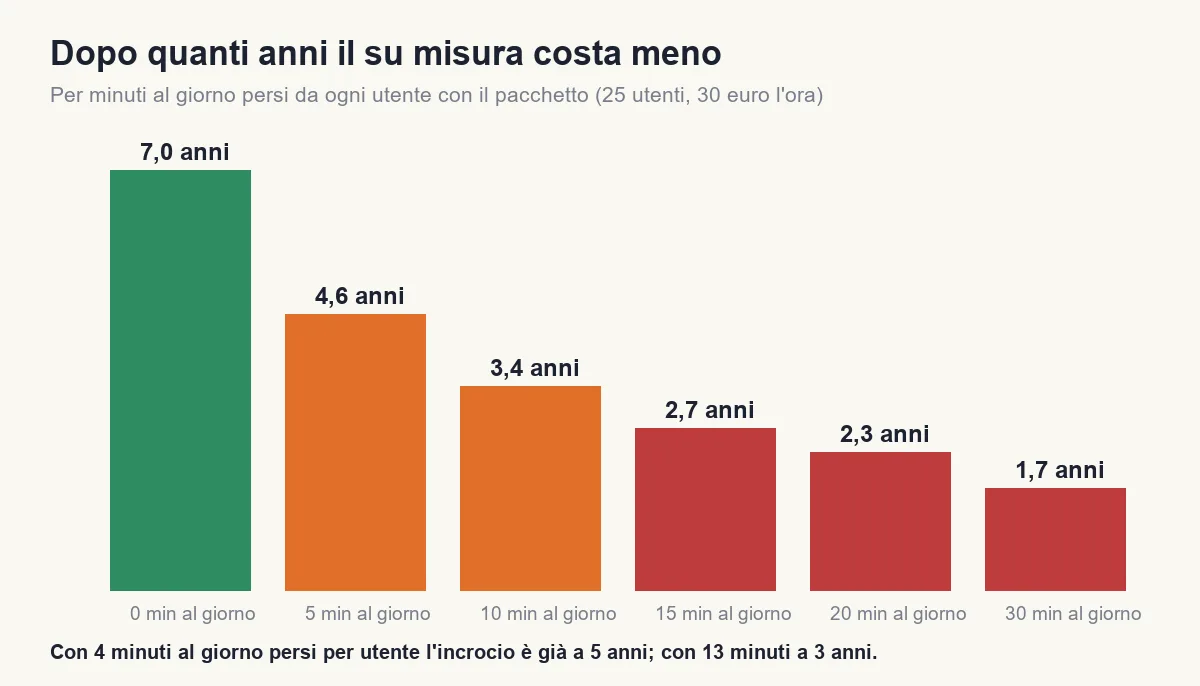
Four minutes a day per user is less than a coffee, and it is the figure that makes the bill even at five years. There is one limit I want to state clearly: the 30 euros an hour is valid when the lost time would be productive time. If your processes are standard, the package is the right answer. Custom software is bought when processes are your competitive difference, not when "the package is not liked".
How to measure lost minutes in a week
- Monday: list the workarounds, department by department. In a 25-user company there are usually 8-15.
- Tuesday and Wednesday: how many times a day and for how many people.
- Thursday: time three real runs of each workaround. Estimates from memory are always too low.
- Friday: add up times x minutes x people, divide by users. That is your figure.
If it is under 4 minutes, buy the package. If it is over 13, custom has already won. In between, it depends on the horizon.
Not every cost is in the minutes. Errors made by manual workarounds, dependence on a supplier who can raise fees 10% a year, the ability to change a process in ten days, and ownership of your own data weigh on the choice too. On the other side, a custom project can fail: phases with usable deliveries and handing the sources to the client reduce that risk almost to zero.
How do you redo the calculation with your company's data?
The model is a few lines of plain C#. Paste it into a console application on .NET 10, replace the assumptions and read the crossover years.
var h = new Ipotesi();
Console.WriteLine($"One minute a day per user is worth {Modello.CostoMinuto(h):N0} euros a year");
foreach (var minuti in new[] { 0, 5, 10, 15, 20, 30 })
    Console.WriteLine($"{minuti} min a day: crossover at {Modello.AnniIncrocio(h, minuti):0.0} years");

record Ipotesi(
    double Tariffa = 420, double GiornateTotali = 463, double GiornateBase = 407,
    double Utenti = 25, double GiorniLavoro = 220, double CostoOrario = 30,
    double CanoneMeseUtente = 180, double GiornateAdattamentoAnno = 15,
    double GiornateAvvioPacchetto = 30, double QuotaManutenzione = 0.18, double Hosting = 3_600);

static class Modello
{
    public static double CostoMinuto(Ipotesi h) => h.Utenti * h.GiorniLavoro * h.CostoOrario / 60;

    public static double AnniIncrocio(Ipotesi h, double minuti)
    {
        double investimento = (h.GiornateTotali - h.GiornateAvvioPacchetto) * h.Tariffa;
        double annoSuMisura = h.QuotaManutenzione * h.GiornateBase * h.Tariffa + h.Hosting;
        double annoPacchetto = h.Utenti * h.CanoneMeseUtente * 12
                             + h.GiornateAdattamentoAnno * h.Tariffa
                             + minuti * CostoMinuto(h);
        return investimento / (annoPacchetto - annoSuMisura);
    }
}
Run it three times: prudent (minutes halved, 25 euros an hour), base, and optimistic. If the crossover stays in the same zone in all three, the decision is solid. If not, measure the minutes better before spending.
How do you cut the cost without cutting the value?
- Start from the core. Phase 1 at 97,230 euros gives you the system people use every day. In the projects I follow, one feature in five requested at the start is never built.
- Clean the data before starting. The 25-day import becomes 12 if data arrives clean.
- Replace the Excel sheets that matter, not all of them. The guide on when to replace Excel with a management system gives the criteria.
- Use standard components where you are no different. E-invoicing, email and login are not your competitive edge.
- Have an internal owner with time to answer. A client who answers in two days instead of two weeks makes the project cost 15-20% less.
What does not work is compressing quality. Removing the 84 days of analysis and testing brings the total down to 159,180 euros but raises maintenance from 18% to 30% of the base cost: 51,282 euros a year instead of 30,769. In under two years the saving is gone.
Which signs tell you to reject a quote?
- No days written down.
- Zero items for analysis, testing and acceptance.
- The source code stays with the supplier: you would pay 194,460 euros for a disguised subscription.
- Fixed price without a list of exclusions.
- No usable intermediate phase: for eighteen months you see nothing working with your data.
- "Unlimited" maintenance at a low price.
The good signs are the mirror: days written, stated assumptions, phases with usable deliveries, a visible margin, sources that are yours, and a yearly maintenance cost stated before signing.
What would the Brescia owner do today?
With the calculation in hand he would have seen that the 38,000 euros covered two modules out of nine, that the 94,000 included neither invoicing nor import, and that the 210,000 was the full job, with a running cost of about 34,000 euros a year. If his warehouse workarounds cost nine minutes a day per user, the crossover with the package is 3.6 years and custom is right if the system must live six years or more. If they were two minutes, he would buy the package and spend 12,600 euros on setup, without regrets.
If you are evaluating a management system, the path starts from custom software for businesses. If you already have an old system and wonder whether to redo it, the guide on rewriting or refactoring legacy software does the same calculation for the opposite case. If you need someone to read the quotes with you, there is software consulting.
In five lines. Write down how many years you need the software. Measure the minutes lost per user every day: 4 are enough to make custom pay off at five years. Compare quotes by days and modules, never by price. Pay by phases with the sources yours. Budget the running cost, about 18% a year, because at five years the bill is double the quote.
Frequently asked questions
For a company with 25 users and nine modules, 463 days, that is 194,460 euros at 420 euros a day: 170,940 euros base plus 23,520 margin for the unexpected. Bands range from 33,600-50,400 euros for 2-3 modules to 336,000-630,000 for several sites and integrations.
About 18% of the base cost, 30,769 euros, plus 3,600 euros of hosting and backups: 34,369 euros a year in the case described. At five years the total cost is about twice the initial quote, 366,306 euros against 194,460.
It depends on the minutes each user loses every day working around the package's limits. With zero minutes the package costs less for 7 years, with 4 minutes custom costs less at 5 years, with 13 minutes at 3 years. If your processes are standard, the package is the right choice.
For projects of around 190,000 euros, pay by phases with a fixed price per phase and a usable system at the end of each. A single fixed price is 25-40% higher because the supplier covers itself, and uncontrolled daily rates inflate.
Six variables: module scope, integrations, starting data, roles and permissions, required quality (tests, acceptance) and the seniority of the people writing it. On the same list of items, three quotes between 38,000 and 210,000 euros come closer from fivefold to twofold.
No days written down, no items for analysis and acceptance, source code staying with the supplier, fixed price without a list of exclusions, no usable intermediate phase and unlimited maintenance at a low price.
Leave your details in the form below