What is the number that decides whether auto repair shop software will save you money?
Below 10 per cent a well made paper form is enough; above 25 a system pays for itself. In a garage with 14 employees, 6 lifts and 3,200 orders a year the share was 43 per cent, only 22 per cent of customers were called back before their deadline, and the five costs of working by word of mouth came to about 111,000 euros a year, 5.9 per cent of revenue. A product costs between four and nine thousand euros a year, the custom piece with approved quote, work order and callbacks between twenty-eight and fifty-five thousand euros. Against no solution the custom piece pays for itself in about ten months, against a product it pays above 2,000 orders a year, about four lifts.


At a quarter past eight on a Tuesday in October, in a multi-brand garage in northeastern Italy with six lifts and fourteen employees, the workshop foreman is holding three pieces of paper. The first is the reception sheet, where an Audi A4 is written down as "service + brakes, call the customer for the quote". The second is a sticky note on the monitor: "front pads ordered, arriving Thursday, customer said yes on the phone". The third is the mechanic's notepad, where nobody has written that halfway through the job he also changed the brake fluid and two bulbs. Lift four is occupied by a car waiting for a part. The customer phones to ask how it is going, and nobody knows for certain.
Auto repair shop management software exists to take that Tuesday morning away, but not every garage needs it, and those who do often buy the wrong thing. Here you will find what the term really means and what it is not, the three numbers that tell you whether you need it or whether a better paper form is enough, the sum of what working by word of mouth costs every year, the checks that cost nothing, the price difference between product, module and custom piece, and the threshold beyond which it pays to build. The case that follows is a typical case, reconstructed from situations I have seen in garages and in companies with an in-house workshop, with rounded numbers.
An honest premise: I built and sold LegalDesk, a program for law firms where a missed deadline is not an annoyance but damage, and in twenty-six years in the trade I have learned that a garage's problem is the same as a law firm's. It is not the lack of work. It is the thread that holds together quote, part, job and callback, and that today lives in the head of whoever is in that day.
What auto repair shop management software is, and what it is not
Auto repair shop management software is a program that keeps in one place customers, vehicles, quotes, work orders, parts, mechanics' hours and callback dates, and for each job says what was promised, what was done and what must be invoiced. It is not just invoicing, not a parts catalogue and not a simple booking diary.
The search brings together very different tools, and whoever picks the wrong one finds out six months later, when the garage is still writing on the notepad. It is worth separating them straight away, because each solves one piece and leaves others uncovered.
The first is the invoicing and accounting program, which issues invoices, sends them to the Italian Interchange System (SdI) and keeps the customer records. Almost every garage has one, and it does what it does well. Its limit is that it starts when the job is finished: it does not know what was promised on the phone or how long the mechanic took.
The second is the parts catalogue, the database that from a number plate or chassis number tells you which part fits that vehicle, with manufacturers' codes and suppliers' equivalents. The most widespread catalogues, such as TecDoc and the manufacturers' labour-time guides, are paid for by licence. They are valuable, but they answer one question only: which part. They do not say who ordered it, for which customer and whether it has arrived.
The third is the booking diary, sometimes as an app the customer uses alone. It fills the lifts, but it does not know what happens once the car has come in. The fourth is the proper garage program, the one that handles quotes, work orders and stock: it is the core, and it deserves a close look. The fifth, and the one that interests the reader, is the set of rules and memory that sits between the moment the customer hands over the keys and the moment they take them back: who said yes to what, which part has arrived, how long it took, what must be called back in twelve months. This is not a module. It is a process, and it has a time, a cost and an error rate that can be measured.
Quote, work order, part, hour, callback: five objects, not one
In everyday speech "the car" is everything. In the system it helps to distinguish. The quote is what you proposed to the customer, with a price and a validity. The work order is what the customer has authorised, and the mechanic may carry out only that. The part is an item with a code, a supplier, a purchase price and a selling price. The hour is the mechanic's real time, different from the labour-time guide. The callback is the future deadline: service, roadworthiness test, tyres, timing belt. Almost all the trouble starts when they are confused in a single line of the notepad.
What it must be able to do, one line per function
A useful system holds six things together: the vehicle record with its history, the quote that becomes a work order without being rewritten, the parts tied to the order, the hours clocked by the mechanic, the invoicing that starts from what was done and the reminder of the next deadline. Every product on the market does two or three of these well. Almost none keeps all six in the same place, and when they do not, the missing piece goes back to the notepad.
Why does a job get lost in a garage when nobody makes a mistake?
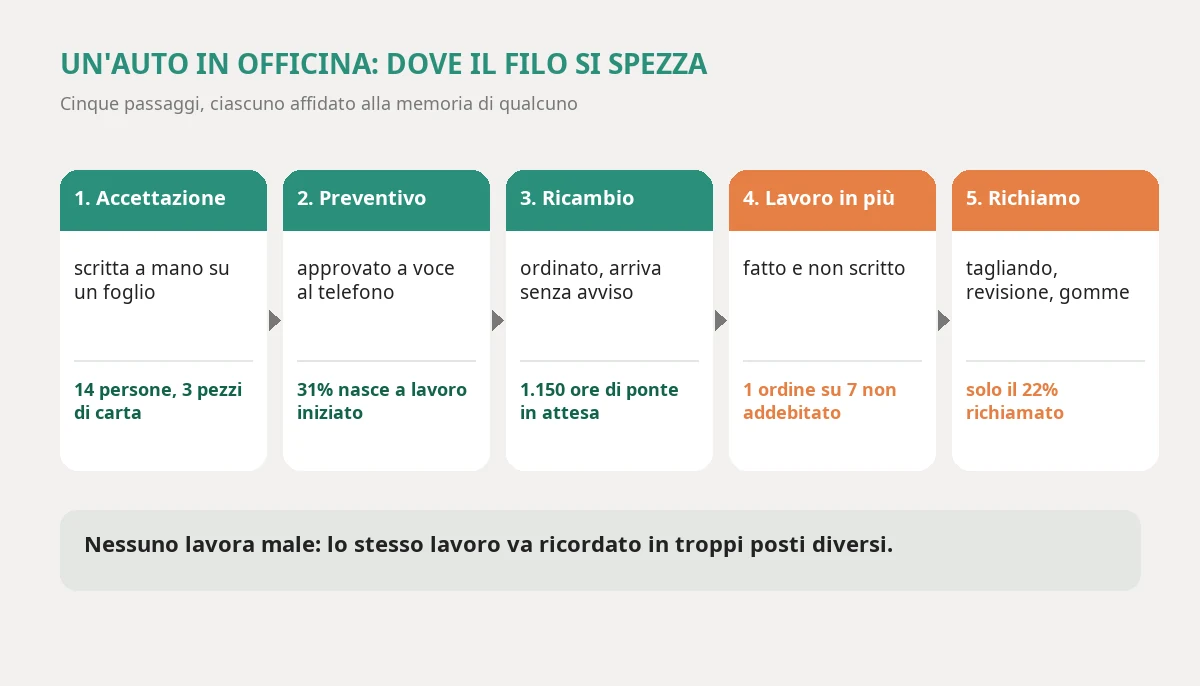
In the garage I am talking about nobody worked badly. The eight mechanics were good, the foreman knew every customer by name and reception answered the phone on the second ring. Every single action was right. What did not work was the number of different places in which the same job had to be remembered.
We followed it over a year of data. The garage did about 3,200 work orders a year, thirteen a day on average, and had 4,200 active customer vehicles, meaning seen at least once in the last three years. Revenue was 1.9 million euros between labour, parts and tyres, and purchases of parts and tyres were worth about 520,000 euros. The customer handed the keys to reception, who wrote the job on a sheet. The quote was given by phone or on another page. The mechanic noted his hours on his own notepad. The storekeeper ordered parts on the supplier's portal and passed the word on verbally. The invoice was prepared by the back office at the end of the day, reading three pieces of paper.
Every step is a small bet on memory. A quote approved by word of mouth is a sentence that exists as long as the person who heard it remembers it. An ordered part is a notification the supplier sends to one person, who may be on holiday. An extra job is a hand the mechanic lends "because it takes a minute", and nobody writes it down.
The three points where the thread breaks
The first is the job authorised by word of mouth. The customer says yes on the phone, reception remembers, but the mechanic did not hear it. Or he does, and does something else as well. Either way the invoice reflects what somebody remembers and not what happened. In the case, one order in seven closed with at least one job or material not charged, and one in twenty with a customer disputing a line they did not remember approving.
The second is the part nobody follows. A part ordered on Thursday for a car on lift four arrives on Friday afternoon, the storekeeper has already gone and the car sits there all weekend. Or the wrong part arrives, and the correction costs another day. Over the year, about 1,150 lift hours were occupied by vehicles waiting for a part or an answer from the customer.
The third is the customer nobody calls back. A car's service falls due every twelve months or every fifteen thousand kilometres, the roadworthiness test every two years after the first, winter tyres where local ordinances require them between mid-November and mid-April. These are certain, calculable deadlines, and they mean guaranteed work. In the garage in the case only 22 per cent of customers received a reminder, and when it happened it was because somebody had time to phone. The others came back by chance, or did not come back.
All three points show up in a day if the data lives in one place, and take a year to show up if it lives in the heads of fourteen people. This is the difference that auto repair shop management software must make: not to make mechanics work faster, but to give every job a single record, every promise a trace and a thread that does not depend on who is in that day.
How much does it cost every year to run a garage by word of mouth and on paper?
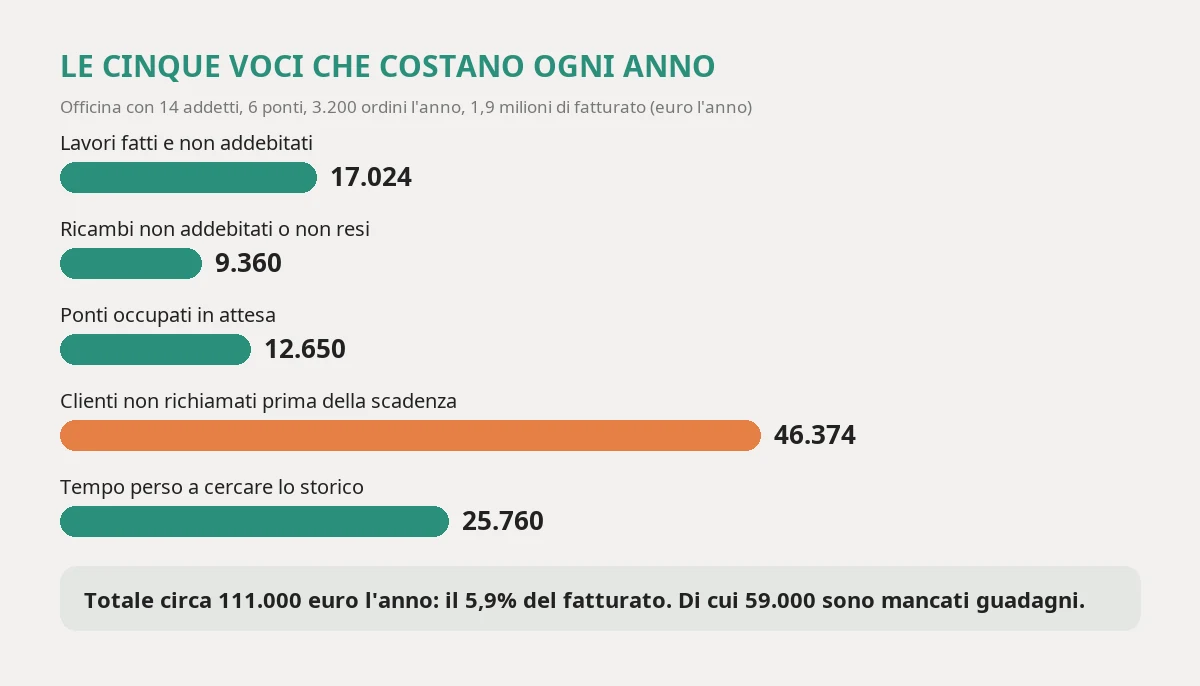
In the garage in the case, working by word of mouth and on paper cost about 111,000 euros a year, 5.9 per cent of revenue. The sum has five items, and it is worth redoing with your own numbers before talking about software, because the money is real and the largest part appears in no accounts.
The premises are few. The garage had 14 employees: eight mechanics, a foreman, two at reception, a storekeeper and two owners. An hour of an employee's work cost 28 euros on average, all included, and an hour sold was worth 55. A job left 118 euros of margin on average. Active vehicles were 4,200, work orders 3,200 a year, purchases of parts and tyres 520,000 euros.
Jobs done and not charged. Of 3,200 orders, 14 per cent, that is 448, closed with at least one job or material not invoiced: brake fluid topped up, bulbs, an extra check, consumables. The average value was 38 euros between hours and materials. Four hundred and forty-eight times 38 makes 17,024 euros a year.
Parts not charged or not returned. A part ordered and never fitted because the customer changed their mind, and returned outside the supplier's deadline. A part fitted and not recorded on the order. In the case, 1.8 per cent of parts purchases, that is 1.8 per cent of 520,000, stayed in stock or was never invoiced: 9,360 euros a year.
Lifts occupied while waiting. The 1,150 lift hours with the car standing for a part or an answer were half avoidable: 575. The real cost exists only in the months when the garage is full and turns work away, in the case about 40 per cent of the year, so 230 hours. At 55 euros an hour of labour sold that is 12,650 euros of work not done.
Customers not called back. Of the 4,200 vehicles, 924 received a reminder before the deadline, 3,276 did not. Whoever is called back returns to the garage twelve percentage points more often: 393 more jobs a year. At 118 euros of margin that is 46,374 euros, and it is the biggest item.
Time lost searching. Four people, the two at reception, the foreman and the storekeeper, lost five hours a week looking for a vehicle's history, calling back for an approval, copying out a quote. Five hours for 46 weeks for four people is 920 hours, at 28 euros: 25,760 euros.
The total is about 111,200 euros a year, 5.9 per cent of 1.9 million. Two honest warnings. The first: 59,000 euros is missed earnings, 26,400 is money that was there and was not collected, and 25,800 is hours, which are recovered only if someone uses them to do something else. The second: the items overlap a little, because a customer not called back is often also search time. If, redone with your numbers, the total is below 2 per cent of revenue, garage software is not a priority. If it exceeds 4, almost certainly it is.
How to redo the sum in an afternoon
You need five pieces of data. The orders closed in the last month compared with the invoices, to count the differences. The year's parts purchases and returns, which are in the supplier portal's statement. The lift hours occupied while waiting, which the foreman estimates in twenty minutes by looking at one week. The number of active vehicles and the share that received a reminder. And the average margin of a job, which the accountant knows. The real time is almost always double what you think, and the lost customers are more than the remembered ones, because you remember only those who complained.
What is the number that decides whether you need auto repair shop software?
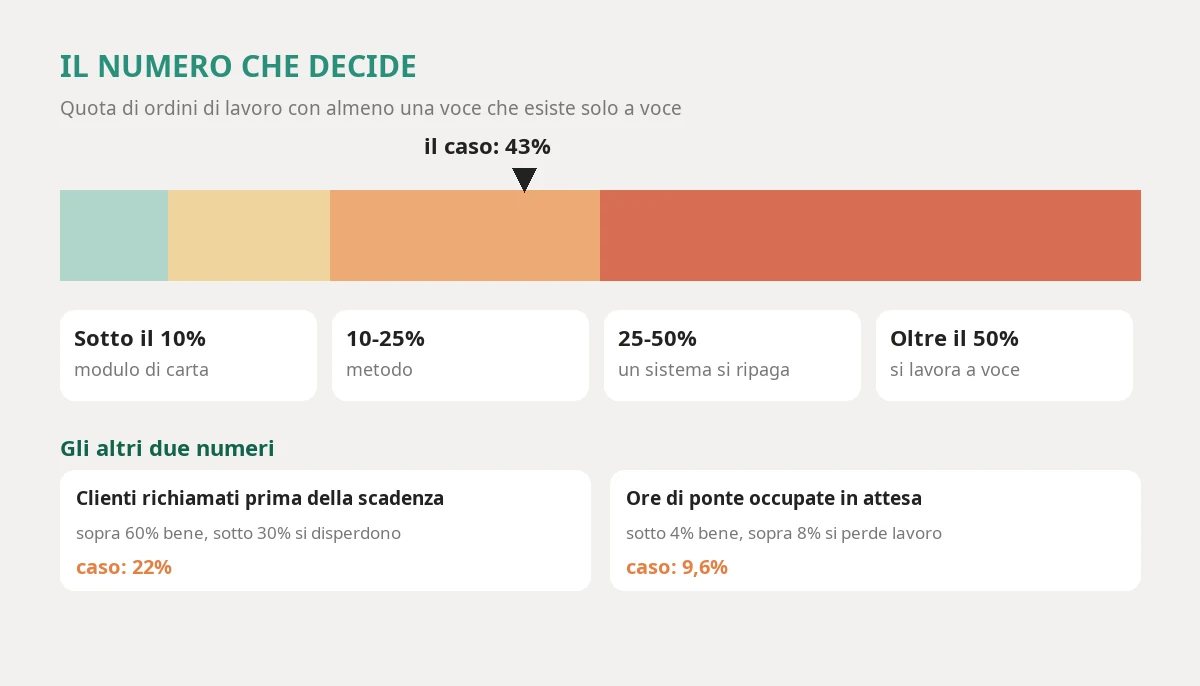
The number that decides is not how many lifts you have or how many mechanics, but the share of work orders with at least one item that exists only by word of mouth: a job authorised on the phone, a part with no trace, an hour never written down. The higher it is, the more the garage invoices what somebody remembers and not what happened.
It is measured in half an hour. Take the orders closed in any one week, forty is a good sample. For each one ask three questions: do the main job and every extra job have a written trace of customer approval? Is every invoiced part recorded on the order with its cost? Are the mechanic's hours written down? If even one answer is "no", the order counts as "by word of mouth". In the case, out of 40 orders closed in a week in September, 17 had at least one item by word of mouth: 43 per cent.
The thresholds I use are four. Below 10 per cent the situation is under control: a paper form or a well made spreadsheet is enough, with a rule and one person who checks it. Between 10 and 25 the problem is method: before writing code you need to decide who authorises what and where it is written. Between 25 and 50 a system pays for itself, because the gap is structural and no discipline removes it. Above 50 the garage works by word of mouth: the most valuable work, that of mechanics and receptionists who know the customers, is remembering promises.
The second number: customers called back before the deadline
The second number shows in the accounts before any other: the percentage of active vehicles that receive a reminder before the service, the test or the tyre change. Above 60 per cent you are doing well. Between 30 and 60 the method can be improved with a weekly list. Below 30 your customer base disperses every year. In the case it was 22 per cent.
The third number: lift hours spent waiting
The third comes from the lift: the share of hours in which a vehicle occupies a lift with nobody working on it, because a part or an answer is missing. Six lifts for about 2,000 hours a year make 12,000 hours: the 1,150 waiting are 9.6 per cent. Below 4 is fine. Above 8, as in the case, in the busy months you are giving work to another garage. These three numbers are simple to read and say more than any demonstration of a program: if the first is below 10 and the other two are good, your problem is not software.
Why counting lifts is not enough
A well organised garage with eight lifts is better off than one with four run from a notepad. Size matters only because it multiplies the orders, and with them the chances of forgetting an item. The right number is not the size, it is the share of work that lives by word of mouth.
How do you make a quote the customer approves and that stays written down?
You make it starting from the vehicle record: the system proposes the jobs and parts, the price is calculated from labour-time guide and price list, and the customer approves with a message or a click that stays tied to the order. From then on the mechanic sees on his screen only what is authorised, and every addition goes through a new approval.
The garage quote has a problem that a manufacturer's quote does not: it is often born after the car has already been taken apart. The customer brings the car for a noise, the mechanic looks, finds three things and phones. If the customer says yes on the phone, the sentence ends up in the memory of whoever answered. In the case, 31 per cent of quotes were born with the work already under way, and those were the most exposed to disputes.
The rule that works is simple and fits in one line: no extra job without an approved line. When the mechanic finds something, he reports it from the screen or the phone with two fields, description and photo. Reception turns it into a quote line with a price and sends the customer a message with the detail and a button to approve or refuse. The approval, with date and time, stays on the order. If the customer does not reply within an agreed time, the line stays suspended and the mechanic moves on to something else. It is not bureaucracy: it is the same rule with which a good office keeps its deadlines, and it protects the mechanic too, who no longer works on trust.
How to calculate the price without fighting the labour-time guide
The manufacturers' labour-time guide says how long it takes in theory to replace a component. Your price is guide time times hourly rate, plus parts with your mark-up, plus consumables. The system calculates it and also shows the margin on every line: if a job in the guide is worth 1.2 hours and your mechanic takes 1.8 on average, you see it after ten orders and not after a year.
What the quote record must contain
The vehicle with plate, mileage and date, the customer with consent to be contacted, the lines with type, price and margin, the validity, the approval method and the person responsible. It also contains photos of the problem, because a photo of brake wear is worth more than a sentence, and a customer who sees it approves more willingly. Saying "I am sending you the photo of the disc" is a way of selling an extra job without insisting.
The quote for insurers, fleets and rental companies
When a third party pays the bill, an insurer, a company fleet or a rental firm, the quote follows a different path: it must be approved by whoever pays, with their own conditions, price lists and timings. The logic is the one described in the article on quotation management software: a document with a validity date, a person responsible and a reminder task is far more useful than a document alone.
How do you keep the thread between reception, lift and parts?
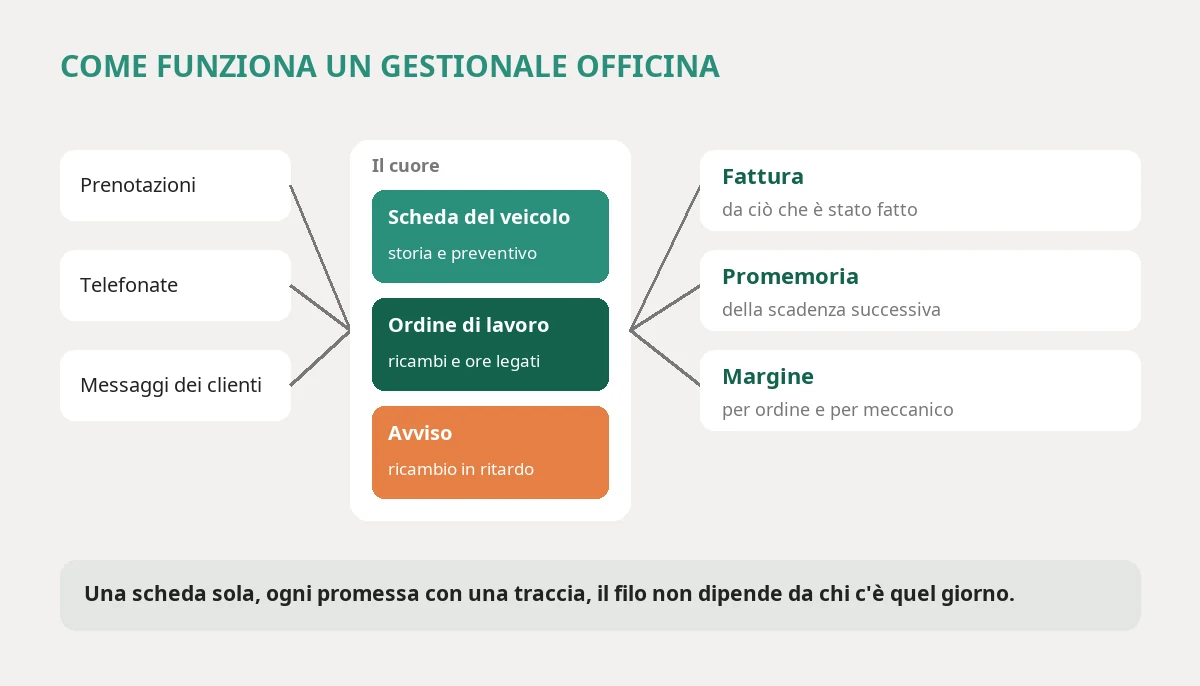
You keep the thread with a single work order that starts at reception and carries quote, parts and hours with it. Every part is tied to the order, every order has a status visible to everyone, and an alert flags when a part does not arrive by the promised hour. The lift does not stay occupied for nothing.
The core of garage software is the work order, and it helps to think of it as a small state machine: received, waiting for quote, waiting for approval, waiting for part, in progress, in testing, ready, delivered. Every step has a person responsible and a time. At the end of the morning the foreman looks at a single list and sees where the cars are stuck, instead of walking between the lifts.
The most delicate piece is the parts. When reception turns a quote line into a work order, the system proposes the order to the supplier with the right code, and the part stays tied to that vehicle. On arrival, the storekeeper scans it and the order moves from "waiting for part" to "ready to fit", with an alert to the mechanic. If the part does not arrive by the hour the supplier gave, reception sees it in red and can warn the customer before they phone. In the case, this alone nearly halved the lift hours spent waiting.
The wrong part: the most hidden cost
The code is chosen from the plate or chassis number, not from memory. When the system proposes the part from the catalogue and the storekeeper confirms, ordering errors fall a lot. And when the wrong part arrives anyway, the return starts from the order, with the deadline by which it must go back, so it does not sit in stock as dead capital.
The mechanic's hours: few and true
The mechanic must not fill in forms. One tap to start the job, one to stop it, two lines of note if he finds something. The system calculates by itself the comparison between actual hours and guide hours, order by order. With data of this kind you talk about efficiency without accusations: if a dismantling always costs twenty minutes more than planned, a tool is probably missing, not the will to work.
The day's plan: who works on what
With six lifts and eight mechanics, assigning jobs is a daily puzzle the foreman solves from memory. The system does not replace him: it puts in front of him the waiting jobs, the expected duration, the skills and the parts already arrived, and he decides. The value lies in not having to reconstruct the state of every car each morning.
How do you call customers back before service, test and tyres?
You call them back by calculating for each vehicle the nearest date among the certain deadlines, by time and by mileage, and sending a reminder thirty days ahead, with the chance to book in one click. The date is calculated by a written, tested rule, not by the memory of whoever has time to phone.
It is the biggest item in the sum: 46,374 euros a year out of 111,200. And you can see why: a customer who is called back returns more often, but nobody makes the call, because it is not urgent. Phoning four hundred people about a service in a month never beats the car that is already on the lift.
The deadlines that matter are few and checkable. The service follows the manufacturer's instructions, generally every twelve months or every fifteen or thirty thousand kilometres, whichever comes first. The roadworthiness test for cars falls four years after registration, then every two. Winter or all-season tyres must be fitted where ordinances require it from 15 November to 15 April, with the seasonal change in spring. Then there are the timing belt, the brake fluid every two years, the cabin filter. The system keeps them as rules with an interval, and every vehicle has its next date.
The calculation by time and by mileage is the part that seems hard and is not. This is the bare minimum, written in C#, which compiles and can be tested:
public record Veicolo(string Targa, DateOnly UltimoTagliando, int KmAnnuiStimati);

public static class Scadenziario
{
    // Returns the nearer date between the time-based and the mileage-based deadline.
    public static DateOnly ProssimoTagliando(Veicolo v, int ogniKm = 15000, int ogniMesi = 12)
    {
        var kmAnno = Math.Max(v.KmAnnuiStimati, 1000);
        var perData = v.UltimoTagliando.AddMonths(ogniMesi);
        var perKm = v.UltimoTagliando.AddDays((int)(ogniKm / (kmAnno / 365.0)));
        return perData < perKm ? perData : perKm;
    }

    public static bool DaRichiamare(Veicolo v, DateOnly oggi, int giorniDiAnticipo = 30)
        => ProssimoTagliando(v) <= oggi.AddDays(giorniDiAnticipo);
}
Annual mileage is estimated from the last two visits to the garage, and corrected at every visit. The rule need not be perfect: it must be written, visible and the same for every vehicle. A date that is three weeks off is a reminder a little early, not damage.
The message that really gets read
A reminder works if it is short, with the customer's name, the model and a concrete reason: "Your Golf is due its service in three weeks: if you like, I can offer Thursday morning or Saturday." With a button to choose. The generic mass message is read by nobody. Two ready-made time slots take away the effort of deciding, and that is almost always the reason a customer does not reply.
Consent and people's data
A customer's plate and name are personal data. A deadline reminder tied to a service the customer has already used is one thing, a promotional offer is another and requires consent. It is worth asking your privacy adviser how to write the notice and where to record consent, once, properly, in the customer record.
Tyres: the callback worth the most
The seasonal tyre change is the most predictable job of the year: twice a year, in the same period, for the same customers. A tyre storage with the list of who left theirs, and a message in October and in April, fills the lifts in two weeks of days that would otherwise be empty.
How do you calculate hours, labour-time guide and margin for each job?
You calculate it by comparing, for each order, three numbers: the guide hours sold, the hours clocked by the mechanic and the cost of the parts. The gap between the first two gives efficiency, the gap between price and costs gives margin, and everything can be read by order, by mechanic and by type of job.
A garage can work for years without knowing how much it earns on a service and how much on a clutch job. The accounts say that at year end there are 120,000 euros of profit, but they do not say that the service leaves 38 per cent and that repairing an automatic gearbox loses five. To find out you need data per job, and it exists only if somebody writes it down at the moment it happens.
In the case, the comparison between hours sold and hours clocked showed something nobody suspected. The hours sold by the eight mechanics were 9,100 a year, the hours clocked 11,600: an efficiency of 78 per cent. It was not a question of laziness. Part of the 2,500 hours of difference was unpaid diagnosis, part waiting for parts, part extra jobs never invoiced, and only a smaller part was time that was truly slow. Until then the discussion was about "slow mechanics". With the numbers the discussion was about diagnosis to be charged, parts to keep in stock and lines to add to the quote.
The diagnosis that is given away
Half an hour of diagnosis with the tool is a service, and as such it has a price. If there is no line in the price list, it does not exist in the order, and the time disappears. In the case, introducing a "diagnosis" line at 35 euros, credited if the customer then approves the job, moved about 18,000 euros a year from hours given away to revenue. It is not in the five sums above: it is an example of what you discover when hours become visible.
Margin by type of job
With a year of orders you get a simple table: for each type of job, how many orders, average revenue, average cost of parts and hours, margin. You find out where you earn and where you work to keep a customer. Not to eliminate the thin jobs, but to choose with your head: a tyre change at 18 euros of margin fills a lift hour in which nothing else would come in.
Comparing mechanics, done well
Data per mechanic should be used to help and not to punish. A mechanic with low efficiency on one type of job has a tooling or training problem. One with high efficiency but many returns for badly finished jobs has another problem. The numbers serve to ask the right question, and the answer comes from the foreman talking to the person.
What must auto repair shop software do for invoices, warranties and fleets?
It must generate the invoice from what was done and send it to the SdI, remember for each part and job the applicable warranty, and handle customers who pay at month end, such as fleets and rental companies, with their own price lists and agreements. It must not redo accounting, it must pass it clean data.
Invoicing is the point where errors become money. With a work order that contains approved lines, hours and parts recorded, the invoice composes itself, and the back office no longer has to read three pieces of paper. The system generates the electronic invoice file in the required format and transmits it to the Interchange System, or passes it to the accounting program the garage already uses. This second road is almost always the best: the accountant knows his program and should not be taken away from it.
Warranties are a deadline like any other, and usually the most forgotten. A fitted part has a supplier warranty, and the work has a warranty towards the customer. If the part fails after three months, the garage must know in ten seconds what it fitted, when, from which batch and which supplier to ask for the replacement. Without a trace, the garage pays for the warranty. In the case, parts under warranty not claimed from the supplier were worth about 4,000 euros a year, not counted in the total because they had never really been measured: it is proof that a trace is useful even for what you could not see.
Fleets and rental companies are a customer apart. They have agreements with their own hourly rates, authorisations to request before any job over a certain amount, payments at thirty or sixty days and a contact for each vehicle. A garage that works for a rental company has a portfolio of open authorisations living in an inbox. Treating that flow like the quotes above, with date, contact and reminder, reduces waits, and therefore occupied lifts. Whoever runs their own fleet and has an in-house workshop will find the subject from another side in the article on fleet management software.
Documents: registration papers, orders, photos
Every vehicle has a file: photo of the registration document, past orders, photos of damage at reception, approved quotes. When a customer disputes a scratch, the photo taken at the door with date and time is worth more than an argument. The archive is the same one described in the article on contract management software, with dates, versions and alerts, applied to vehicles and orders.
The link with accounting and with stock
The accounting program stays where it is, and receives invoices and payments. The parts stock is tied to the orders: every fitted part unloads, every returned part loads. When the three systems talk to each other, the year-end inventory is no longer a week of counting. Whoever wants to reason about stock and codes more broadly will find it in the article on warehouse management software.
How much does auto repair shop software cost: product, module or custom?
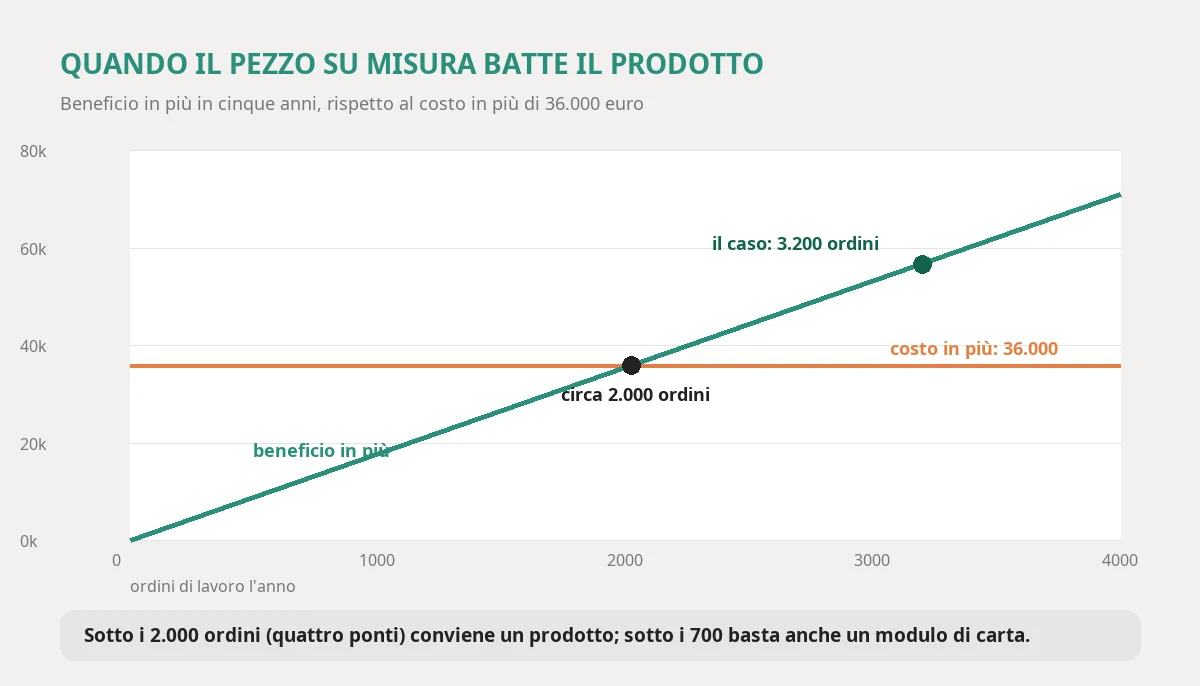
Auto repair shop software costs from 4,000 to 9,000 euros a year if it is a ready-made product, from 4,000 to 12,000 euros if it is a module of a system you already have, and from 28,000 to 55,000 euros plus maintenance if it is a custom piece. The price depends on how many workstations use it and how many of your own rules it must know.
The ready-made product, a garage program paid by subscription, usually costs between 50 and 150 euros a month per workstation. For a garage like the one in the case, with five workstations between reception, stock and foreman, that is about 5,500 euros a year, with a setup between 500 and 5,000 euros. It is the right road for nearly every garage, because it already has the parts catalogue, supplier links and a diary. The limits are two: the rules that are only yours, such as agreements with a fleet or the in-house labour guide, fit badly; and the data sits elsewhere, under the conditions of whoever sells the product.
The module of the system you already have, if your accounting program has one for garages, costs between 4,000 and 12,000 euros in licence and configuration. It does invoices and stock well, less well the part in front: quotes, approvals and callbacks. It is often a starting point for keeping the data in one place.
The custom piece sits alongside what exists: it holds the vehicle record, the quote with traced approval, the work order with parts and hours, the callback calendar, and passes clean data to accounting and to the catalogue. In the case it cost 38,000 euros, plus 15 per cent a year for maintenance. A complete system built from scratch, with several sites, a central warehouse and a customer portal, sits between 90,000 and 150,000 euros and makes sense for chains of garages, not for one with fourteen employees.
The threshold, with the numbers
Here the right comparison is not between the custom piece and nothing, because against nothing any solution pays for itself. It is between the custom piece and a ready-made product. Take the full annual benefit of the case: 25,760 euros of hours, 26,384 of money lost, plus 40 per cent of the 59,024 of missed earnings, that is 23,610. That makes about 75,800 euros a year. A product recovers 55 per cent of it, because your own rules fit badly: about 41,700 euros, less 5,500 of subscription. The custom piece recovers 70 per cent, about 53,000, less 5,700 of maintenance.
The custom piece against no solution pays for itself in about ten months, fifteen if you count only hours and money lost. Against a product, the cost difference over five years is about 36,000 euros and the extra benefit is about 3.5 euros per work order: they cross at around 2,000 orders a year, that is four lifts. With 3,200 orders the case sits well above. Below 700 orders, two lifts, the total lost is about 24,000 euros a year and a well made paper form or a product at a few thousand is enough.
The assumptions are prudent but they are assumptions, and must be redone with your numbers. Whoever is weighing up whether to take a package or have something custom built will find the broader reasoning in the article on business management software, off the shelf or custom.
The questions to ask whoever proposes a product
Ask whether the data is yours and how it is exported in a readable format. Ask which parts suppliers are connected and with what kind of update, and how much the catalogue costs. Ask whether the quote with customer approval and the callbacks are configurable or need a paid intervention. Ask how to leave, and how long it takes. And ask to see, in the demo, your worst case: the extra job found halfway, the part that arrives wrong, the fleet customer with the authorisation.
Where does artificial intelligence help in auto repair shop software, and where not?
Artificial intelligence helps to prepare: turning the spoken description of a fault into a tidy record, searching technical manuals, writing the callback message, summarising a vehicle's history. It must not decide diagnoses, prices or safety. It prepares, and a competent person checks and signs.
The first useful use is the description of the fault. The customer says "it makes a noise when I brake, especially when cold", reception writes it as it comes, and a model tidies it into a record with symptom, conditions and questions to ask the customer. The second is searching the manuals: the mechanic asks "wheel bolt tightening torque for this model" and the system searches the garage's technical documents, showing the source. If it does not find it, it says so, and does not invent a number.
The third is the message to the customer: the draft of the quote in plain language, with "the front brakes are worn down to 20 per cent, it is worth replacing them within two months", which reception corrects and sends. The fourth is the summary of the history: a car with eight years of jobs becomes four lines at the top of the order. In the case, reception's time on messages was halved.
Where it must not decide
The diagnosis of a fault involving brakes, steering, suspension or airbags is not made by a model that estimates. An error there is not an annoyance: it is a risk for whoever drives, and a liability for the garage. The model can suggest hypotheses to check, but the signature on the job belongs to a qualified mechanic. The same goes for prices: a proposal can be prepared, but the rate and the discount are the owner's decisions. And the calculation of a deadline is done by a written, tested rule, like the one in the section on callbacks, because a plausible but wrong date is worse than no date.
People's data
Names, plates and phone numbers are personal data. When a model is used, you choose a service with a contract that excludes the use of data for training, you send only what is needed and you remove the data that identify the customer when they are not required. It is not a brake, it is the same care you would ask of a new colleague.
The criterion for telling the difference
If the error shows immediately and costs little, like a text to correct, the model is fine. If the error shows late and costs a lot, like a diagnosis, a date or a price, a rule or a person decides and someone with the competence checks. This criterion holds for every new tool that will be offered to you in the coming years.
Which mistakes should you avoid, and where do you start in thirty days?
The five costliest mistakes are: choosing the program before the method, loading dirty data, not involving the mechanics, wanting to replace everything at once and not measuring first. You avoid them by deciding first who authorises what and starting from the piece that loses the most money: the single record with approved quote and the callback calendar.
The first mistake is choosing the product before the method. You watch three demos, pick the one with the prettiest colours and only afterwards ask who authorises the extra jobs. The product does not change the method: it makes it faster, good or bad as it may be. The second is loading dirty data: 4,200 records with plates written in three ways, customers with two phone numbers, vehicles without mileage. The program will work, and it will show wrong reminders with an air of authority.
The third is not involving the mechanics. A mechanic has dirty hands, and a system that asks him to type five more fields will not be used. The test of a good system is that the mechanic opens it because he needs it: he sees the authorised jobs, the photos, the part that has arrived. The fourth is wanting to do everything at once: stock, fleets, warranties, customer portal. The fifth is not measuring first: without the three starting numbers whoever says "it was not needed" will be right, because nobody will be able to prove otherwise.
The first week: measure and clean
You calculate the three starting numbers: the share of orders by word of mouth, the customers called back, the lift hours spent waiting. You clean the records of active vehicles, starting from those seen in the last twelve months. You decide one rule: no extra job without an approved line.
The second and third weeks: single order and callbacks
You switch on the quote with traced approval and the work order with parts tied to it. You work in parallel for a week, with the notepad still there. Then the callback calendar starts, with the first message to customers whose service falls due in the next thirty days. These are the items that weigh the most, about 85,000 euros out of 111,200, and they show at the end of the first month.
The fourth week: the numbers and what to leave for later
After thirty days you redo the three numbers. If the share by word of mouth has fallen below 20, if customers called back exceed 45 and if lifts waiting have dropped by a third, the first release has worked. You leave for later stock, fleets, warranties, the artificial intelligence part and the customer portal: they produce value only on a work order that works. If the numbers have not moved, the problem is method or habit, and it is better to know before spending more.
The cost of small delays
Every month in which nothing changes costs, in the case, about 9,300 euros, a twelfth of 111,200. It does not mean you must rush. It means that "let us talk after winter" has a price, and that it pays to choose the start date instead of waiting for the Tuesday morning to decide it, perhaps in the tyre month.
What to ask whoever builds it
Ask to see a small release in a month, not a plan for a year. Ask that the data stay yours, in a format you can export. Ask who answers when a reminder does not go out, and how quickly. And ask that the system can be switched off without losing the archive, because trust comes from knowing you can leave.
What if the number says it is not your problem?
It may be that, once measured, the share of orders by word of mouth is below 10 per cent, that customers are called back in 60 per cent of cases and that lifts waiting are below 4. That is good news, and it is worth saying plainly: in that case custom auto repair shop software is not needed, and whoever tells you otherwise is selling you something.
In that case the bottleneck, if there is one, is almost always elsewhere. If customers come back but the margin per order is low, the problem is prices, an hourly rate frozen for years or parts bought from the wrong supplier, and a program does not solve it. If the lifts are always full but profits do not grow, the problem is the mix of jobs, too many repairs with thin margins and too few planned maintenance jobs. If the garage has two lifts and an owner who follows everything in person, it does not need a system: it needs a person who keeps doing it well and a paper form to remember the promises.
And there is a case where software is not the answer even with bad numbers: when the problem is the lack of mechanics. A garage that turns work away because it cannot find staff does not have a software problem, it has a hiring and pay problem, and a program only helps to use the hours that exist better.
If you have read this far, you probably have your own Tuesday morning in mind. Before watching any demonstration, take the last forty orders you closed and write down, for each one, whether every job and every invoiced part has a trace of approval and of consumption. Then count how many of your active vehicles received a reminder before their last deadline. If more than one order in four has an item by word of mouth, or if fewer than one customer in three is called back, you already have the answer. The rest is a project, not a choice of product.
If you want a second look at your case, the road is a conversation through the contact page, and when the right solution is a piece built around the way you work you will find it explained in the page on custom software development. For the method of reading the margin of a whole company, from above, there is the article on management control software.
Frequently asked questions
It depends on the road. A ready-made garage product usually costs between 50 and 150 euros a month per workstation, that is between four and nine thousand euros a year for a garage with five workstations, with a setup between five hundred and five thousand euros. The garage module of a system you already have costs between four and twelve thousand euros in licence and configuration. A custom piece with customer-approved quote, work order and callbacks costs between twenty-eight and fifty-five thousand euros, plus fifteen per cent a year for maintenance. A complete system from scratch sits between ninety and one hundred and fifty thousand euros and suits chains of garages.
You calculate three numbers. The share of work orders with at least one item that exists only by word of mouth, on a sample of forty orders closed in one week. The percentage of active vehicles that receive a reminder before service, test or tyres. The share of lift hours occupied by vehicles that are waiting. Below 10 per cent of orders by word of mouth a paper form is enough, between 10 and 25 the problem is method, between 25 and 50 a system pays for itself, above 50 the garage works by word of mouth.
Five items: jobs done and not charged, parts not charged or not returned, lifts occupied while waiting, customers not called back and time lost searching. In a garage with 14 employees, 6 lifts, 3,200 orders a year and 1.9 million euros of revenue they were worth about 17,000, 9,400, 12,700, 46,400 and 25,800 euros, about 111,000 euros a year in all, 5.9 per cent of revenue. More than half is missed earnings. Below 2 per cent of revenue the problem is not a priority, above 4 it almost certainly is.
No. The invoicing program starts when the job is finished and does not know what was promised on the phone. The parts catalogue says which part fits a vehicle, but not who ordered it or whether it has arrived. Auto repair shop management software covers the whole journey: the vehicle record, the quote that becomes a work order, the parts tied to the order, the mechanic's hours, the invoice from what was done and the reminder for the next deadline. Many products do two or three of these well and almost none keeps all of them in the same place.
No, it can prepare but not decide. It helps to tidy the description of a fault, to search technical manuals showing the source, to write the callback message and to summarise a vehicle's history, always with a person checking. It must not diagnose faults in brakes, steering, suspension or airbags, nor decide prices and discounts, nor calculate deadlines: a plausible but wrong date is worse than no date, and deadlines are calculated by a written, tested rule.
For almost every garage a ready-made product, which already has a parts catalogue, supplier links and a diary. The custom piece pays for itself in about ten months against no solution, but against a product it pays above 2,000 work orders a year, about four lifts, or when you have rules no product knows, such as agreements with fleets and rental companies. Below 700 orders a year, two lifts, a product at a few thousand euros or a well made paper form is enough.
Leave your details in the form below