C# - Microsoft's Enterprise Language
Complete guide and related articles on C#
Complete guide to C#: syntax, best practices, patterns and modern C# to master Microsoft's language and build readable, maintainable enterprise software.
Practical guides to master C#
3 articles found

Polly in .NET: complete guide to resilience with retry, circuit breaker and fallback
Complete guide to Polly v8 in .NET with retry, circuit breaker, timeout and resilience pipelines for production-ready applications.
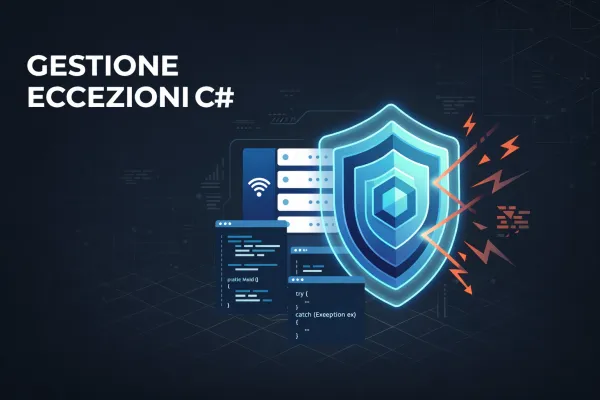
C# Exception Handling: Stop Suffering Errors and Start Governing Them
Beyond try-catch: learn how to create custom exceptions, preserve stack traces and adopt structured logging in your C# code.
When C# becomes a competitive advantage
C# becomes a competitive advantage when it is no longer just a language you know, but a tool you use to build readable, maintainable software that is ready to scale. People who master it make stronger decisions on testing, architecture, performance, and code quality.
Technologies that amplify C#
- .NET - complete ecosystem that brings C# to web, cloud, desktop and mobile
- ASP.NET - web framework that fully leverages modern C# capabilities
- Blazor - full-stack web development with C# and no JavaScript
- WPF - rich and structured desktop with C# and XAML
Sources and references
Martin Fowler - Software architecture
I use this source to ground structural decisions and explain why architecture is really about the economics of change.
Gregor Hohpe - Enterprise essays
This is useful when systems, integration, technical strategy, and organizational consequences must be discussed together.
Robert C. Martin - Clean architecture
I include it when the page needs to stress the link between code responsibility, clear boundaries, and long-term sustainability.
Frequently asked questions
C# combines strong typing, advanced OOP support, native async programming, and a mature ecosystem with .NET. In enterprise contexts it is preferred because refactoring is safe, Visual Studio tooling is unmatched, performance is competitive with Java, and long-term Microsoft support guarantees investment stability.
Modern C# introduced records for immutable DTOs, expressive pattern matching with switch expressions, nullable reference types to eliminate NullReferenceException at compile time, raw string literals for multiline strings, and primary constructors to reduce boilerplate. Each version aims at more readable code with less syntactic ceremony.
For enterprise projects you need: LINQ for expressive data querying, async/await for non-blocking async code, Dependency Injection with the .NET container, proper exception handling, interfaces and generics for reusable code. Knowledge of patterns (Repository, CQRS, Factory) completes the picture.
In Europe and the Italian market, C# has a dominant position for enterprise Windows and Azure cloud applications. Java maintains a solid base in the banking world and large system integrators. The choice should be based on the local market where you want to work and the ecosystem of the specific project, not on aesthetic language preferences.