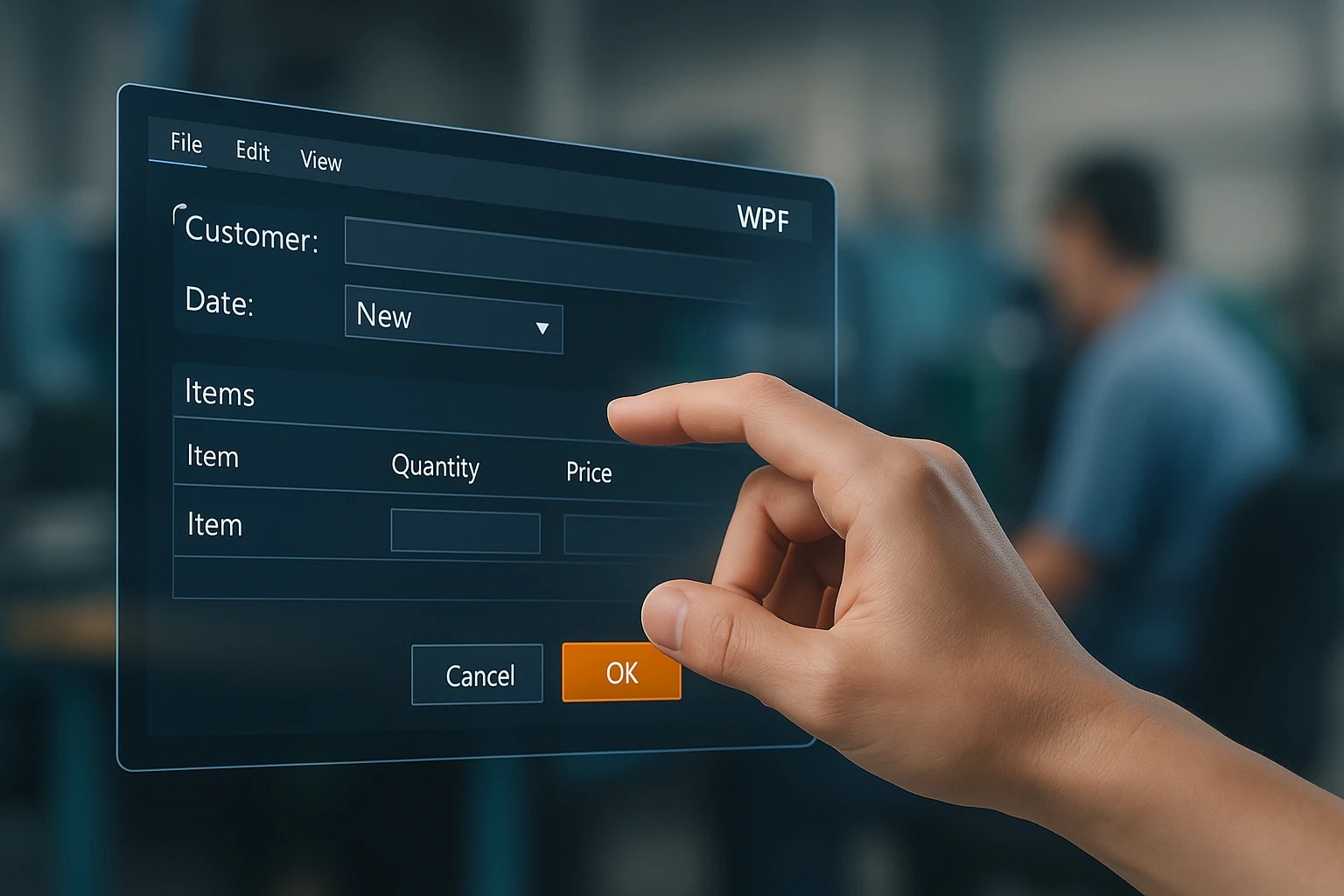

In a world where everything now seems to revolve around the web and mobile apps, where lightness is synonymous with innovation and speed is trendy, talking about desktop interfaces it may seem almost anachronistic.
Yet, those who work in the field know that there are contexts in which lightness is not enough, and where efficiency cannot be a compromise.
Sectors in which technology must always work, immediately, and without errors: this is where desktop applications not only resist: they remain indispensable.
It is not a nostalgic attachment, but a choice based on concrete and non-negotiable operational needs.
And anyone who has had the responsibility of developing software in the healthcare, financial or industrial fields, even just once, knows it: when reactivity, security and integration with hardware become real and essential constraints, there is no web app that can stand up to it to one Desktop UI composition well designed.
Fashions favor fast development, low impact frameworks, promises of "instant" scalability.
But there is a price behind all this: substance is often sacrificed on the altar of apparent speed.
And while a large part of the market is struggling with trendy technologies and solutions built more to impress than to last, the most demanding companies remain anchored to what really works.
According to Statista.com, in 2024 over 58% of companies active in highly complex sectors continued to invest in desktop interfaces, with a peak of 68% recorded in the manufacturing sector alone.
This is not a passing phenomenon, but a clear orientation: when error is not allowed, the desktop is still the reference.
It is not just a question of technical continuity: something deeper is moving beneath the surface, less visible but decisive for those who know how to look beyond the immediate.
While the web attracts more and more developers, seduced by the low barrier to entry, the desktop world becomes empty.
That void has created a valuable niche, where skills are rare and demand continues to rise.
In the last two years, the demand for developers specialized in C#/WPF has increased by 22%, bringing average European salaries above 75,000 euros per year, with significantly higher figures in more complex projects.
But the real leverage isn't the salary, it's the positioning.
Designing desktop UI today isn't just about writing code, it's about hiring a key role in contexts where technology must guarantee precision, operational continuity and total reliability.
There is no Progressive Web App that can guarantee, on its own, the performance required in contexts with high operational responsibility.
Only desktop development, when done with method and vision, can support intense loads and guarantee all this.
This is a real answer to real problems, not a technical advantage.
If you recognize yourself as that type of developer who is not satisfied with making things work, but aims to build solid, reliable and long-lasting software, then this is not simply a skill to acquire, but a real distinctive element capable of changing the direction of your career.
Because learning to develop desktop interfaces today is still a winning skill

For years they told you that everything would end up in the browser, that the future would be mobile, lightweight, entirely web-based.
And it was true, at least in part.
The “mobile-first” paradigm has conquered the industry and, along with it, an idea as convenient as it is misleading has also made its way: that desktop development it was now a closed chapter, good only for those who don't want to update.
You just need to look at the market with a clearer eye and less influenced by fashions to realize that the desktop has not disappeared at all.
It simply is evolved away from the spotlight, becoming more technical, more selective and, precisely for this reason, even more relevant.
Because while increasingly complex technologies and constantly transforming development ecosystems are being pursued externally, there are sectors that continue to focus on what only desktop development can truly offer.
And they do it not out of preference, but out of necessity.
In contexts such as real-time control of industrial plants or high-frequency trading, even a delay of a few milliseconds can cost millions, or put lives at risk.
In the world of healthcare, aerospace, logistics and automotive, the web alone is not sufficient, because in these contexts precision, reliability and total control are needed.
And desktop development has guaranteed all these features for years, reaching today, thanks to WPF technology, a even higher level.
A recent Gartner report is clear: 41% of companies have suffered direct losses due to web interfaces not optimized to handle intensive loads.
What does it mean for you?
That the interface is now a strategic lever and if you learn to design it well, you have the power to transform a system into a concrete advantage.
Especially where the shortage of specialized desktop developers is increasingly felt, because the market has moved elsewhere in the meantime the needs remained.
This is not just a "niche", but a discovered, technical and profitable area in which emerging is possible: often faster than you imagine.
If today you choose to invest in WPF, the MVVM pattern and the design of professional interfaces, you are not simply enriching your CV, but you are building a rare technical identity and a recognizable signature.
Because, when you know how to design UIs that really work, that last, integrate and bring concrete results, the market stops considering you one of many and begins to recognize you as the one who solves.
And in a world where everyone writes code, being the one who solves it makes all the difference.
Which companies are looking for developers who know how to build robust UIs

The tech sector runs fast but often seems to go in circles, with a new framework every six months and a supposed revolution every year, in the midst of this whirlwind there is still something that resists and produces concrete results.
It is the world of professional desktop UIs not made up of startup aesthetic experiments but of interfaces designed to work today, tomorrow and in five years' time even under stress with complex hardware and in difficult conditions.
While the consumer world chases portability and lightness, the enterprise asks for something completely different such as reliability, interoperability and full control on the behavior of applications in complex scenarios.
And who answers this question?
Companies that move critical infrastructures and real capital such as Siemens Bosch Philips Bloomberg and Medtronic certainly need no introduction; yet, they continue to look for C# and WPF developers.
But these are not just historical names because even emerging companies in the biotech, fintech, logistics and industrial automation sectors are returning to the desktop not out of habit but out of precise technical needs.
This is not conservatism but a design choice lucid born from the awareness that many web architectures do not offer the same level of reactivity, reliability and control of the execution environment.
An emblematic case is that of ABB Group which has renewed its energy monitoring suite with WPF solutions capable of communicating in real time with sensors and proprietary systems without compromises.
No web app could have offered that type of integration in a scenario where every second counts and every error has real consequences on industrial processes.
Then there is Bloomberg which works on a global scale and continues to rely on C#/WPF for its financial terminal not because it lacks funds but because focus on solidity and on the performances guaranteed by this technology.
The positions opened by Bloomberg are not just looking for experience but vertical technical skills such as the ability to manage graphic rendering on complex datasets with reliable performance on a large scale.
Epic Systems for the healthcare sector and Rockwell Automation for the industrial sector also confirm this trend with the former focusing on .NET MAUI and the latter having invested over 30 million in advanced HMIs based on WPF and 3D UI.
All this is not an exception but a clear signal that shows how the desktop is regaining space in enterprise software precisely for needs that require rigorous control and continuity.
So the question is simple: if the giants are returning to the desktop, what are we waiting for to stop chasing hype and start designing seriously again?
Because while the world of the web is crowded with developers competing for 20 dollar tasks, the desktop opens up roles of responsibility with salaries exceeding 500 euros per day and projects in which your code really makes a difference.
Here we don't write code to amaze but to stand the test of time because in critical environments you can't bluff with the user experience and those who know how to build robust interfaces are not just developers, they are a key element of the system.
The difference between an improvised UI and one designed by a professional

An improvised UI doesn't just look sloppy or careless: it represents one of the main causes of daily frustration for those who work with an application eight, ten or twelve hours a day.
The discomfort is not just visual: it is operational, mental and psychological.
If you've ever clicked an unresponsive button multiple times, or had to decipher a chaotic layout while under pressure, then you've experienced first-hand how an interface can transform into a invisible but constant barrier.
The user begins to doubt the software, then themselves, and finally the entire system: a downward spiral that reduces productivity, undermines trust and slows down every important decision, especially in areas where operational efficiency is vital.
On the contrary, an interface designed by a professional immediately conveys a feeling of control, clarity and reliability.
Every action feels fluid, natural, almost instinctive, as if the software “knows” what you're trying to do even before you do it.
In these cases, the UI stops being a simple visual layer and it becomes a bridge between the logic of the machine and the way of thinking of the human being.
You don't even need to think about it too much: the flow works, the experience is coherent, the time spent is well spent.
The impact of this type of interface is not only measured with technical metrics, but with an indicator that is much more difficult to build and fundamental to maintain: trust.
A trust that arises from the coherence of choices, attention to detail and design empathy.
When a software becomes intuitive to the point of disappearing in the user's mind, leaving only the function, the gesture, the result, that is where UI design reaches its highest purpose: facilitate the user, don't hinder him.
This is why today, in a market saturated with "fast but superficial" coders, if you know how to design solid, fluid and well-thought-out interfaces you stand out clearly.
It is no coincidence that this skill makes the difference between a generic developer and a truly central figure for the success of a project.
If you aspire to become a professional capable of leaving your mark, start looking at each screen not as a set of elements to be assembled, but as an experience to be designed with the same care and awareness that you would reserve for a valuable human interaction.
In contexts where a well-made interface can alleviate hundreds of daily micro-decisions, improve operational precision or even reduce the risk of error in critical situations, the UI is no longer window dressing.
It is an act of responsibility.
When every click can lighten or burden someone's day, the way you design an interface becomes a gesture of care that can be felt before it is even seen.
Have you ever built an interface that works but which, even if technically correct, doesn't give you that feeling of solidity that every professional product should have?
Or do you find yourself faced with too many possible solutions, without a really clear criterion on which is the right choice to make to guarantee a user experience that lives up to expectations?
It's not a question of talent or experience, but of method: without a strong design structure, even an orderly code risks generating friction that undermine the quality of your work.
If you aspire to become the kind of developer capable of designing solutions that work silently, it's time to start looking at every interface as a gesture, not as a collection of elements.
Because the real difference is not made by those who write code that works, but by those who manage to make the user feel like they are in the right place, at the right time, with a flow that feels natural from the first click.
Ours WPF course it is designed precisely for this: to help you escape from the logic of "it just needs to work" and guide you towards a way of designing that has value, depth and vision.
Leave us your details and we will contact you to understand together if this path can really help you make that technical and professional leap you are looking for.
It's not just a course to add to your CV, but it's a turning point: we'll talk together, without obligation, to understand where you are and where you want to go.
Top mistakes to avoid when starting to build desktop applications.

Building a desktop app in a real context such as a clinic, a technical office or a monitoring system immediately puts you in front of a clear and concrete truth that it is not enough that it works, it must hold up, it must last and it must improve the work of those who use it every day.
Yet even among expert developers there are errors that are repeated and that over time compromise the stability, quality and credibility of the entire project, calling into question every choice made upstream.
- We start by writing code without having a clear structure and this often leads to building interfaces like you assemble a cheap piece of furniture, that is, quickly and intuitively, hoping that everything will remain standing over time and without too many surprises.But a simple graphic change or an evolving flow is enough to find yourself immersed in cross-dependencies, rigid code and exhausting debugging where every change weighs in terms of time, effort and perception of professionalism.The safest way to avoid all this is to adopt the MVVM pattern from the beginning not to respect a pattern but to separate responsibilities increase testability and make the code reusable over time.
- A second mistake is consider the UI as an aesthetic part to be fixed at a later time without understanding that every visual detail influences the operational flow and daily productivity of those who use the application.You don't need to be a designer to create effective interfaces only respect for expected behaviors for the coherence of the paths and for the user's habit of not having to think about every click he makes.A predictable UI is worth more than an original one because usability is not noticed when it works but you pay dearly every time it is missing and every second wasted looking for something breaks the flow and undermines trust.
- A mistake that is still too common is underestimate accessibility, treating it as a simple bureaucratic requirement rather than what it really is: a powerful form of inclusion and a concrete competitive advantage.Many developers miss out on important projects, especially in the public sector, simply because they didn't include screen reader support or effective keyboard navigation.An error that excludes people with disabilities who cannot (and must not) be ignored.
- Finally, an aspect that seems technical but is profoundly experiential is often underestimated: fluidity and performance of the interface under loadNot everyone in the company works on modern machines and a slow or freezing interface is perceived as faulty even if the underlying code is solid.These problems almost always arise from superficial threading management with too many blocked UI threads or synchronous operations that slow down everything precisely at the moments when the system should support the user.
Solutions exist and are often simple but they must be known and applied consistently, carefully and responsibly because a slow UI is tolerated only once and then avoided forever.
The basics of WPF explained with real-world, easy-to-replicate examples

In an era where many UIs seem cookie-cutter, WPF still represents one of the few technologies that it lets you build interfaces with true expressive freedom and architectural control. It's not just a question of style: it's a statement of technical responsibility.
Using WPF does not mean dragging buttons onto a canvas, but designing an interface that lives over time, that grows with the application and that respects the user's logic as much as that of the machine. And to do it well, you don't need magic: you need the right tools, method and a clear vision.
At the heart of everything is XAML, a declarative language designed to make the interface readable, separate, scalable.
Writing UI in XAML means give shape to intentions, not just pixels.
It means building coherent visual hierarchies and reusable structures, reducing the complexity of the code behind.
The strength of WPF is not in "modern graphics", but in the ability to clearly separate logic and presentation, to organize the code in a testable way, to build interfaces that work in complex and highly reliable environments, without losing usability.
The styling and templating features, often underestimated, allow you to define the aesthetics of entire families of controls in a single point, as you would with CSS, but with a much stronger precision and linked to real interaction, not just the visual.
But it's the MVVM pattern that makes WPF a truly scalable technology.
Thanks to automatic binding and role separation, it allows you to design applications where each component has its own space, its own responsibilities and its own testability.
In a real-world project, adopting MVVM allowed a banking team to reuse 80% of their application logic when migrating to .NET MAUI, reducing porting time from six months to less than three.
It's not just theory: it's time saved, costs avoided, quality preserved.
Working with WPF also means learn to handle threading in a mature way, to keep the UI smooth even under load.
Too often the impact of a blocking call is underestimated, until the interface freezes during a critical operation.
Intelligently managing background operations can radically change the user's perception of the application, making it more fluid, responsive and reliable even in the most critical moments.
When the interface remains responsive even during the most demanding operations, the user not only has the impression that the system is reliable: he perceives it clearly and he starts to really trust.
Even accessibility, often overlooked, can prove to be a determining factor, as demonstrated by the real case of an application excluded from a public tender due to incompatibility with screen readers, a problem that could be solved in a day but cost hundreds of thousands of euros.
Features such as accessibility support or keyboard navigation are not simply optional extras, but concrete signs of professional maturity and, in many cases, make the difference between win a project or miss an important opportunity.
Finally, when architecture, UX and performance align, the results can also be seen in the field.
An application developed for warehouse management in the automotive sector has allowed BMW to reduce staff training times by 25%, thanks to an intuitive interface, simple to use and built on clear and coherent visual paths.
That's the point: a well-designed UI accelerates business.
It's not just code that works, it's efficiency that you can experience first-hand, it's a competitive advantage that starts in your .xaml files and manifests itself in the operational results of those who use it every day.
Why C# is still the best choice for the enterprise world

In an age where attention shifts to a new language every month, it's easy to think about staying put C# means making do.
But it is precisely this idea, as widespread as it is superficial, that we invite you to question.
Because in the real world, the one in which companies have to function every day and not just during pitches, what matters is not how "new" a tool is, but how reliable, clear and ready it allows you to be to manage complexity without wavering.
C# is not a relic to be kept in a shrine.
It is a technology that continues to hold up the entire weight of the enterprise ecosystem, with a solidity that few other tools can boast.
Those who master it today have not been left behind: they have simply chosen to build on foundations that do not collapse with each trend update.
He chose to be stable in an unstable industry.
Companies know this, and for this reason they continue to rely on those who know C# and .NET i more sensitive projects, the most critical ones, those where the error is not contemplated.
Here, experimentation as an end in itself is not rewarded, but the ability to maintain control even when the context changes.
Today C# allows you to combine stability and openness, remaining anchored to a solid environment while confidently approaching even more modern technologies, without having to start from scratch or continually chase the latest news to keep up.
The truth is that C# doesn't need to be noticed at all costs, it doesn't follow the fashions of the moment and for this reason it continues to be chosen in contexts where solidity, vision and design ability are needed.
The professionals who know it well operate in a well-defined niche, where theatrical pitches are not needed to sell themselves.
We need solutions that stand up, that perform, that integrate real processes, and this is exactly what C# offers.
If you feel your potential is ready for a more vertical, more conscious trajectory, C# is not a brake: it's an accelerator which he has already demonstrated that he knows how to bring to his destination.
You don't need to change everything to feel in step with the times, but to change perspective and start building your career on solid foundations, choosing technologies that allow you to grow, consolidate and truly stand out without having to start over every six months.
You have just read that choosing C# does not mean falling behind, but taking a position in a market where solidity is worth more than window dressing.
If inside you you start to feel that chasing passing frameworks is no longer enough, Maybe it's time to stop looking the latest news and start building something that lasts.
You don't need to overturn everything to feel up to speed, you need to understand where you really want to get to and start investing in what allows you to do it with clarity, coherence and control.
C# is still one of the most powerful choices for those who want to become the kind of professional who doesn't get flustered by every change, but knows how to tackle it with tools that hold up.
If you feel it's time to clarify who you really want to become as a developer, this is the right opportunity.
How to connect graphics and logic without going crazy with the MVVM pattern

If you have ever started a project born "in a hurry" or "in an emergency", you know what it means to find yourself in front of an interface that seems to work... until you try to modify it.
Every little change it can set off a chain of problems, misunderstandings and malfunctions between those who develop and those who use the application.
The real obstacle is not the complexity itself, but the lack of a structure capable of managing it, because without a clear distinction between what you see and what makes things work, the interface stops helping and starts hindering.
It is precisely here that the value of thoughtfully designed architecture comes into play.
The MVVM pattern, often cited but too little understood, is not a dogma to be followed by heart: it is a concrete tool to restore order, coherence and stability in interfaces that must really work.
Separating business logic from visual presentation doesn't just mean writing "nice code", it means being able to work in a team without conflicts, integrate new features without breaking existing ones, and above all predicting the behavior of the application in all conditions.
When a project is well organised, those who work on the operation can focus on how the application should behave, while those who deal with the interface can dedicate themselves to the visual experience, without overlapping and without having to redo everything every time something changes.
The result is a stable, maintainable and clear UI even for those who come after you.
It's not a detail for purists: it's a concrete investment in speed, reliability and serenity, because a solid project is recognized when it manages to evolve without getting hurt.
And if today it seems too late to restore order to a project already underway, know that it is not.
Many developers have rebuilt the basics of your software starting from MVVM, discovering that complexity can be tamed, but only if you treat it with respect, not haste.
How long does it take to become independent in creating desktop UIs

We don't promise you magic formulas or shortcuts from motivational commercials because, if you are looking for the easy solution, the one that changes your life effortlessly in a few days, This is not the path for you.
But if you have decided to really change the way you develop, with method, awareness and a more solid vision of where you want to go, in 90 days you can concretely transform the direction of your career and build the foundations to truly stand out.
It's not about going from zero to coding genius, but about escape from the logic of improvisation and start acting intentionally, moving from "dragging controls" to designing interfaces that hold up, that really work and that simplify the work of those who will use them every day.
Along the way you will go through four distinct phases, each designed to help you build, consolidate and demonstrate skills that have a real impact in the professional world:
- Days 1–14: The foundation in this first phase you put order, not only in the code but also in the habits that guide your way of working and reasoning.You learn to recognize them essential elements of a well-designed desktop interface, such as layout, visual structure and logical organization.You do this by building simple but concrete modules that help you understand the relationship between what you see and what makes the interface work.It's not just about making something appear on the screen, but about giving a clear meaning to every choice, starting to design with coherence and intention.
- Days 15–30: Architecture takes shape what was previously just a set of concepts begins to transform into a real structure that takes shape before your eyes and within your way of thinking.You gradually enter the world of conscious design not for fashion or formality but for a real need of solidity and clarity.You learn to distinguish the visual aspect from the functional behavior so as to write code that is more readable and easier to maintain over time.You start to think like someone who builds software that is meant to last and not just like someone who writes lines of code that work by chance.
- Days 31–60: Real project and awareness halfway through the change becomes concrete because you stop working on abstract exercises and start building a real application with a clear structure and well-thought-out paths.The interactions you design are no longer technical demonstrations but coherent usage flows designed for those who will actually have to use what you have built.You start to trust your code not because it works immediately but because it has a solid internal logic that makes it understandable and stable over time.You can see the link between technical choices and design choices without having to depend on tutorials or improvised solutions found on the fly.
- Days 61–90: refinement, quality and method in the last part of the path, development is no longer just construction but becomes careful and intentional refinement that puts everything you have learned to the test.You face real obstacles and concrete problems but you do it with a new attitude that is no longer impulsive or defensive but guided by a solid planning approach.Now you know that quality is not a luxury nor a detail but a concrete form of respect towards those who will really use what you have built with commitment and clarity.It is in this phase that you begin to build your technical signature made of conscious choices, careful details and code designed to last over time and not just to function.
At the end of the 90 days you will not be able to say that you have "taken a course", because what you will have gone through is much more: you will have experienced a profound transformation, technical and mental, which will allow you to create functional, intuitive interfaces capable of truly speaking the user's language.
And, above all, you will have acquired a replicable working method, which you can adapt to each new project, improve over time and use as a starting point for a career that is finally more stable, more recognizable and more in line with what you really want to build.
How to turn your first project into a portfolio that convinces clients

Creating an application that works is certainly an important goal, but alone is not enough.
If no one knows what you accomplished, how you got there and, above all, what the intent was that guided your decisions, that expertise remains invisible.
In the market, what cannot be seen does not exist, is not recognized and does not generate value.
An effective portfolio is not a collage of screenshots or a list of technologies written to impress, but it is a solid and structured narrative in which you show the thinking that guided your choices, the logic with which you built the solution, the difficulties encountered along the way and the results you wanted to achieve.
Precisely in this clarity a selector, a customer or a technical manager recognizes the difference between those who write code to execute and those who design with awareness.
To get started you don't need to have a commissioned project.
Just identify a concrete problem, perhaps inspired by a sector you know or are curious about, such as slow reporting, disorganization in warehouse management or visual inefficiency in a healthcare control panel.
The important thing is that you are able to show your ability to understand a real need and transform it into a useful, clear and functional interface.
Tell us precisely what led you to make certain choices, how you structured the flow of the experience, what obstacles you faced from the user's point of view and what improvements you wanted to achieve.
No beating around the bush or special effects needed: authentic motivations are enough, explained in a direct and professional way.
If you can, insert videos, demos or navigable sequences to make what you tell visible.
Showing your solution next to a more crude version, or alongside a less effective alternative approach, can strengthen your credibility, because you don't just say you did it well: you demonstrate it with intelligence and transparency.
This is what builds your authority: not the aesthetics of the result as an end in itself, but the clarity of the process, the strength of the decisions, the awareness of the context.
It is in this coherence between technical choice and real need that those who observe you begin to trust and see you as a resource, not as a simple executor.
A well-constructed and neatly presented project authentic motivations are enoughauthentic motivations of ten certifications are enough, because it speaks a language that those who decide can recognize.
Even an app developed independently, if told in the right way, can attract customers, open collaborations and position you as a credible developer, regardless of the years of experience you have behind you.
The portfolio is not a space for self-celebration: it is a channel in which you demonstrate to the viewer that you are the right person to solve a specific problem, with method, attention and a sense of result.
When you can convey this, you are no longer selling hours of your time.
You are offering a solution concrete.
You are offering trust.
The most direct path to learning and getting paid to write interfaces

In a market that runs at the same speed as software updates, time is no longer just a resource to be organized but becomes a concrete lever to generate real value and stand out from those left behind.
You don't have to wait for the perfect idea or the ideal condition because that moment never comes alone and if you wait too long you will end up standing still while others build one step at a time.
Learning to design desktop interfaces today is not a nostalgic choice but an act of conscious positioning that separates you from those chasing the latest fashion and puts you at the center of what you really need.
It's a concrete way to state that you're not chasing noise but building something that has solid foundations and last over time even when everything else is constantly changing.
To get started you need a real and structured path that in ninety days takes you from daily practice to technical awareness up to the ability to transform everything into value.
It is not a course to be consumed but a process to go through in which you learn to think in a design way and develop solutions that really work and improve the work of those who use them.
At the beginning, put the foundations in order by tackling real components and concrete cases and stop limiting yourself to understanding how they work to start thinking like someone who designs with method and vision.
Code stops being just technical writing and it becomes an extension of your thinking visual, transforming itself into a stable solution that is useful and understandable even for those who come after you.
Later you learn to talk about what you do and why you do it by creating a portfolio that communicates real value and shows the decisions that make your work something recognisable.
You don't just say what you did but you manage to explain why you did it that way and while others look for clients without direction you learn to make yourself chosen with clarity and authority.
Finally, you enter the market with something to show and tell a concrete track that speaks for you whatever path you choose to follow as a freelancer in a company or in consultancy.
You are no longer one of many but a figure with a precise direction, a recognizable technical signature and a professional identity built on tangible evidence and not on words.
There is no need to rush at all costs or skip stages, what is needed is a method of consistency and an environment in which to stay focused on what matters to obtain true clarity and authority.
As we have seen, technologies like WPF and C# continue to be the engine of entire business systems, where stability is not a preference but a requirement, where control, precision and integration with complex environments are needed.
The desktop developer is not plan B, but is a central figure, capable of creating tools that improve the work of people who work every day in sectors where improvisation is not contemplated.
Who masters this discipline he doesn't chase customers, he attracts them, because it conveys reliability and the ability to solve problems that matter.
Every hour you invest in mastering an architectural pattern, designing a fluid interface or integrating it into a real flow is one more step towards a solid reputation and a career built on stable foundations that won't collapse.
It's about building a clear and credible technical identity, recognizable over time, independent of trends, and not just about accessing interesting projects or higher salaries.
For this reason, more than a technical specialization, desktop development is today a declaration of method, vision and professional maturity, because you choose what really works.
Companies are not looking for those who know how to write code, but those who know how to design interfaces that simplify.
If you see yourself on this trajectory and feel that it is time to give a more solid and strategic identity to your technical profile, then it is time to clarify and begin the transition from performer to professional.
Through a structured path based on your objectives and your current level, we can help you bridge the gap between where you are today and where you can position yourself in the coming months, with awareness and method.
It's not a course to watch in your spare time, it's an accelerator of technical and professional transformation, designed to make you emerge in a concrete niche, where talent counts but method even more.
Book your free call now and find out if it's the right path for you.
No pressure, just a conversation about whether this is the time you can really make the leap and how you can do it.
Do you want to understand if all this is for you?
Leave us your details, we will find out together.
Leave your details in the form below