What is the number that decides whether construction site management software will actually help you?
The numbers: no site cost control costs between forty and a hundred and forty thousand euro a year in a company turning over three million with twenty people, across misallocated hours, overruns found after the job closed, materials with no destination, progress claims issued late and technical staff reconstructing what happened. A subscription product costs between twenty five and ninety euro per user per month plus setup, extending the system you already own costs ten to thirty five thousand euro once, and a custom system starts at twenty five thousand euro with fifteen to twenty per cent a year in maintenance. The practical threshold sits around twenty five thousand euro a year of total spend.
Beyond twenty days of lag every control feature produces post mortems, because by the time the number arrives the work is done. The first release that works is always the same: open jobs, hours logged from a phone with a single mandatory field, materials booked from the delivery note, and one screen that on Monday morning shows hours spent against hours estimated.
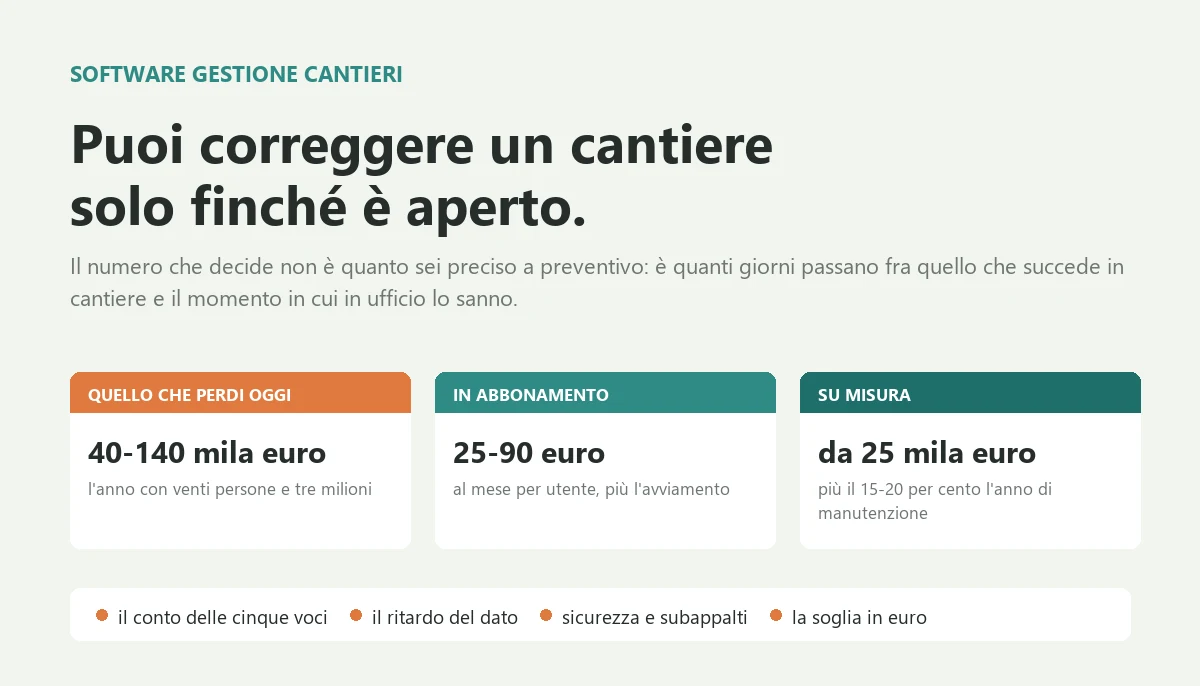

The Brescia job closed three weeks ago. The final figures land now, together with the payroll: forty two days more than estimated, eleven thousand euro of material nobody remembers ordering, and a margin that went from fifteen thousand euro to minus two. The owner looks at the sheet and asks the question everyone asks: why did nobody tell me in March. The honest answer is that in March nobody knew, because nobody had the number.
If you recognise the scene, this article gives you the real cost of not knowing how a job is going while it is still open, the single number that decides whether construction site management software will actually help you or become one more app your foremen never open, the three different things quotes all call site control, what Italian law requires you to keep in order on subcontractors and safety, the real price ranges between a subscription product and a custom system, and the threshold in euro beyond which the arithmetic changes.
I have been writing software for twenty six years and I have seen job sites from the inside in very different companies: building firms with twelve workers and four sites open at once, electrical contractors whose crews touch six or seven jobs in the same week, window and door manufacturers who call it installation but have exactly the same problem, general contractors coordinating and checking twenty subcontractors. I also built and sold a professional software product that lived on documents and case files, so the problem of getting what happens outside into the office is one I have had to solve, not just describe.
What I have learned, and no vendor says during a demonstration, is this: in a company that works job by job the number that matters is not how accurate your estimates are, it is how many days pass between something happening on site and the office knowing about it. If that number is high, everything you build on top of it, job costing, progress charts, overrun alerts, does not solve the problem: it performs the post mortem of a job that is already dead.
What construction site management software is, and why the foreman's spreadsheet is not it
Construction site management software is the system that knows four things a spreadsheet does not: how many hours and which materials went onto each job and when, how far the work has got compared with what was sold, which documents and deadlines that job carries with it, and what you still have to invoice and still have to pay. It answers a single question, but every week: is this job going the way I expected, and if it is not, will I find out in time to do something about it.
On the market you will find it under different names, and the confusion suits whoever is selling. Site management, job costing, contract control, construction ERP, site attendance apps, quantity surveying software, construction project management. These overlap only in part, and working out which one you actually need is already half the negotiation, because the prices differ by an order of magnitude.
The difference between recording and knowing
The foreman's spreadsheet, or the notebook, or the messaging group where photos of daily reports get sent every evening, solves exactly one problem: the data exists somewhere. That is a lot, and it is why a great many companies get this far and stop. But that data is not yet information, because to become information it has to be collected, allocated, totalled and compared with the estimate, and those four steps are done by hand by one person in the office, usually at month end, usually in a hurry.
None of those sheets can answer these questions: how many hours have I burned today on the Brescia job against what I had allowed for that activity; which of the four crews is eating the margin and on which cost line; whether that material delivered on site was in the estimate or is a variation nobody has had signed yet; what percentage complete I am at, and therefore what progress claim I can issue this week; which worker has a training certificate expiring that will keep him off that site on Monday.
It is not a flaw in the spreadsheet: a spreadsheet records facts that have already happened, while running a job site means deciding about facts that are happening now. The whole difference is timing. An estimate that is ten per cent out, discovered in week two of twelve, you recover by changing crew, renegotiating a supply or getting the variation signed. Discovered at closing, all that is left is to write it into the accounts.
The three kinds of company that look for it, and look for different things
Companies with many crews on the move. Electrical and mechanical contractors, maintenance firms, installers. The problem is not the one big job, it is the forty small ones open at once, with crews moving several times a day. Here all the value is in capture: who was where, for how long, on which job. Vendors talk to them about project management, and miss the target.
Companies with few but long jobs. Builders and general contractors. Here the problem is progress, and the relationship between work done, work certified and money collected, plus coordinating subcontractors. The value sits in contract control and in managing mandatory documents.
Companies with an obligation to meet. Those working for public bodies, those with a certified quality system, those whose clients demand documentation in order. Here the document is not just for working, it is for proving, and the cost of not having it is not lost time but an invoice you cannot issue or a site that stops.
The three groups buy the same product and use three different parts of it. Before looking at any demonstration, decide which one you are in, because it is the only thing that makes two quotes comparable.
The real cost of not knowing how a job is going
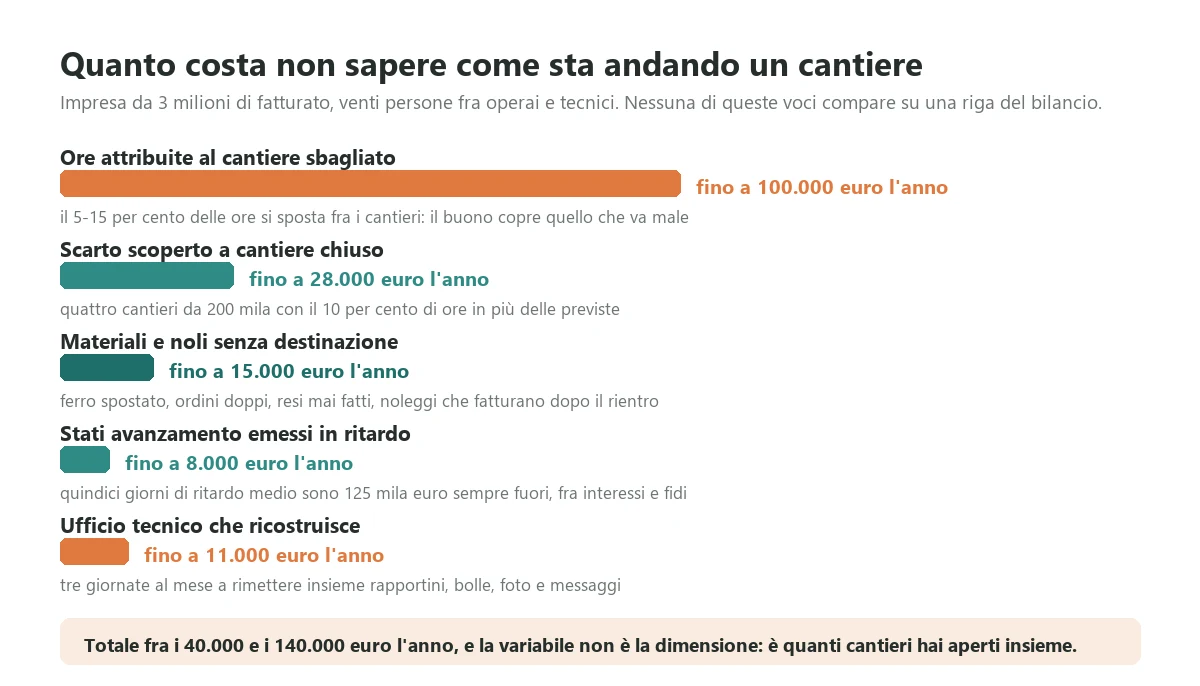
This is the calculation almost nobody does, because none of these items has a line in the accounts: they are margin that never formed, not costs you can see. My reference is a company turning over three million with twenty people between field and office, which is the most common size among those who write to me.
Hours that land on the wrong job
It is not theft and it is rarely dishonesty: it is that the daily report is filled in at the end of the day, from memory, and memory rounds. When a crew touches two or three jobs in a day, the share of misallocated hours normally sits between five and fifteen per cent. Across twenty people at a fully loaded thirty euro an hour, ten per cent of the hours is around a hundred thousand euro a year moving from one job to another.
The damage is not that the money disappears, because you pay for the labour either way. The damage is that the job which looks fine is covering the one that is not, and you keep quoting with rates learned from false figures. It is the most efficient way I know of losing money slowly and with a clear conscience.
The overrun you find after the job closed
This is the biggest item. On a two hundred thousand euro job with a fifteen per cent expected margin, that is thirty thousand euro, labour normally accounts for thirty to forty per cent of the cost. A ten per cent overrun on hours, which is normal rather than catastrophic, is about seven thousand euro: a quarter of that job's margin. With four jobs a year that size it is twenty eight thousand euro. Discovered while the job is open you recover half of it, and the half you do not recover you either get signed as a variation or price into the next estimate.
Materials with no destination
Steel bought for job A and used on job B, material ordered twice because the first order ended up in another store, the return never processed, the plant hire still invoicing three weeks after the machine came back to the yard. In a company that size it is between five and twenty five thousand euro a year, and the least visible item of all is the forgotten hire, because it arrives as a recurring invoice that looks like every other one.
Progress claims issued late
This is not a loss, it is finance, and for a construction business finance is life. If your progress claim goes out fifteen days after the work was done because the figures have to come in first, you have lent that money to your client. On a three million turnover, fifteen days of average delay means roughly a hundred and twenty five thousand euro permanently outside. It does not cost you the whole amount, it costs you the financing and the risk: between interest, facilities and advances it is three to eight thousand euro a year, plus the time you cannot pay suppliers early and lose the discount.
Technical staff reconstructing what happened
One person spending three days a month piecing together reports, delivery notes, photos and messages to work out what happened is thirty six days a year of someone costing between two and three hundred euro a day: seven to eleven thousand euro. And it is the most demoralising work there is, because it is reconstruction, not decision making.
The total, for a three million company, sits between forty and a hundred and forty thousand euro a year. It is a wide range because the real variable is not size: it is how many jobs you have open at once and how much your crews move. Before reading on, do the sum with your own numbers, roughly, on a single sheet. It matters for one specific reason: if your total is below fifteen thousand euro a year, software is not your most urgent problem, and further down I tell you what is.
Data lag: the number that decides whether the project makes sense
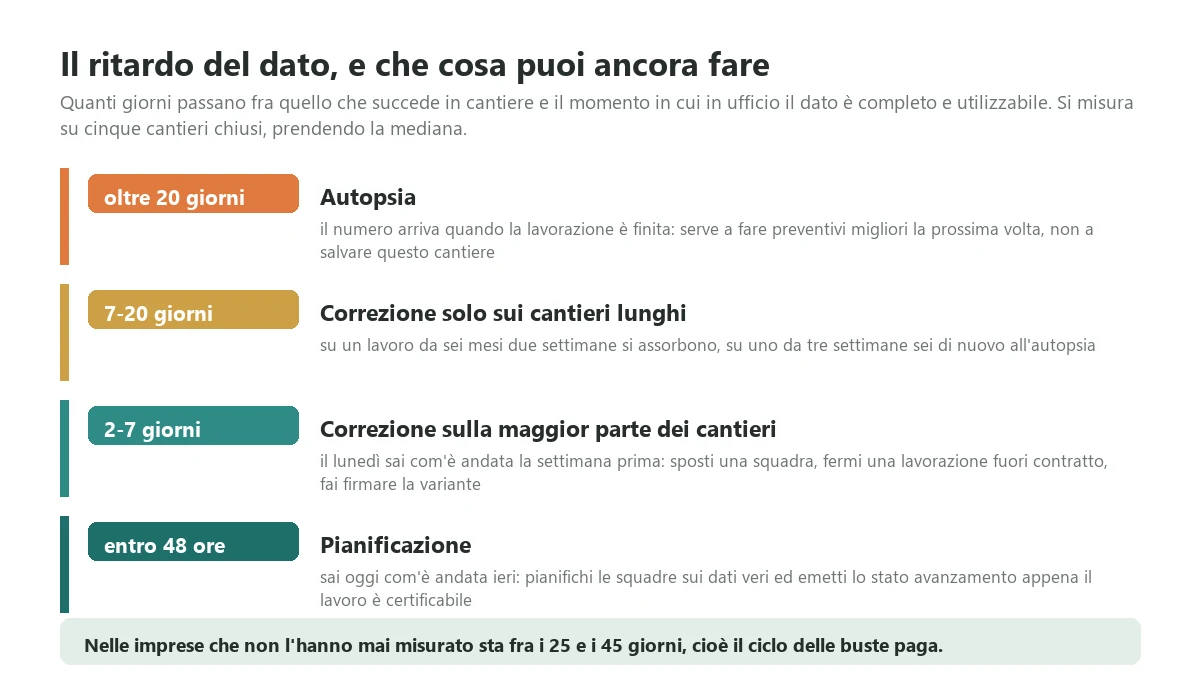
If I had to keep one number from this whole article, I would keep this one: how many days pass, in median, between something happening on site and that data being available in the office in usable form. I call it data lag, and it decides everything, because it determines which decisions you are still in time to make.
How to measure it, in an hour
Take five jobs closed in the last six months. For each one pick a week of work at random and find two dates: the last day of that week, and the day the office had the complete figures for that week, meaning hours allocated and materials booked, not paperwork in a folder but a usable number. The difference is that week's lag. The median of the five is your number.
Three clarifications, because the measurement is easy to distort without meaning to. Count the complete figure, not the first piece to arrive: if hours are there after two days but materials after thirty, your lag is thirty, because margin needs both. Do not count jobs where someone made an exception because the owner had asked personally. And pick mid project weeks, not the last one, because on the last one everybody hurries.
In companies that have never measured it the answer is almost always between twenty five and forty five days, and in most cases the number coincides with the payroll cycle, because the real engine collecting hours is payroll and not cost control. That is a valuable piece of information and worth stating plainly: if you collect hours in order to pay people, you collect them once a month, and no software changes that until you change the reason you collect them.
The four thresholds, and what each one lets you do
Beyond twenty days: post mortem. At this lag every control feature produces a diagnosis of jobs you can no longer fix, because by the time the number arrives the work is finished and often the job is closed. It helps you quote better next time, which is not nothing, but it is half the value you were sold. In this band, buying the expensive part of the software is money spent up front for a result that arrives in two years.
Seven to twenty days: correction on long jobs only. On a six month contract two weeks of lag is tolerable, you still have four months to act. On a three week job you are back to the post mortem. If you have few, long contracts this band may be enough, and it saves you a great deal.
Two to seven days: correction on most jobs. This is where the system starts returning what it costs. On Monday you know how last week went, and you can move a crew, chase a supply, stop work outside the contract before it becomes ten days of labour. This is where the real return sits, and it is reachable by almost any company without a revolution.
Within forty eight hours: planning. Today you know how yesterday went. It is the precondition for planning next week's crews on real data rather than the foreman's instinct, and for issuing progress claims as soon as the work is certifiable. It costs a lot in daily discipline and not everyone needs it: with few long jobs, two days buys you nothing that five does not.
There is one practical rule, and it is worth more than any feature list: you can only fix a job while it is still open, so your data lag has to be a small fraction of the length of your typical jobs. If your jobs run three weeks and your lag is thirty days, you do not have a software problem, you have a capture problem, and it has to be solved first because it costs little and nothing works without it.
The part that decides everything: how hours and materials get in
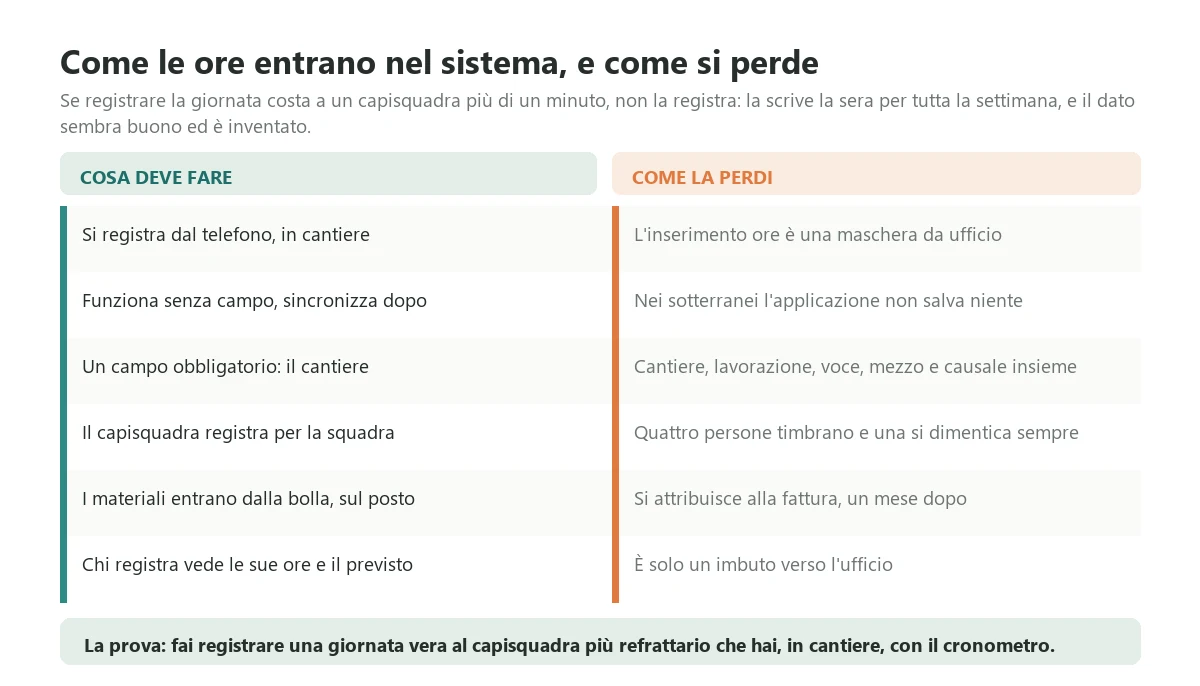
This is where the project lives or dies, and almost nobody looks here while choosing, because demonstrations are about dashboards. Dashboards are the easy part: they are the consequence of data getting in. If the data does not get in, the dashboard is an empty screen nobody opens after three months.
The rule I have seen hold everywhere is this: if logging the day costs a foreman more than a minute, he does not log it, or he logs it badly on Friday evening for the whole week, which is worse because the data looks good and is invented. A minute is a long time when the foreman still has a van to unload, and it is nothing at all if the system asks for eight fields.
The six conditions that make capture workable
Logging happens from a phone, on site, not from a computer at the office. It sounds obvious, yet several construction ERPs have their time entry in a screen designed for the office. If logging means going to the office, the data arrives when somebody goes to the office.
It works with no signal. On many sites phones do not connect, and in basements they never do. The application has to accept the entry offline and sync it later. It is the first question to put to a vendor, and the answer needs testing rather than believing: ask for a trial on the worst site you have.
One mandatory field, the rest later. The job. Everything else, activity, plant, notes, photos, is optional and can be completed afterwards. Anyone demanding job, activity, cost code, plant and reason together gets people always picking the first item in the list, and from that moment you have precise, wrong data, which is the worst outcome of all because you make decisions with it.
The foreman logs for the whole crew. Having four people clock in means one always forgets. A single entry with the people present ticked, in ten seconds, works: it is the same thing the foreman already does on the paper report, except it ends up where it is needed.
Materials enter where they actually arrive, from the delivery note. A photo of the note with the job allocated on the spot is worth more than any warehouse workflow, because it is the moment when somebody knows who that material belongs to. Wait for the supplier invoice and you wait a month, and by then allocation falls to someone who was not there.
Whoever logs gets something back. This is the condition most often ignored. If the foreman can see his crew's hours for the week, the comparison against what was allowed for that activity and his next few days of work, he takes care of the data because it is also his. If the system is only a funnel towards the office, within a month it becomes a chore and quality collapses.
The test that beats three demonstrations
Before signing anything, run this test. Take the most resistant foreman you have, not the best one, hand him the phone with the product under evaluation and ask him to log a real day with a stopwatch running, on site, not in the office. Then ask him to log the same day from a week ago, which will happen often. If the first operation takes more than ninety seconds, or the second is impossible, that product will not take root in your company however good the dashboard is. And if the vendor will not let you run this test before purchase, you already have your answer.
Job costing, progress, safety: three different things
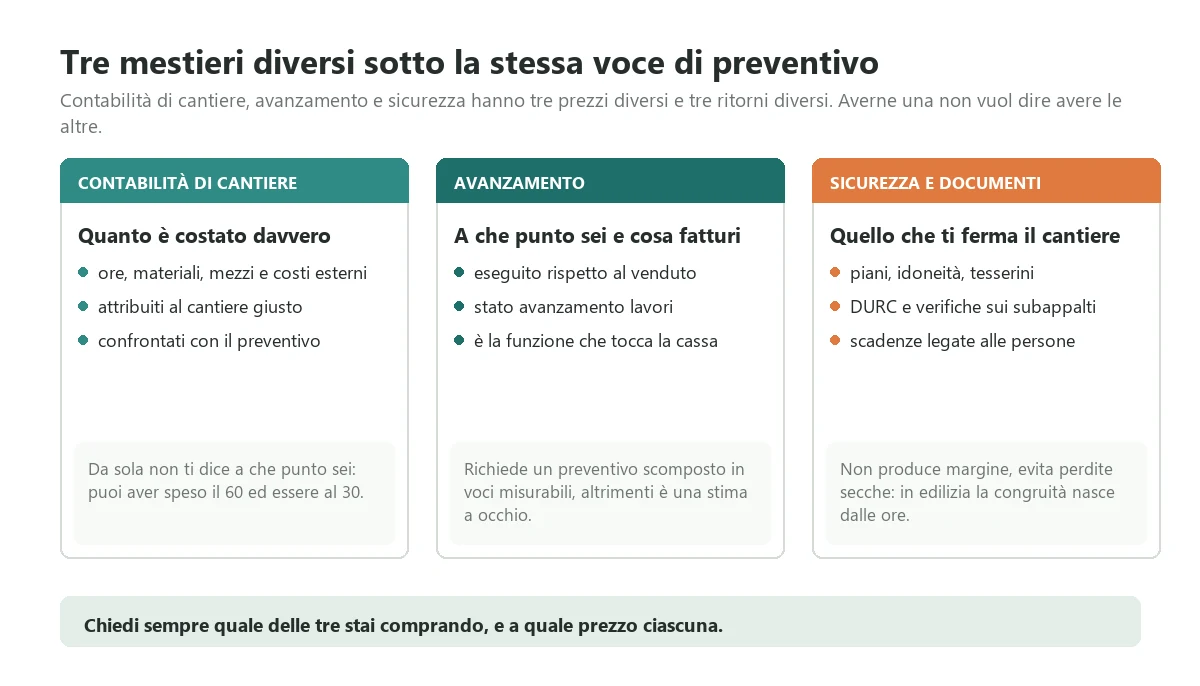
In the quotes that reach me these three end up under one heading, and they have three different prices and three different returns. Having one does not mean having the others, and buying all three at once is the most common way of spending three times as much to use a third.
Job costing: what it actually cost
It collects hours, materials, plant and external costs, allocates them to the job and compares them with the estimate. It is the function that pays back first and the one to start from every time, because it is the only one that tells you whether you are making money. What it does not do: it does not tell you how far along you are. A job can have consumed sixty per cent of the budget while being thirty per cent complete, and costing alone cannot see it.
Progress and certification: how far along and what you can invoice
It measures work executed against work sold, and produces the progress claim. It is the function that touches company cash, and for anyone working with structured clients or public bodies it is worth the most, because it invoices sooner. It does however require something many companies do not have: an estimate structured into measurable items. If your estimate is a lump sum with four lines, progress can only be guessed, and no software saves you.
One frequent confusion is worth settling here: quantity surveying and measured works accounting are a separate trade, with specialised programs and official price books. If you work on public contracts you probably already own one of those and do not need to rebuild it: you need it to talk to everything else. Asking a site management system to replace quantity surveying is almost always wasted money.
Safety and documents: what stops your site
It keeps the documents a site carries with it in order and in date: safety plans, subcontractor checks, worker competence and training, records, periodic plant inspections. It produces no margin but prevents outright losses, and in companies working for demanding clients it is the function that decides the purchase.
The Italian framework is legislative decree 81 of 2008, which for temporary or mobile construction sites requires specific plans, verification of the technical and professional suitability of contractors and subcontractors, and an identification badge for anyone working on site. To that you add the single document of contribution regularity, to be kept valid for yourself and verified on subcontractors, valid for one hundred and twenty days, and in construction the labour congruity rule introduced by decree law 76 of 2020 with ministerial decree 143 of 2021, which above the relevant thresholds ties the attestation to the ratio between declared labour and the value of the works.
On that last point, a practical note worth the whole article: congruity is based on the hours declared to the construction workers' fund for that specific site. If your hours are misallocated between jobs you do not only have a margin problem, you have an attestation problem, and you discover it when you need to get paid. That is why in construction correct time capture is not a management luxury but a requirement, and it should be raised with a vendor before anything else.
I am not an employment adviser nor a safety coordinator, and on these obligations the final word belongs to your own advisers. What I can tell you is where software genuinely helps: in tying deadlines to people and suppliers rather than to a spreadsheet, and in stopping someone whose certificate expired on Friday from going on site on Monday.
Subscription product, extended ERP or custom system: where the threshold sits
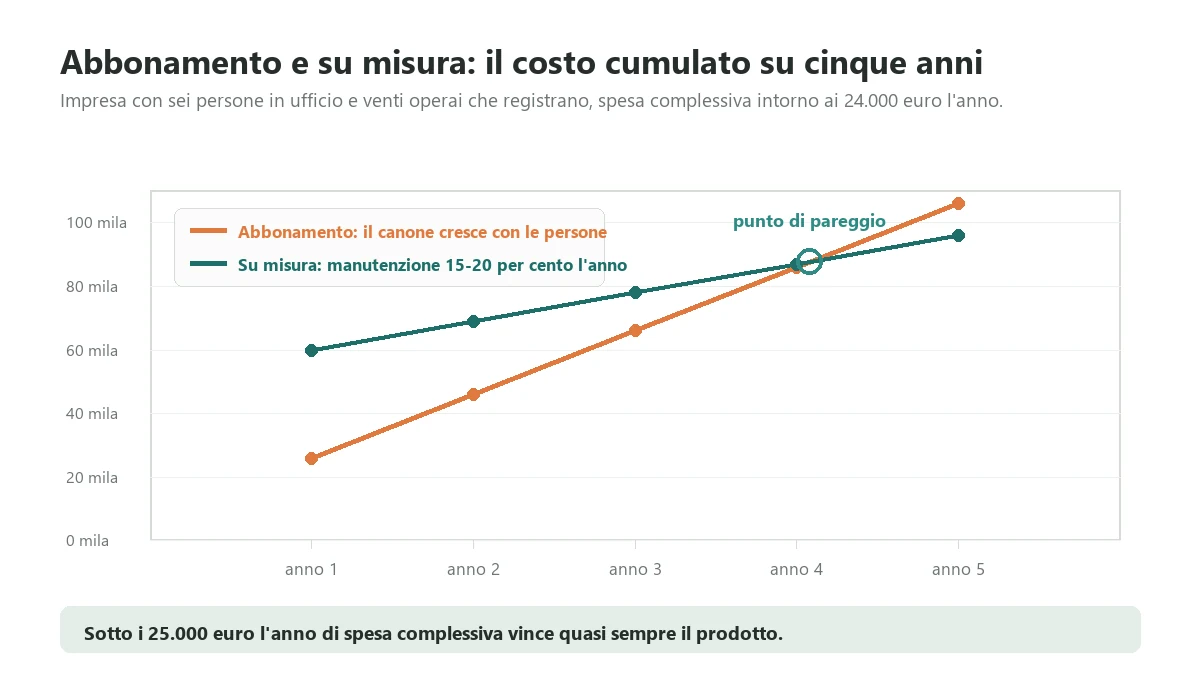
There are three routes with three different economics. The figures below are the ranges I see in practice in Italy for companies between one and ten million turnover, and they are there to give you the order of magnitude, not to replace a quote.
Specialised subscription product
Between twenty five and ninety euro per user per month, with big differences between vendors who count only office users and those who also count the field workers logging from a phone. Setup, meaning job configuration, master data import, price lists and training, runs from two to fifteen thousand euro. For a company with six office staff and twenty field workers logging, the first year normally lands between twelve and thirty thousand euro.
It is the right route for the great majority of companies below five million, and that needs saying plainly because my interest would be in saying the opposite. The advantage is not the price, it is that someone has already solved your industry's problems and you inherit the solutions. The limit is that your way of working has to fit into theirs, and when it does not, the cost of customisations quickly overtakes the subscription.
Extending the system you already own
This is the most overlooked route. Many companies already have a system with accounting and sales, and all they lack is the site part: capture from a phone and comparison against the estimate. Building that piece and connecting it to what exists costs between ten and thirty five thousand euro once, with no new subscriptions and no master data to move.
It has an advantage that only shows later: the cost does not enter the system twice. The most frequent cause of figures that do not reconcile is having the supplier and the job in two programs that talk once a day and not always well. It deserves evaluating first, before you even look at products, and the vendor of your current system is the first phone call to make.
Custom system
It starts at twenty five to forty five thousand euro for the core, meaning job master data, phone based capture, cost allocation and comparison with the estimate, and rises to fifty or a hundred and twenty thousand with progress measurement, safety documents and deep integration with accounting and payroll. Annual maintenance is fifteen to twenty per cent of what you spent, and it belongs in the budget from day one.
It makes sense in three cases, and rarely outside them. When your way of working is the competitive advantage and you do not want to bend it to a product: this happens in specialist firms, where the way production is measured is the trade itself. When the people who have to use it are many, and every minute of daily friction multiplies by fifty people and two hundred and forty days. When you already have systems that work and the problem is making them talk rather than replacing them.
The threshold, in euro
The practical rule I use is this: below twenty five thousand euro a year of expected total spend, subscriptions and customisations included, the product almost always wins. Above that, redo the sum, because at that level the subscription over five years exceeds the cost of building and the difference is all maintenance, which you pay either way.
In practice the break-even point falls just after the fourth year, as in the chart above, and at that point a non financial variable matters: how much your company will change in five years. If you expect to double your crews or move into a new kind of work, the flexibility of your own system is worth the premium; if your way of working has been stable for ten years, the product is the rational choice and anyone telling you otherwise is selling something.
Integration with accounting and payroll: who owns the number
This is the question that never appears in quotes and that a year later explains most failures. A job's cost is born in three different places: hours come from capture and end in payroll, materials come from the delivery note and end in the supplier invoice in accounting, revenue comes from the progress claim and ends in the sales invoice. If you do not decide who owns each one, you will have three different numbers for the same job and spend your meetings arguing about which is right instead of what to do.
Three decisions to make before signing
Hourly cost: who sets it. Will the site system use a standard cost by grade, or the real cost coming from payroll? The standard is available immediately and approximate; the real one is precise and arrives at month end, which is to say late. The right answer is almost always both: standard for steering while the job runs, real at closing for the final figures and for updating next year's standards. Ask the vendor whether the system supports that dual valuation, because plenty do not and you find out at the first job closing.
Materials: when they become cost. At the delivery note or at the invoice? At the note the data is timely but the price may change; at the invoice the price is certain but arrives a month later. The workable answer is to book at the note using the order or list price and adjust at the invoice, but it must be decided in advance, because it is the difference between a system that helps you in March and one that helps you in May.
Job master data: where the good copy lives. A job opened in the site system but not in accounting produces costs without a contract; the reverse produces contracts without costs. There must be one place where a job is born, and the others receive it. It sounds like a technical detail and it is the number one cause of endless reconciliation.
How to ask a vendor
Do not ask whether the product integrates, because the answer is always yes. Ask three concrete things: which data flows in which direction and how often, what happens when a job is closed on one side and not the other, and who pays if your accountant asks for a change to the file format next year. The answers to those three questions, written into the contract, are worth more than twenty pages of features.
How to choose construction site management software in two weeks
A long selection does not produce better choices, it produces more defensible ones. This is the method I use with clients, and it fits into two weeks of real work rather than waiting.
First week: your own numbers
Measure data lag on five closed jobs as described above: one hour. Cost out the five loss items with your own figures, roughly: half a day. Write on a single page how a crew's day unfolds today, from arriving on site to the data being in the office, with the names of the people who touch that data: two hours, and it is usually the document that opens more eyes than anything else, because two steps nobody knew existed almost always turn up.
Then choose your five scenarios. Not features: scenarios. For example: a crew logs a day split across two jobs with no signal; a delivery note becomes cost on the right job; on Monday morning the owner sees four open jobs with the variance against estimate; a worker's training expires and the system says so before he goes on site; a progress claim is issued and the revenue lands on the contract. Five, not twenty.
Second week: demonstrations, done properly
Ask two or three vendors to show you those five scenarios, in the order you choose, with data resembling yours. Do not let the salesperson drive, because their script is built around the product's strengths and it is their job to build it that way. The most informative moment of the whole selection is when you ask for something off script and watch the reaction: someone who knows the product tells you straight away that it cannot be done and how to work around it, someone who does not know it promises and then files a development request.
The questions to ask everyone, always the same ones so you can compare. What the total costs in year three, not year one, with the headcount you expect in three years. Whether the subscription counts field workers logging from a phone. What happens if I stop after two years: how does my data come out, in what format, and what does that extraction cost. Who runs the implementation, a consultant who knows the industry or a technician. How many companies like mine use this product today, and can I speak to two of them without the salesperson present.
That last point is worth insisting on until you get it. Half an hour on the phone with a company that went through the same process a year before you is worth more than the entire selection, and there is one question to ask them: if you were doing it again, what would you do differently.
Three things to fix before buying anything
Some work costs little, takes a few weeks and without it any software returns half of what it could. It has to be done first, not afterwards, because afterwards the project has started and nobody goes back.
The site cost structure. The categories you classify costs under have to be the same in the estimate and in the final figures, and there have to be few of them. If the estimate says labour, materials and plant, and the outturn arrives with forty two lines, nobody makes the comparison. Eight or ten categories is the right size for a company of a few million, and it is worth choosing them by looking at where estimates most often go wrong, because those are the lines you want to see variance on.
The structure of the estimate. If you sell lump sum and want to control production, you need at least an internal breakdown into measurable activities, even if the client never sees it. Without it, progress is the foreman's guess and estimate versus outturn only works on the total, which is to say when it is too late. It is technical office work, it costs a few days and it is worth more than half the software.
The decision about hours. Establish that hours are collected to run jobs and not only to pay wages, and that they are collected daily. That is an organisational decision, not a technical one, and without it your data lag stays at the payroll cycle whatever you buy. Anyone proposing a project without addressing this point is selling you the part with the lowest return.
One more thing, not a task but a way of starting: pick one pilot job, just one, ideally a mid sized one with a foreman who does not hate you. Run everything there for six weeks before extending. Companies that start on every site at once end up back on paper reports at the first difficult month, and the second attempt is much harder, because by then everyone in the company knows that thing did not work.
Where to start
A site management system is not an IT project, it is a data capture project, and capture projects succeed when they start small and ask little of the people outside. The first release that works is almost always this: master data for open jobs, hours logged from a phone with a single mandatory field, materials booked from the delivery note, and one screen that on Monday morning shows open jobs with hours spent against hours estimated. Nothing else.
With that scope you are running in a few weeks with a product, in two or three months if you build custom, and from then on you can repeat the data lag measurement every month on the same five jobs. If it falls, the project is working. If it does not, the problem is in capture or in the rules, and no additional feature will fix it. Everything else, progress, automatic claims, safety deadlines, crew planning, gets built on top of data you can trust, and costs less because by then you know what you actually need.
If you are running this calculation now and want to know which side of the threshold you are on before spending anything, send me two pages: how a crew's day works today from the site to the office, plus the two numbers from the test, meaning data lag across five jobs and the total of the five cost items. In half an hour I will tell you whether yours is a product problem, an extension problem or a custom problem, and where it is an organisational problem I will tell you that too, because a client who buys the wrong thing comes back angry. You can ask for a consultation to run that calculation together, or look at how we work on custom software development.
If you are still framing the problem, two related reads. Controlling costs when the work is a contract rather than a site, which is the same problem under another name, is in job costing software. And if what is really holding you back is the age of the systems you already run, that is in legacy software modernization.
Frequently asked questions
There are three routes with three different economics. A specialised subscription product costs between twenty five and ninety euro per user per month in Italy, with large differences between vendors who count only office users and those who also count field workers logging from a phone, plus setup between two and fifteen thousand euro for configuration, master data, price lists and training: for a company with six office staff and twenty field workers the first year usually lands between twelve and thirty thousand euro. Extending the system you already own with just the site part costs between ten and thirty five thousand euro once, with no new subscriptions, and it is the most overlooked route. A custom system starts at twenty five to forty five thousand euro for the core and rises to fifty or a hundred and twenty thousand with progress measurement, safety documents and deep integrations, with annual maintenance between fifteen and twenty per cent.
It is the median number of days between something happening on site and that data being complete and usable in the office. You measure it in an hour: take five jobs closed in the last six months, pick a mid project week for each, and compute the difference between the last day of that week and the day the office had hours allocated and materials booked, not paperwork in a folder but a usable number. Count the complete figure: if hours arrive after two days and materials after thirty, your lag is thirty, because margin needs both. In companies that have never measured it the answer is almost always between twenty five and forty five days, and it usually matches the payroll cycle, because the real engine collecting hours is payroll rather than cost control.
Almost always for one reason: the data never arrives. Dashboards are the easy part and the part shown in demonstrations, but they are a consequence of daily logging that has to cost a foreman less than a minute. Above that threshold the day is not logged on the spot, it is written from memory on Friday for the whole week, and the data looks good while being invented, which is worse than missing data because you make decisions with it. The six conditions that make the difference: logging happens from a phone on site rather than a computer at the office, it works with no signal and syncs later, there is a single mandatory field which is the job, the foreman logs for the whole crew, materials are booked from the delivery note on site rather than the invoice a month later, and whoever logs gets something back, namely their own hours against the estimate.
The practical rule is that below twenty five thousand euro a year of expected total spend, subscriptions and customisations included, the product almost always wins, and that deserves saying even by someone who builds custom software. The advantage of a product is not the price, it is that someone has already solved your industry's problems and you inherit the solutions. Custom makes sense in three cases: when the way you measure production is your competitive advantage and you do not want to bend it to a product, when the number of people using it is large and every minute of daily friction multiplies by fifty people and two hundred and forty days, and when you already have systems that work and the problem is making them talk rather than replacing them. Before either, though, consider the third route that is nearly always overlooked: extending the system you already own with only the site part.
They are three distinct disciplines that quotes lump under one heading, with three different prices and three different returns. Job costing collects hours, materials, plant and external costs, allocates them to the job and compares them with the estimate: it is the function that pays back first and the one to start with, but on its own it does not tell you how far along you are, because a job can have consumed sixty per cent of the budget while being thirty per cent complete. Progress measurement compares work done against work sold and produces the progress claim, so it touches cash, but it needs an estimate broken down into measurable items. Safety and documents keep plans, competence checks, ID badges, subcontractor verifications and training expiries in order: they produce no margin, they prevent outright losses and stopped sites.
The first week is spent on your own numbers: measure data lag across five closed jobs, cost out the five loss items with your figures, write on a single page how a crew's typical day unfolds today from the site to the office including the names of everyone who touches that data, and choose five scenarios to be shown rather than twenty features. The second week is for demonstrations of those five scenarios, in the order you decide and with data resembling yours, without letting the salesperson drive. The questions to ask everyone are always the same: what the third year costs with the headcount you expect in three years, whether the subscription counts field workers logging from a phone, how your data comes out if you stop after two years and what that extraction costs, who runs the implementation, and whether you can speak without the salesperson present to two companies like yours using the product today.
Leave your details in the form below