What is the number that decides whether CRM software will really make you money?
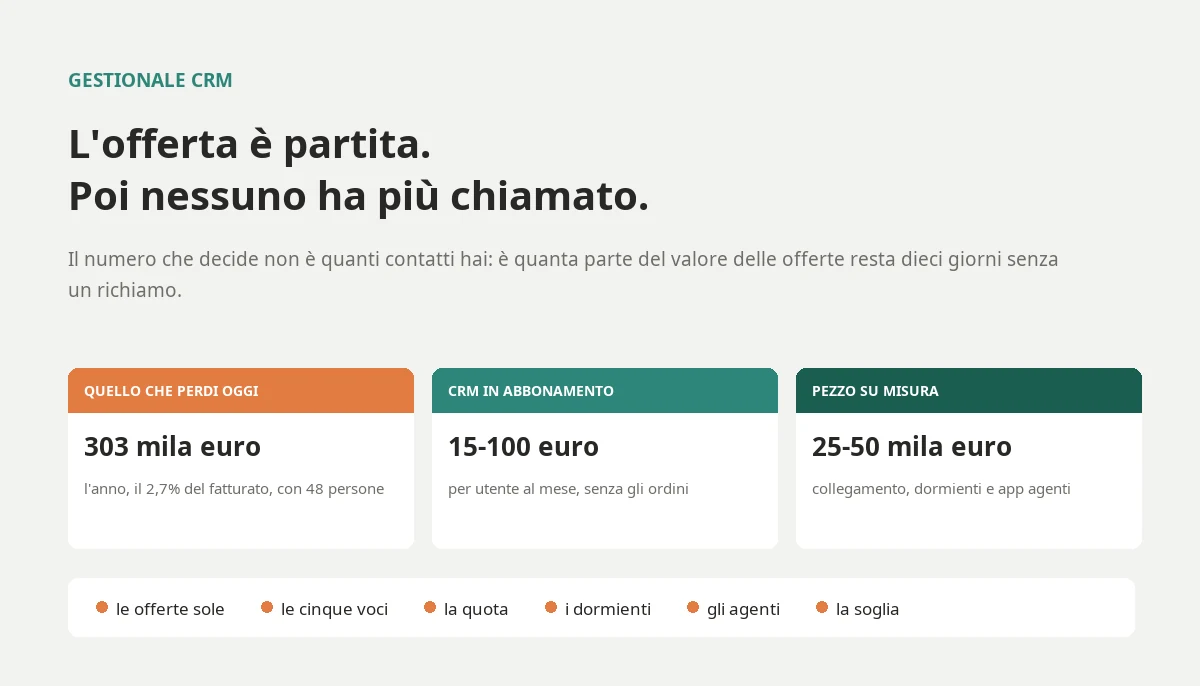
Below ten per cent sales discipline works and a simple tool is enough; above twenty-five a system that remembers on its own pays for itself. In a components manufacturer with 48 people the share was 34 per cent, and the five costs of sales followed through Excel, email and agents' memory came to about 303,000 euros a year, 2.7 per cent of turnover. A subscription CRM costs between fifteen and one hundred euros per user per month, the custom piece that links it to the management system, flags dormant customers and serves the agents between twenty-five and fifty thousand euros. Counting time alone the two roads cross at around twelve people who sell, and with quotes followed up and customers won back the threshold drops.

The sales director of a company near Brescia that makes hydraulic components, forty-eight people and eleven million euros of turnover, does the same thing every Friday afternoon. He opens the quotes file, scrolls through last month's rows and tries to remember which ones have been followed up. For half of those rows he knows the answer. For the other half he has to call an agent, who in turn has to search through his emails. If you are looking for CRM software, in this article you will find a way to understand what you really need, how much not having it costs you today and how much it will give back, with a number instead of a feeling.
You will find the difference between a management system, a CRM and the two put together, the reason quotes get lost even when the sales team is good, the bill for what sales run across Excel, email and agents' memory cost today, the single number that tells you whether a CRM will make you money or just give you a tidier list, the calculation written in code, a way to spot customers who stop ordering before they leave, the real price ranges between a subscription CRM, the module of your management system and a custom system, and the threshold beyond which the maths changes.
What CRM software is, and what it is not
CRM stands for customer relationship management. Put like that it means almost nothing, and in fact tools that do very different things are sold under the same name. Whoever buys the wrong one finds out six months later, when the sales team has stopped updating it and the Excel file is back in its place.
The distinction that matters is between two questions. The management system, which companies also call ERP, answers the question "what have we sold": orders, delivery notes, invoices, payments, stock. The CRM answers another question: "what are we about to sell, to whom, and who is looking after it". They are two views of the same customer, one looking back and one looking forward. The value comes when they talk to each other.
Three things everyone calls CRM software
The first is the subscription CRM: HubSpot, Pipedrive, Zoho, Salesforce in its smaller editions. Contacts, companies, opportunities split by stage, tasks to do, tracked emails. They can be switched on in a day and cost from a few tens of euros per user per month. They were built for people who sell services or software to many new customers, and there they work very well. They know little or nothing about what the customer has ordered over the last five years, because that data sits in the management system.
The second is the CRM module of the management system: almost every Italian management system has one. The advantage is that it already knows customers, price lists and order history. The drawback is that it was usually designed for the office, not for people who sell on the road: it is awkward to use from a phone, it does not see emails and external agents often cannot be given access without opening half the management system to them.
The third is the one that matters to a company selling to other companies through a network of sales reps and agents: a system that holds quotes and activities like a CRM, but links them to the order history, price lists and terms held in the management system, and that an agent can use from a phone in ten seconds. It can be a heavily configured product, an extended module or a custom piece. It is the category where off-the-shelf products work least well, because every company has its own way of preparing quotes, calculating discounts and paying commissions.
Who looks for CRM software, and why it matters to know
Searches for "CRM software" come from two worlds. The first is people who need to find many new customers: agencies, consultants, service companies, software houses. For them the problem is filling the funnel, and a subscription CRM is almost always the right answer. This article concerns them very little.
The second is companies that sell to a customer base that is largely already known: component manufacturers, distributors, wholesalers, plant companies. Seventy or eighty per cent of turnover comes from customers who have already bought. For them the problem is not finding contacts, it is not losing the quotes and customers they already have along the way. The rest of this article is addressed to them.
The difference changes everything. Whoever needs new customers measures how many contacts come in. Whoever lives on repeat customers needs to measure how many quotes go out and are then left alone, and how many customers stop ordering without anyone noticing. A CRM that solves the first problem well can be completely blind to the second, because it does not see the orders.
Why quotes get lost even when the sales team is good
At the Brescia company the problem was not the quality of the sales team. The four internal reps had known the customers for years, the agents were experts in their territory, the prices were competitive. The problem was that nobody knew, at any given moment, which quotes were waiting for a phone call. Each rep kept a list in a different place: a spreadsheet, flags in the inbox, a notebook, memory. The agents sent quotes from their own software and, when things went well, a copy to the office.
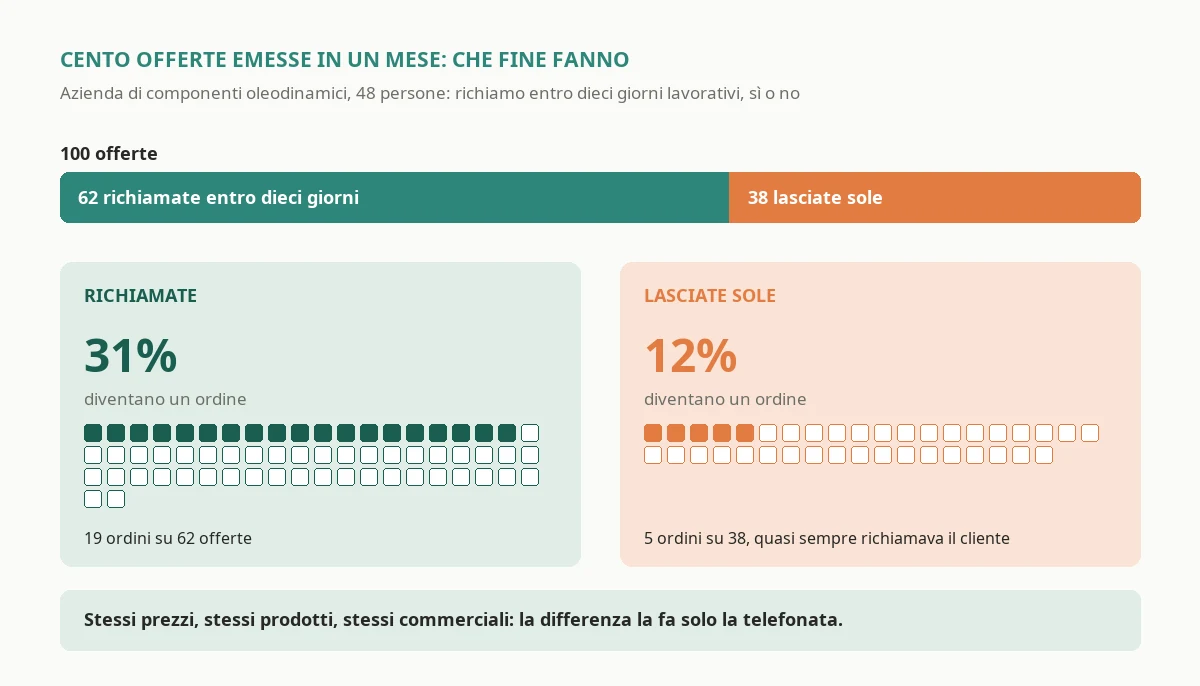
Together with them I reconstructed a year of quotes: about 1,900, with an average value of 7,400 euros. Then, for each one, we looked for the first trace of a later contact: an email, a logged phone call, a visit. The result was that 38 per cent of quotes had received no follow-up in the ten working days after they were sent. It was not carelessness: the following week more requests arrived, more urgent ones, and the quotes already sent slipped to the bottom.
The instructive part is the close rate. Quotes followed up within ten days turned into an order in almost one case in three, 31 per cent. Those left alone closed in 12 per cent of cases, and almost always because the customer called back. Same company, same prices, same products: the only difference was the phone call.
A silent customer is not a no
Anyone who has been selling for years knows this, but it helps to say it with numbers. A quote the customer does not answer is almost never a refusal. More often the customer has passed it to a colleague, filed it while waiting for budget, or is comparing it with another one and waiting for someone to give them a reason to decide. In most cases the order goes to whoever gets in touch first with a useful question, not to whoever has the lowest price.
There is also a less visible effect. When quotes are not followed up, the sales team compensates by sending more of them, with bigger discounts, to raise the chance that some will close by themselves. The number of quotes grows, the time to follow them shrinks, and the close rate drops further. At the Brescia company quotes had grown by twenty per cent in three years, and turnover by four.
The real bill: what sales run across Excel, email and agents' memory cost you today
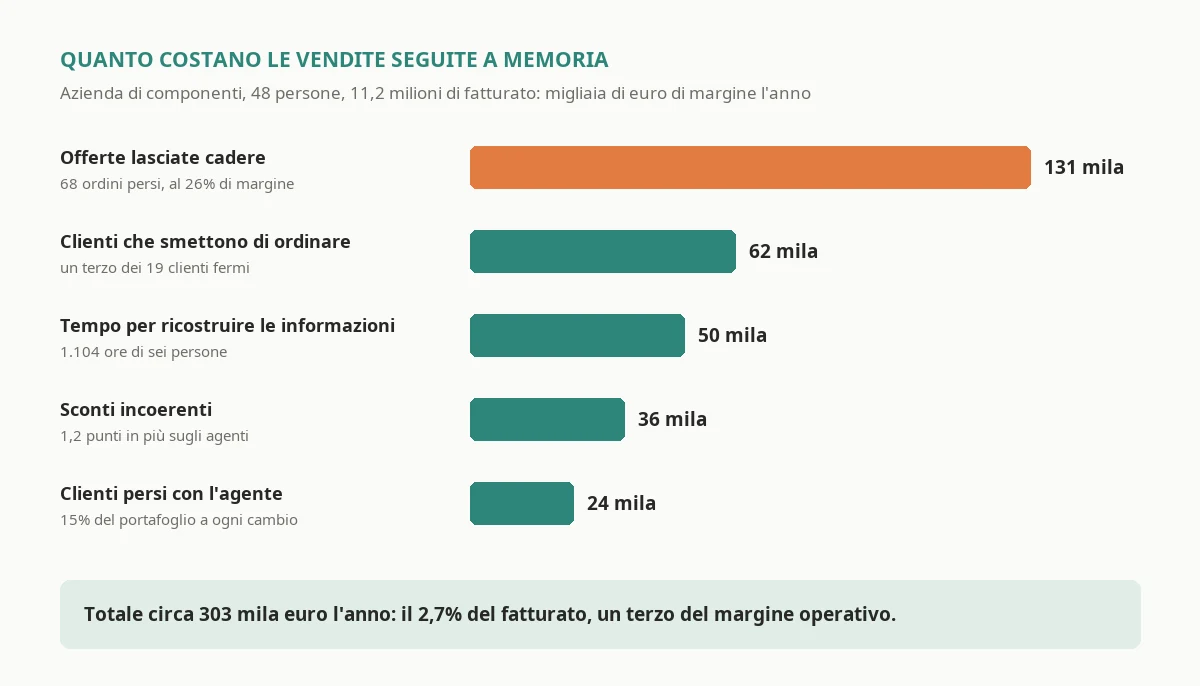
Before talking about software it is worth adding up what today's situation costs. At the Brescia company, with an average contribution margin of 26 per cent, there were five items. I report them with the calculation method, so you can redo it with your own numbers.
Quotes left to drop. About 720 quotes a year with no follow-up, with a close rate nineteen points lower than those that were followed. Had they all been followed up, there would have been about 137 more orders. To be prudent I counted half of them, because some of those quotes could not really be followed: 68 orders at 7,400 euros make about 500,000 euros of turnover, which at a 26 per cent margin is about 131,000 euros a year. It is the largest item and the one nobody sees, because an order that never arrives leaves no trace.
Customers who quietly stop ordering. In the last year nineteen customers who used to order regularly had stopped, without a complaint and without a phone call. Average turnover for each, about 38,000 euros a year. Talking to some of them, a third could have been recovered with a call in the first few weeks: a delivery problem never solved, a new buyer who knew nobody, a competitor who had dropped by. A third of 722,000 euros, at 26 per cent, makes about 62,000 euros.
Time spent reconstructing information. Four internal reps and two people in the sales office spent on average four hours a week searching emails, calling agents to find out where a customer stood, reconstructing the history before a visit. Four hours for forty-six weeks for six people makes 1,104 hours, which at 45 euros an hour comes to about 50,000 euros.
Inconsistent discounts. With no shared history of terms, every rep and every agent decided the discount based on their own experience. Comparing quotes to the same customer for the same items, the average discount granted by agents was 1.2 points higher than what the customer had accepted in the past. On the roughly three million euros of turnover that went through agents, that makes about 36,000 euros given away without anyone having decided it.
Customers who leave with the agent. On average an agent gave up the mandate every eighteen months. With him went the notes, the contacts, the state of negotiations, and the new agent started from zero. In the handover about fifteen per cent of that area's portfolio was lost. On an average portfolio of 900,000 euros, spread over the years and at a 26 per cent margin, that makes about 24,000 euros a year.
The total is about 303,000 euros a year, 2.7 per cent of turnover, in a company with an 8 per cent operating margin. Put another way: a third of the margin was going on the way sales were followed, not on price or product. There was no lazy salesperson. There was a company in which everyone knew their own part, and nobody knew the sum.
Your bill will be different, but the items are almost always these five. If you redo the calculation and the total is below 0.5 per cent of turnover, a CRM is not your priority. If it is above 1.5, it almost certainly is, even if nobody in the company calls it that.
The share of quotes with no follow-up: the number that decides
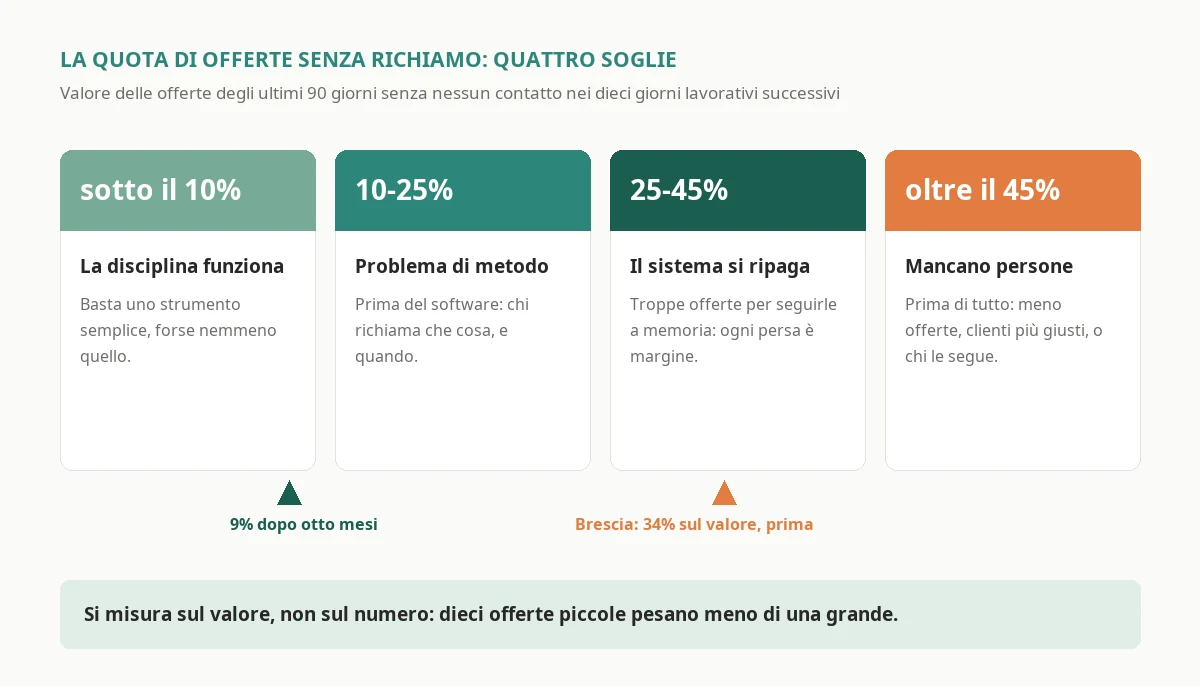
The five-item bill tells you how much you are losing. It does not tell you whether software will help you recover that money, because part of the losses depends on people and decisions that no program replaces. The number that tells you is a different one, and I call it the share of quotes with no follow-up: of the value of all quotes issued in the last ninety days, how much received no contact in the ten working days after being sent.
The definition matters in the details. It is measured on value and not on count, because ten three-hundred-euro quotes left to drop weigh less than one worth fifty thousand. Only contacts made by the company towards the customer count as follow-up: if it is the customer who calls to ask how the order is going, the quote was left alone anyway. And quotes closed within the ten days, either way, are excluded, because they did not need a follow-up.
I use four thresholds. Below ten per cent sales discipline works: a simple tool is enough, and perhaps not even that. Between ten and twenty-five the problem is one of method: some people follow up and some do not, and before software you need to decide who follows up what and when. A CRM helps, but only if the rule is already there. Between twenty-five and forty-five a system that remembers by itself and puts quotes in order pays for itself, because there are too many quotes to follow from memory and each one lost is margin. Above forty-five the people selling are not enough for the volume of quotes, or too many quotes go to people who will not buy: before any software you need to choose who gets quotes, or someone to follow them.
At the Brescia company the share was 34 per cent by value, 38 by count, in the band where the system pays for itself. And as always the distribution said more than the average: the agents with the largest portfolios had the highest shares, up to sixty per cent, because they had more quotes than they could follow. The internal reps were below twenty.
How to calculate it, with the data you have
You do not need a CRM to take the first measurement. You need two lists: the quotes issued, which almost every management system keeps with date, customer, value and sales rep, and the later contacts, which can be taken from emails sent to customer domains, the phone call log and recorded visits. The second list is the harder one to put together the first time, but it is enough to extract sender, recipient and date from the mail server, without the body. Put into two tables, the calculation fits in one query.
-- Share of the value of quotes with no follow-up at all
-- in the ten working days after sending, last ninety days.
WITH Quotes AS (
    SELECT q.QuoteId, q.CustomerId, q.SalesRep, q.SentDate, q.Value,
           q.ClosedDate,
           -- ten working days are roughly fourteen calendar days
           DATEADD(day, 14, q.SentDate) AS Deadline
    FROM IssuedQuotes AS q
    WHERE q.SentDate >= DATEADD(day, -104, CAST(GETDATE() AS date))
      AND q.SentDate < DATEADD(day, -14, CAST(GETDATE() AS date))
),
FollowedUp AS (
    SELECT DISTINCT q.QuoteId
    FROM Quotes AS q
    JOIN Contacts AS c
      ON c.CustomerId = q.CustomerId
     AND c.Direction = 'outbound'
     AND c.Date > q.SentDate
     AND c.Date <= q.Deadline
)
SELECT q.SalesRep,
       COUNT(*) AS Quotes,
       SUM(q.Value) AS QuotedValue,
       SUM(CASE WHEN f.QuoteId IS NULL THEN q.Value ELSE 0 END) AS ValueWithoutFollowUp,
       CAST(100.0 * SUM(CASE WHEN f.QuoteId IS NULL THEN q.Value ELSE 0 END)
            / NULLIF(SUM(q.Value), 0) AS decimal(5, 1)) AS ShareWithoutFollowUpPct
FROM Quotes AS q
LEFT JOIN FollowedUp AS f ON f.QuoteId = q.QuoteId
WHERE q.ClosedDate IS NULL OR q.ClosedDate > q.Deadline
GROUP BY q.SalesRep
ORDER BY ValueWithoutFollowUp DESC;
The query returns the share for each sales rep; the company share is the sum of value without follow-up divided by the sum of quoted value. Two warnings. First: if agents send quotes from their own software and nothing reaches the company, the measurement has to be done by asking each of them for the list of the last quarter, and that is already a finding: if the company does not know which quotes are out there, no software will tell you until you change that step. Second: look at the value without follow-up column before the share column. The rep with the highest share is not always the one losing the most.
The second number: how many customers stop ordering without anyone calling
Alongside the share of quotes with no follow-up I measure a second one: of all customers who ordered at least four times in the previous year, how many have stopped ordering for a period longer than twice their usual interval, and for how many of them someone from the company got in touch in the meantime. At the Brescia company nineteen out of two hundred and forty customers had stopped, and none of them had been called before three months had passed. The figure comes from the management system alone, and it is the one that makes the biggest impression on the owners, because everyone knows the names of those customers.
Dormant customers: the calculation no subscription CRM does on its own
If the company lives on repeat customers, the CRM function that pays most is not the opportunity funnel. It is the alert on customers who change their rhythm. A subscription CRM cannot do it alone, because it does not see orders: the management system does. And this is exactly where the link between the two is worth more than any screen.
The idea is simple. Every repeat customer has their own rhythm: some order every two weeks, others every three months. A customer becomes dormant when the time since the last order is well beyond their usual interval. You do not need a sophisticated statistical model: the median of the intervals between recent orders, multiplied by a factor, works surprisingly well. What follows is the core of the version I wrote for the Brescia company, simplified.
// Which customers have stopped ordering at their usual rhythm?
// A subscription CRM does not see orders: this calculation starts from the management system.
public sealed record Order(string CustomerId, DateOnly Date, decimal Amount);

public sealed record DormantCustomer(
    string CustomerId,
    DateOnly LastOrder,
    int DaysSinceLast,
    int UsualInterval,
    decimal RevenueLastYear)
{
    // How many times the current silence exceeds the customer's usual rhythm.
    public decimal Delay => Math.Round((decimal)DaysSinceLast / UsualInterval, 1);
}

public static class Dormant
{
    public static IReadOnlyList<DormantCustomer> Find(
        IEnumerable<Order> orders, DateOnly today,
        int minimumOrders = 4, decimal factor = 2.0m)
    {
        return orders
            .GroupBy(o => o.CustomerId)
            .Select(g => g.OrderBy(o => o.Date).ToList())
            .Where(list => list.Count >= minimumOrders)
            .Select(list =>
            {
                var intervals = list.Zip(list.Skip(1),
                    (a, b) => b.Date.DayNumber - a.Date.DayNumber).Order().ToList();
                var median = Math.Max(1, intervals[intervals.Count / 2]);
                var last = list[^1].Date;
                var revenue = list.Where(o => o.Date > today.AddYears(-1)).Sum(o => o.Amount);
                return new DormantCustomer(list[0].CustomerId, last,
                    today.DayNumber - last.DayNumber, median, revenue);
            })
            .Where(c => c.DaysSinceLast > c.UsualInterval * factor)
            // Most valuable first: the list is for deciding who to call on Monday.
            .OrderByDescending(c => c.RevenueLastYear)
            .ToList();
    }
}
With the numbers of a typical Brescia customer, a farm machinery manufacturer that ordered every twenty-two days and had not ordered for seventy, the calculation returns a delay of 3.2 times the usual rhythm and puts it at the top of the list, because it was worth 64,000 euros a year. The call went out on Monday. The reason for the silence was a batch of fittings with an out-of-tolerance thread, reported three months earlier to a warehouse worker and never passed on to the quality office. The customer had started buying some of the items elsewhere, and would have done so for all of them by the summer.
There is nothing sophisticated here, and that is exactly the point: the value is not in the algorithm, it is in the calculation running every night on real data and the result reaching the right sales rep as a task to do, not as a report to read. A list of dormant customers emailed once a month gets read by someone the first time and by nobody the third.
The three rules that make a CRM credible
A CRM is only useful if the sales team keeps it up to date, and they only do so if the system follows three rules.
What already exists is never retyped. Customers, contacts, terms, orders and invoices live in the management system and must appear in the CRM by themselves. If a rep has to type in information the company already has, sooner or later they stop doing it, and rightly so. Emails sent to customers attach themselves to the right customer, by recognising the recipient's domain.
Every open quote has a next action with a date. This rule alone is worth half the system. A quote without a next action cannot be saved: the rep must write what they will do and when, even just "call back Thursday". The day after that date, if the action has not been done, the quote rises to the top of their list. You do not need a flood of alerts, reminders and notifications: you need a single, well-ordered list.
From the phone, in ten seconds. An agent coming out of a visit has ten seconds of attention before getting into the car. If in ten seconds they cannot record that the visit happened and when to call back, they will not do it. Voice dictation, with a model that turns the sentence into a task and a date, has changed this point more than any other feature in the last two years.
Integrated or separate CRM software: where the value lies
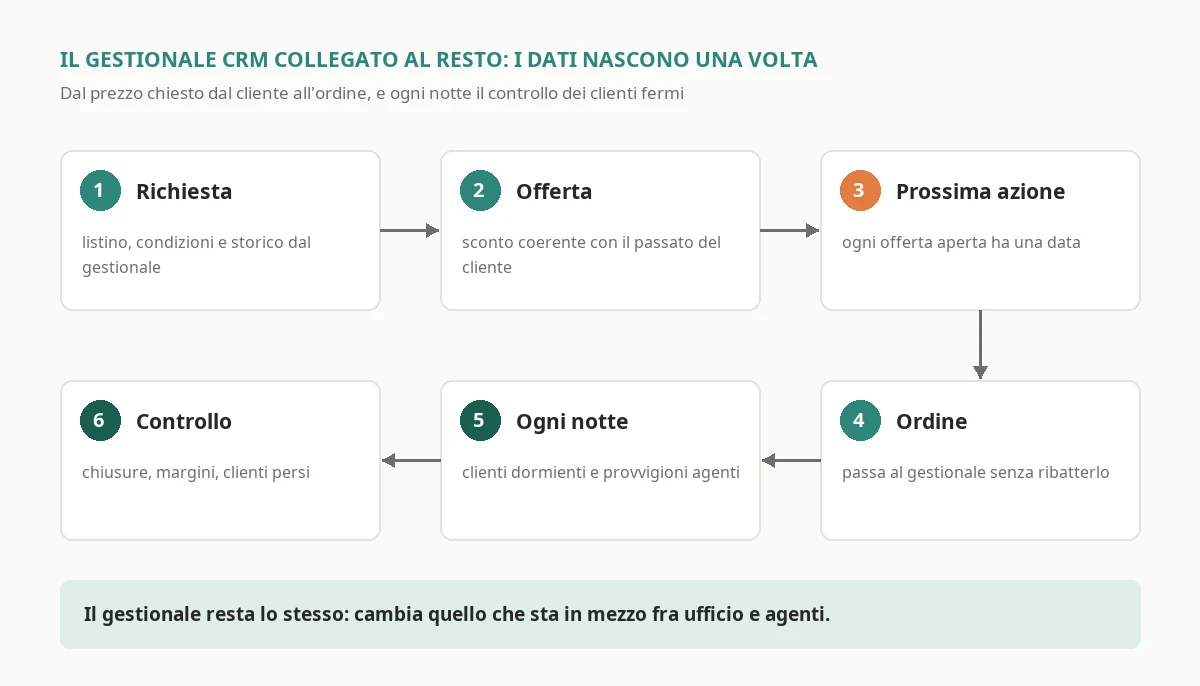
The question I am asked most often is whether the CRM should sit inside the management system or outside it. The honest answer is that it matters less than it seems. What matters is that data is created only once and moves from one side to the other without anyone copying it. The flow that works has six steps.
The request becomes a quote with real data. When a customer asks for a price, the quote is built from the price list, the customer's terms and the history of what they have already bought and at what price. This is where inconsistent discounts are recovered: the agent sees that last year the same item was sold to that customer at fifteen per cent off, and does not start from twenty. For companies selling products with many variants, the piece that builds the quote is often a configurator, and I have written about it in product configurator.
The quote always has a next action. With a date, as mentioned. This is the part that turns an archive of quotes into a list of things to do.
The accepted order passes to the management system. When the customer accepts, the quote becomes an order without being retyped. At the Brescia company the sales office spent an hour a day copying into the management system orders that arrived by email as attachments to quotes: that hour disappeared in the second week.
Reorders do not go through the sales rep. Some orders are reorders of the same item, which need neither a quote nor a phone call. Letting them come in through a portal leaves the rep time for real quotes, and I have written about it in B2B portal.
Orders feed the dormant customer check and the commissions. Every night the system rereads the orders, updates the list of customers who have stopped and calculates the commissions earned by agents. Commissions are a delicate point: they are the reason agents keep information to themselves, and the way a CRM persuades them to share it is to show them, every day, how much they have earned. At the Brescia company the agents started updating the system when they found in it a commission statement more up to date than the one they received from the accounts office.
Everything reaches management control. Close rate by sales rep, by product family and by area, margin on quotes won and lost, customers lost and recovered: these are numbers management wants to see, and without a link they are reconstructed by hand once a year. How that part is built, from the side of whoever has to read the numbers, I have described in management control software.
None of these steps requires changing management system. At the Brescia company the management system stayed the same, and so did the program agents used to print catalogues. What changed was what sat in between: the quotes file and the Friday phone calls were replaced by a piece of software that talked to the management system on one side and to the agents' phones on the other.
When contracts matter more than quotes
If a significant share of turnover comes from framework agreements, annual supplies or service contracts, the CRM also needs to know when they expire, because the renewal is the most important negotiation of the year and the easiest to forget. It is a topic with its own logic, different from that of quotes, and I have covered it in contract management software.
How much CRM software costs: subscription, management system module or custom
There are three routes, and the prices below are the ones I see in 2026 for Italian companies with between five and fifty million euros of turnover.
The subscription CRM. The editions useful for a company selling to other companies cost between fifteen and one hundred euros per user per month, depending on product and tier. For twenty people across sales reps and agents that is between four thousand and twenty-four thousand euros a year, with a setup cost ranging from almost nothing, if you configure it yourself, to ten thousand euros with a consultant. They are the right choice when the share of quotes with no follow-up is low, when order history is not needed to sell or when the business is mostly about new customers. They become a hidden cost when someone has to keep customers, orders and terms in line by hand between the CRM and the management system.
The CRM module of the management system. It usually costs between five thousand and twenty-five thousand euros in licences and configuration, plus the annual fee for the management system, which grows accordingly. It has the huge advantage of already knowing everything. It works well when the people selling are in the office. It works less well when the network is made up of external agents, because giving them access to the management system costs licences and opens up data they should not see, and because it is awkward to use from a phone.
The custom system. Here too there are two figures, and the difference is important. A custom piece that sits alongside what is already there, meaning the link with the management system, the next action rule, the dormant customer check, the app for agents and commissions, costs between twenty-five and fifty thousand euros, plus fifteen or twenty per cent a year for maintenance. Complete custom CRM software, which also replaces the subscription tool, costs between eighty and one hundred and fifty thousand euros, and is only justified when the way the company sells is its competitive advantage, for example with complex technical quotes or commissions built on rules no product handles.
The threshold, with numbers
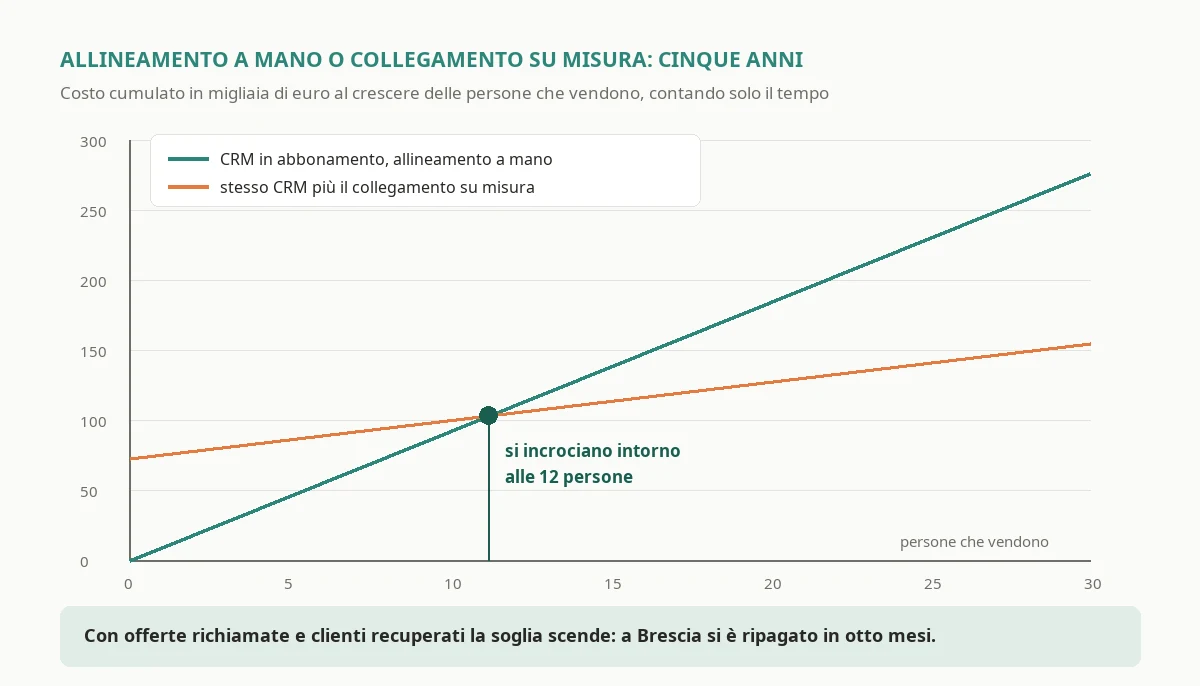
The most useful comparison is between a subscription CRM kept in line with the management system by hand, and the same CRM with a custom link. The subscription cost is the same in both cases, so two things are compared: the time spent aligning data and searching for information, which grows with the number of people selling, and the cost of the custom piece, which is fixed.
With the Brescia company's numbers, the link saved about forty minutes a week for each person selling, between searches in the management system, calls to the office and data copied over. Over five years, counting the custom piece at thirty-eight thousand euros plus its maintenance, the two lines cross at around twelve people selling, sales reps and agents together. Below that, a subscription CRM used with discipline is the better deal; above it, the link pays for itself on time saved alone.
And time alone is the smallest part of the bill. Adding the quotes followed up, the dormant customers recovered and the discounts brought back in line, at the Brescia company the custom piece, which cost forty-four thousand euros including the agent app, paid for itself in eight months. The share of quotes with no follow-up fell from 34 to 9 per cent by value, the overall close rate rose from 24 to 29 per cent and of the nineteen dormant customers from the year before, seven came back. It is not thanks to the software: it is thanks to the fact that every Monday each rep opened a single list, ordered by value, instead of trying to remember where to start.
The route I recommend in most cases is therefore a mixed one: a subscription CRM or the management system module for contacts and activities, and a custom piece for the link with orders, the next action, dormant customers and agents. People use a widespread, well-made tool, data stops being copied and the part that makes money is built around the way the company really sells. How to choose in general between a product and a custom-built system, and what to ask whoever builds it, is something I am happy to discuss: you can reach me from the contact page.
The questions to ask whoever offers you a CRM
If you are evaluating a product, five questions separate those that solve the problem from those that just move it.
How do the orders from my management system get into the CRM, and how often? Ask to see a customer with their order history updated to yesterday. If the answer is "you can import a file", someone will do the alignment by hand, forever.
Can an open quote be saved without a next action? If so, in six months half the quotes will have none.
What does an external agent see, and how much does it cost to give them access? Agents are often half the sales force. If their licence costs as much as an employee's, or if they see everything, the project will start with a limp.
How is a customer who has stopped ordering flagged? If the product does not see orders it cannot do it, and the function that pays most will be left out.
How does the data get out? A CRM that does not expose its data through a documented interface becomes another island, and customer information is the last thing a company can afford to leave locked inside a supplier's program.
Artificial intelligence in the CRM: where it really helps and where it does not
Almost every CRM in 2026 promises an assistant based on artificial intelligence, and it is worth separating what works from what is a demo. I have used language models every day in my work since 2023, and in sales I have seen three uses that pay and two that do not.
Notes that write themselves. An agent who dictates for thirty seconds after a visit, "the buyer wants the new valve series by March, call back after the trade fair", and finds the task created with customer, topic and date, keeps the system up to date. One who has to fill in five fields does not. It is the least spectacular gain and the one that most changes data quality.
The follow-up draft. When a quote reaches its follow-up date, a model prepares a draft email that starts from what the customer asked for, what they have bought in the past and a useful question, not from "I wanted to know whether you had a chance to look at our quote". The rep reads it, corrects it and sends it. At the Brescia company the average time for a written follow-up fell from eight minutes to two, and follow-ups rose accordingly.
The summary before a visit. Latest orders, open quotes, complaints, emails from the last three months: a model summarises them in ten lines, and the agent arrives at the customer knowing that the March batch had a problem. It is the kind of preparation the best reps already do, and the others skip for lack of time.
What does not pay, on the other hand, is the magic contact score, the one that assigns each customer a probability of buying without explaining where it comes from. In a company with two hundred repeat customers the reps know the customers better than any model, and a number they cannot explain gets ignored after a week. The dormant customer check works precisely because it can be explained: "they ordered every twenty-two days, it has been seventy". Nor does the automatic sending of emails to customers without a person reading them pay: the first wrong message sent to an important customer costs more than a year of time saved.
The rule I apply is the same one I use everywhere: artificial intelligence prepares, the person decides. The model writes the note, the draft and the summary; the rep confirms, corrects or discards them. That way the system improves with the corrections, and customers keep talking to people.
Where to start: the first release in ninety days
Whether you choose a subscription, the management system module, a custom piece or a combination, the order in which things are done matters more than the choice. What follows is the plan I use for a company selling to other companies, and it fits in ninety days.
The first two weeks: measurement. Extract the quotes of the last ninety days and the later contacts, and calculate the share of quotes with no follow-up. Calculate the list of dormant customers from the management system. Compare the discounts granted to the same customer for the same items. It costs little and decides everything else, including whether to go on.
Weeks three to six: the link and the next action. Connect customers, terms and orders from the management system to the CRM, and introduce the dated next action rule on every open quote. Each rep has a single list, ordered by date and value. By the end of this phase the Friday quotes file is no longer needed.
Weeks seven to ten: the agents. Give agents an app that does three things well: see the customer with their history, record a visit by voice, see the commissions earned. Nothing more at first. It is the most delicate phase, because agents are not employees and need to be persuaded, not forced: the lever is visible commissions.
The last three weeks: dormant customers and orders. Switch on the nightly check on customers who have stopped, with tasks assigned to the area rep, and link the accepted quote to the order in the management system. From here on data is created only once.
The rest, from follow-up drafts written by the model to summaries before visits, comes later, once the data is there and reliable. A model working on incomplete data writes wrong drafts with great confidence, and the reps stop trusting it by the third.
If the number says it is not your problem
It may be that, once measured, the share of quotes with no follow-up is low, the customers who have stopped are few and already called, and discounts are consistent. That is good news, and it is worth saying clearly: in that case custom CRM software will not give you much money back. A well-used subscription CRM, or the module of your management system, will give you order and visibility, and it is worth the price of a subscription, not of a project.
In that case the bottleneck, if there is one, is almost always elsewhere. If quotes are followed up but the close rate stays low, the problem lies in price, product or the choice of customers who get quotes, and no CRM solves it. If turnover is not growing because new customers are missing, the answer lies in marketing and the network, not in the system that follows the ones you have. And if orders come in but get lost in delivery, the problem lies in the warehouse or in production.
And there is one case where software is not the answer even when the numbers are bad: when the share of quotes with no follow-up is above forty-five per cent because there are too few people selling for the volume of quotes. The system will show it every day with great precision, and nothing will change until someone decides to send fewer quotes to better-chosen customers, or to hire someone to follow them. It is a decision for the owners, not the sales office, and it must be taken before spending a single euro on software.
If you have read this far, you probably have the sales director's Friday afternoon in mind, with the quotes file open and the phone in hand. Before watching any demo, take the quotes of the last three months and look for the first contact after sending for each one: it is two or three hours of work, it costs nothing, and it tells you whether you are buying a tidier list or higher turnover. If the numbers tell you it is worth talking about, you can tell me about your situation from the contact page: from there on decisions become much simpler, and you make them yourself instead of leaving them to the quotes nobody followed up.
Frequently asked questions
It depends on the road. A subscription CRM for a company that sells to other businesses costs between fifteen and one hundred euros per user per month, with a setup from almost zero to ten thousand euros. The CRM module of your management system usually costs between five and twenty-five thousand euros in licences and configuration, plus the fee. A custom piece that sits alongside what you have, with links to orders, a mandatory next action, dormant customer checks and an app for agents, costs between twenty-five and fifty thousand euros, plus fifteen or twenty per cent a year for maintenance. A complete custom CRM system sits between eighty and one hundred and fifty thousand euros.
You calculate the share of quotes without follow-up: of the value of all quotes sent in the last ninety days, how much received no contact from the company in the ten working days after sending. Below ten per cent a simple tool is enough, between ten and twenty-five the problem is one of method, between twenty-five and forty-five a system that remembers on its own pays for itself, above forty-five there are not enough people to follow the quotes. Alongside that, measure how many repeat customers stopped ordering without anyone calling them.
The management system, or ERP, answers the question of what we have sold: orders, delivery notes, invoices, payments, stock. The CRM answers another question: what we are about to sell, to whom, and who is looking after it. They are two views of the same customer, one looking back and one looking forward. For a company that lives on repeat customers the value comes when they talk: the quote starts from the prices and history in the management system, and orders flow back to the CRM to flag customers who change rhythm.
Because nobody knows, at any given moment, which quotes are waiting for a call. Each rep keeps their list in a different place and the following week more urgent requests arrive. In a components manufacturer with 48 people, 38 per cent of quotes had not been followed up within ten working days: those followed up became an order in 31 per cent of cases, those left alone in 12. The remedy is that every open quote has a next action with a date, and every rep has a single list sorted by date and value.
By comparing, for each repeat customer, the time since the last order with their usual interval, that is the median of the intervals between recent orders. When the silence exceeds twice the usual rhythm the customer is dormant, and the area rep receives a task, in order of revenue. A subscription CRM cannot do this on its own because it does not see orders: it needs the link with the management system. In a company with 240 repeat customers, 19 had stopped, and with calls in the first weeks seven came back.
In most cases a mixed road: a subscription CRM or the module of your management system for contacts and activities, and a custom piece for the link with orders, the mandatory next action, dormant customers and the agents' app. Counting time alone, the custom piece pays for itself above twelve people who sell, reps and agents together; with quotes followed up, customers won back and discounts realigned, the threshold drops. Companies selling mostly to new customers often find a suitable product; those living on repeat customers with an agent network much less so.
Leave your details in the form below