What is the number that decides whether event management software will save you money?
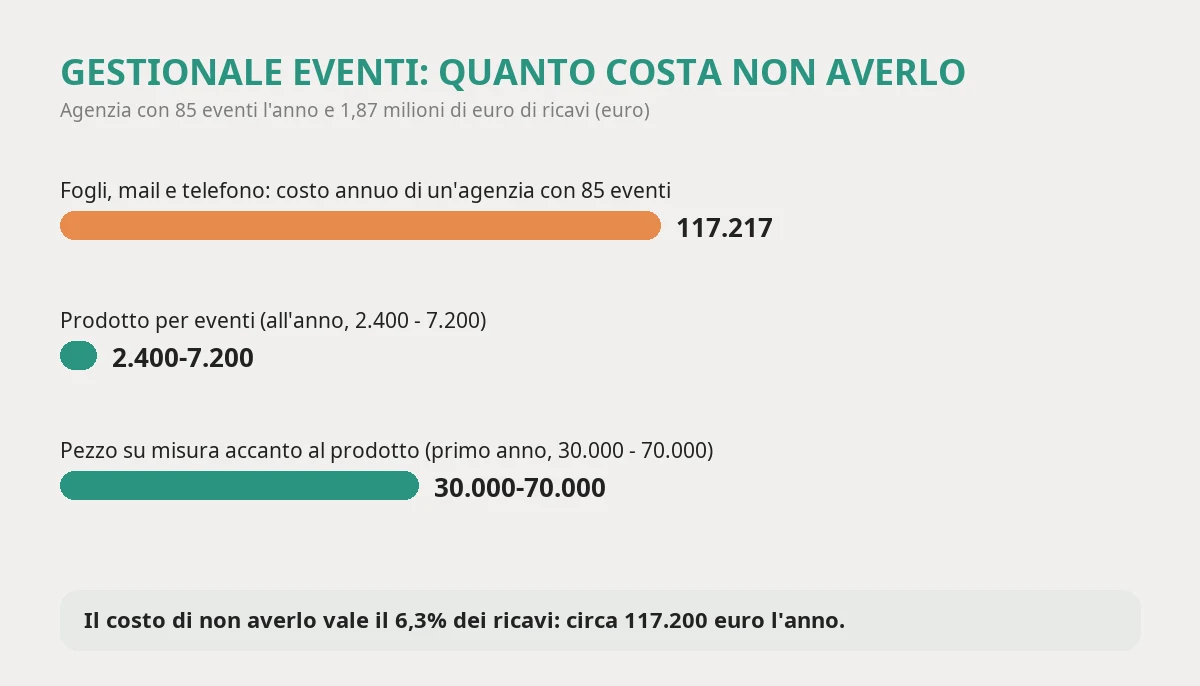
With less than one point a quote template and a shared sheet are enough; between one and three points a product for events pays for itself within the year; above three points management software almost certainly pays. In an agency with 85 events and 1.87 million euros of revenue, the six items of working with sheets, emails and phone calls cost about 117,200 euros a year, 6.3 per cent of revenue. A product costs between 2,400 and 7,200 euros a year, the custom piece between 30,000 and 70,000 in the first year and beats a product above 2.4 million of revenue or with several sites and rules of their own.

It is six in the evening, the day before a convention for three hundred people. In the office of an event agency, a manager sits with three spreadsheets open and a phone in her hand. The quote signed by the client covered two screens, the audio technician, catering for 300 covers and a shuttle. Over the next ten days the client asked for a third screen, an extra room for breaks, a second shuttle run and an aperitif before dinner. Every request was accepted by phone or by email, every supplier named a price, and none of it made it back into the quote. The margin the agency thought it had was 22 percent. On the final cost report, two months from now, it will be a smaller number, and nobody will be able to say exactly where it went.
Event management software exists to remove that afternoon. But not every agency needs it, and those that do often buy the quoting tool first and discover later that the problem sat downstream. In this article you will find what the term really means, the number that tells you whether you need it, what it costs each year not to have it, how quote, suppliers, resources and invoices are held together, when a ready-made product makes sense and when to build something, and where artificial intelligence helps without doing damage.
An honest premise: I have been building software for companies since 1999, and I know the event business through clients who work project by project, with a small team, many suppliers and a date that does not move. The case I use throughout the article is a typical agency, built from orders of magnitude I have seen in similar projects and from industry averages. These are not a client's data and I do not want to pass them off as such. They are there to show the method, and you can redo the method with your own numbers in one afternoon.
What event management software is, and what it is not
Event management software is a system that keeps in one place the things an agency, a catering company or a technical service company touches every day: the quote and its versions, the cost budget, supplier orders, the people and equipment assigned to each date, deposits and invoices, and the final cost report. The value is not in any one of these functions alone. It is in the fact that each one reads what the others have written, so that when a line of the quote changes, the budget, the supplier order and the margin forecast change with it.
It is not a quoting program. That produces a nice document to send to the client, and it is useful, but on its own it does not know that the third screen costs the agency 780 euros and that nobody put it on the invoice. It is not an invoicing program: it issues electronic invoices and nothing more, and it usually ignores deposits tied to event milestones and costs that arrive from suppliers after the fact. It is not even the spreadsheet with one sheet per event, which works very well as long as there are three events in progress and one person writing in it, and stops working the day there are twelve events and four people.
You can feel the difference with one question: "on this event, right now, how much margin do I have left?" If the answer requires opening the quote, three supplier emails and the cost sheet, and trusting the memory of whoever followed the job, what you have is a set of tools, not a management system. That is not necessarily bad. An agency that runs eight events a year, all with the same two suppliers, can live perfectly well with a quote template and a shared spreadsheet, and further on you will find the threshold below which nothing else pays off.
The term covers different trades, and it helps to tell them apart. A corporate event agency sells a project and buys everything outside: venue, technical equipment, catering, hostesses, transport. Catering and banqueting sells menus and staff, and its problems are quantities, raw materials and shifts. Technical services and staging rent equipment and crews, and their problem is that the same spotlight cannot be in two theaters on the same night. Whoever runs trade fairs and conferences also has registrations, spaces, speakers and sponsors. The right system for each is different, and a product designed for weddings rarely holds up at a conference.
What if you already have a management system?
This is the most common case, and the answer is almost never "throw it away". Before changing, measure what it does and what it does not do. If your system keeps the budget updated when the quote changes, warns you when a resource is assigned to two events on the same day, and produces the final cost report without retyping, the problem is not the tool but how it is used. If instead every answer requires an export and a spreadsheet, you have an archive, not a management system. In that case the cheapest route is often a small piece next to what you have, one that reads the data and produces the list of open jobs and the margin of each, without touching cash and accounting.
One last calculation, which sellers do not make: the cost of changing your mind. A product can be left with a data export and a month of annoyance. A custom piece has an owner, and that owner is you. Before signing any contract, ask how you export the customer registry, quote history, supplier archive and final cost reports, and in what format. It is the question that separates a vendor who treats you as a customer from one who treats you as a hostage.
Why does an event's margin vanish between the quote and the final cost report?
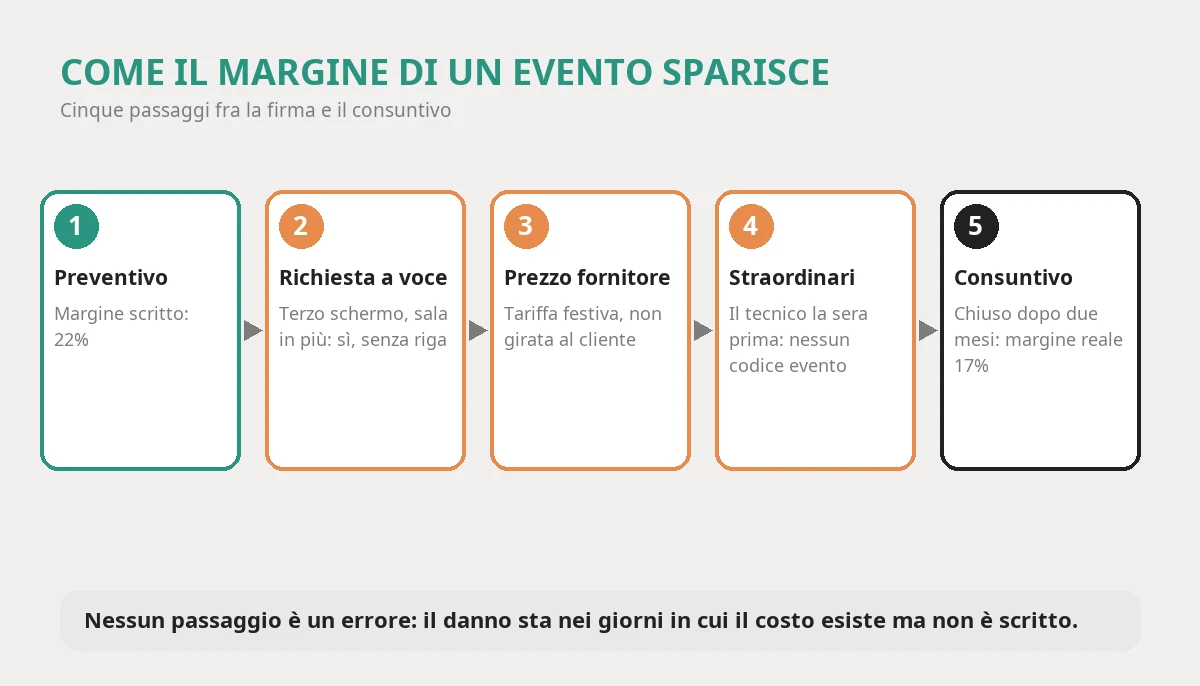
It vanishes because an event is not a product with a list price. It is a project that is partly decided in the days after signing, and every decision has a cost that falls on the organizer. No single step, taken alone, is a mistake: the client asks, the agency obliges, the supplier names a price. The damage lives in the gap between one thing and the next, in the days when the cost exists but is not yet written down anywhere.
The first gap is between the request and the change order. The client phones and asks for something extra. Whoever answers says yes, because it is a good client and the date is getting close, and makes a note. If the note does not become a line of the quote with a price, that yes is a gift. In the typical case, in 32 events out of 85, at least one change order was agreed verbally and never invoiced, for an average of 640 euros.
The second gap is between the supplier's price and the client's price. The audio technician asks for a night shift, the rental company applies the holiday rate, the shuttle runs an extra hour. These are real costs, they arrive after signing and end up in a budget that nobody compares with the quote. The third gap is in resources: the same crew, the same van or the same room assigned to two nearby dates, which turns out to need duplicating at an emergency cost. The fourth is in closing times: the final cost report is done when all the supplier invoices have arrived, that is, two months later, when the agency is already deep into five other events.
None of these errors has a culprit, and that is why they cost so much. A system that only prints a quote does not see them. One that keeps a single record per event, with the quote, the budget and the assignments linked together, brings them to the surface one by one, each with a line and an amount. The rule I use with clients is simple: if answering "how much margin do I have left on this event" takes more than ten minutes and more than one person, the margin is not under control.
How much does it cost each year to run events with spreadsheets, emails and phone calls?
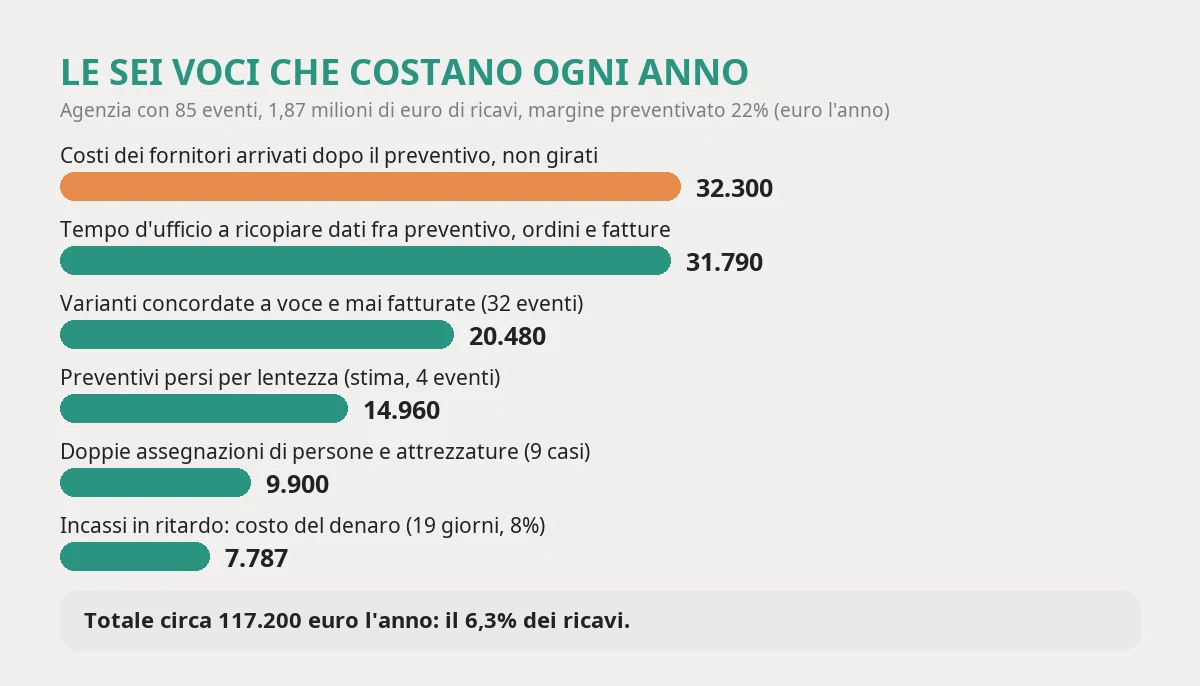
You calculate it in six items, each measurable with data the agency already has. The typical case is an agency with nine people that runs 85 events a year, corporate and high-end private, with an average revenue of 22,000 euros per event. That makes 1.87 million in revenue. The budgeted margin is 22 percent of revenue. The direct cost, meaning what goes through suppliers, is about 1.46 million. Each event involves eleven suppliers on average, and the office sends about 260 quotes a year, of which one in three becomes an event.
The first item is change orders agreed verbally and never invoiced: 32 events at 640 euros, or 20,480 euros. It is the most underestimated item, because it leaves no trace: no invoice, no cost you can point a finger at, just a margin lower than expected. You measure it by taking the last ten events and counting the lines of the final cost report that were not in the signed quote.
The second item is costs that suppliers sent after the quote and that the agency did not bill back: extra rentals, holiday rates, overtime, shuttle hours. They average 380 euros per event, or 32,300 euros. These are not change orders requested by the client. They are side effects of real work, which the quote had not foreseen and which nobody had time to pass on.
The third item is office time. For every event, someone copies the quote into the cost sheet, the sheet into the supplier orders, the orders into the staffing plan, the plan into the invoices and the invoices into the final cost report. That is about 11 hours per event, at a cost of 34 euros an hour, for 85 events: 31,790 euros. It is the time of capable people, used to do the photocopying.
The fourth item is quotes lost to slowness. If the quote goes out after four days, some of the clients have already chosen another agency. In the typical case that is four events out of 260 quotes, with a margin of about 3,740 euros each: 14,960 euros. It is an estimate, and I flag it as such: you only know your own share of quotes lost to delay if you ask the clients who said no.
The fifth item is double bookings: the same technician, the same van or the same room promised to two events on the same date, discovered late and fixed with an emergency rental or a supplier paid double. Nine episodes a year at 1,100 euros: 9,900 euros. The sixth item is the cost of money: deposits and balances invoiced late, on average 19 days after they should have gone out, on 1.87 million in revenue and at a cost of money of 8 percent: 7,787 euros.
The sum is about 117,200 euros a year, or 6.3 percent of revenue. I have tested this against several criteria, and the rule of thumb I took from it is this: below 2 percent the disorder is an annoyance and not a priority, between 2 and 4 it is worth a careful look, above 4 you almost certainly need something. In this case, 6.3, it is not an annoyance. It is more than three salaries.
Two caveats. Not all items are recoverable: no system gives you back the 117,200 euros, and anyone who promises it is selling you something. What a good system recovers, in projects I have seen, is between 40 and 70 percent, because unwritten change orders and costs not passed on can only be recovered if there is a place to write them down right away, while quotes lost to delay depend on the market. And the items must be recalculated with your numbers: if your events are few and large, the first weighs more; if they are many and small, the third does.
What is the number that decides whether you need event management software?
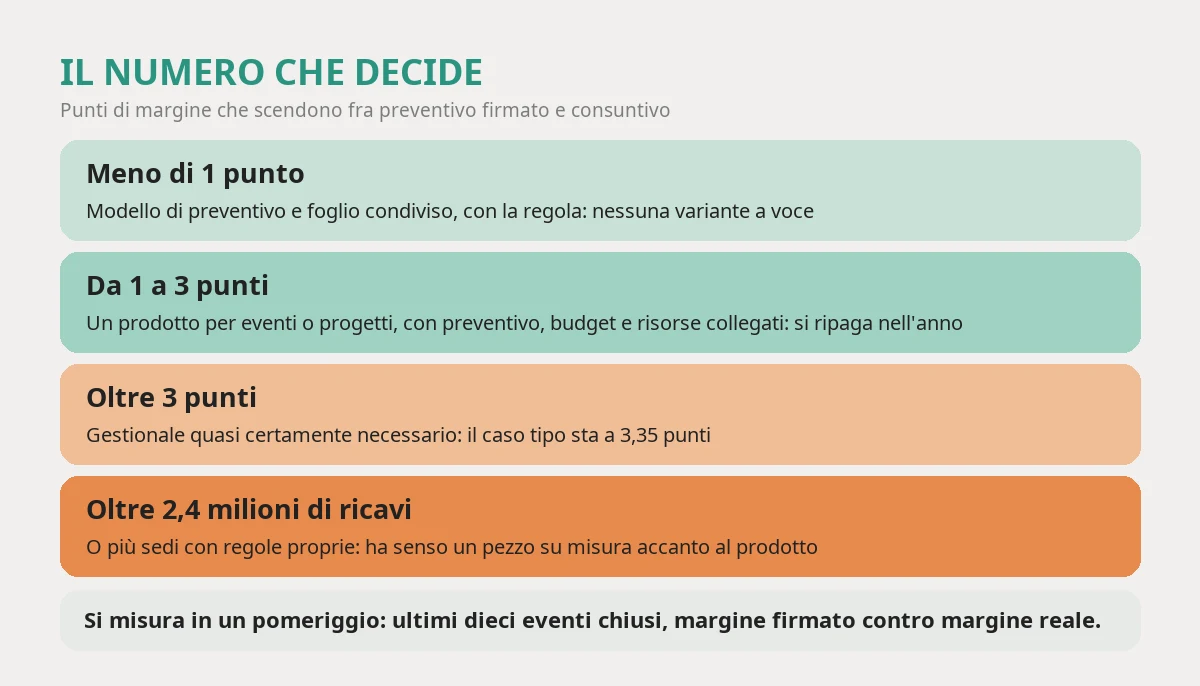
It is not how many events you run. The deciding number is how many margin points are lost between the signed quote and the final cost report: the difference between the margin you wrote down on the day of signing and the one you find at closing, calculated on a sample of real events. The reason is simple: the margin points that disappear are the sum of everything a management system should see, namely unwritten change orders, costs not passed on and wrong resources. If the margin drops a little, the process holds even with poor tools. If it drops a lot, no spreadsheet will save you.
In the typical case the budgeted margin is 22 percent, and the average margin on the final cost report is 18.65. The gap, 3.35 points, matches the three heaviest items (uninvoiced change orders, costs not passed on, double assignments) divided by revenue. You measure it like this, in one afternoon: take the last ten closed events, set the margin of the signed quote next to that of the final cost report, and average the gap, weighted by revenue.
I use four thresholds. With less than one point of gap, a well-made quote template and a shared spreadsheet with a written rule are enough: every client request goes into the quote as a line before it is accepted. Between one and three points, a product for events or projects is worth it, with quote, budget and assignments linked: it pays for itself within the year. Above three points, a management system is almost certainly necessary, and the question becomes which one. Beyond 2.4 million in yearly revenue, or with several locations, divisions or rules of their own, a piece built to measure next to the product starts to make sense.
For those who love numbers, here is the extraction I use when the client has a management system or a quote database. It is an example query: the table names are made up, the method is not. For each event closed in the last year, it gives the signed margin, the actual margin and the gap in points.
SELECT
    e.Codice,
    e.Cliente,
    e.RicavoFirmato,
    ROUND(100.0 * (e.RicavoFirmato - p.CostoPreventivato) / e.RicavoFirmato, 1) AS MargineFirmato,
    ROUND(100.0 * (e.RicavoFatturato - c.CostoConsuntivo) / e.RicavoFatturato, 1) AS MargineReale,
    ROUND(
        100.0 * (e.RicavoFirmato - p.CostoPreventivato) / e.RicavoFirmato
      - 100.0 * (e.RicavoFatturato - c.CostoConsuntivo) / e.RicavoFatturato, 1) AS ScartoInPunti
FROM Eventi e
JOIN (SELECT EventoId, SUM(Importo) AS CostoPreventivato FROM BudgetRighe GROUP BY EventoId) p
    ON p.EventoId = e.Id
JOIN (SELECT EventoId, SUM(Importo) AS CostoConsuntivo FROM FattureFornitori GROUP BY EventoId) c
    ON c.EventoId = e.Id
WHERE e.Stato = 'Chiuso'
ORDER BY ScartoInPunti DESC;
If you have no database, the same calculation can be done with a spreadsheet and ten rows. The number that comes out is not a grade: it is a threshold. And like all thresholds it has another side, which is the map of where the gap falls. In almost every case I have seen, two or three types of event cause more than half of the damage, for example weddings with many different suppliers or conferences with rooms that change. Knowing where the gap falls is already half the cure.
And the other two numbers?
There are two that go with the first, and that you will find in this article as a cross-check. The quote turnaround time, meaning the days between the client's request and the sending of the document: above three days, for events decided within two weeks, you lose work. And double bookings discovered late: more than three episodes a year say that the resource calendar is not shared. With a low gap and these two numbers in good shape, change nothing.
How should an event record that holds everything together work?
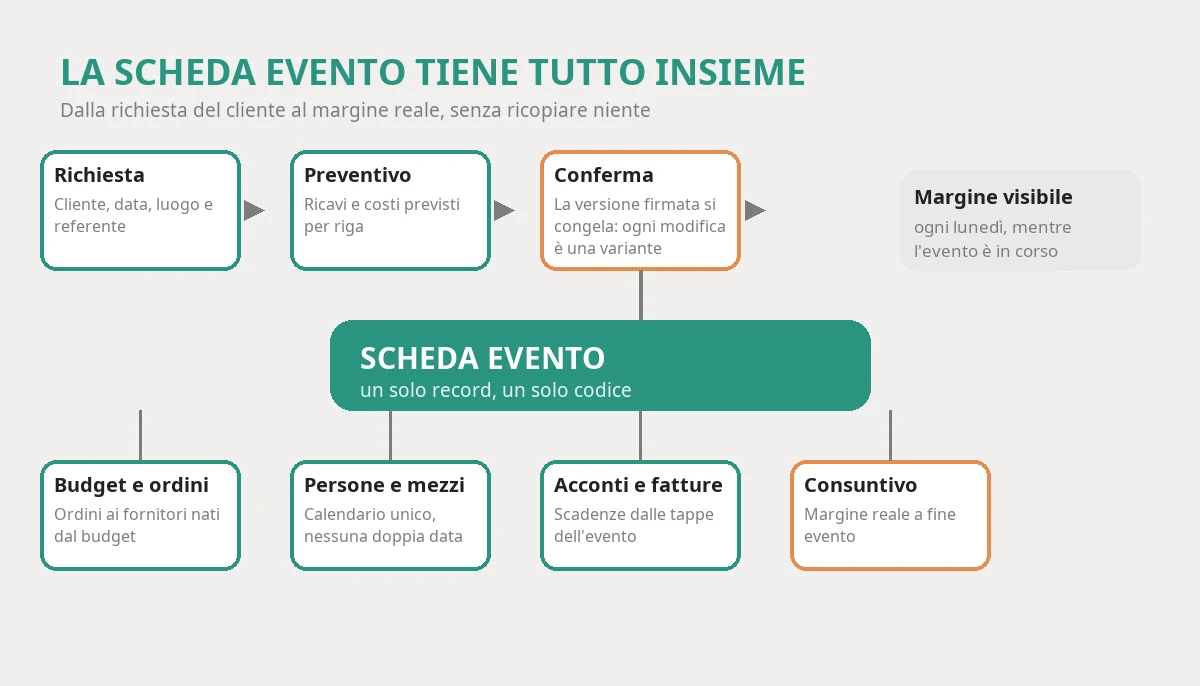
The heart of a good system is one thing: the event record. A single record that is born with the client's request and runs through the whole cycle, without anyone having to copy data from one place to another. All the other functions start from the record, and all the data comes back to it. If a system has ten menus but no record where you can find the whole event, you do not have a management system, you have ten programs in the same container.
The path is linear and can be told in six stages. In the first, the client's request becomes a quote: a numbered version, with revenue lines and, next to them, the expected cost lines for each. The client sees the price, the agency also sees the margin. In the second, at signing, the accepted version is frozen and becomes the reference: from then on every change is a change order with a number, a date and an amount. In the third, the cost lines become the event budget and, from there, the supplier orders, which are born already carrying the event code and the agreed price.
In the fourth, people and equipment are assigned, and the system checks that no resource is already committed on the same date. In the fifth, deadlines are set: deposits tied to milestones, the balance invoice, supplier terms. In the sixth, when the event is over, the system compares the quote, the budget and the invoices received, and produces the final cost report without asking anyone to fill it in. What was a week of work for the typical-case agency is, in a well-made system, a page that opens.
For this to work you need three rules, which are process choices before they are software. The first: no cost exists without an event. An order, an invoice or an hour of overtime without the event code is an orphan cost, and orphan costs are where margin goes to die. The second: no change order exists verbally. If the client asks for something, the request enters as a change order before it is accepted, even if it is five minutes of work and fifty euros. The third: the margin is visible to decision makers while the event is in progress, not two months later.
How much information do you really need?
Less than products ask for. An event record that asks for forty fields does not get filled in, and empty fields are worse than missing fields. The information that is always needed is eight items: client, date and place, contact person, accepted quote version, revenue lines, cost lines with supplier, people and equipment assigned, collection deadlines. The rest is added when there is a question to answer. The test for whether a field is needed is one: will someone, sooner or later, have to make a decision by looking at it?
How do you avoid double bookings of people and equipment?
You avoid them with a single resource calendar, which reads the assignments from the events and not from a parallel spreadsheet. It sounds obvious, and it is the point where most errors are born. An agency's resources are of three types: agency people (project managers, hostesses hired by the day), equipment owned or rented (screens, lights, speakers, structures) and supplier capacity (the caterer that can handle only one large event per evening). For each one the system must answer a question: "is it free on this date, at this time, in this place?"
The hard part is that availability is not just the date. A technician who finishes at two in the morning in Verona is not available at eight in Milan, even if the two events are on different days. A structure dismantled on Friday evening is not free on Saturday morning in the middle of assembly. A good system takes into account setup, transfer and teardown times, and not only the day written in the contract. In a standard product this is rare; in a custom piece it is a rule of a few lines, and this is where the comparison changes.
The second point is the difference between a confirmed resource and a pre-assigned one. Between the request and the signing, the agency holds people "on option" so as not to lose them, but cannot block them forever: you need an option expiry that frees the resource if the client does not sign. Without this rule the calendar fills with events that will never happen, and the agency says no to real jobs to protect hypothetical ones. In the typical case, options that expired without being released cost the agency about three events a year, a figure nobody had put on the books.
The third is the daily plan: the list, for each person, of where they must be, at what time, with whom and with what material. When it exists, it lives in an email that nobody updates. When the system produces it from the assignments, it is printed the day before and you know who changed what. For a technical service company, which moves crews, trucks and loads, it is the function that most often decides whether a management system is worth its cost.
How do you manage suppliers without losing the agreed price?
You manage them by treating the supplier as part of the event and not as an address book. An agency has two types of supplier: those it always uses, with a price list and a relationship, and those it finds for one event, for which it asks three quotes. The system must serve both well, and the difference lies in the data you keep: for the first, the price list, for the second, the history of offers, so next time nobody starts from scratch.
The function that really saves money is simple: the supplier order is born from the budget line and is not rewritten. The agreed price is the same one found in the internal quote; when the supplier invoices, the system compares invoice and order, and flags the difference before payment. In the typical case, 14 percent of supplier invoices arrived with a figure different from the order, by more than a hundred euros. Nobody meant to cheat: they were holiday rates, extra hours, travel. But as long as the difference does not surface within a few days, nobody passes it on to the client, and it becomes the second item in the calculation.
Another useful thing is the review after the event. A supplier who was late, changed the price or sent a substitute leaves a trace in the system, with a line and a date. After a year, the question "who do we like working with?" has an answer based on facts and not on the memory of whoever was there. You do not need a complicated scoring system: three fields are enough, punctuality, quality and respect for the price, with a free note.
Finally, documents. For an agency that brings people and equipment to places open to the public, every supplier has paperwork: insurance, qualifications, the single certificate of contribution compliance, safety appointments. If they expire in a drawer, a supplier with an expired document enters an event without anyone knowing. A system that flags the expiry of documents for suppliers used in the next thirty days removes a risk that has no price, because when it materializes someone else sets the amount.
How do you turn client requests into change orders that get invoiced?
You turn them with one rule and a one-minute form. The rule is the one I wrote above: no change order exists verbally. The form is a single line with four data points: what the client asked for, what it costs the agency, how much you propose to charge, who accepted it. Nothing else is needed. If the system makes it possible from the phone, in thirty seconds, the rule holds. If it requires opening a program and searching for the record, the rule lasts a week.
For the client to accept, the change order must be visible to them and not only to the agency. A short message with the description, the price and a confirm button is enough to turn a request into a commitment. It is the part clients appreciate most, contrary to what agencies fear: nobody is offended by an amount in writing, and many prefer to know in advance. In the typical case, change orders written and confirmed on the same day went from one in three to eight in ten in two months.
Then there is the matter of costs that cannot be passed on. Not everything that arises after signing can be billed back: if the client signed a fixed price, a supplier delay or an agency error stays with the agency. The system does not solve the commercial question, but it makes it readable: every cost outside the quote has a label, "client change order", "our error", "unforeseeable event", and at the end of the year you can see what each is worth. Almost always, the "our error" item is smaller than feared and easier to reduce than believed.
One last effect, which I always see, concerns starting prices. When the agency discovers, after three months, that out-of-town transport costs on average 18 percent more than it had written, the line in the price list changes. It is the most underrated function of a well-made final cost report: it is not there to check the last event, it is there to write the next quote better.
How do you invoice deposits and collect on time?
You invoice by tying each deadline to a fact of the event. An event usually has a deposit at signing, a second one before the date and a balance afterward. If the deadlines live in one person's head or in a calendar reminder, the average delay of 19 days in the typical case is normal, and it costs about 7,800 euros a year in interest. If the system generates them from the accepted quote version, the deposit invoice is ready on the day it is due and goes out with one click.
The rules are few. The invoice is born from the record, with the lines already written, and is not retyped in another program. The balance accounts for change orders: if three were accepted, the total includes them. Amounts already collected appear in every version, and the client never receives an invoice whose sum they cannot reconstruct. For clients with several events, the same scheme applies to a cumulative invoice at the end of the month. The system talks to the accounting program through a file or an integration, and does not replace it: accounting has its own rules, and an event management system should not rewrite them.
For those who work with public bodies or large companies, add two things. The tender code or purchase order goes on the electronic invoice from the start, because an invoice rejected for a missing field is a collection that slips by thirty days. And the collection plan must be visible together with the plan of payments to suppliers: knowing that in June 180,000 euros go out for three events and 120,000 come in is the kind of cash forecast that saves a quarter.
The final check is on margin while the work is in progress. Not only at closing, but every Monday: for open events, the signed margin, the cost already incurred, the cost still to pay and the expected margin. An agency that looks every week at four lines like "Rossi event, signed 22, expected 19.5" knows where to step in while it is still possible. The day after the event is too late.
What changes between agency, catering, technical services and conferences?
The center of the system changes, which is why the product "for everyone" works badly for each. For the corporate event agency the core is the relationship between quote and final cost report, with many suppliers and little merchandise: you need quote versions, change orders, supplier orders and margin while work is in progress. For weddings and private events, with clients who decide on emotion and change their minds until the week before, traceability of requests and clarity toward the client weigh more.
For catering and banqueting the center is quantities. The number of covers changes until the last day, recipes lead to an ingredient list, the list to supplier orders, and staff hours to a shift. Here the system must talk to the warehouse and to attendance records, and the margin is decided in the kitchen: a 5 percent error on quantities is worth more than a forgotten change order. Those who work this way find a system born from the restaurant more useful than one born from the agency.
For technical services and staging the center is equipment and crews. The warehouse is not a stock of goods for sale, it is a fleet of assets that go out and come back, with maintenance, a serial number and availability by date. The dominant question is "what do I have available on the fifteenth, and in what condition?", and the system is closer to a rental management system than to a project one. If this is your case, the piece you are missing is called availability by date with return times.
For those who organize trade fairs, conferences and courses the center is the people who register: attendees, speakers, sponsors, spaces. Here come online registrations, payments, badges, entrance checks and certificates. The problem is that the audience is part of the product, and a system not designed for the registrations of a thousand people gives way in the hours when it is needed. For this type of business the comparison with specialized products must be done with total honesty: they are often already good enough, and it is best to build only the bridge to accounting.
One observation useful for everyone: trades differ more in how they sell than in how they work. Whoever sells a project at a fixed price carries the quote risk, whoever sells on actuals carries the risk of a client who disputes, whoever rents carries the risk of the asset that does not come back. The management system must protect you from your risk, not from a generic one. That is why, before looking at features, ask yourself where you lost money in the last twelve months.
How much does event management software cost: product, project system or custom?
It costs much less than not having it, and the difference between the routes comes down to two numbers. A product for events or projects usually costs between 2,400 and 7,200 euros a year for a team of nine people, with a setup between 1,000 and 4,000 euros to import clients, price lists and suppliers. A broader management system, with warehouse and rental, registrations and a client portal, runs between 7,000 and 15,000 euros a year. A custom piece next to a product, which handles the rules no product knows, costs between 30,000 and 70,000 euros in the first year and about 15 percent each year afterward, for maintenance and small changes.
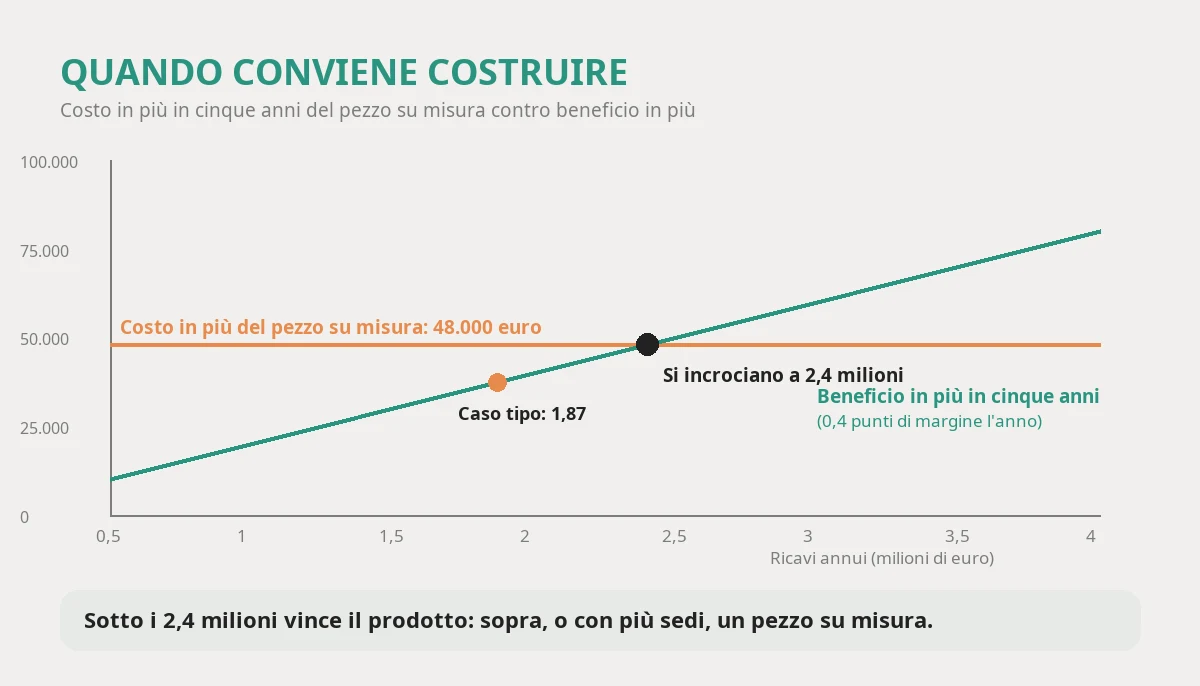
The comparison for the typical case: the product costs 4,800 euros a year plus 3,000 for setup, which is 7,800 euros in the first year. The benefit, even if only 40 percent of the six items is recovered, is about 46,900 euros. The payback comes in under two months. The custom piece costs about 72,000 euros over five years, against 24,000 for the product: 48,000 euros more. To justify it, it must recover, on top of what the product recovers, at least those 48,000 euros over five years, or about 9,600 euros a year.
How much more can it deliver? It depends on how different your rules are from the product's. In my experience, a system built around your way of working recovers about 0.4 more margin points than a standard product: pricing rules per supplier, assignments with setup times, integrations with accounting and with your channels. Take it clearly as a hypothesis, and verify yours. With 0.4 points, the custom piece yields 9,600 euros a year when revenue is 2.4 million. Below this threshold the product wins; above it, or with more divisions, commercial rules of your own and volumes that make every point count, the custom piece starts to win.
The typical case, with 1.87 million, sits below. That means for that agency the reasonable choice is a product, perhaps with a small bridge to accounting for about 5,000 euros. But if the same agency grows its revenue or opens a second location with different rules, the calculation changes, which is why the threshold should be rewritten every year. It is best to repeat it always with the same criteria: so as not to change your mind for fashion, but for numbers.
What if the product "almost" fits?
It is the most common situation, and the one where a small piece next to the product pays more than a large one in its place. A real case: an agency that uses a good product for quotes and invoices but cannot see the margin while work is in progress, because supplier costs arrive from accounting two months late. The solution is a view that reads orders and invoices received, attributes them to the event and shows the expected margin every morning. Cost: a small application that reads the data and produces a page. Benefit: the "costs not passed on" item falls within a few weeks. This piece is not a management system, it is a dashboard on the system you already have, and it is often the right answer.
Where artificial intelligence helps in event management software, and where it does not
It helps where it prepares work for a person who then checks it, and it must never decide on its own where the agency's money or its clients' data are involved. In the events world the line is clear, and it is worth drawing it before buying anything that promises miracles.
It can write the first draft of a quote starting from a client request and from similar quotes already done: a structure of lines, with proposed amounts, which the manager corrects. It can summarize the emails of an event into a tidy record, with decisions made, things to do and deadlines. It can compare supplier offers by putting the same items in columns and flagging that one is out of line with the others. It can prepare communications to attendees, notices of schedule changes and answers to frequent questions, in several languages, as drafts to be read. And it can flag an anomaly: an event with an expected margin much lower than others of a similar type.
It must not set prices for the client by itself or accept a change order in its name. It must not decide a refund, a change of supplier close to the event or the outcome of a complaint: these are decisions with a face, which need someone who answers for them. It must not even read attendee lists, allergies or documents on an external service unless the vendor has been named and regulated: the attendee list of a convention contains personal data, and a caterer's often contains health data.
The criterion for every "intelligent" function is just one: who answers for the error? If the answer is "a person who checked", it is fine. If it is "nobody, the system decided", it is not. An artificial intelligence service that receives names, emails and information about guests is a vendor that processes personal data, and must be regulated as such. The less data you put in the hands of an external tool, the less you have to explain, and it is worth remembering this for anyone who, close to an event, wants to go fast.
Which mistakes should you avoid, and where do you start in thirty days?
There are six mistakes, and I have seen almost all of them more than once. The first is buying the quoting program before measuring: you choose the prettiest document and later discover that the margin was lost downstream. The second is importing everything as it is: duplicate clients, old price lists and suppliers no longer used enter the new system and make it unreliable from day one. The third is not naming a person: a management system without an owner who updates it and checks the margin every week gets old in three months.
The fourth is not changing habits. The system is only as good as the person who enters the change order: if people keep saying "fine, I'll write it down later", the data does not exist and the margin drops anyway. The fifth is starting in the worst month: the corporate event season, with ten jobs open at once, is not the time to try a new system. The sixth is not testing plan B: what does the office do if the system does not respond for an hour on the day of the event? A printed page with the contacts of suppliers and crews for the three events of the week is worth more than a support contract.
Where to start, in thirty days, is this. In the first seven you take the last ten closed events and calculate the gap between signed margin and actual margin, marking which data are measurements and which are estimates. In the second week you ask whoever runs the events to write every change order in a column of the spreadsheet, to see how many there are and what they are worth. In the third you ask two or three products for demos, bringing a real quote and a case of a change order close to the event. In the fourth you choose, ask how the data is exported, and set the start for a quiet month.
If after six months the gap has not dropped, the fault is not the program's, or not only: someone is still writing change orders outside the system. That is why the measurement is repeated, with the same method, and written where everyone can see it. A system that costs five thousand euros a year and returns forty or fifty thousand in margin is a result you can see, and one that those who achieved it show with pride to their accountant.
And if the number says it is not your problem?
It may be that, once you measure, the gap is under one point, double bookings are rare and quotes go out in one day. That is good news, and it is worth saying clearly: in that case you do not need event management software, or you need a well-made quote template and a shared spreadsheet, and whoever tells you otherwise is selling you something.
In that case the bottleneck, if there is one, is almost always elsewhere. If events are many but profits do not grow, the problem is the starting price: you are selling at a fixed price things that cost more than you think, and a program will not price them for you. If clients do not come back, the problem is the relationship with them, and there you need a good CRM system, or simply a phone used more often. If you are always at the event and never in the office, you do not need a system: you need one more person, and then the system.
And there is a case where software is not the answer even with ugly numbers: when low margins come from a product the market no longer pays for. An agency that runs the same events as ten years ago, at prices clients no longer recognize, does not have a management system problem, it has an offer problem, and the margin gap is only the thermometer that signals it.
If you have read this far, you probably have your own afternoon before the convention in mind. Before looking at any demo, take the last ten closed events and compare the margin of the signed quote with that of the final cost report. Then look at how many days pass between the client's request and the sending of the quote. If the gap is over three points, if you discovered more than three double bookings late, or if the final cost report depends on who is in the office, you already have your answer. The rest is a project, not a product choice.
If you want a second look at your case, the way is software consulting, and it covers the case where the right solution is a piece built around your way of working, for a network of locations, a group with several brands or an offer that no product knows how to sell. For the pieces that surround events, you will also find quote management software, the supplier management system, staff shift software and the restaurant management system for catering.
Frequently asked questions
It depends on the road. A product for events or projects usually costs between 2,400 and 7,200 euros a year for a team of nine, with a setup between 1,000 and 4,000 euros. A broader system, with warehouse, rental and registrations, sits between 7,000 and 15,000 euros a year. A custom piece next to a product costs between 30,000 and 70,000 euros in the first year and pays only above about 2.4 million euros of revenue, or with several sites that have rules of their own.
You count three numbers: the margin points lost between the signed quote and the final result on your last ten closed events, the days between the customer's request and sending the quote, and the double assignments of people or equipment discovered late. With less than one point of gap a quote template and a shared sheet are enough; with more than three points management software almost certainly pays for itself.
Six items: supplier costs that arrive after the quote and are not passed on, office time spent retyping, change orders agreed by word of mouth and never invoiced, quotes lost because of slowness, double assignments of resources and late collections. In an agency with 85 events and 1.87 million euros of revenue they were worth about 117,200 euros a year, 6.3 per cent. Below 2 per cent it is not a priority, above 4 almost certainly it is.
No. Quoting software produces a document to send to the customer. Event management software keeps quote, budget, supplier orders, assignment of people and equipment, deposits, invoices and the final cost report linked in a single event record. The value is that when a line of the quote changes, the budget and the margin forecast change too.
It can prepare the draft, not decide. It helps write the structure of a quote from requests and similar jobs, compare supplier offers, summarise the emails of an event and flag an unusual forecast margin. It must not set prices, accept change orders on behalf of the agency, decide refunds, or read lists of attendees with personal data on an unregulated outside service. The criterion is who answers for the error: it must be a person.
For almost every agency a ready-made product, which already has quotes, budget and invoices. The custom piece pays above about 2.4 million euros of annual revenue, with several sites or divisions, or when you have rules no product knows: prices per supplier, assignments with set-up and transfer times, integrations with your own channels. Otherwise a small bridge between product and accounting, around 5,000 euros, is enough.
Leave your details in the form below