What is the number that decides whether fleet management software will give you anything back?
Under five per cent you are buying convenience, not margin; over fifteen the fleet has no memory and no telematics will replace it. With 86 vehicles and 1.1 million of annual spend, the five costs of a fleet run on invoices and spreadsheets come to around 168,000 euros a year, fifteen per cent of the spend. A product with telematics costs between fifteen and thirty euros per vehicle per month plus setup, a custom system starts at thirty five thousand euros. On five year cost the two roads cross at around one hundred and forty vehicles: below that the product almost always wins, with a custom piece to charge vehicle costs to service calls and jobs.


The head of administration at a heating, plumbing and maintenance company near Padua, one hundred and forty employees and eighty six vehicles, showed me the folder she opens on the fifth of every month. Inside are the invoices from two long term rental companies, the fuel card file, the motorway toll statement, three or four traffic fines with their sixty day deadline already half gone, and a spreadsheet with eighty six rows, one per plate, which she updates by hand. That month, among the rows of the fuel file, there was a ninety two litre refuel on a van with a seventy litre tank. Nobody could say who had been driving it that day, because the van had passed from one technician to another the week before and the handover was not written down anywhere.
If the scene sounds familiar, this article gives you the real cost of a fleet run on invoices and spreadsheets, the single number that tells you whether fleet management software will give you margin back or only a tidier archive, why the heart of the project is not the tracking box but the vehicle master data, what Italian law lets you do with employee vehicle tracking and what it does not, how the problem changes when vehicles are owned, leased or rented, the real price ranges between the rental company's portal, a subscription product and a custom system, and the number of vehicles beyond which the maths changes.
I have been writing software since 1999 and I have seen and built plenty of systems that follow vehicles, people and costs: installation companies with fifty vans leaving every morning loaded with parts, service companies with hundreds of assigned cars, distributors with their own delivery fleet, construction firms where the same excavator changes site three times a month. I have also built and sold a software product used by many companies, and from the seller's side I learned the thing that applies here too: fleet software is sold by showing the map with moving dots, and it is used or abandoned because of a boring table that never appears in the demo, the one that says who had which vehicle on which day.
What I have learned, and what explains why so many companies fit tracking boxes to every vehicle and a year later still do not know what each van really costs, is this: the number that decides is not how many vehicles you can see on the map, it is how much of your fleet spend you cannot attribute to a vehicle, a driver and a period. Every euro you cannot attribute is a euro nobody can decide anything about: you cannot dispute it, you cannot reduce it, you cannot charge it to a job. If that share is high, a good system brings it down within a few months and pays for itself. If it is already low, what you are buying is convenience, and it should be bought from a different budget.
What fleet management software is, and what it is not
Fleet management software is the system that holds together, for each vehicle, four things that today live in four different places: what the vehicle is and under which contract you have it, who used it and when, what it cost day by day, and what needs to happen to it in the coming months. If one of those four is missing, you do not have a fleet management system: you have a list of plates.
The difference from a tracker is not one of degree, it is one of kind. A tracker records a physical fact: at 10:14 the van with plate GH 214 KL was in via Venezia in Padua, stationary for twelve minutes. A fleet management system turns that fact and a thousand others into economic decisions: that van costs fifty eight cents per kilometre against a fleet average of forty one, its rental contract will end eleven thousand kilometres over, its driver has three fines in the last quarter, and its roadworthiness test is due in twenty two days. You can buy the tracker. You cannot buy the second thing: it depends on data you already have, scattered, that nobody has ever connected.
Telematics, fleet management and transport management: three different things
The confusion here is expensive, because you end up buying the tool for a different problem. Telematics is the tracking box or the connection to the manufacturer's data: position, mileage, fuel use, driving style, engine fault codes. It solves the collection of movement data and does not touch costs. Fleet management software in the proper sense is the system that holds the vehicle, contract and assignment master data, collects every item of spend and attributes it: that is what you need if your problem is knowing what each vehicle costs and why. Transport management software is something else again: it plans deliveries, trips and routes, and it serves companies that sell transport or run it to distribute their own goods. I wrote about it in transport management software, and if your vehicles exist to deliver goods, that is the starting point, not this.
Most small and mid sized Italian companies with a service fleet need the second, get sold the first because the map is impressive and cheap per month, and are occasionally sold the third because the telematics vendor also has a planning module. Before you look at any demo, write a single line: what do I want to stop happening. If the answer is "I want to stop paying invoices I cannot attribute to anyone", you are looking for the second, and the questions you ask suppliers change completely.
The four kinds of fleet that look for it, and look for different things
The first family is technical fleets: installers, maintenance crews, field service, industrial cleaning. Vans full of parts leaving every morning, one regular driver per vehicle, high mileage. The number one problem is that a van off the road also stops the technician, so the big cost is not fuel but downtime. The second is assigned cars for sales people and managers with mixed private use: few operational decisions, a lot of admin, the benefit in kind on the payslip, and fines that reach the company and must be passed on to the driver. The third is pool cars shared by offices and departments: no regular driver, so nobody looks after them, and the number one problem is that you do not know how much they are used. The fourth is site vehicles and registered equipment, from crane trucks to excavators: here the vehicle changes location more often than driver, and the cost must be charged to the site before the person.
All four families type the same thing into Google and find the same ten results, but they only buy well if they have understood which family they belong to. Almost every company has two or three at once: the reference company in this article has fifty two technical vans, twenty two assigned cars and twelve pool cars. A product designed for assigned cars handles the benefit in kind perfectly and has no idea what to do with a van that must go to the garage without leaving an area uncovered for two days. A product born from telematics sees every kilometre and does not know that the vehicle's rental contract ends in March.
The real cost of a fleet run on invoices and spreadsheets

I will take the reference company, the one with the ninety two litre refuel, and keep it for the whole article so the numbers stay comparable. Eighty six vehicles: fifty two technical vans, forty on long term rental and twelve owned; twenty two assigned cars with mixed use, all rented; twelve pool cars, eight rented and four owned. Two rental companies, two fuel card issuers, one toll contract. The vans cover thirty five thousand kilometres a year on average, the assigned cars thirty thousand, the pool cars twelve thousand.
Fleet spend, adding everything up, is around one million one hundred thousand euros a year: just over half a million in rental fees, three hundred and eighty thousand euros of fuel, fifty five thousand of tolls, seventy thousand between insurance on owned vehicles, excesses and damage, forty five thousand of maintenance and tyres outside the contracts, and the rest in fines, road tax and minor items. For a company turning over twenty two million it is the third largest cost after staff and materials. The five costs below do not show up as lines in the accounts: they sit inside that million, mixed with the legitimate spend, and no supplier will ever point them out, because each of them invoices its own part correctly.
Vans off the road when they were needed
This is the big one and the one almost nobody includes in the fleet account, because it does not arrive as an invoice: it arrives as a job not done. A technical van that stays off the road for a day and a half without a replacement does not cost the van, it costs the technician who does not go out, the jobs that slip and, in companies with service contracts, the penalties on response times. The causes are almost always trivial and almost always predictable: the expired roadworthiness test discovered at a roadside check, the service postponed until a warning light forces a stop, winter tyres fitted in late November, the vehicle sent to the garage on Monday morning because nobody looked at the calendar on Friday.
At the reference company the vans had on average two and a half unplanned stops a year, each lasting a day and a half. Across fifty two vans that is almost two hundred lost technician days, which at five hundred euros of margin per day comes to up to ninety five thousand euros a year. Not every stop is avoidable, because breakdowns happen. But when you look at the reason for each one, two thirds have a date written somewhere: in a logbook, in a contract, in a rental company notice nobody read.
Fuel that does not match the mileage
This is the cost everyone suspects and almost nobody measures, because measuring it means putting two files side by side that do not talk to each other: fuel card transactions and kilometres driven. The gap contains everything: the van's card used on the family car, which is rare but happens; premium fuel that costs fifteen cents more per litre and does nothing for a diesel van; the engine left idling to keep the heating on during the break; driving style, which for some drivers is worth twenty per cent of consumption; and the simple mistake of a card linked to the wrong vehicle, which moves the problem from one van to another and makes it invisible.
In fleets where nobody compares litres and kilometres the gap is usually between six and twelve per cent of fuel spend. For the reference company, with three hundred and eighty thousand euros, that is up to forty six thousand euros a year. The fraudulent part is the smallest, and it is worth saying straight away because it changes the tone of the project: almost all of the gap comes from habits and linking errors, not theft. Treating it as a hunt for a thief only makes the data disappear.
Vehicles nobody uses
There are almost always more pool cars than needed, and the reason is understandable: if a car is missing on the wrong day somebody complains, if one is spare nobody does. So the pool grows one car at a time, each one justified by an episode, and nobody ever measures it because there is no booking log: the keys are in a drawer at reception.
At the reference company the twelve pool cars were used on average on thirty one per cent of working days, and on the busiest day of the year seven had gone out. Five cars could be handed back at the first contract end without anyone noticing, and two more could be replaced with short term hire for the trade fair weeks. Between fees, insurance on owned vehicles and maintenance, that is up to fifty eight thousand euros a year. The same reasoning applies to spare vans kept "just in case", which only make sense if you know how many stops you really have.
The rental you pay at return
Long term rental is a reasonable choice for many companies and that is not the point. The point is that the contract has two items you only discover at the end: the mileage adjustment and return damage. The contract is signed with an estimated mileage, usually the same for every vehicle in the same category, and then the vehicles live different lives: a van covering the mountain area does fifty thousand kilometres a year, its twin in the city does twenty five thousand. At return the first pays every excess kilometre at full rate, the second gets the unused ones refunded at a much lower rate, where that is provided for at all.
Then there is the return inspection, which assesses scratches, dents and interiors: without photos at assignment and without damage reports during the contract, you argue empty handed. The reference company returned seventeen vehicles a year and paid on average one thousand six hundred euros of mileage adjustment and one thousand two hundred of damage per vehicle: up to forty eight thousand euros a year. Part of it can be avoided with a move that costs nothing, which I come back to later: swapping vehicles between drivers halfway through the contract to balance the mileage.
Fines, tolls and the office chasing invoices
The last cost falls on the admin office, which is why nobody measures it. Every fine that reaches the owning company or, worse, the rental company that re-notifies it with an admin charge, opens a small investigation: who was driving that vehicle that day at that time. Italian traffic law gives sixty days to communicate the driver's details, and if the company fails to do so an extra penalty is added that often exceeds the fine itself. Then there are tolls to reconcile with the transponders, which move from one vehicle to another without anyone recording it, and rental invoices to check line by line against the contracts.
At the reference company the head of administration spent about seven tenths of her time on this, and the company paid a few thousand euros a year in re-notification charges and penalties for late driver communication. In total up to forty two thousand euros a year. The five costs at their maximum add up to two hundred and eighty nine thousand euros, but they never all peak in the same year: measured one by one at the reference company they came to around one hundred and sixty eight thousand euros a year, fifteen per cent of fleet spend. Look at where the weight sits, though: the two biggest items, downtime and fuel, both depend on the same thing, namely that nobody knows for sure which vehicle was with whom, and what was supposed to happen to it.
The unattributed spend rate: the number that decides
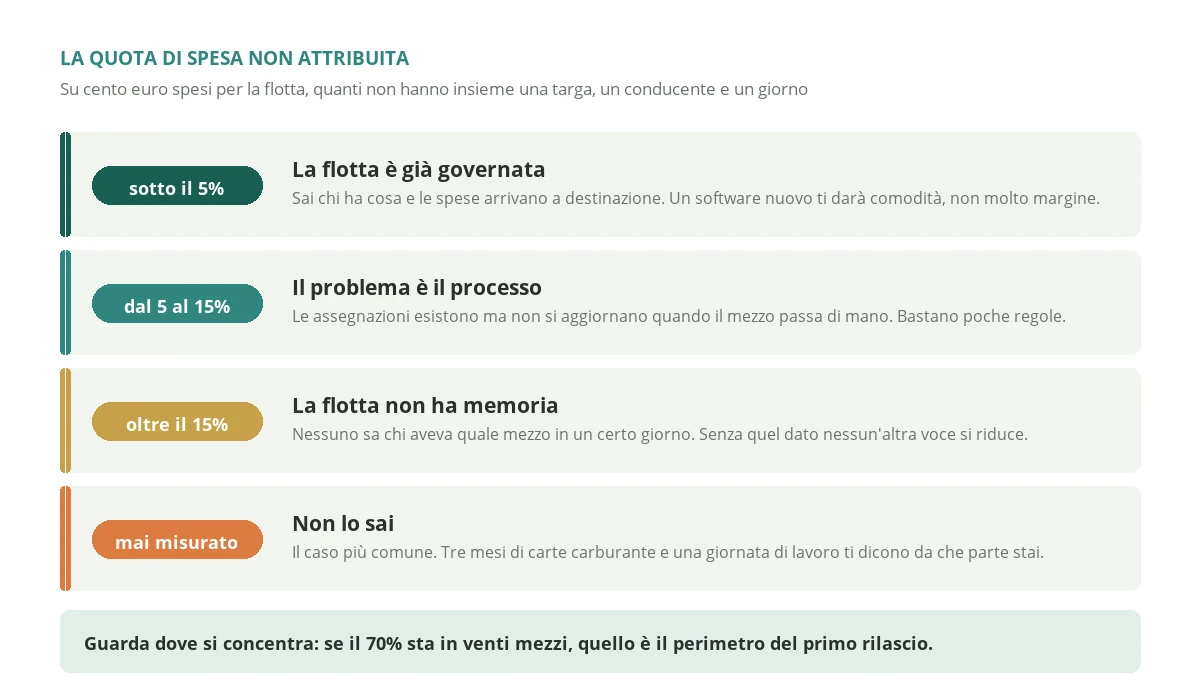
The exact definition, because it is what makes the number useful rather than suggestive: out of every hundred euros spent on the fleet in the last quarter, how many can you not attribute at the same time to a plate, a driver and a day. The plate alone is not enough: a refuel attributed to a van that changed hands that day tells you nothing about who made it. The driver alone is not enough either: a fine attributed to a person on a vehicle that is not assigned to them is an argument, not a fact. You need all three together, and that is exactly what you want to know before buying any system.
How to measure it, in a day
If you already have a system that holds vehicle assignments, even a rough one, the measurement is a query. You need two tables: spend items with plate and date, imported from the fuel card, toll and rental invoice files, and the assignment history with start and end dates. This is the form I use on SQL Server, over three months, because a single month might be the holiday month:
-- Unattributed spend rate: out of a hundred euros spent on the fleet,
-- how many do not have a recognised plate, a driver and a day together
WITH spese AS (
    SELECT s.IdSpesa,
           s.Fonte,              -- 'Carburante', 'Pedaggio', 'Noleggio', 'Verbale', 'Officina'
           s.Importo,
           m.IdMezzo,
           a.IdConducente
    FROM SpesaFlotta s
    LEFT JOIN Mezzo m
           ON m.Targa = s.Targa
    LEFT JOIN Assegnazione a
           ON a.IdMezzo = m.IdMezzo
          AND s.DataSpesa >= a.Dal
          AND (a.Al IS NULL OR s.DataSpesa < a.Al)
    WHERE s.DataSpesa >= DATEADD(MONTH, -3, CAST(GETDATE() AS date))
)
SELECT Fonte,
       SUM(Importo) AS Spesa,
       SUM(CASE WHEN IdMezzo IS NULL OR IdConducente IS NULL
                THEN Importo ELSE 0 END) AS NonAttribuita,
       SUM(CASE WHEN IdMezzo IS NULL OR IdConducente IS NULL
                THEN Importo ELSE 0 END) * 100.0 / NULLIF(SUM(Importo), 0) AS QuotaNonAttribuita
FROM spese
GROUP BY Fonte
ORDER BY QuotaNonAttribuita DESC;
Two details that look like pedantry and are not. The end date condition is open on the right, meaning the day a van changes hands belongs to the new driver, and that must be decided once and for all: otherwise the same refuel ends up with two people or with nobody. And the query returns the rate by source, not a single number, because the causes differ: rental invoices can almost always be attributed to the vehicle and almost never to the driver, fines the other way round.
If assignments are not written down anywhere, as at the reference company, you do not need to digitise anything for the first measurement. Take three months of fuel card statements, ask each team leader who had which vehicle week by week, and mark next to each row whether the answer is certain, likely or unknown. Two people, one day. The uncertainty column is already a result: it tells you which vehicles change hands without anyone recording it.
What each threshold tells you
Under five per cent your fleet is already under control: you know who has what and the spend reaches its destination. New software will bring convenience, continuity when the person who looks after the vehicles changes job, and some fuel savings, but it will not give you much margin. Between five and fifteen the problem is usually not the master data but the process: assignments exist but are not updated when a vehicle changes hands, cards are tied to the person instead of the vehicle or the other way round, toll transponders wander. A few rules fix it, and within a couple of months the number falls. Over fifteen per cent, which is where the reference company sat with its nineteen, the problem is that the fleet has no memory: nobody knows for sure who had which vehicle on a given day, and without that fact none of the other costs can be reduced. If you are here and you install telematics before fixing the master data, a year from now you will have a beautiful map and the same invoices with no owner.
Then look at where it clusters. At the reference company seventy per cent of unattributed spend came from just two groups: the twelve pool cars, which had no departure log, and the ten vans used as spares, which changed driver every time someone went to the garage. Twenty two vehicles out of eighty six generated two thirds of the problem, and that is the right scope for the first release.
The heart of the project is not the tracker, it is the vehicle master data
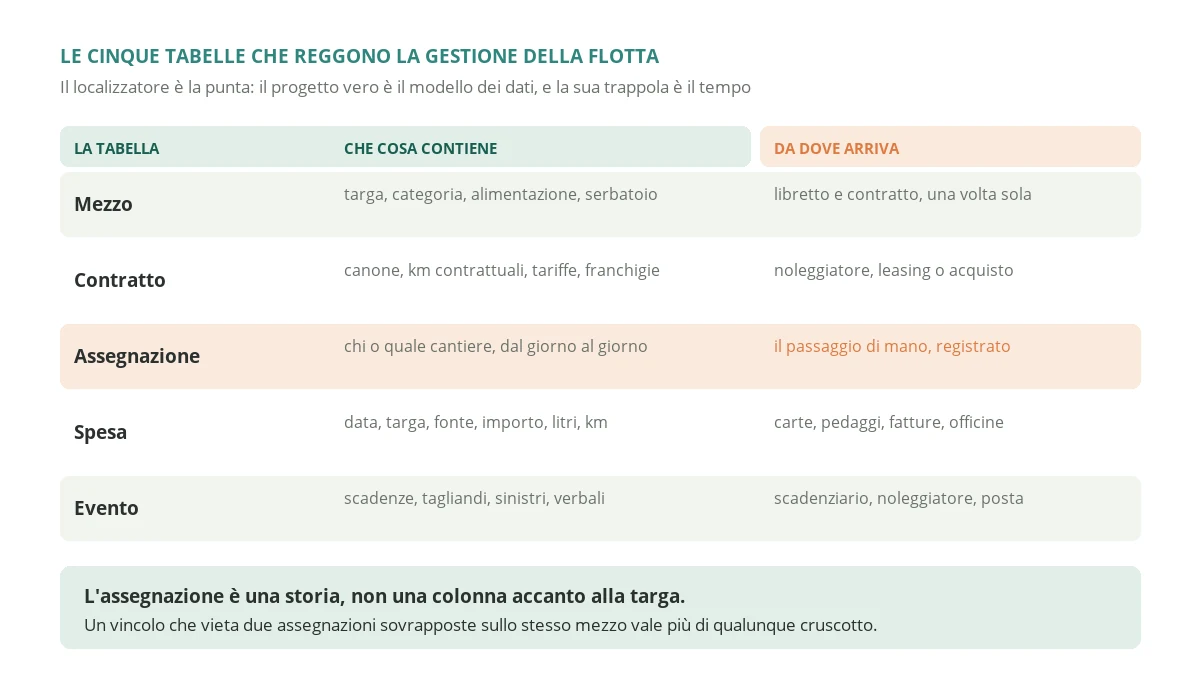
This is the part that pushes most projects past their deadline, and it is also the part no telematics vendor has any interest in raising, because it does not sell boxes. The box is the tip: it takes an hour per vehicle to install and does one thing. The real project is the data model, and the data model of a fleet, simple as it looks, has a trap that almost every spreadsheet and many products get wrong: time.
The five tables, and the one everybody forgets
There are five tables, and they fit on one page. The vehicle: plate, chassis number, category, fuel type, tank capacity, registration date, owned or rented. The contract: supplier, duration, fee, contract mileage, rates for excess and shortfall kilometres, excesses, included services. The assignment: which vehicle to which driver, or to which site, from this day to that day. The spend: date, plate, source, amount, litres, declared mileage. The event: deadlines, services, accidents, fines, returns, with their dates.
The one everybody forgets is the third, or rather they forget it in the right shape. In the typical spreadsheet the driver is a column next to the plate: just one, overwritten every time the vehicle changes hands. It works until a fine from two months ago arrives, and at that point the column tells you who has the vehicle today, not who had it that day. An assignment is a history, not an attribute, and it must be kept as a table with start and end dates, with no overlaps and no gaps. A database constraint that prevents two overlapping assignments on the same vehicle is worth more than any dashboard, because it makes impossible the error that generates half of the unattributed spend.
Fuel checks in twenty lines
Once vehicle, assignment and spend sit in the same place, the checks nobody does today become trivial. This is the core of what I use on fuel card transactions. Just three rules, deliberately simple, because a rule the fleet manager understands gets used and a sophisticated statistical rule gets ignored:
public record Rifornimento(string Targa, DateTime Quando, decimal Litri, int KmDichiarati);
public record DatiMezzo(decimal CapacitaSerbatoio, decimal ConsumoAtteso); // litres per 100 km

public IEnumerable<string> Anomalie(Rifornimento attuale, Rifornimento? precedente, DatiMezzo mezzo)
{
    // 1. More litres than fit in the tank, with a five per cent margin
    if (attuale.Litri > mezzo.CapacitaSerbatoio * 1.05m)
        yield return $"Litres over tank capacity: {attuale.Litri} of {mezzo.CapacitaSerbatoio}";

    if (precedente is null)
        yield break;

    // 2. Two refuels too close together for a vehicle that works one shift a day
    if (attuale.Quando - precedente.Quando < TimeSpan.FromHours(6))
        yield return "Two refuels less than six hours apart";

    // 3. Consumption outside the expected range, computed between two fill ups
    var km = attuale.KmDichiarati - precedente.KmDichiarati;
    if (km <= 0)
    {
        yield return "Declared mileage not increasing";
        yield break;
    }

    var consumo = attuale.Litri * 100m / km;
    if (consumo > mezzo.ConsumoAtteso * 1.3m)
        yield return $"Consumption of {consumo:0.0} l/100 km against {mezzo.ConsumoAtteso:0.0} expected";
}
The point is not the code, which is elementary. The point is that without the vehicle and its tank capacity, and without the assignment that says whose refuel it was, these three rules cannot be written, and with that data anyone can write them. At the reference company, applied retrospectively to a year of transactions, they flagged two hundred and forty refuels out of eleven thousand. Looked at one by one, one hundred and ninety were card to vehicle linking errors, thirty two were mileages typed at random at the pump, and eighteen deserved a conversation. The number that matters is the first: one hundred and ninety refuels attributed to the wrong vehicle means one hundred and ninety points where every consumption analysis was false.
Why the standard product "does not fit", and why that is usually not the product's fault
I often hear that a fleet product was tried and did not fit. When I go and look, the story is almost always the same: the product was reasonable, but it was rolled out by loading the list of plates and the list of drivers, without the assignment history and without the rules on who pays for what. After three months the reports said things nobody recognised, and the conclusion was that the software was wrong.
The test that exposes the problem costs one day, and I recommend it before signing any contract. Take three months of past data, meaning card transactions, rental invoices and fines, pick the twenty most complicated vehicles, the ones that changed hands or went to the garage, and ask the supplier to load them and show you, for each one, the cost per kilometre and the driver behind every expense. If the system reconstructs ninety per cent you have found the right product. If it reconstructs sixty, you are missing the assignments, and no product will invent them for you.
Vehicle tracking and Italian law: what you can do and what you cannot

This is where many projects stall for weeks, and almost always for an avoidable reason: the tracking box is bought before anyone has decided what it will be used for. In Italy the location of a vehicle driven by an employee is data about the employee, and the question is not whether it is lawful in the abstract but what you use it for.
Article 4 of the Workers' Statute and the circular on tracking systems
Article 4 of the Italian Workers' Statute, as rewritten in 2015, distinguishes two worlds. On one side, tools that may allow remote monitoring of activity and are installed for organisational and production needs, workplace safety or asset protection: these require an agreement with the union representatives or, failing that, authorisation from the Labour Inspectorate. On the other, tools the employee uses to perform the work, which require neither.
The temptation is to put the tracking box in the second world, because the van really is a work tool. The National Labour Inspectorate, in circular number 2 of 2016 devoted precisely to geolocation systems, clarified that as a rule this is not the case: a tracker on a company vehicle normally serves organisational, safety or asset protection needs, and therefore falls into the first world. It can only fall into the second when it is truly indispensable to perform the work, or when a specific rule requires it, as happens in some special kinds of transport. In plain terms: for an ordinary service or sales fleet, before switching tracking on you need the agreement or the authorisation, and you need clear information for drivers in any case.
What changes in the project, in practice
The Italian data protection authority has insisted on the same principles in several decisions: processing must be proportionate to the declared purpose, the data must not become a tool for continuous surveillance of the person, and the driver must know when the system is locating them. In design terms this means specific choices, best made before choosing the supplier rather than after. Collecting mileage and consumption per vehicle, without position, is the least intrusive option and is enough for half of the cost items. Position recorded at events, meaning ignition on, ignition off and refuelling, is enough to verify refuels and reconstruct mileage. Continuous tracking must be justified by a purpose that cannot be achieved any other way, for example the safety of people working alone in isolated areas or assigning an urgent job to the nearest technician. And the live map open on the manager's screen, with the history of every stop by every person, is the one that creates problems and that almost no company really uses after the first month.
Cars with mixed private use add one more detail: outside working hours the vehicle is used for private life, and the system must allow tracking to be suspended, or at least not process that data. A private mode button is not a nicety: it is how you keep the system within its declared purpose. I described the same line between work tools and monitoring tools, for clocking in by phone, in time attendance software. Before you sign, have your employment adviser check the choices: the technical side is simple, the legal framing is not.
Benefit in kind and fines: the two rules the software must know
For assigned cars with mixed use, the benefit value that goes on the payslip is calculated on the per kilometre rates published by the Italian automobile club for a conventional fifteen thousand kilometres a year, and from 2025 the percentage depends on the fuel type: the budget law set it at fifty per cent for combustion engine cars, twenty for plug in hybrids and ten for electric cars, for vehicles assigned from that year, with transitional rules for those ordered earlier. The software does not need to act as a tax adviser, but it must know for every assignment which car, with which fuel type, from which date, because the figure sent to payroll depends on those three things. Check with whoever runs your payroll, because the transitional rules are where mistakes happen.
On fines there is just one rule, and it is the one that costs money: when the offence involves licence points and the driver was not identified at the time, the owning or renting company has sixty days to say who was driving, and if it does not it pays an extra penalty. With an assignment history the answer is a ten second search. Without one, it is a phone call to three team leaders, and every so often the answer does not arrive in time.
Owned, leased or long term rental: what changes for the software
The choice between buying, leasing or renting is a financial and tax decision, and it is not the subject of this article. But it changes the software you need a great deal, and almost nobody thinks about it when choosing.
With owned or leased vehicles the whole life cycle is yours: deadlines, services, tyres, garages, accidents. The software must hold the full deadline calendar and collect garage invoices, and the cost that matters is downtime. With long term rental maintenance is in the fee and the rental company manages it, and the problem seems to disappear. It does not disappear: it moves. Service data sits in the rental company's portal, not with you, and you still need it to know how long each van was off the road. And the two items you pay at the end appear, the mileage adjustment and return damage, which do not exist with owned vehicles.
The move that costs nothing: balancing mileage before return
This is the easiest saving in the whole article and I see it done very rarely. If you have several vehicles of the same type on the same contract, halfway through you compare each one's mileage with the expected figure at that date. The mountain area van that is already at seventy per cent of its mileage halfway through gets swapped with its city twin at thirty. At the end both arrive close to the contract figure and you pay neither the excess at full rate nor get the shortfall refunded at a reduced rate. The projection takes a few lines:
-- Mileage projected to contract end, to decide which vehicles to swap
SELECT m.Targa,
       c.KmContrattuali,
       k.KmAttuali,
       DATEDIFF(DAY, c.Inizio, CAST(GETDATE() AS date)) * 1.0
           / NULLIF(DATEDIFF(DAY, c.Inizio, c.Fine), 0) AS QuotaTempo,
       k.KmAttuali * 1.0
           / NULLIF(DATEDIFF(DAY, c.Inizio, CAST(GETDATE() AS date)), 0)
           * DATEDIFF(DAY, c.Inizio, c.Fine) AS KmProiettati,
       (k.KmAttuali * 1.0
           / NULLIF(DATEDIFF(DAY, c.Inizio, CAST(GETDATE() AS date)), 0)
           * DATEDIFF(DAY, c.Inizio, c.Fine) - c.KmContrattuali) * c.TariffaKmEccesso AS ConguaglioStimato
FROM Mezzo m
JOIN Contratto c ON c.IdMezzo = m.IdMezzo AND c.Fine > GETDATE()
JOIN UltimiKm k  ON k.IdMezzo = m.IdMezzo
ORDER BY ConguaglioStimato DESC;
At the reference company the first run showed six vans heading for more than two thousand euros of excess each, and eight heading for a refund of unused kilometres. Two mid contract swaps and a mileage renegotiation on three vehicles, which almost every rental company accepts if you ask early rather than at the end, took around twenty thousand euros off the return bill. No software to buy: just the data lined up. The same principle applies to return damage: a set of photos at assignment and at every handover, taken on the driver's phone in two minutes, turns the inspection from a negotiation into a comparison.
What it costs: rental company portal, subscription product or custom
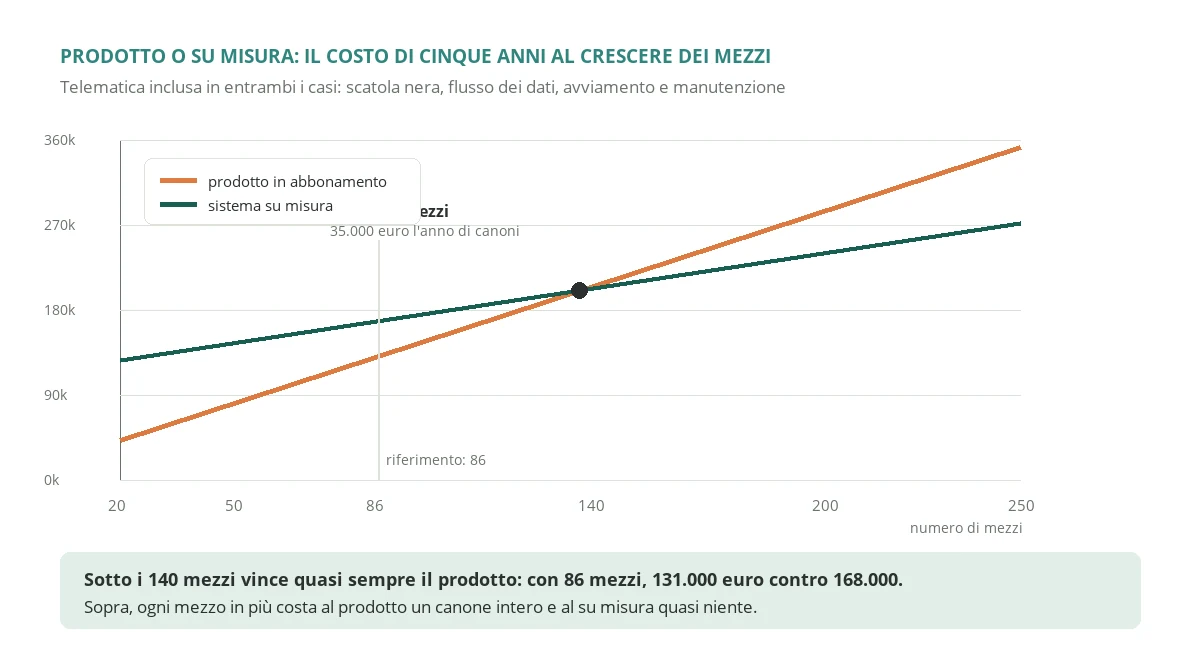
There are three roads, plus a fourth I recommend almost always, and choosing the wrong road costs more than choosing the wrong supplier. These are the orders of magnitude I see on the Italian market, for a company like the reference one.
The rental company's portal. If much of the fleet is on long term rental, your rental company already gives you a portal with contracts, deadlines, services and often the re-notified fines. It costs nothing and is underrated. The limit is obvious: it only sees its own vehicles, and if you have two rental companies, or owned vehicles as well, you have two or three portals that do not talk to each other. And it attributes nothing to drivers, because it does not know who drives. If you have a single rental company and fewer than thirty vehicles, start here, with a well kept assignment sheet.
A subscription fleet management product. Without telematics it costs between four and ten euros per vehicle per month; with telematics between fifteen and thirty euros, plus the installed tracking box at eighty to two hundred euros per vehicle. For eighty six vehicles with telematics that is fifteen to thirty one thousand euros a year in fees. Plus a setup between five and twenty thousand euros, which is mostly loading history, connecting fuel cards and rental companies, and rebuilding assignments. Good products exist and are mature, especially on the telematics side.
A custom system. It starts at thirty five thousand euros for vehicle, contract and assignment history, import of fuel cards, tolls and invoices, a deadline calendar, fine handling with the driver identified, and a cost per vehicle and per driver dashboard. It reaches one hundred and ten thousand with a driver app including photos at assignment and damage reporting, pool car booking, telematics integration and charging costs to service calls and jobs. Plus fifteen to twenty per cent a year of maintenance. Telematics, if you want it, is still paid separately, though less, because the boxes and the data feed remain a third party service.
The threshold. The product costs in proportion to the number of vehicles, custom software hardly does. On cumulative five year cost, with telematics in both cases, the two lines cross at around one hundred and forty vehicles, which is when product fees exceed thirty five thousand euros a year. Below that threshold the product almost always wins, and the reference company, with eighty six vehicles, sits below it: one hundred and thirty one thousand euros over five years against one hundred and sixty eight thousand. Above it the maths changes, and changes fast, because each extra vehicle costs the product a full fee and custom software almost nothing.
There is a fourth road, though, and it is the one I recommend in most cases: a product for telematics and the standard part, a custom piece for the thing that sets you apart. At the reference company that piece was charging each van's cost to the service calls it had served, because maintenance contracts were renewed at a fixed price and nobody knew which customers made them loss making. I covered the cost of a service call in field service management software, and cost per job in job costing software. The custom piece costs between twelve and forty thousand euros, hooks into the product through its interfaces and does not force you to maintain the part the market already does well. If you want to discuss where that line falls for your company, you can get in touch here.
Where to start: the first release in ninety days
The first release does not have to be complete, it has to be useful to someone within three months. This is the order I use, and the first three steps cost little and are worth a lot because they happen before any software.
Week one: measure. Compute the unattributed spend rate over the last three months, by source, and note which vehicles generate the uncertainty. By the end of the week you should have a number, the source that weighs most and the group of vehicles that generates most of the problem. With that number in hand every later discussion, including those with suppliers, becomes concrete.
Weeks two and three: master data and assignment history. A list of vehicles with the real data, tank capacity included, contracts with mileage and rates, and the history of who had what for at least the last twelve months, rebuilt with the team leaders. It is the most boring part of the project and the one that decides half of it. At the same time you write one rule, worth more than all the rest: no vehicle changes hands without the handover being recorded, with the date and two photos.
Week four: data feeds. Ask the fuel card issuers, the toll operator and the rental companies what file format they can give you and how often. One week, almost all of it waiting, and it saves you the worst surprise of the project: discovering in the third month that one of the suppliers only sends PDFs.
From month two: the first release, on the worst group. Not on the assigned cars, which are already fairly tidy: on the vehicles that generate unattributed spend. At the reference company that meant the pool cars and the spare vans, twenty two vehicles. Just three things: a departure log on the phone, automatic spend attribution, a deadline calendar with fifteen day alerts. No map, no dashboards, no telematics.
Month three: fines and mileage projection. The fines flow with the driver identified automatically and the projection of end of contract adjustments, with the first vehicle swap decision. Telematics comes later, once you know what you will do with it and have the agreement or authorisation you need.
One last piece of advice on what not to do first. The driver ranking by driving style is the feature that sells best and is needed last: if assignment data is not reliable it attributes one driver's harsh braking to another, and if you open it before clarifying the purpose with the workforce it becomes the issue that sinks the agreement. It comes later, if at all, and when it does it is best presented as a tool to reduce fuel use and accidents, which is what it really does.
If the number says this is not your problem
It can happen, and it is worth saying because almost nobody does. If your unattributed spend rate is under five per cent, if you know what each vehicle costs per kilometre and if fines reach the right driver within a week, new fleet management software will not give you much margin back: it will give you convenience, continuity when the person who looks after the vehicles changes role, and a few percentage points on fuel. Those things are worth something, and in a small company the second is worth more than it seems, because there is almost always a single person who knows how the contracts really stand. But they are worth the price of a subscription, not of a project.
In that case the bottleneck is almost always elsewhere, and in companies with a service fleet it is one of these three: job scheduling, meaning the vans are there but run badly because appointments are set without looking at where the technicians are; the maintenance of installations you carry out for customers, where the van is only the means and the real cost lies in repeat visits, which I wrote about in maintenance management software; or management control, meaning you know fleet cost perfectly well but do not charge it to anything, and then the subject is the one described in management control software.
And there is one case where software is not the answer even when the numbers are bad: when the cars are a form of pay never declared as such. If the pool car is in fact one person's car, or if the van goes home every evening because it is more convenient that way, no system will change that choice: it will only tell you precisely what it costs. Which, incidentally, is already an excellent reason to measure, because many concessions made to keep someone are worth more than they seem, and until the number exists the discussion cannot even begin.
If you have read this far you probably have your own fifth of the month folder in mind and a fairly clear idea of which of the five costs affects you most. Compute the unattributed spend rate for the last three months before you look at any demo: it is a day's work, it costs nothing, and it tells you whether you are buying margin or just convenience. From there the decisions become much simpler, and you make them yourself instead of leaving them to the most persuasive map.
Frequently asked questions
It depends on the road. The long term rental company's portal is free but only sees its own vehicles and does not know who drives them. A subscription product costs between four and ten euros per vehicle per month without telematics and between fifteen and thirty with telematics, plus the installed tracking box at eighty to two hundred euros per vehicle, plus a setup between five and twenty thousand euros that is mostly loading history, connecting fuel cards and rental companies, and rebuilding assignments. For eighty six vehicles with telematics that is fifteen to thirty one thousand euros a year in fees. A custom system starts at thirty five thousand euros for vehicle, contract and assignment history, spend import, a deadline calendar, traffic fines and cost per vehicle and per driver, and reaches one hundred and ten thousand with a driver app, pool car booking, telematics integration and charging costs to service calls and jobs, plus fifteen to twenty per cent a year of maintenance.
You compute the unattributed spend rate: out of every hundred euros spent on the fleet in the last three months, how many do not have a recognised plate, a driver and a day together. If vehicle assignments already sit in a system it is one query joining spend to assignment history by date; if they do not, you take the fuel card statement, ask the team leaders who had which vehicle week by week and mark each answer as certain, likely or unknown, which takes a day with two people. Under five per cent the software will give you convenience rather than much margin, between five and fifteen the problem is how handovers are recorded, over fifteen the fleet has no memory. Look at where it clusters too: usually twenty vehicles generate two thirds of the problem, and that is the scope of the first release.
For an ordinary service or sales fleet, as a rule yes. Article 4 of the Italian Workers' Statute requires an agreement with the union representatives or, failing that, authorisation from the Labour Inspectorate for tools that may allow remote monitoring and are installed for organisational, safety or asset protection needs. The National Labour Inspectorate, in circular number 2 of 2016 on geolocation systems, clarified that a tracker on a company vehicle normally falls into this category, except when it is truly indispensable to perform the work or required by a specific rule. Clear information to drivers is required in any case, and on cars with mixed private use it is wise to allow tracking to be suspended outside working hours. Have your employment adviser check the choices before switching the system on.
With a mid contract projection and a few vehicle swaps. If you have several vehicles of the same type on the same contract, you compare each one's mileage with the expected figure at today's date and project it to the end of the contract. The vehicle that is already at seventy per cent of its mileage halfway through gets swapped with its twin at thirty, so both end close to the contract figure and you pay neither the excess at full rate nor get the shortfall refunded at a reduced one. For vehicles that will still end up outside, renegotiating the mileage before the end is accepted almost always. The same principle applies to return damage: photos at assignment and at every handover turn the inspection from a negotiation into a comparison.
Almost always it is not the product that is missing, it is the assignments. Many rollouts load the list of plates and the list of drivers without the history of who had which vehicle on which day. After three months the reports attribute spend and fines to the wrong people, nobody recognises them, and the conclusion is that the software does not work. The test that exposes this costs one day: take three months of past data, pick the twenty most complicated vehicles, the ones that changed hands or went to the garage, and ask the supplier to load them and show you each one's cost per kilometre and the driver behind every expense. If it reconstructs ninety per cent you have the right product, if it reconstructs sixty you are missing the assignments.
Below one hundred and forty vehicles, almost never fully custom. The product costs in proportion to the number of vehicles and custom software hardly does, and on cumulative five year cost, with telematics in both cases, the two lines cross at around one hundred and forty vehicles, when product fees exceed thirty five thousand euros a year. With eighty six vehicles the product costs around one hundred and thirty one thousand euros over five years against one hundred and sixty eight thousand for custom. The road I recommend almost always is the fourth one: a product for telematics and the standard part, plus a custom piece between twelve and forty thousand euros for the thing that sets you apart, which is usually charging vehicle costs to service calls and jobs, or pool car booking connected to your business system.
Leave your details in the form below