What is the number that decides whether gym management software will save you money?
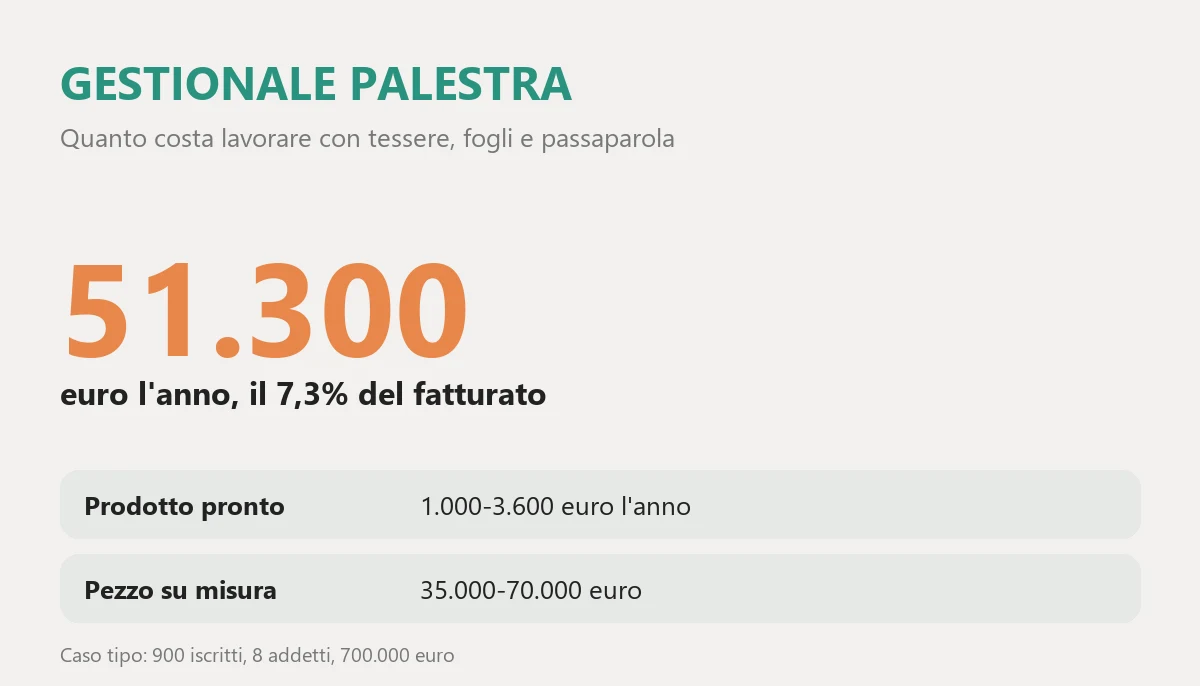
Above 75 per cent a weekly list of those who have not come in for three weeks is enough; between 50 and 65 a system pays for itself. In a gym with 900 members, eight staff and 700,000 euros of revenue renewal was at 58 per cent, and the five costs of working with cards and sheets came to about 51,300 euros a year, 7.3 per cent of revenue. A product costs between one and four thousand euros a year, the custom piece between thirty-five and seventy thousand euros. For a single gym a product is almost always better: the custom piece beats a product above 2,900 members, about 2.2 million euros of revenue, or with several sites and rules of their own.

At ten past six on an October Monday, in a provincial gym with nine hundred members and eight staff, the manager opens reception and has three things in front of her. The first is a card index where one card in five has the expiry date written in pencil. The second is an entry reader that opens the turnstile for anyone holding a card, including a member who expired two months ago, and that knows nothing about the medical certificate, which sits in a blue folder in the cupboard. The third is this month's renewals sheet, with forty-two names to call, half of whom stopped coming weeks ago and have already decided not to come back. Nobody did anything wrong. Yet at the end of the year three hundred and eighty people did not renew, and nobody had time to ask even one of them why.
Gym management software exists to remove that Monday, but not every gym needs it, and those that do usually buy the turnstile first and discover later that the problem was upstream. You will find what the term really means and what it is not, the number that says whether you need it or whether a better list is enough, the cost of working with cards and sheets every year, the price gap between product, module and custom piece, and the threshold above which building makes sense. The case that follows is a typical case, rebuilt from situations I have seen in gyms, sports centres and small chains, with rounded numbers.
A fair warning: I have been building software for companies since 1999, and I built and sold LegalDesk, a program for law firms where a missed deadline is damage. A gym has the same problem with another raw material: it does not lack work, it lacks the thread that ties together who joins, who comes, who pays and who disappears, which today lives in the memory of whoever is at the desk that day. As in the article on restaurant management software, for most gyms the conclusion will be: buy a product, do not have anything built. I will explain when not.
What is gym management software, and what is it not?
It is a system that keeps in one place the five things a sports centre touches every day: the member record with its subscription, the entry, the collection of the fee, the classes with their bookings and the instructors with their pay. The value is not in any of the five, it is in the link between them: when a member goes through the turnstile, the system knows whether the subscription is valid, whether the fee has been paid and how many days it has been since the last visit, and at the end of the month it can tell you who is about to leave.
It is not the turnstile or the card reader. The reader opens a door, which is useful, but it does not know why the person walking through will not renew. It is not a class booking app: it fills rooms and stops there, and often keeps the members' data at its own home. It is not a generic business system, the kind for invoicing and accounting, which does not know that a twelve-month subscription is suspended for an injury and then extended. And it is not a spreadsheet with colour-coded expiry dates, which works as long as one person keeps it updated.
The difference shows in one question: "how many of the members expiring this month have not been in for more than three weeks?". If the answer takes an hour, a spreadsheet and the memory of whoever is at the desk, what you have is a set of tools, not a management system. That is not necessarily bad, and as you will see it is sometimes the right choice, but it is better to call things by their name before buying.
For a centre with several sites, a small chain or an association running a pool, a gym and children's classes, the definition widens: cards valid at more than one site, corporate agreements, pay-per-entry passes, lesson packages and different price lists for each site. It is the same pattern as CRM software, with one complication more: the customer does not buy once, but has to decide to stay every month.
Why does a gym member leave without anyone making a mistake?
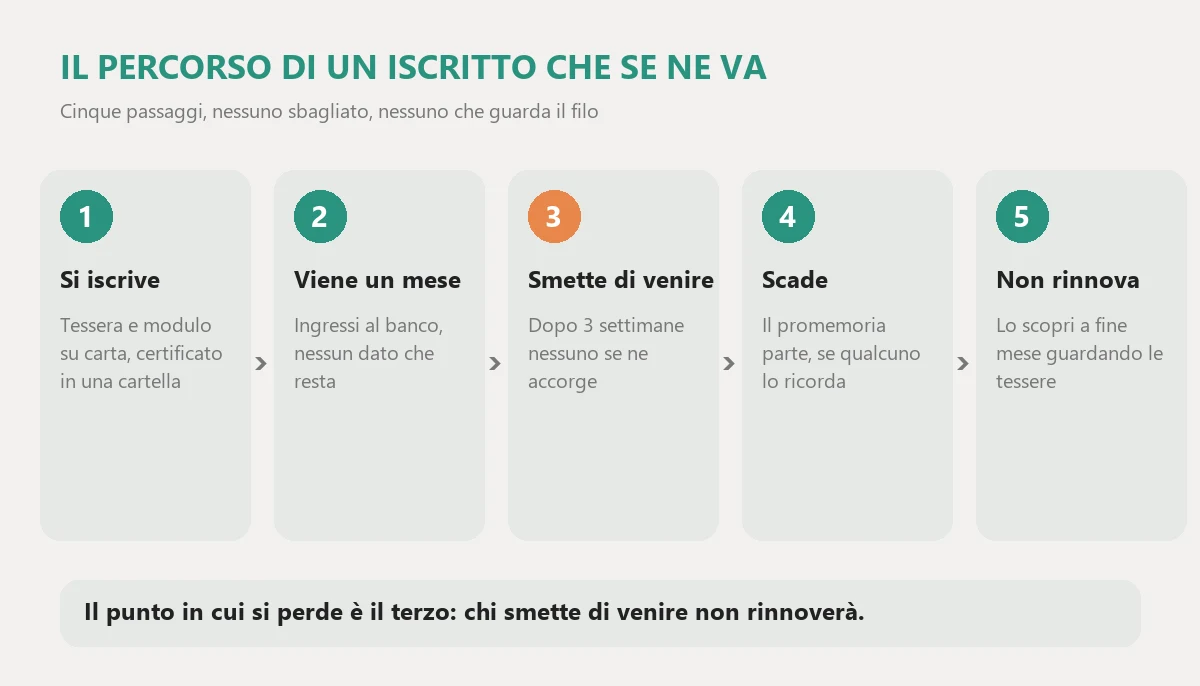
He leaves because every step, taken alone, works. The enrolment is done, the card is handed over, the turnstile opens, the fee is collected. The damage is in the spaces between the steps, where information stays in one person's head or does not exist.
The first gap is between joining and habit. Someone who signs up in October with good intentions has a high chance of stopping within six weeks, and that is the moment when a phone call from an instructor is worth more than any promotion; but nobody knows who "joined recently" if the date is on a paper card. The second is between absence and expiry: the member who has not come in for three weeks is invisible, because the turnstile records who goes through and not who is missing. The third is between expiry and renewal: the reminder goes out if someone remembers, usually close to the date, when the decision has already been made.
The fourth is at the door. A member whose subscription expired two months ago gets in anyway because the card still opens the turnstile, and nobody likes stopping a customer in front of the others. The fifth is collection: fees paid in cash or by transfer need someone to chase them, and the person chasing is the same one at the desk answering the phone.
None of these mistakes has a culprit, and that is why they cost money. A system that only opens the turnstile does not see them; one that ties entry, subscription and payment together brings them out one by one, with a name and an amount. The rule I use with clients is simple: if answering "who has not been in for three weeks and expires within a month?" takes more than ten minutes, the information does not exist in the centre, it only exists in the head of whoever remembers it.
How much does it cost every year to run a gym with cards and sheets?
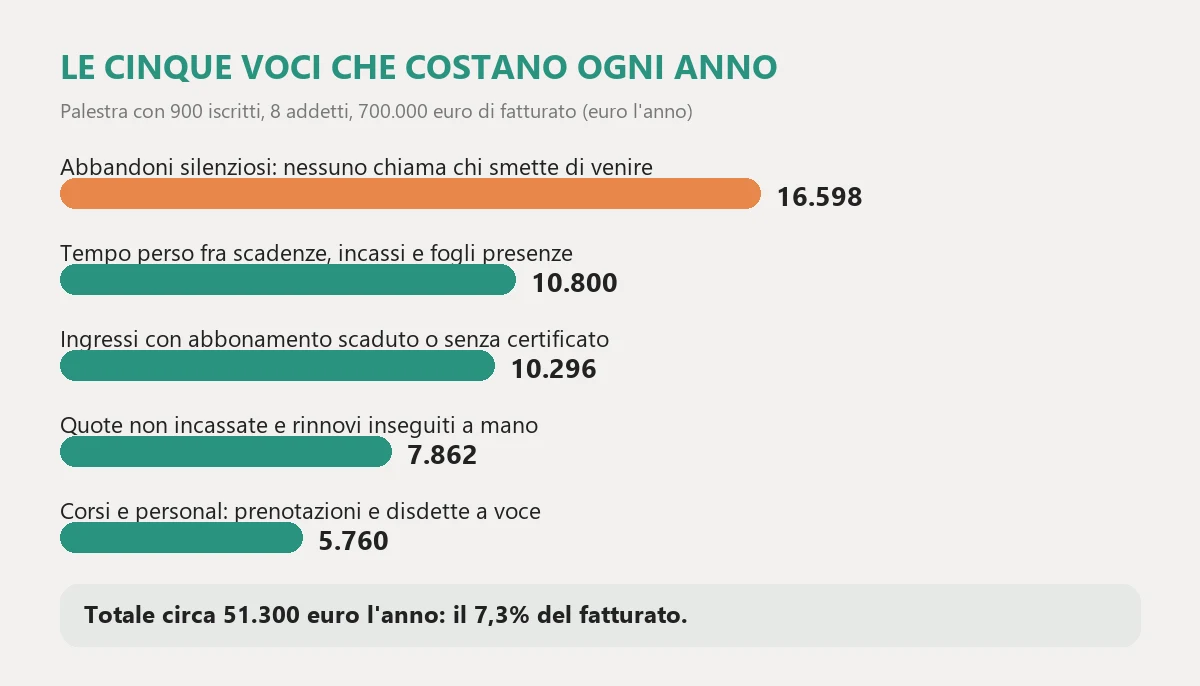
It is calculated in five items, each measurable with data the centre already has. The typical case is a gym with 900 active members, eight staff between reception and instructors, an average fee of 52 euros a month, that is 624 euros a year, and about 700,000 euros of revenue: 561,600 euros of fees, 96,000 of extra classes and personal training, the rest from the bar and supplement sales.
The first item is silent drop-outs: members who stop coming and do not renew without anyone having called them. In the case, 380 people a year did not renew; if a call or message after three weeks of absence recovers 10 per cent of them, that is 38, the sum is 38 times 624 euros at a contribution margin of 70 per cent, that is 16,598 euros. It is the biggest item and the one nobody looks at, because it needs two data points, the last entry and the expiry date, that do not sit in the same sheet.
The second is entries that should not happen: 22 a week with an expired subscription, an unpaid fee or a certificate not in force, for 52 weeks and about nine euros of value per entry, that is 10,296 euros. The third is time: nine hours a week on expiries, receipts, instructors' attendance sheets, pay calculation and collections, at twenty-four euros an hour for fifty weeks, 10,800 euros.
The fourth is uncollected fees: 1.4 per cent of 561,600 euros, that is 7,862 euros, among unpaid fees, delays never chased and suspensions forgotten. The fifth is classes and personal training booked by word of mouth: 6 per cent of 96,000 euros, that is 5,760 euros, in empty places, unfilled cancellations and missed lessons nobody made up.
The total is about 51,300 euros a year, 7.3 per cent of revenue. The first three items alone weigh 73 per cent. A practical rule: below 2 per cent of revenue the problem is not a priority and it is better to look elsewhere; above 4 it almost certainly is. In between, it depends on how much effort recovering it takes. The assumptions are prudent but they are assumptions, and should be redone with your figures. The method for reading a company's margin from above is in the article on management control software.
What is the number that decides whether you need gym management software?
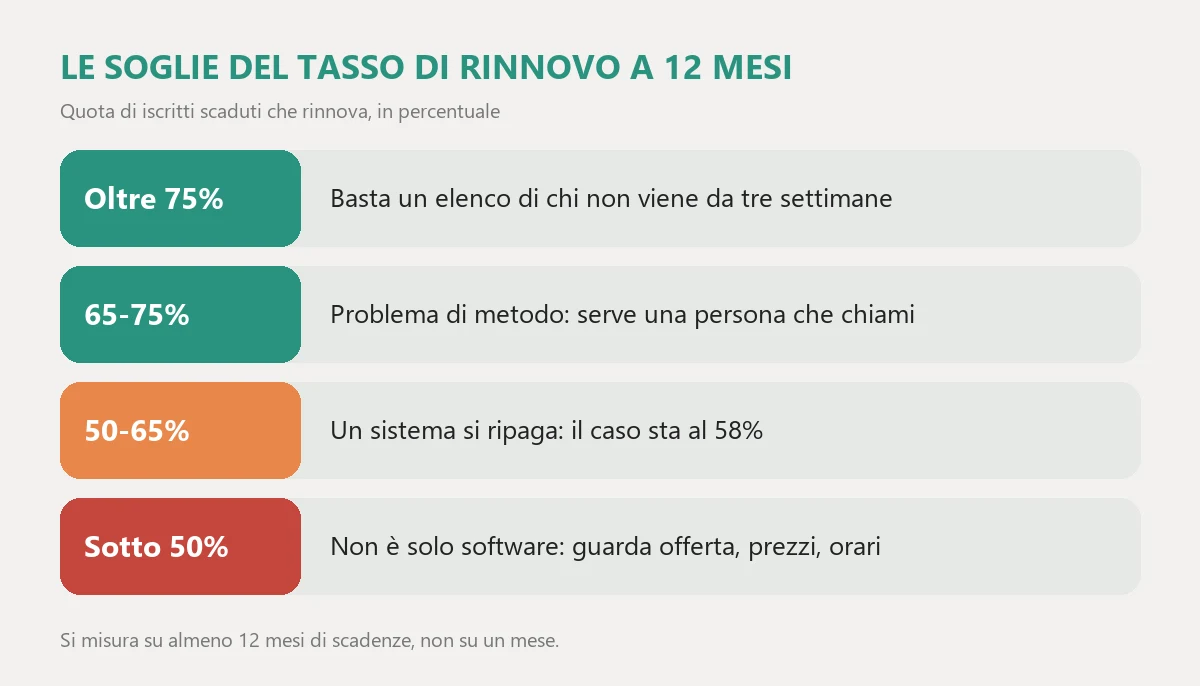
It is not how many members you have, nor how many entries you count. It is the twelve-month renewal rate: of the members who reach expiry, how many renew. It is calculated in a day, with a spreadsheet: take all the expiries of the last twelve months, count those followed by a renewal within thirty days and divide by the total. In the case there were 900 expiries and 520 renewals: 58 per cent.
The thresholds I use are these. Above 75 per cent the centre is under control: a weekly list of who has not been in for three weeks is enough, and whoever proposes a ten-thousand-euro system is selling you a problem you do not have. Between 65 and 75 the problem is method: nobody has the job of calling, and it is often solved by one person spending two hours a week on it. Between 50 and 65 a system pays for itself, because the gain has five figures and the cost four. Below 50 it is no longer only a software question: if more than half of the members do not come back, look first at opening hours, prices, crowding and the quality of the classes, because a program will not bring back someone who leaves because there is no space on the weights floor at six in the evening.
The typical case stood at 58: in the band where a product pays for itself in a few months. Next to this, two checks that cost nothing. The first: the share of members whose certificate is checked at entry when the centre's rules require one; in the case it was 71 per cent, and the rest got in on trust. The second: the share of fees collected by direct debit; in the case it was 34 per cent, and the rest needed a reminder or someone at the desk.
To measure the rate you need twelve months of expiries, not one. A single month is easily misleading, because September and January renew differently from July. It is better to calculate it by cohort too: members who joined in October and those who joined in April have different stories, and someone who signs up on a start-of-year offer almost always renews less than someone who arrives by word of mouth.
How do you tell who is about to leave before the subscription expires?
You look at two dates together: when the member last came in and when the subscription expires. Someone who has not been in for three weeks and expires within forty-five days is almost always a member who will not renew; someone absent for three weeks with months ahead can still be recovered with a message that does not mention money.
The calculation is simple and takes a few lines. In C# that compiles and can be tried with a test, the criterion I use with clients is this:
public enum Priorita { Nessuna, Chiamare, Urgente }

public record Iscritto(string Nome, DateOnly Scadenza, DateOnly? UltimoIngresso, bool AddebitoAutomatico);

public static class Abbandono
{
    // Whoever stops coming before expiry is the one who will not renew.
    public static Priorita Valuta(Iscritto i, DateOnly oggi)
    {
        var assenza = i.UltimoIngresso is null ? 999 : oggi.DayNumber - i.UltimoIngresso.Value.DayNumber;
        var allaScadenza = i.Scadenza.DayNumber - oggi.DayNumber;

        if (assenza >= 21 && allaScadenza <= 45) return Priorita.Urgente;
        if (assenza >= 21 || (allaScadenza <= 30 && !i.AddebitoAutomatico)) return Priorita.Chiamare;
        return Priorita.Nessuna;
    }

    // Renewal rate as a percentage: renewed over expired.
    public static decimal TassoRinnovo(int scaduti, int rinnovati) =>
        scaduti == 0 ? 0m : (decimal)rinnovati / scaduti * 100m;
}
The twenty-one and forty-five day limits are not written in stone: they are tuned by looking, after six months, at which flagged members really did leave. The value of the system is not in the formula, it is in the list it produces every morning: ten names, with the reason next to each, to hand to whoever is at the desk. A list of ten names gets used, one of two hundred does not.
How you phrase it matters. The best message does not talk about renewal: it asks how things are going, offers to change the time slot, offers a session with an instructor. In the centres I have followed, a call from an instructor, three minutes, recovers more than discounts, and costs less. Whoever wants to build the relationship side and the contact history will find the reasoning in the article on CRM software, where every contact has an owner and a next action.
Who calls and when
One rule is worth a thousand features: every name on the list has a person assigned and a date. Without that, the list becomes one more list nobody opens. Better two calls made on Monday and Thursday, with the outcome written on the record, than a campaign of three hundred messages that nobody checks.
How do you control entries, certificates and expired subscriptions?
You let the system decide at the door, in under a second: the member's card or QR code goes past the reader, the system checks subscription, fee and, where needed, certificate, and the turnstile either opens or shows the desk the reason for the block. The decision no longer rests with the person at reception, and that also removes the embarrassment of stopping a customer in front of the others.
The delicate point is the medical certificate. Where the centre's rules or the law require it, it must be in force, but it is better to keep in the system only the expiry date and not the document: health data is a special category under the European data protection regulation, and the less you hold the less you risk. The document stays with the member or in a separate archive with its own rules. A question to put to your privacy adviser once, properly, and not to improvise in front of the turnstile.
A word on biometric systems, that is fingerprint or face to open the turnstile. They sell well, but they require a data protection impact assessment and a reason why a less invasive alternative cannot be used. In the centres I have seen, a QR code on the phone or a card is enough, and the risk of a penalty is not worth the convenience. If the member forgets the card, a temporary code at the desk solves it in twenty seconds.
Guests and free trials are the other leak. A trial entry that is not recorded never becomes a contact, and a guest who comes in three times on a friend's card is a lost fee. The system must allow a trial entry with name, phone and consent to be contacted again, and record who brought them. In the typical case the 22 irregular entries a week were half unregistered guests and half expired members: two different problems that look the same.
One last rule, which also concerns safety: the turnstile must always be openable by a person. A power cut or a network failure must never block an exit, and the system must be able to work without a connection for at least an hour, synchronising afterwards. It is a question to ask the supplier before signing, and a vague answer is already an answer.
How do you collect fees without chasing anyone?
You collect them by direct debit: the member signs the mandate once for a debit on their bank account or authorises a card, and every month the fee arrives by itself. In the typical case only 34 per cent of fees went through this way; taking it above 70 reduces unpaid fees, removes hours of reminders and makes next month's income predictable.
The system does three things. The first is producing the collection: it generates the requests to the bank or payment service and records the outcomes. The second is handling the exception: a rejected debit must not become an awkward phone call, but an automatic message with a link to pay and, if that is not enough, blocking entry after an agreed number of days. The third is suspending and extending: an injury, a trip or a pregnancy move the expiry, and done by hand it is the operation that goes wrong most often.
In the case, the 1.4 per cent of unpaid fees was worth 7,862 euros a year. With direct debit and a reminder that goes out by itself on the second day, you generally fall below 0.5 per cent: a recovery of about 5,000 euros, which alone covers a good part of the fee for a product. The rest does not show in the profit and loss: the manager stops being a debt collector.
A warning on legal form. Many centres are amateur sports associations or companies, with membership fees, cards, a members' register and receipts, and a tax regime that is not that of an ordinary business. A management system must be able to handle them, and it is worth clarifying with your accountant before choosing how fees, classes and bar sales are to be recorded, and whether the product talks to the fiscal register. It is the point where a serious product stands apart from an improvised one, and ten minutes with whoever keeps the books saves a year of corrections.
For companies with agreements, corporate welfare and packages with pay-per-entry passes, the reasoning is that of recurring contracts: every agreement has a date, an amount and a renewal. Whoever has many agreements with different expiries will find the method in the article on contract management software, where every expiry has an alert before it becomes a problem.
How do you keep the thread between member, classes, instructors and payment?
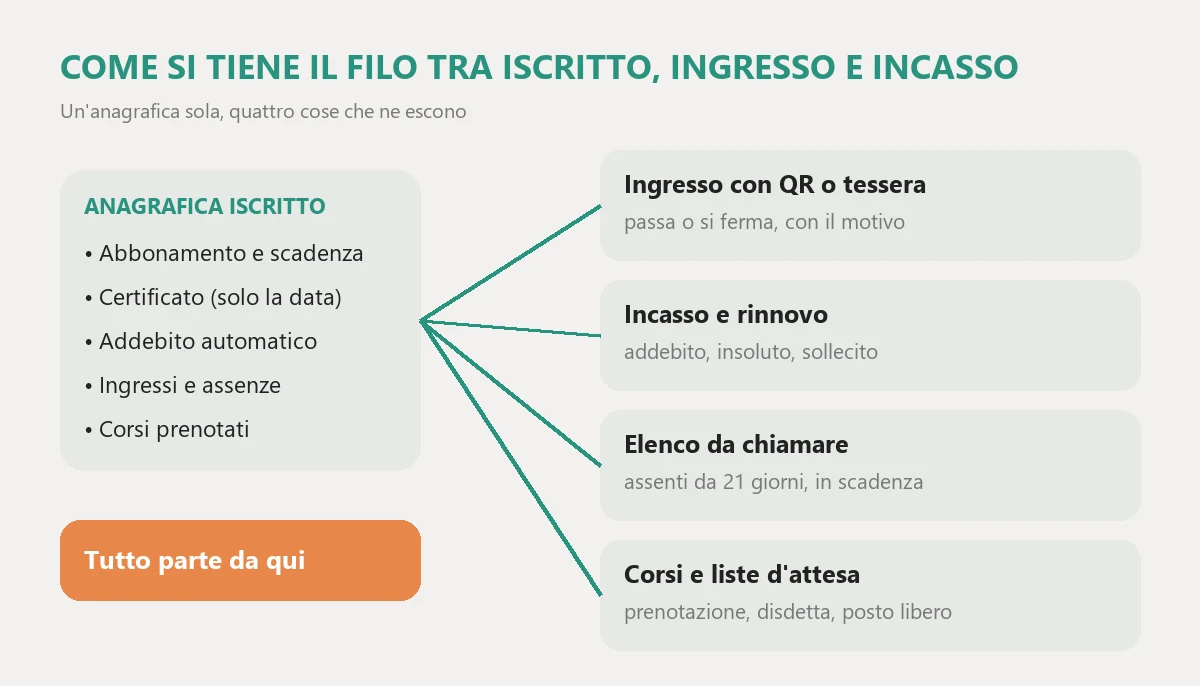
You give everything a single place to live. The member has one record, with subscription, certificate expiry, payment method, entry history and booked classes. Four things come out of it: the decision at the turnstile, the collection, the list of who to call and the management of classes. None of the four requires copying a piece of data from somewhere else.
Classes are where the thread breaks most often. A class with fifteen places and twenty enrolled has five people who arrive and cannot get in; one with fifteen places and nine booked has six places nobody offered. With booking from the phone, cancellation up to two hours before and a waiting list that alerts the first in line, the room fills itself. In the case, 6 per cent of extra class revenue, 5,760 euros, was there.
Instructors are often sports collaborators paid by the hour or by the lesson. The system records who taught which lesson, how many people were there and calculates the month's pay, so the attendance sheet is not rebuilt from memory on the twenty-eighth. Whoever has a large team, on rotation and with different contracts, will find the reasoning in the article on shift management software and in the one on attendance tracking. With eight staff shifts fit on a sheet; with twenty, across several sites, the sheet stops holding.
Communication completes the picture: the welcome message, the expiry reminder, the notice of a cancelled class, the invitation to bring a friend. Every message has a reason and a consent: those tied to the service, such as booking confirmation, are one thing; promotional offers are another and require consent recorded in the right place. One tidy channel is worth more than five confused ones.
Is an app for members worth it?
It is if it does few things and does them well: show the entry code, book and cancel classes, see expiry and fee. It is not if it is a second website with its own rules. For a gym with fewer than a thousand members, a well-made web page that opens from the phone, with nothing to install, is often enough and costs a fraction.
How much does gym management software cost: product, module or custom?
It depends on the road. A ready-made product for gyms usually costs between ninety and three hundred euros a month per site, with separate modules for the app, recurring payments and access control: between a thousand and four thousand euros a year for a single centre, with a setup between five hundred and three thousand euros for configuration and member import, plus fifteen hundred to six thousand euros once for readers and turnstiles. The sports module of a system you already have costs between three and seven thousand euros, but it usually has weak access control and no app. The custom piece, with member record, entry rules, recurring debits, renewal list and classes, costs between thirty-five and seventy thousand euros, plus fifteen per cent a year for maintenance. A complete system from scratch, for a network of centres with different fees and rules, sits between a hundred and a hundred and sixty thousand euros.
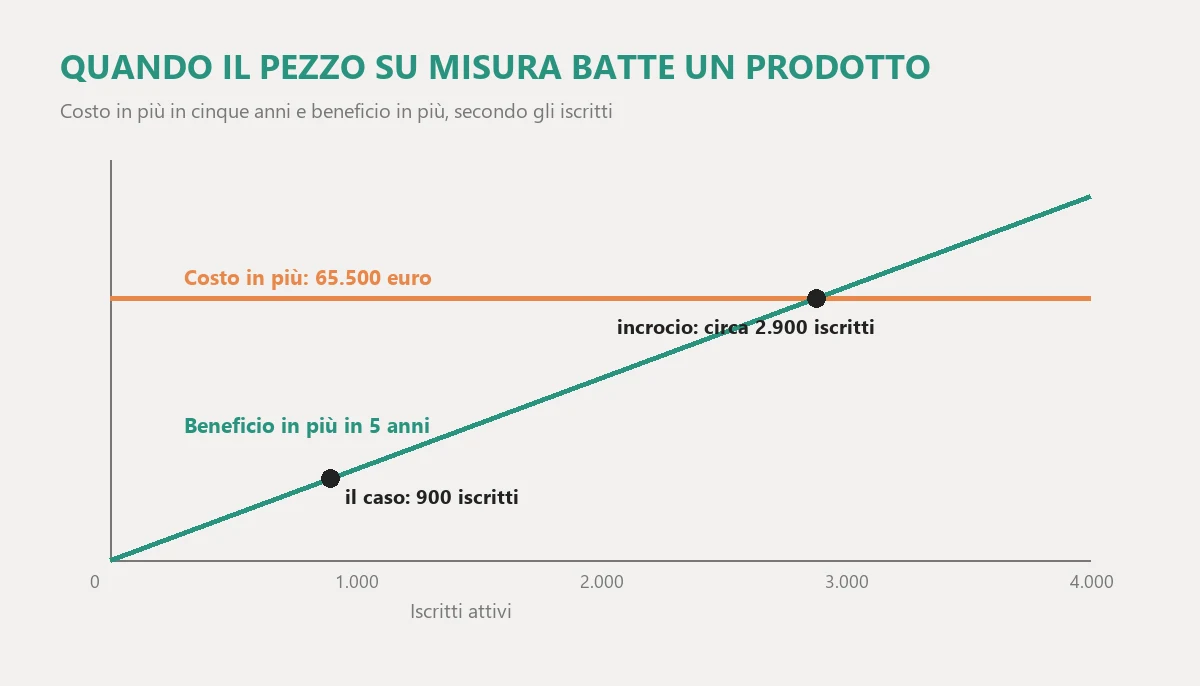
In the case, a product cost 3,500 euros to set up and 3,000 euros a year; if it recovers 40 per cent of the bill, about 20,500 euros a year, it pays for itself in about three months. The custom piece costs 48,000 euros and about 7,200 a year in maintenance; if it recovers 48 per cent, because it knows rules a product does not, it yields about 24,600 euros a year. Compared with the product, though, over five years it costs 65,500 euros more and recovers about 20,500 more.
The crossing point is around 2,900 members, about 2.2 million euros of revenue, because the extra benefit grows with volume and the cost does not. Below that figure, and almost always below three sites, a product is better. Above it, or when you have rules no product can handle, it is worth evaluating a piece built around you. A centre with a thousand members and one site needs a good product and a person who uses it well, not a project.
The rules no product knows are few and recognisable: a network with cards valid at several sites and revenue sharing; agreements with dozens of companies, each with its own price list and budget; pay-per-entry passes shared among pool, gym and spa; a franchise where the parent company collects and shares out. In these cases the product adapts with difficulty and the custom piece pays; a single gym, however good, usually is not one. Whoever is weighing a package against a built system will find the wider reasoning in the article on management control software.
What if the gym already has a management system?
It is the most frequent case, and the answer is almost never "throw it away". Before changing, measure what it does and what it does not: if the system you have produces the list of people absent for three weeks, calculates the renewal rate and blocks expired entries, the problem is not the tool but its use. If instead every answer requires an export and a spreadsheet, you have an archive, not a management system. In that case the cheapest road is often a small piece next to what you have, which reads the data and produces the daily list, without touching the till and the accounts. It costs a fraction of a new system and is done in a few weeks, because it does not redo what already works.
An example from the typical case: the gym had a ten-year-old program, reliable on fees and knowing nothing about absences. A small service that every morning read entries and expiries, and sent the manager a list of ten names with the reason next to each, cost a fraction of a new product and moved renewal by four points in six months. It is not the solution for everyone, but it is proof that before replacing it is worth asking which piece is really missing.
One last sum, which sellers do not do: the cost of changing your mind. A product is left with a data export and a month of nuisance; a custom piece has an owner, and that is you. Before signing any contract, ask how member records, entry history and debit mandates are exported, and in which format: the mandates in particular cannot be made nine hundred people sign again. It is the question that separates someone who treats you as a customer from someone who treats you as a hostage.
Where artificial intelligence helps in gym management software, and where it does not
It helps where it prepares work for a person who then checks, and it must never decide alone where the health of the person training or their data is at stake. In a gym the line is clear, and it is better to draw it before buying something that promises miracles.
It can write the messages to members at risk, in the tone the centre has chosen, starting from the list of who has not been in for three weeks: a draft for each, which the instructor reads and sends. It can summarise in three lines how the week went, how many entries, how many renewals, which classes are under threshold. It can suggest the time of a new class by looking at the slots where the weights floor is fullest and those where bookings stay low, as a suggestion to evaluate.
It must not decide on a certificate or someone's fitness: reading a date from a photo is one thing, deciding whether someone can train is a health responsibility that belongs to a doctor. It must not set prices or discounts on its own, nor suspend a subscription or block an entry without a rule written by a person. Nor should it "invent" a training programme for a member with health problems: the plan is written by the instructor, who knows the person, not by a model that has read a questionnaire.
The criterion for any "smart" function is one: who answers for the mistake? If the answer is "a person who checked", it is fine. If it is "nobody, the system decided", it is not. It is the same criterion that applies to any personal data: the less you put in the hands of an outside tool, the less you have to explain. An artificial intelligence service that receives members' names, phones and absences is a supplier processing personal data, and must be named and regulated as such.
Which mistakes to avoid and where do you start in thirty days?
There are six mistakes, and I have seen almost all of them more than once. The first is buying the turnstile before measuring: you choose the system with the prettiest reader and find out later it does not tie entry to renewal. The second is importing everything as it is: duplicate records, wrong expiries and members who left three years ago enter the new system and make it unreliable from day one. The third is not naming a person: a management system without a manager who updates it and calls whoever is about to leave grows old in three months.
The fourth is not training the desk. The system is as good as the person entering the trial entry: if the desk opens the turnstile "by hand to be quick", the data does not exist and the renewal rate stays as it was. The fifth is leaving the debit mandates to the last minute: collecting signatures takes weeks and must be planned. The sixth is choosing the worst day to start: the first week of September or January, with the queue at the desk, is not the time to try a new system.
Where you start, in thirty days, is this. In the first seven you calculate the renewal rate with a spreadsheet over the last twelve months of expiries. You also note the share of members with a checked certificate and of fees on direct debit. In the second week you clean the records: you remove duplicates and anyone who has not come in for a year, and recheck the expiries of active cards. In the third you ask two or three products for a demonstration, ones that talk to your reader and your fiscal register, bringing your members and your rules, not their examples. In the fourth you decide, starting from a quiet period and a trained desk, and set the date on which you measure again to see whether the number has gone up.
If the rate does not rise after six months, the fault is not the program's, or not only: it is that someone is not calling or that the problem was elsewhere. That is why the measurement is repeated, with the same method, and written where everyone sees it. A system that costs three thousand euros a year and lifts renewal from 58 to 64 per cent, on 900 members, gives back about 23,000 euros a year of margin that used to leave: a result you can see, and which whoever achieved it shows proudly to the accountant.
And if the number says it is not your problem?
It may be that, once measured, the renewal rate is above 75 per cent, fees are already on direct debit and certificates are checked. That is good news, and it is worth saying clearly: in that case you do not need gym management software, or only a better reader, and anyone who says otherwise is selling you something.
In that case the bottleneck, if there is one, is almost always elsewhere. If members stay but profits do not grow, the problem is prices, rent or the cost of instructors, and a program does not solve them. If the room is full at six in the evening and empty at two, the problem is the timetable and the kind of offer, not the software. If the centre is small and the owner is at the desk every day, you do not need a system: you need a person who keeps knowing everyone by name and a notebook to remember who got injured.
And there is a case in which software is not the answer even with bad numbers: when members leave because the centre is no longer what they were looking for. A gym with old equipment, neglected changing rooms and an atmosphere nobody likes does not have a management problem, it has a product problem, and the renewal rate is just the thermometer that signals it.
If you have read this far, you probably have your own Monday morning in mind. Before watching any demonstration, take the expiries of the last twelve months and calculate the renewal rate. Then count how many members pay by direct debit and how many certificates are checked. If the rate is below 65 per cent, or fewer than one subscription in two renews without someone calling, you already have the answer. The rest is a project, not a choice of product.
If you want a second look at your case, the road is the software consultancy, and when the right solution is a piece built around the way you work, for a network of centres, a franchise or an association with several disciplines, you will find it explained on the page about custom software.
Frequently asked questions
It depends on the road. A ready-made product for gyms usually costs between ninety and three hundred euros a month per site, between one and four thousand euros a year for a single centre, with a setup between five hundred and three thousand euros and, for readers and turnstiles, fifteen hundred to six thousand euros once. The sports module of a system you already have costs between three and seven thousand euros. A custom piece with member record, entry rules, recurring debits and renewal list costs between thirty-five and seventy thousand euros plus fifteen per cent a year. A complete system for a network of centres sits between a hundred and a hundred and sixty thousand euros.
You calculate three numbers: the twelve-month renewal rate, that is renewed members over expired ones; the share of fees collected by direct debit; and the share of members whose certificate is checked at entry, where the rules require it. Above 75 per cent renewal a list of those who have not come in for three weeks is enough, between 65 and 75 the problem is method, between 50 and 65 a system pays for itself, below 50 the problem is not only software.
Five items: silent drop-outs, entries with an expired subscription or no certificate, time lost on expiries and collections, uncollected fees and class bookings by word of mouth. In a gym with 900 members, eight staff and 700,000 euros of revenue they were worth about 16,598, 10,296, 10,800, 7,862 and 5,760 euros, about 51,300 euros a year, 7.3 per cent of revenue. Below 2 per cent it is not a priority, above 4 it almost certainly is.
No. The turnstile opens a door but does not know why the person walking through will not renew. The class app fills rooms and stops there. Gym management software ties together member record, subscription, entry, payment and classes, so that every pass at the turnstile checks the subscription and at the end of the week you can see who has not been in for three weeks and is about to expire.
No, it can prepare but not decide. It helps to draft messages to those about to leave, to summarise the week and to suggest class times. It must not decide on a certificate or someone's fitness, nor set prices, suspend subscriptions or block entries without a written rule. One criterion: who answers for the mistake? It must be a person who checked.
For almost every gym a ready-made product, which already has entry, recurring debits and classes. The custom piece beats a product above 2,900 members, about 2.2 million euros of revenue, or when you have rules no product knows: cards valid at several sites, agreements with dozens of companies, shared pay-per-entry passes, a franchise. Below that it costs about 65,500 euros more over five years and recovers about 20,500 more.
Leave your details in the form below