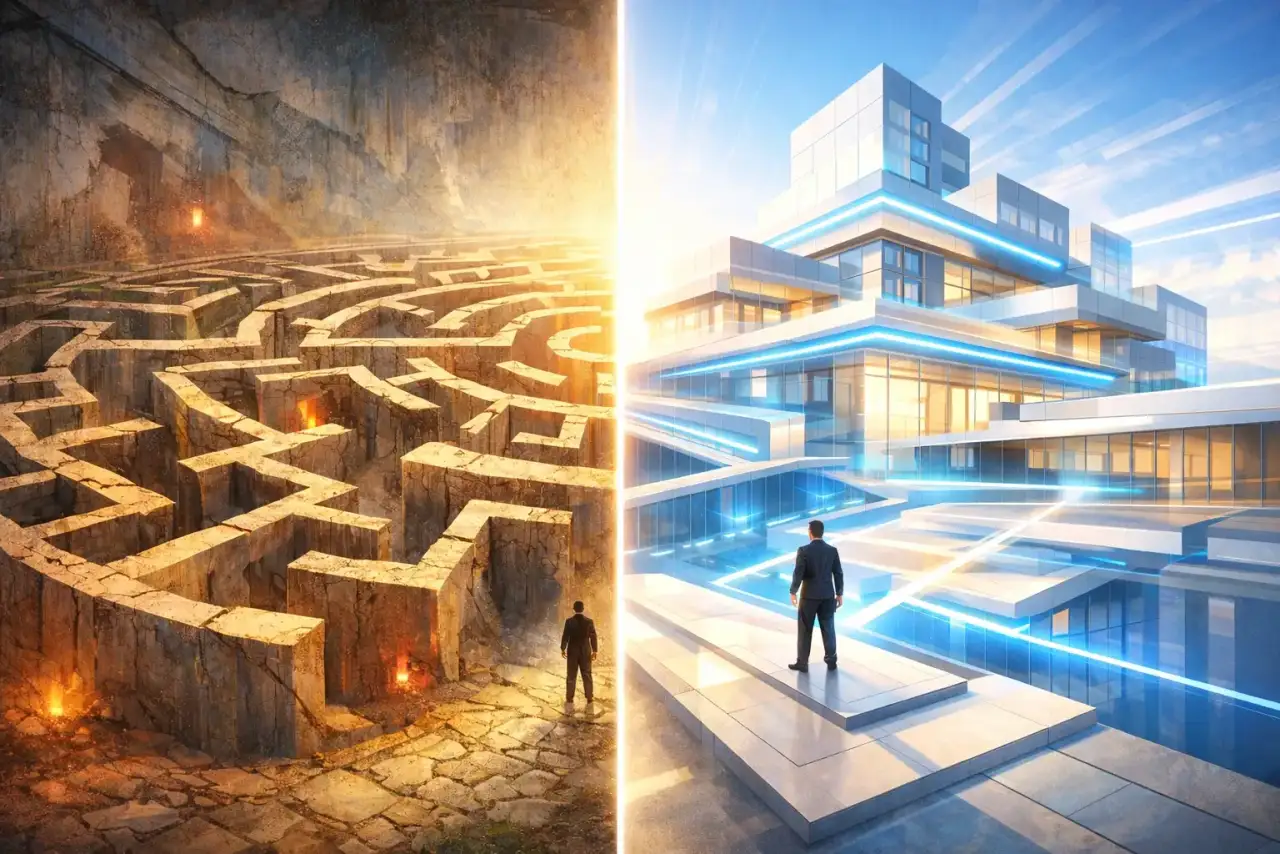

If you have been working with CMS for long enough, you have probably already passed that phase in which you get excited because "everything works", because the site is online, the contents are published without problems and the client, at least at the beginning, seems satisfied with the result obtained.
It is a reassuring phase, because it gives you the feeling of having made the right choice and of having used proven, familiar tools, which do not require you to question the way you have always worked.
The problem is that this tranquility lasts as long as the project remains at a standstill.
As long as the frontend doesn't have to evolve. As long as the content doesn't have to live on multiple channels.
As long as no one asks you to integrate more complex logic, different flows or architectures that go beyond the classic page-content-theme scheme.
When that moment arrives, nothing explodes.
There is no obvious error, there is no sensational crash, there is no clearly wrong choice to correct.
There's something worse: you start to realize that every change requires an explanation, a justification, a compromise that you didn't foresee at the beginning.
And it is there that, often without saying it openly, a question arises that weighs more than all the others: this architecture I would actually be able to defend her in front of a developer more senior than me?
We are not talking about “it works” or “it doesn't work”.
We are talking about choices that are explainable, arguable, sustainable over time, even when the project grows and when you yourself, in one or two years, will have to revisit it with a much more critical look.
Headless CMS come into play exactly at this point in the career path.
Not as a trend to follow because there is so much talk about it.
Not as yet another tool to add to the stack.
But as a natural consequence of a change of mentality, which leads you to separate what was previously confused, coupled and mixed for convenience.
This article is not created to teach you how to use a headless CMS, nor to convince you that it is always the right choice.
Rather, it serves to clarify what headless really means, why this approach arises precisely from structural limits of traditional CMS and, more importantly, what type of developer you are when you start to seriously consider it.
If you're looking for a quick fix or reassuring answer, you probably won't find it here.
If, however, you feel that some architectural decisions can no longer be made "out of habit", then you are exactly in the right place to start the reasoning.
What is headless mode?
When we talk about headless mode, we often start from a technical definition that seems to clarify everything, but which actually leaves out the most important part of the discussion.
Saying that “the frontend is separated from the backend” is correct, but it doesn't explain why this separation becomes relevant only at a certain point in life of a project.
The headless mode was not created to simplify the work of developers, nor to make the CMS more modern on paper.
It is born when the CMS, from being a useful tool, begins to occupy a space that it should no longer occupy, making architectural decisions for you without you immediately realizing it.
In a headless system, the CMS stops being responsible for how content is displayed and limits itself to doing one specific thing: storing, structuring and making it available in a consistent way.
Everything related to presentation, interaction and application logic is moved elsewhere, where it can evolve without being dragged along constraints that no longer make sense.
This change is not neutral.
It forces you to ask yourself who decides what, where the line between content and application lies, and what responsibilities you are assigning to each part of the system.
The headless mode becomes relevant when the contents stop being simple pages and start being shared, reusable resources, destined to live on different frontends, perhaps written with technologies that the traditional CMS had not even foreseen.
At that moment, the coupling between content and interface, which previously seemed comfortable, it becomes a limit difficult to justify.
Choosing a headless approach means accepting that some initial conveniences are lost, in exchange for greater structural clarity.
It's not a choice that makes everything easier, but it's a choice that makes the system explainable, especially when someone with more experience starts asking you questions about why certain decisions were made.
And that's where headless stops being an abstract concept and becomes a concrete answer to a problem that isn't about the CMS, but about the way you're designing the software.
But what does headless mean?

The term headless is often used as a technical label, but if you take it literally it says much more than it seems, especially if you look at it from the point of view of those who design systems and not those who simply assemble them.
Headless literally means "headless", but in the context of a CMS it does not indicate the absence of something, but rather the conscious choice of remove responsibility from the system which he previously exercised implicitly.
In traditional CMS, the "head" is the interface, i.e. the mechanism through which the content is transformed into pages, layout, navigation and visual behaviors.
This head is not optional, because it is integrated into the heart of the system and ends up influencing every other decision, even when the project grows and needs change.
When we talk about headless meaning, we are talking about a choice that breaks this automatism.
The CMS continues to exist, continues to manage content, models, relationships and editorial flows, but stops imposing a predefined way of displaying them.
The head does not disappear, it is simply moved elsewhere, to a level that you can design, replace and evolve without having to renegotiate the role of the CMS every time.
This shift has an immediate effect about the way you think.
You can no longer rely on implicit shortcuts, because the connection between content and interface is no longer automatic.
You have to decide how the frontend consumes data, what APIs the CMS exposes, what transformations happen where, and most importantly who is responsible for what.
This is where many developers understand that headless is not synonymous with "more modern", but with "more explicit".
Every choice becomes visible, every pairing must be justified, and every compromise emerges immediately, instead of hiding behind comfortable conventions that only work as long as no one questions them.
A headless CMS forces you to look at the system as a set of collaborating parts, not as a single block that does everything.
And it is precisely this initial loss of comfort that makes the approach interesting for those who have already passed the phase in which it is enough to make things work and are starting to wonder if what they are building is really defensible over time.
In other words, headless does not describe a technology, but a shift in responsibility.
And if this distinction seems important to you, it is likely that you are already thinking at a level where the CMS is no longer the protagonist, but only one of the actors of the architecture.
If reading this section you had the feeling that the problem was not the CMS, but the responsibilities you were delegating, you're probably already past the tutorial stage.
In the Software Architect Course we work on this very step: learning to make choices explicit, before they become invisible debt.
You can take a look at the route and understand, in a few minutes, if it is aligned to the level of decisions that you're starting to get.
What is meant by CMS?
When it comes to CMS, especially after years of daily use, it's easy to take the concept for granted and reduce it to something operational, as if it were simply a tool for inserting content, managing pages and making those who don't write code work independently.
In reality, a CMS has always been much more than this, even when we didn't realize it, because from the beginning it embodied a precise idea of how content, structure and presentation should coexist within the same system.
A CMS was born as a response to a clear need: to separate the contents from the application code, allowing them to be updated without having to intervene on the development every time.
The problem is that, over time, this separation it has become partial, because most traditional CMS have ended up incorporating not only content management, but also rendering logic, layout, navigation and often even parts of application behavior.
This centralization initially seemed like a virtue.
Having everything in the same place made the system easier to use, quicker to get up and running, and more accessible even to those without deep technical skills.
But every choice that simplifies too much at the beginning introduces a cost that emerges only later, when the project stops being a site and starts becoming a system.
The critical point is not the CMS itself, but the fact that, as it is commonly understood, the CMS decides implicitly how the software should be built.
It decides how content becomes pages.
It decides how the frontend should query the data.
Decide what trade-offs you are willing to accept in exchange for initial speed.
As long as you work on simple projects, this pact is never questioned.
But when the context changes, when the content must be distributed across multiple channels, when the frontend becomes a real application or when requirements come into play that were not foreseen at the beginning, that pact begins to weigh.
Understanding what CMS really means means recognizing that you are not just choosing an editorial tool, but an implicit architectural model.
Each CMS brings with it insight into who controls the flow of data, where content transformation occurs, and how much leeway you have in separating different responsibilities without forcing the system.
It is from this awareness that the need to rethink the role of the CMS arises, not to eliminate it, but to put it back in its place.
And when you start asking yourself these questions, you are no longer thinking like someone who has to "manage content", but as a developer who he wants to be able to explain, without hesitation, because the core of its software is organized in a certain way.
Because traditional CMS show all their limitations
The limits of traditional CMS do not emerge when everything goes smoothly, but when the project it starts doing exactly what it's supposed to making good software: growing, adapting and responding to needs that were not completely predictable at the beginning.
At the beginning, in fact, these systems seem to offer everything you need, because they allow you to get started quickly, to have something visible immediately and to solve many problems with configurations, themes and plugins that seem made specifically to avoid difficult decisions.
The point is that this apparent completeness has a price that is not paid immediately, but accumulated over time in the form of invisible couplings.
You can make these invisible couplings explicit by clarifying that, in daily practice, a traditional CMS tends to link together elements that should remain independent, such as:
- The content, which is modeled as a function of a single page structure
- The frontend, which must comply with the rendering rules imposed by the CMS
- Extensions, which solve local problems but introduce dependencies that are difficult to remove
- The application logic, which ends up infiltrating where there should only be presentation
And every extension added to solve a local problem introduces a dependency that makes the system less readable and harder to explain.
When the project is small, these tradeoffs go unnoticed.
But when you start adding features, integrating external services, or supporting more distribution channels, you realize that the traditional CMS is no longer making your job easier, but rather he's driving it in a direction you did not consciously choose.
That's when solutions become workarounds and shortcuts start to look like rags.
The real limit is not technical, but conceptual.
A traditional CMS assumes that content and presentation must live together, because it was born in an era in which the website was the main channel, if not the only one.
But today the contents they must power applications, services, different interfaces, and that basic assumption begins to creak under the weight of requirements that it can no longer support without forcing.
At this point, each new request becomes a negotiation with the tool.
You can do this, but you have to fold the structure.
You can integrate it, but you have to make compromises.
You can evolve it, but you have to explain why the architecture has become so complex compared to the problem it is supposed to solve.
And this is where technical defensibility comes into play.
If you have to justify every choice as "the only way possible with this CMS", it means you are no longer designing the system, but you're suffering it.
Recognizing the limitations of traditional CMS doesn't mean rejecting them outright, but understanding when their mental model is no longer aligned with the type of software you're trying to build and the level of responsibility you want to take on as a developer.
How a headless CMS works at an architectural level
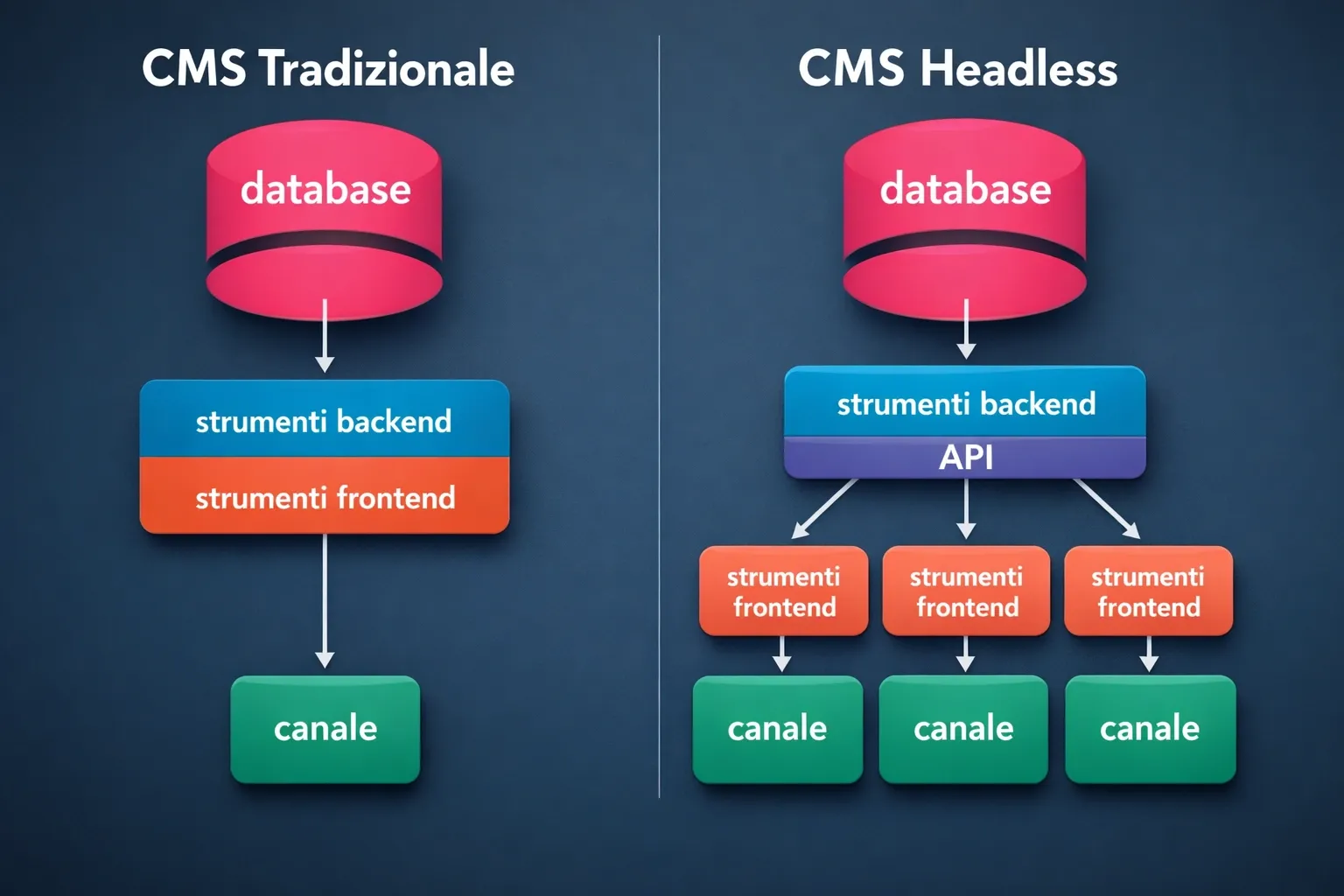
When you start looking at a headless CMS from an architectural point of view, the first thing that changes is that stop thinking of it as a single block and you start to see it for what it really is: a specialized component within a larger system.
This distinction seems trivial, but it's exactly the point at which many projects start to become defensible, because each part returns to having a clear and limited role, instead of overlapping with the others for convenience.
In a headless architecture, the CMS has no responsibility for the final presentation of the content.
It doesn't decide how they will be shown, it doesn't know the layout, it knows nothing about user experience.
His task is define content models consistent, manage reports, versions, editorial workflows and make this data reliably available through well-defined interfaces.
Everything else happens outside.
This leads to an important consequence: the CMS becomes a data provider, not a page generator.
The frontend, which can be a website, an application, an external system or multiple frontends at the same time, consumes that data through APIs and transforms them into a user experience according to logics that no longer depend on the editorial tool.
In this way, the data flow is explicit, traceable and above all explainable.
From the designer's point of view, this means be able to think in terms of boundaries.
You know where content originates.
You know how they are exposed.
You know where they are played.
Each step is an architectural choice and not an implicit consequence of the CMS you are using.
This clarity has an initial cost, because it requires designing before building, but it returns control as the system grows.
When you have to change frontend, you don't touch the CMS.
When you need to change how content is presented, you don't rewrite the backend.
And when someone asks you why the architecture is made a certain way, you can answer without taking refuge in "it's like this because the CMS works like this".
A headless CMS really works on an architectural level when it ceases to be perceived as the center of the system and becomes one of its fundamental services.
That's when software starts to resemble something that can evolve without losing coherence and that can be discussed, analyzed and defended to anyone with enough experience to look at it in detail.
API, content and frontend: roles separated by choice
The separation between API, content and frontend is often described as a technical consequence of the headless approach, but in reality it is an intentional decision, which arises from the moment you stop accepting that a tool chooses for you how the entire system should work.
Here it is not a question of distributing components for fashion or following a pattern because "that's how it is done", but of establishing clear boundaries that make architecture legible, governable and above all defensible.
When the CMS exposes content via RESTful APIs, is openly declaring its role.
He does not interpret, he does not present, he does not decide.
It makes structured, coherent, versioned data available and delivers it to those who will consume it.
This step is crucial because transforms content into a resource, not on a page, and forces those who develop the frontend to treat it as such, with all the responsibilities that come with it.
The frontend, in turn, stops being an extension of the CMS and becomes a full-fledged application.
Whether it is a site, a web app, a mobile app or multiple interfaces at the same time, the frontend makes autonomous decisions on how content is used, aggregated, transformed and presented.
It does not ask for permission from the CMS, it is not subject to its structural limits and can evolve following changing needs without dragging behind it logic that does not belong to it.
APIs become the point of contact, but also the point of responsibility.
Defining an API means make a contract explicit, and a contract, by its nature, must be clear, stable and justifiable.
When you take this approach, you are implicitly accepting certain architectural responsibilities that can no longer be delegated to the tool, including:
- Decide what is content and what is logic
- Establish which data to expose and with what granularity
- Keep stable the contract between backend and frontend
- Make every choice explainable to those who will join the project after you
You can no longer hide behind internal calls or implicit behaviors, because everything that passes through that interface must have a precise architectural sense.
You're giving up the convenience of a system that does everything by itself in exchange for the ability to explain, point by point, why each component exists and what problem it solves.
And when someone with experience looks at the system as a whole, he sees not a tangle of dependencies, but a structure in which each part has a defined perimeter.
Separating API, content and frontend does not serve to complicate the software, but to make it honest.
At this point, the difference between a traditional CMS and a headless CMS is no longer a question of tools, but of the responsibilities that the system assumes or delegates.
| Comparison size | Traditional CMS | Headless CMS |
|---|---|---|
| Role of the CMS | Central system that manages content, presentation and part of the logic | Specialized service that manages content and templates |
| Content and interface relationship | Coupled and often implicit, difficult to separate without forcing | Separate and governed by an explicit contract |
| Presentation responsibility | Internal to the CMS through themes, templates and rendering rules | Outsourced to the frontend, designed and modifiable without CMS constraints |
| Frontend evolution | Conditioned by the CMS stack and theme choices | Independent, replaceable without rewriting the CMS |
| Explanation of choices | Many decisions remain hidden behind conventions and shortcuts | Every choice is visible, declared and questionable |
| Reuse of content | Often limited to one main channel with laborious adjustments | Native across multiple frontends and channels, without duplicating structures |
| Complexity management | Accumulate dependencies and workarounds as the project grows | Distributes responsibilities among components with clear roles |
| Architectural defensibility | Often linked to the limits of the instrument and its internal rules | Linked to the decisions made and the perimeter assigned to each part |
| Developer positioning | Tool operator, geared towards startup speed | System designer, oriented towards boundaries and responsibility |
Honest in the way it grows.
Honest in the way it changes.
Honest in the way it can be discussed without having to continually justify choices you never actually made.
At this point a question is inevitable: could you explain this architecture to another developer, without relying on “this is how it works”?
It is exactly on this type of clarity that the Software Architect Course is built: not patterns to copy, but criteria for deciding, defend and evolve a system as it grows.
If you want to understand how this way of thinking really works, here you can find the complete path.
What is the most used CMS?
When it comes to this question, many still expect a clear answer, a precise name to compare in terms of diffusion, market share or number of installations.
It's an understandable reaction, but also a limiting one, because it shifts your attention to the tool instead of the decisions that the tool forces you to make.
Asking yourself which CMS is the most used only makes sense if you clarify first in what context and to do what, because adoption is never an indicator of architectural quality, but only of initial simplicity, familiarity or technical inertia.
In the world of traditional CMS, some solutions dominate because they allow you to get started quickly, offer a broad ecosystem and reduce the number of choices you have to make at the beginning.
This explains why they are used even when the project begins to exceed the perimeter for which they were designed.
The problem arises when diffusion is confused with solidity and fragile architectures begin to be justified with phrases like "everyone uses it" or "it's the standard".
In that moment you are no longer consciously choosing, you are accepting compromises out of habit.
In the headless world, however, the question changes again.
You are no longer looking for the most used CMS of all, but the one that interferes the least with the architectural choices that really matter.
A tool that does its job well without trying to govern everything else.
This is why solutions like Strapi are mentioned: not because they are definitive, but because they represent the idea of CMS well accept to be a service, not the center of architecture.
They expose content via API, allow you to model complex structures and are inserted into systems where frontend and application logic live elsewhere.
But as understanding of the problem grows, even this distinction begins to no longer be enough.
There comes a time when you realize that there is no CMS on the market It can really meet your needs, your flows and your responsibilities without introducing unnecessary compromises.
Not because it's poorly made, but because it was designed to work in many contexts, not yours.
This is where another, often overlooked possibility takes shape: implementing your own CMS.
Implementing your own CMS, however, does not necessarily mean doing it yourself, nor starting from scratch hoping not to make mistakes.
You risk running into common, predictable mistakes that almost everyone makes the first time.
The real advantage emerges when this path is tackled followed by those who have already made those mistakes, has solved them, and knows how to recognize them before they become structural.
Modeling errors that seem harmless at first. API choices that work today but create friction tomorrow.
Couplings that emerge only when the project grows and going back costs much more than deciding well beforehand.
Being followed means save months of trying, because you are not exploring blindly, but following a path already mapped out, with the dangerous deviations well known.
And this is where time becomes the real cost.
It's also where AI becomes really useful, if used within a guided perimeter, and not as an uncontrolled shortcut.
Today, AI can greatly speed up development, reduce hours of writing, and help explore solutions faster, but it remains an accelerator, not a substitute for reasoning.
The generated code must be understood, adapted, corrected and inserted into a coherent design, otherwise the effect is only to produce more complex problems more quickly.
When competence and experience are combined with AI in the right way, however, the result changes: times are shortened, known errors are avoided and a working and defensible solution is arrived at sooner, without going through blind attempts.
In the end, the right question is not which CMS is most used, but whether the system you are building allows you to explain, without apology, why each part of it exists and why no others exist.
When you start thinking like this, you stop choosing tools for popularity and start designing systems for accountability.
And that's when headless CMS stops being a trend, until the moment comes the instrument is no longer chosen, but constructed with criteria.
When is it the right choice?
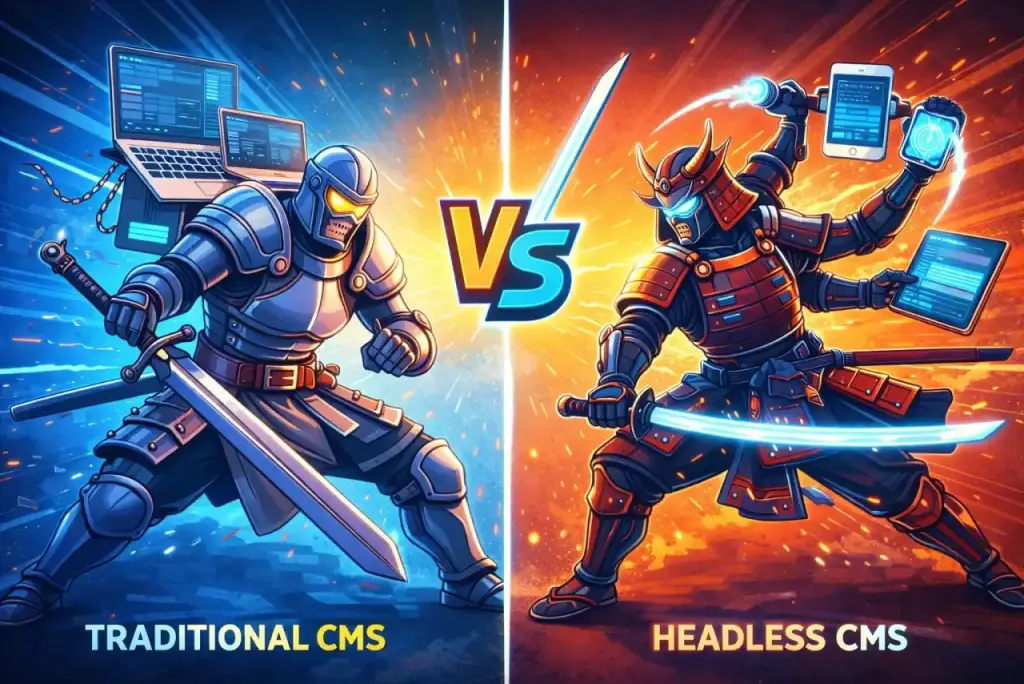
A headless CMS becomes the right choice not when you need something more modern, but when you start to feel that the architectural decisions you are making today they will have to hold up tomorrow, in front of people who will not accept vague answers or justifications based on habit.
It is a choice that matures over time, often after having already experienced the limits of a traditional CMS and having understood that the problem was not the tool itself, but the implicit model that forced you to think in a certain way.
In practice, this moment comes when you start to recognize precise signals in your way of working, such as:
- you notice that every new request requires architectural compromises increasingly difficult to explain
- you start to mentally separate contents, logic and presentation, even if the tool does not provide it
- feel like some “comfortable” choices today they will become a problem tomorrow
- you stop wondering how to do it and start wondering if it makes sense to do it that way
The choice of a headless CMS makes sense when the content stops being tied to a single interface and becomes a resource that must feed multiple frontends, multiple channels or multiple experiences, without each new need leading to a profound restructuring of the system.
In these cases, continuing to use a CMS that links content and presentation means accepting a coupling that is no longer defensible, especially when the project grows and the requests become less predictable.
It is the right choice when the frontend is no longer a simple rendering layer, but an application with its own logic, independent release rhythms and constraints that cannot be subordinated to the internal rules of the CMS.
In this scenario, forcing the frontend within the confines of a tool designed for a completely different purpose generates friction, slows down evolutions and makes every change more expensive than it should be.
A headless CMS also makes sense when you start thinking in terms of separate responsibilities, not because someone suggested it to you, but because you feel the need to be able to precisely indicate where the contents originate, where they are transformed and where they become a user experience.
This clarity doesn't make the job easier in the short term, but it makes it more robust in the medium to long term, especially when the system needs to be understood, maintained, or extended by people other than you.
However, it is not the right choice if you are looking for a faster solution or a way to avoid complex decisions.
A headless CMS requires you to take responsibility for the architecture and accept some upfront conveniences are lost in exchange for control and transparency.
If this exchange seems excessive to you, it's probably not the time yet.
But when you start thinking that an architecture should be explainable without excuses, that choices should stand up to critical review, and that software should be able to grow without accumulating invisible debt, then a headless CMS stops being an abstract possibility and becomes a concrete response to a real need.
How to develop a sustainable headless CMS
Developing a sustainable headless CMS does not mean choosing the right tool and hoping that it will do the rest, because sustainability, in this context, is not a property of the CMS but of the set of decisions you make around it.
A headless CMS can be technically correct and at the same time become unsustainable if it is inserted into an architecture that replicates the same conceptual errors of traditional CMS, only distributed across multiple components.
Sustainability comes from how you define content models, because that's where you decide how flexible or rigid the system will be over time.
Templates that are too general seem to fit everything, but end up representing nothing clearly, while templates that are too specific tie content to contingent use cases that may no longer exist a year from now.
Finding the balance point requires you to think about the domain, not on the interface, and this is already a first sign of design maturity.
Another central aspect concerns the APIs, which in a headless system become the real contract between the CMS and the rest of the architecture.
Sustainable APIs are APIs designed to be stable, readable, and versioned, not just shortcuts to make today's frontend work.
Each endpoint tells a choice, and if that choice is not clear even to those who made it, it will hardly be able to be defended when the system grows or changes direction.
Sustainability also depends on the way in which the CMS is integrated into the development flow.
A headless CMS should not impose rhythms, processes or dependencies that slow down the team's work, but fit into a coherent pipeline, in which content, code and deploy on cloud infrastructure they follow compatible logics.
When this alignment is missing, the CMS becomes a bottleneck, even if it was technically chosen to avoid them.
Finally, there is an often underestimated aspect, which concerns the comprehensibility of the system over time.
A sustainable headless CMS is what you can explain to another developer without having to tell the complete story of every choice made in the past.
If the architecture requires too many exceptions, too many side notes, or too many “workarounds,” it means that something was not designed to last.
Developing a sustainable headless CMS ultimately means accepting that technology is only part of the problem and that the real difference is made by the decisions that make the system readable, extensible and defensible even when those who built it are no longer the only ones who know it inside out.
The change of mentality required of the developer
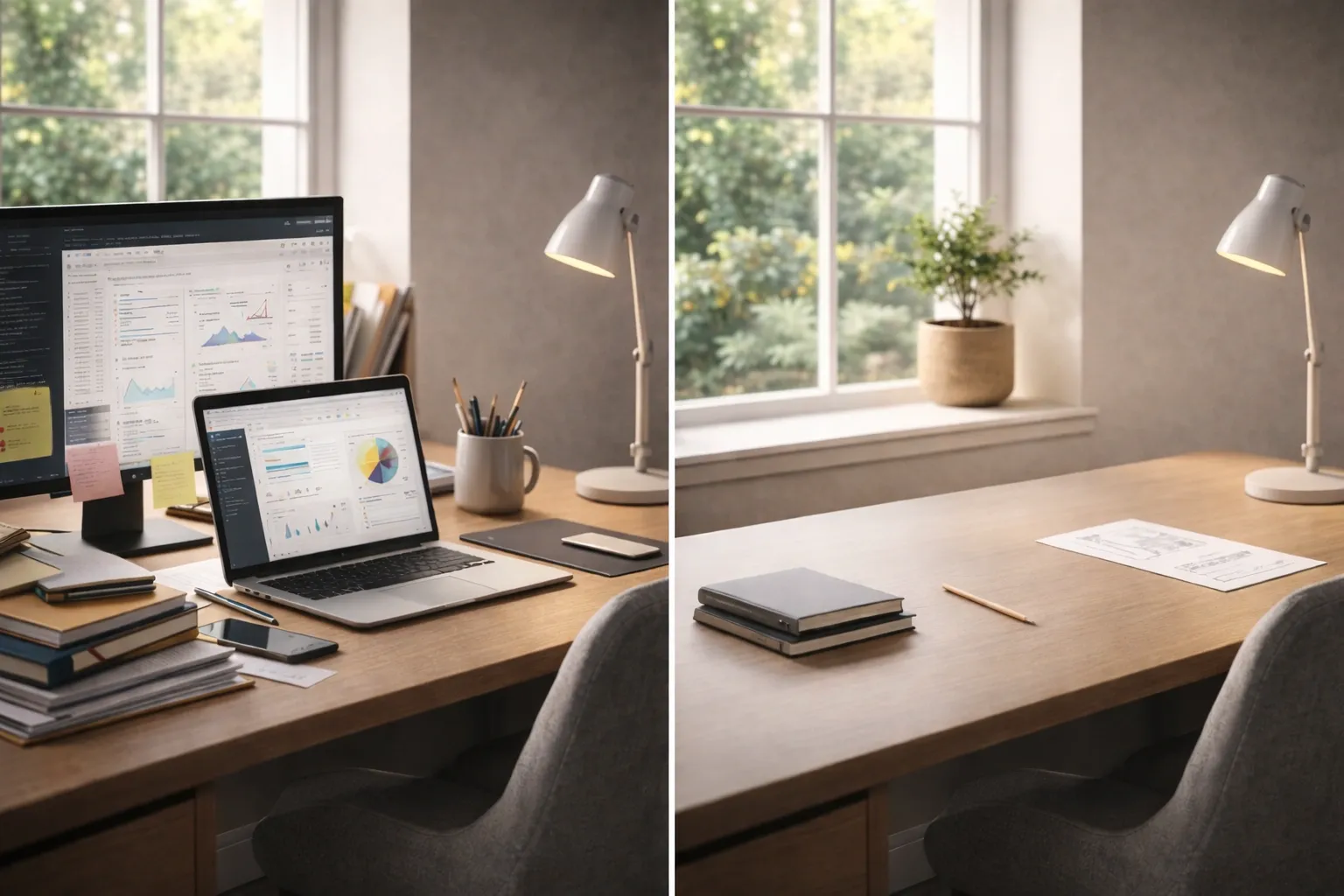
Getting to seriously consider a headless CMS is not the result of having discovered a new technology, but the consequence of a change much deeper in how you look at your role as a developer.
It is the transition from those who implement solutions that work to those who make decisions that must hold up over time, even when the context changes and the people involved in the project are no longer the same.
The change in mentality begins when you stop evaluating a choice only based on how convenient it is today and start wondering if you will be able to explain it tomorrow, without relying on shortcuts or phrases like "it was the simplest solution".
This type of question it does not arise from insecurity, but from responsibility, because it implies the awareness that the software does not live in the moment it is delivered, but in everything that happens afterwards.
Thinking from a headless perspective means accepting that some comforts are lost in exchange for clarity.
You can no longer hide behind implicit behaviors, because every boundary between parts of the system must be intentionally drawn.
This makes the work more demanding, but also more honest, because every decision is visible, questionable and improvable.
The change in mentality also concerns the relationship with tools.
A headless CMS is not something that automatically “makes you work better”, but a tool that amplifies the way you think.
If your approach is superficial, it will amplify the confusion.
If your approach is structured, it will amplify the solidity of the architecture.
In this sense, technology it stops being a shortcut and becomes a mirror.
Then there is an identity aspect, which is often ignored.
When you start thinking in terms of separation of responsibilities, contracts between components and sustainability of choices, you are implicitly shifting your professional positioning.
You are no longer just the one who “makes things go”, but the one who can explain why they work a certain way and why they will continue to do so even when the project grows.
The headless CMS, in the end, is not the end point, but an indicator.
It indicates that you've moved past the phase where just making something work was enough and into the phase where it matters be able to defend every choice in front of those who have enough experience to ask uncomfortable questions.
And that's when you stop being a solution assembler and really start behaving like a software designer.
If reading this article you have found yourself thinking several times that the problem was not the CMS, but the way you have been used to thinking up until now, then you are probably already beyond the phase of tutorials and solutions "that work".
At this point the difference is not made by a new tool, but by... a context that helps you to really train architectural thinking, which makes choices explainable, defensible and sustainable over time.
Our Software Architect Course was created exactly for this type of developer: those who don't want to learn what to use, but how to think when the software grows and decisions start to weigh.
If this approach is familiar to you, it's worth taking a look and understanding if it's the right step for you, now.
Leave your details in the form below