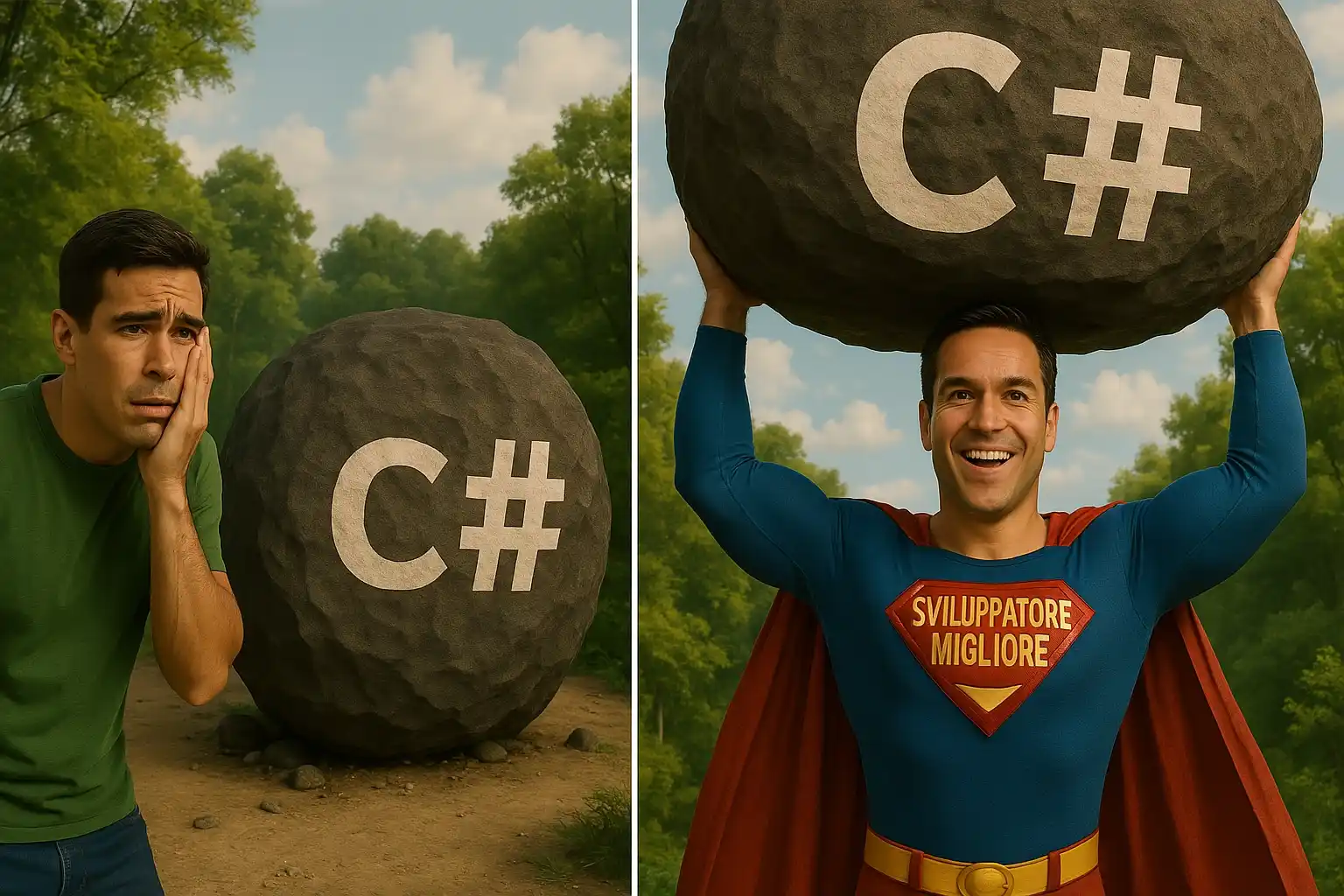

When you hear about C#, the first reaction is often a mixture of curiosity and fear, not because it is a monster to be tamed, but because you were told the wrong way.
You've read articles full of abstruse terms, watched videos that took everything for granted and listened to the opinions of those who abandoned it after barely touching the surface.
Now, you're probably wondering: "Is it really that complex?", "Is it worth tackling?".
The truth is that C# is like a door that it only opens if you approach it with the right key, which is not that of innate talent, but that of the correct approach.
If you want a language that can transform you from an avid geek to a professional developer, then you're in the right place, not because it's necessarily “easy,” but because it's the ideal language for those who want to really learn, build a solid foundation, and not settle for staying on the surface.
C# is only difficult for those who write code without thinking

The real difficulty of C# is not in the language itself, but in how you approach it.
It's easy to think that a language created by Microsoft, used for business software, video games and the web, is necessarily complex by definition.
The truth, however, is that most people find it difficult because they approach it with the wrong mentality: the copy-paste, quick-fix, "it works, therefore it's good" mentality.
He doesn't claim genius, but precision and reasoning, and this is precisely what makes the difference.
Those who approach programming thinking that it is enough to replicate a few tutorials or blindly rely on artificial intelligence to write code, very quickly discover that the real problems begin when something stops working.
It is precisely at that moment that one realizes that it is not enough to just know "how" to write, but above all it is necessary to understand the «why» write in a certain way.
The problem is not the language but the way you think

How many times have you said to yourself: "It's not for me, it's too technical, I'll never understand anything"?
That's normal, but let me tell you a secret: C# isn't hard, it just is extremely logical and, for those with a mind trained in reasoning, this feature represents an enormous advantage.
It is not necessary to think like an expert computer scientist; what is needed is simply to get used to thinking in a more orderly and structured way.
It's a bit like training a muscle when you start playing sports: at first it's tiring, but over time it becomes natural and even rewarding.
In fact, it teaches you to break down complex problems into manageable parts, to plan before acting and to consider different scenarios; skills that go far beyond programming alone and significantly improve your approach to any professional challenge.
The beauty of this language lies precisely in its predictability because, when you write code in C#, every element has a precise purpose, every rule has its own reason for being.
It is not a question of having an innate talent, but rather of developing an analytical mindset which, once acquired, it will appear to you as the most natural thing in the world.
Those who manage to overcome the initial obstacle quickly discover that it is not an obstacle at all, but rather an ally that leads you towards elegant and sustainable solutions over time.
If you're looking for shortcuts you're already in trouble

There's nothing wrong with wanting to learn quickly, as long as it's clear that learning quickly doesn't mean skipping the fundamentals.
C# is one of those languages that punishes you if you try to be clever, giving you the illusion that everything is going smoothly until your code suddenly breaks, leaving you confused and without answers.
At that point you enter a frustrating tunnel of forums, online searches and unsuccessful attempts, which often only make things worse.
Anyone who really wants to learn it must understand that every "shortcut" taken today is nothing more than a longer and more tiring road, disguised as an easy way, which will still have to be retraced in the future.
Those who proceed by learning step by step soon discover that even the seemingly most complex aspects of the language, such as object-oriented programming or memory management, become clear, logical and even pleasant to use.
In contrast, shortcuts in C# often end up turn into technical debt, that is, poorly structured code that, sooner or later, you will be forced to repay with heavy interest in terms of maintenance and debugging.
A solid foundation, on the other hand, allows you to add new features to your software without fear, having the certainty of understanding exactly what is happening "under the hood".
Experienced programmers know this well: the time you decide to invest today in learning the fundamentals it's an investment which will continue to bring you concrete returns for many years.
Keep in mind that there is, in fact, no miraculous tutorial capable of replacing the profound understanding of the key concepts.
The initial curve seems steep but it trains you for the real world

When you start with C#, it seems like everything is complicated.
The brackets, the classes, the types, Visual Studio, .NET... it seems like a jungle.
But then, if you resist the first obstacles, you realize that every element is there to help you, not to get you into trouble.
It is meant to climb; not only in terms of performance, but of skills.
It immediately gets you used to working as you do in the real world: with order, with solid architecture, with code that lasts over time.
This is an incredible advantage compared to those who start with "easier" languages but are then forced to start again from scratch when they enter the world of work.
In tech companies they don't ask you to write simple code, but robust and efficient code.
It teaches you to consider critical aspects, all elements that distinguish a professional programmer from a hobbyist.
Its apparent initial complexity simply reflects the multifaceted nature of modern software.
When an application must manage thousands of users, financial transactions or sensitive data, precision becomes essential.
Once you get past the initial phase, you will discover that has given you the right tools to face real challenges.
It's easier than you think if you know what to avoid

Do you know what the biggest problem is?
The amount of confusing, outdated, or poorly explained information you find online: tutorials that skip critical steps, videos that take everything for granted, forums full of copycat solutions without any real context.
Learning C# is not difficult though someone guides you avoiding the most common traps: useless installations, patterns introduced too early, examples too abstract for beginners.
What you really need is clarity and concreteness, someone who tells you honestly: "You need this, you don't need this. For now, focus here."
With the right direction, complexities are reduced, concepts begin to connect with each other, and everything finally begins to fall into place.
One of the biggest difficulties for those approaching it is distinguishing between essential and accessory characteristics, and it is not uncommon to see people get lost in advanced details before you've even mastered the fundamentals.
A structured path helps you avoid this disorientation and allows you to progress with greater confidence.
Skipping the most common mistakes can literally save you weeks of frustration.
Have an expert mentor by your side, who can tell you what to leave out initially and where to focus your attention, allows you to gradually acquire the truly crucial skills.
Paradoxically, making learning C# easier doesn't mean adding more content, but often reducing the noise and carefully selecting only what you need, exactly when you need it.
Those who start from scratch often learn faster than "fake experts"

There is a very widespread prejudice according to which "if you have never planned, it will be very hard", but the reality is different.
Often, in fact, those who start from scratch are in one advantageous position, because he has not yet acquired bad habits, he does not look for pre-packaged solutions and he does not delude himself into thinking he already knows everything.
On the contrary, those who we could define as "fake experts", i.e. those who have only a little experience with HTML or have superficially tinkered with other languages, they are often in more difficulty in adapting to its rigor and precision.
This happens because they must first unlearn some incorrect concepts before they can learn correctly.
Those who, on the other hand, start completely from scratch tend to have a more humble and open approach, which makes them extremely receptive.
In other words, if you've never written a line of code, you are in the ideal position to face it with the right mentality.
Teaching experience confirms this: absolute beginners often show faster and more constant progression.
This happens because they don't carry with them bad habits typical of those who have already programmed.
Additionally, those starting from scratch tend to be more meticulous in following guidelines and ask key questions rather than assuming they already know all the answers.
Precisely this aptitude for learning is extremely precious to successfully deal with such a rigorous and structured language.
This mental blank slate thus becomes a real competitive advantage, allowing you to absorb concepts in their purest form and without contamination deriving from previous experiences.
Now, do you want to understand which path is best suited to you?
Tell me about yourself, tell me where you start from, what goals you have and where you want to go, so together we can build a path tailored to your specific needs, whether you want to work in a company, become a freelancer or launch your own personal project.
In short, let's start with you.
Learning C# requires discipline, not genius

Let's dispel this once and for all: you don't have to be a genius to learn C#.
What you really need is discipline, because C# is not one of those “creative” environments where you can afford to improvise; it is a serious, structured language designed to build robust and reliable applications.
Precisely for this reason it trains you right from the start to be constant, not to give up when faced with the first difficulties, to fully understand what you are doing and why you are doing it.
And when you develop this aptitude, you not only learn it, but you also become a person capable of confidently tackling any other technology, thanks to a solid and replicable method.
Statistics clearly demonstrate that those who can master C# are not necessarily those who have a higher IQ, but who is constantly dedicated and learning regularly.
Half an hour a day for six months brings much better results than intensive weekend marathons followed by weeks of inactivity.
This discipline emerges clearly when you tackle more advanced concepts: they are not topics that you can assimilate superficially, but require repeated practice, patience and reflection to be fully understood.
The true value of learning it lies precisely in this mental transformation: you develop precision, clarity and clarity problem-solving skills methods that will distinguish you in any professional context, even outside of programming.
It is not a question of innate talent, but of conscious and constant commitment.
The hardest part is not writing code but being consistent

Code, with a good teacher, can be learned; technical concepts are understood with time and practice.
But the part that really tests isn't the theory, but the consistency: finding time every day, resisting the temptation to procrastinate, managing frustration when something doesn't work as it should.
It is precisely here that the real game is played, because whoever manages to get ahead is not necessarily the most intelligent, but the most determined.
Every line of code you write today is a brick that contributes to building your professional future, but to see the results you have to continue building even when you don't yet perceive the concrete effects.
Professional developers know this well: learning C# It's a marathon, not a sprint, and tracing a realistic and sustainable path over time is essential to avoid the burnout that, unfortunately, affects many aspiring programmers.
Stall moments are part of the growth process: there will be days when you feel like you're not making progress, when a seemingly trivial bug can hold you back for hours.
It is precisely in these critical moments that determination makes the difference between those who abandon and those who persevere to become a professional.
Creating daily study and practice habits, even short but regular ones, produces exponentially better results than intensive but sporadic sessions.
The human brain learns most effectively through constant exposure and spaced repetition, especially when it comes to developing complex skills like C# programming.
Studying alone makes it much more complicated than it is

The Internet is full of resources.
The real problem is that no one really tells you where to start, what to do next, or how to avoid common mistakes.
You find yourself jumping from one tutorial to another, without ever actually building anything.
Studying alone means risking wasting months on useless things, misunderstanding fundamental concepts, or getting discouraged because you don't see real progress.
The solution?
Be accompanied by those who have already traveled that road, by those who can tell you precisely where you are, where you are going and what you need to do to get there.
The average self-taught person learning C# takes three times as long as it should, navigating an ocean of information without a compass.
Without guidance, it is easy to develop partial or incorrect understandings of fundamental concepts, creating gaps that will only emerge later, when they are more difficult to fill.
An experienced mentor not only spares you this disorientation, but can customize the path based on your specific needs and professional goals.
It can immediately identify when you're making a conceptual mistake, correcting course before it becomes a habit.
Self-study also lacks the crucial element of feedback: You have no one to evaluate the quality of your code, suggest alternative approaches, or confirm that you're progressing in the right direction.
This continuous feedback is irreplaceable for effective learning.
C# is the perfect excuse to become a real professional

C# is much more than a language: It's a real training camp to become a professional developer.
If you learn this, you learn to think like a real programmer; you learn to structure, design, build solutions that really work.
This skill not only prepares you for what you are facing today, but becomes the basis for everything that comes next: .NET, web APIs, modern architectures, scalable and sustainable applications over time.
If you approach C# with the right attitude, it won't simply be another language to add to your resume, but it will become a real turning point in your career.
The job market confirms this reality very clearly: C# developers are among the most sought after and best paid, because their skills immediately translate into value for companies.
Companies know well that those who master it are able to manage complex projects with method, efficiency and professionalism.
Furthermore, the .NET ecosystem goes far beyond classic desktop applications: you can develop for the cloud, create cross-platform mobile apps, design video games, implement IoT solutions and much more.
This versatility it opens the doors to diversified sectors, offering you endless professional possibilities.
Those who seriously invest in learning C# aren't simply adding a new tool to their arsenal, they're embracing it a real development philosophy suitable for high-level professional/business contexts, which will distinguish him throughout his entire career.
You already have everything you need to become a professional developer.
The first step is to choose a language that concretely prepares you for the real world: C# is the ideal springboard for consciously and competitively entering the software development sector.
Learn this and stop feeling “late” – you can still do it, but you need to start today, not tomorrow.
Book a free call, tell me your story and I'll help you chart the course.
Leave your details in the form below