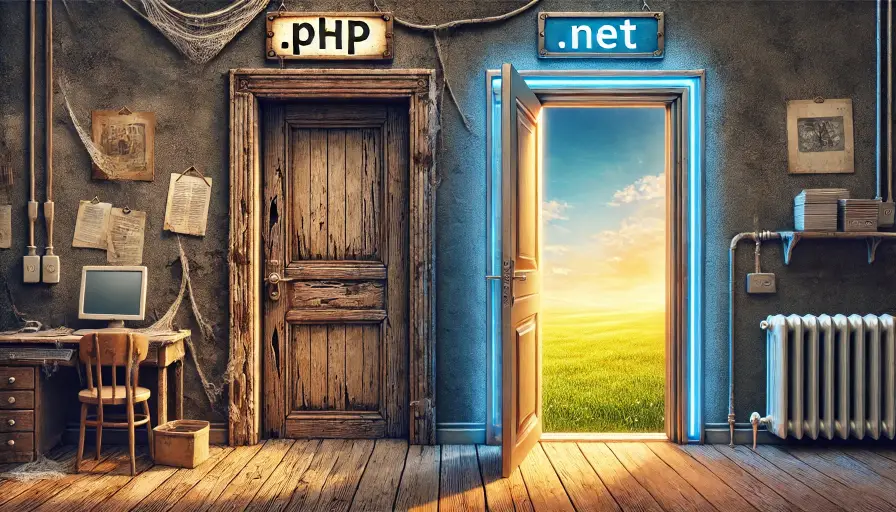

PHP: a relic of the past or a still sensible choice?
If you are here, it's because you want to certainties. Do you want to know if a PHP course it is the launching pad for your career or the dead end that no one warned you to avoid.
The answers you will find in this article may surprise you. Or upset you. Because we won't just repeat what you've already heard around.
Here we analyze what companies don't say, what recruiters know but don't reveal, what could change your professional life.
If you want make the right decision, you need to know the whole truth about PHP. You're ready to find out what no one will ever tell you?
PHP course: the right move or a leap into the void?
They told you that learning PHP is essential.
They have convinced you that it is still a required skill, which can open the doors of the market for you. But have you ever stopped to ask yourself: is it really like that?
The world of programming changes at the speed of light.
What was indispensable yesterday can be a dead end today. PHP is still a strategic choice or became a weight that risks anchoring you to a past that no longer exists?
Observe the market. Are companies really looking for PHP developers as enthusiastically as they once did?
O are they closing their doors, focusing on more modern, more scalable, more requested technologies?
There's a reason why big tech is investing in other ecosystems. There's a reason why more ambitious developers are migrating. It's not a matter of preference, it's a matter of survival.
Stop for a moment. Reflect. Do you really want to invest your time and energy on a language that risks becoming irrelevant? Or do you want to understand what the real opportunities are to build a solid career, with technologies that will guarantee your future?
The choice is yours. But before you make a decision, you need to know the truth that (probably) no one has ever told you.
Learning PHP today: investment or waste of time?

Time is the only resource you cannot buy. Yet, it's one that many developers waste without even realizing it.
Have you ever wondered if you're investing in the future or if you're anchoring your career in a past that won't return?
The question is simple: is investing in PHP today a strategic choice or a one-way ticket to obsolescence?
Maybe you've heard that PHP is still the most used language for the web. And it's true... if you look at the numbers the wrong way. The problem is not how many lines of PHP code still exist in the world, but what future awaits you if you decide to focus on it.
Look at market trends.
Startups receiving million-dollar investments are building with .NET, Python, Node.js. What about companies desperately looking for PHP developers? They are the ones with legacy systems, with old, chaotic code that no one wants to maintain anymore.
Of course, there are still job openings for PHP. But what is the quality of these works? Develop ambitious new projects or maintain antiquated sites, written with outdated technologies?
Your time is your most valuable currency: are you investing it wisely?
Learning PHP today means risking being trapped in a declining ecosystem.
It means accepting lower salaries than those who work with more advanced technologies.
It means playing defense while the rest of the world advances. If you want to secure a future as a developer, you need to look further. You need to focus on technologies that give you a real competitive advantage.
The world is changing. The question is: do you want to change with him or stay stuck in the past?
Is PHP dead? The truth that no one wants to accept

For years we have heard: “PHP is dead”.
But is it really like that? We analyze the data to understand the current reality.
Who provides this data? W3Techs is an independent organization that analyzes the technologies used on the web, monitoring millions of sites to track trends in the most used programming languages, CMS and frameworks.
According to their latest reports, PHP is used by 75% of all websites with a known server-side language.
This means that three out of four sites around the world still rely on PHP to manage their online content and services.
Furthermore, major platforms such as WordPress, which powers over 40% of global websites, are based on PHP, contributing to its diffusion and maintaining its presence in the technological landscape.
But be careful: being widely used does not mean it is the best investment for the future. The real question is: does PHP continue to grow or is it maintaining its position just by inertia?
However, popularity is not the only indicator to consider.
Technological evolution and market needs are redefining the software development landscape.
While languages like Python and JavaScript are carving out specific spaces for themselves, such as artificial intelligence and front-end development, the real change concerns technologies capable of offering scalability, performance and robustness in the long term.
And this is where .NET is emerging as the most strategic choice. Its modern ecosystem, enterprise support and the ability to develop high-performance applications for web, desktop and cloud make it an increasingly adopted tool by companies that want to build robust, scalable and secure software.
Forward-looking developers are choosing technologies that not only meet current needs, but that ensure a stable and competitive future.
And the future of web and software development increasingly speaks the language of .NET.
PHP vs .NET which technology opens more career opportunities in software development

Two technologies, two different destinies. On the one hand, PHP: a language born in 1995 to solve simple problems, grown without a solid architecture and today maintained more by inertia than by innovation. On the other hand, .NET: an ecosystem designed with a vision, capable of scaling, evolving and dominating the enterprise market. The question is: which of the two would you focus your future on?
PHP has reigned the web for years, powering 75% of online sites. But quantity does not determine quality. Many of these platforms are based on old, fragile code, written in an era when security, scalability and performance were just details. Today, languages are measured on their ability to resist evolution, integrate with the most advanced technologies and guarantee developers solid, well-paid careers.
.NET, with its modern and scalable ecosystem, is the language of choice for companies that want to build the future. Backed by Microsoft, optimized for the cloud, with a solid foundation for mission-critical applications. The comparison is not only technological, but strategic: a choice determines your career path, your growth and the opportunities you will have in the next ten years.
Head-to-head comparison: PHP vs .NET
| Criterion | PHP | .NET |
|---|---|---|
| Performance | PHP 8 has improved speed, but remains an interpreted language. Optimizeable with caching and JIT, but under heavy loads suffers from the interpreted nature. | JIT compiled to CLR, with native optimizations for large-scale applications. ASP.NET Core is among the fastest frameworks in the world. |
| Scalability | PHP is mainly used in monolithic architectures (LAMP). To scale, server cloning and advanced caching are used. | Designed for microservices and cloud-native. It natively supports Docker, Kubernetes and Azure, allowing vertical and horizontal scalability. |
| Security | PHP offers protections, but security depends a lot on the programmer. Many PHP sites are vulnerable if not updated regularly. | Enterprise security by default, with advanced authentication and encryption. Follows Microsoft's Security Development Lifecycle. |
| Market demand | Still widely used for websites and CMS, but declining for new complex applications. Lower pay than more advanced languages. | High demand in enterprise, cloud and mission-critical systems. Higher salaries, with constant growth in the job market. |
| Ecosystem | PHP is optimized for the web, with numerous frameworks and full compatibility with Linux. Strong presence in CMS. | .NET is a complete ecosystem: web, desktop, mobile, cloud, artificial intelligence and IoT. Perfect integration with the Microsoft world and cloud computing. |
At this point the question becomes inevitable: are you sure you want to focus on PHP? Sure, it's familiar, you've worked there before, and you still find job offers. But are these opportunities that will lead to a future of growth or will they keep you stuck in a maintenance loop of outdated code?
The question isn't whether PHP will disappear, but whether those who choose to stick with PHP will still be relevant in five years.
The world of development does not reward those who stand still. Companies invest in those with a vision, in those who know the technologies of the future. Today, .NET is not just an option: it is the choice of those who want to command, innovate, dominate.
Do you want to earn with PHP? Only if you avoid this mistake
Can PHP really make you money? The answer is more complex than it seems. If you think that knowing the syntax is enough to get paid well, you are looking at the question from the wrong point of view. Today, the market doesn't pay for the code, it pays for the value. And PHP, alone, is no longer a guarantee.
There is a clear difference between those who use PHP to build digital empires and those who find themselves stuck in poorly paid projects, made up of obsolete CMS and low-cost websites. The truth is, if you want to make money with PHP, you need to understand where the market is going and how to position yourself strategically.
PHP for SaaS, APIs and Scalable Platforms: Is it Still a Good Choice?
PHP is still used to develop advanced products, but it is gradually losing ground. It was once a common choice for building SaaS applications, marketplaces and APIs, but today companies are migrating towards more scalable and performing solutions.
Industries where PHP is still used include:
- CMS-based SaaS backends (e.g. WordPress-based SaaS).
- E-commerce platforms such as Magento and WooCommerce.
- Maintenance of old systems and legacy projects.
- REST API, but increasingly overtaken by cloud-native technologies.
However, PHP suffers from structural limitations: It is not designed for native microservices, does not efficiently handle large concurrent loads, and struggles to compete with more modern stacks.
The market is shifting: here's where the real profits are going
Companies developing SaaS products, scalable applications and modern APIs today are turning to more advanced technologies. Some of the most used stacks are:
- .NET (C#) → Perfect for cloud, microservices and enterprise projects.
- Node.js → Used for real-time applications and web scalability.
- Python (Django/FastAPI) → Dominant in AI and automation.
- Golang → Chosen for high-performance cloud systems.
- Rust → Emerging for ultra-performance and secure software.
Even Facebook, once the largest user of PHP, had to rewrite much of its backend, because the traditional one no longer supported scalability request.
PHP vs .NET: The Difference Between Surviving and Thriving
If your goal is to build a solid, well-paying career, you need to ask yourself: Is PHP still the right tool? Or are there alternatives that allow you to access more profitable projects?
.NET has one key advantage: It is used in large enterprises, mission-critical projects, cloud computing and enterprise architectures. This means less competition, customers with bigger budgets and better career opportunities.
| Feature | PHP | .NET |
|---|---|---|
| Market | Declining for new applications, still used in traditional CMS and websites. | Strong growth for enterprise, cloud-native and microservices projects. |
| Scalability | Possible with load balancing and caching, but structurally limited. | Designed for microservices and cloud computing, with native support for Kubernetes. |
| Salary | Lower average salaries (~$84k/year in US). | Higher average salaries (~$116-125k/year in US). |
| Future | It risks being confined to legacy projects and traditional websites. | Innovative and expanding thanks to integration with AI, cloud and modern architectures. |
The real question is not how much you can earn with PHP, but how much you are losing by not exploring more profitable alternatives such as .NET course.
PHP can still generate revenue, but the market is shifting. Companies looking for PHP developers today often do so to maintain old code. Those that focus on the future are investing in technologies that guarantee scalability, security and performance.
If your goal is a solid, well-paid career, .NET course represents one of the most strategic choices. The world does not wait: those who adapt to new technologies advance, those who remain stagnant are overtaken.
The language you need to know if you want to overcome the limitations of PHP

Do you want to know the real secret? There is a language that allows you to overcome the limitations of PHP and which is opening the doors to a new era of web development. Those who discover this stop using PHP in the traditional way and position themselves among the most sought after professionals.
PHP's problem is not just technical, but strategic.
It was born in an era when the web was simple, needs were limited and backend development was based on monolithic logic.
Today, the market has changed: companies are looking for efficiency, scalability and integration with advanced systems. And there is a language that responds perfectly to these needs.
PHP limits you. That's why you need a more powerful alternative
PHP has helped build millions of websites, but when it comes to modern projects, obvious limitations emerge:
- Reduced scalability: it was not born for microservices, while today cloud-native architectures require independent and highly scalable components.
- Security not integrated- Securing a PHP app requires advanced skills and consistent best practices, while other languages offer native security.
- Lower performance: PHP 8 has improved performance a lot, but in large-scale tests it continues to be beaten by more modern solutions.
- Narrow scope of application: PHP is excellent for the web, but beyond the confines of e-commerce sites and CMS, it loses competitiveness.
.NET: the key to the future of web development
If you want to overcome these limitations and work on innovative projects, you need to look at a .NET course. It is the choice of companies that invest in cutting-edge technologies and that are looking for developers capable of building scalable, secure and high-performance software.
Why is .NET the future? Because it allows you to develop not only websites, but also high-level APIs, microservices, enterprise applications and cloud systems. Thanks to its native integration with Azure and the performance guaranteed by JIT compilation, it is the perfect choice for those who want to stand out in the world of development.
PHP or .NET? The choice you make today decides who you will become
The real question isn't whether or not PHP will disappear.
Languages don't die overnight, but they transform, adapt, evolve... or are left behind. And today, as the world of programming moves towards more advanced architectures, PHP is losing ground.
Every developer reaches a crossroads: continue to invest their time in a technology that, although still widespread, is gradually being overtaken by market needs, or focus on tools that offer a more solid, scalable and profitable future.
The data speaks clearly: companies are increasingly looking for .NET developers to build cloud solutions, microservices and large-scale applications. The demand for qualified .NET professionals is constantly growing, and with it the possibilities for earning and career advancement.
If you want to overcome the limitations of PHP and access the most profitable opportunities, you need to master modern tools and winning strategies. The .NET course it is the bridge to ambitious projects and high-value careers.
PHP has been a mainstay of web development, but the future doesn't wait. Progress rewards those who are willing to reinvent themselves, master modern tools and stay ahead of the market.
The choice is yours: remain anchored to a language that is progressively losing relevance, or embrace a technology that will guarantee you more security, more opportunities and more professional growth?
The future belongs to those who are ready to evolve. Are you ready to make the leap?
Leave your details in the form below