What is the number that decides whether law firm management software will save you money?
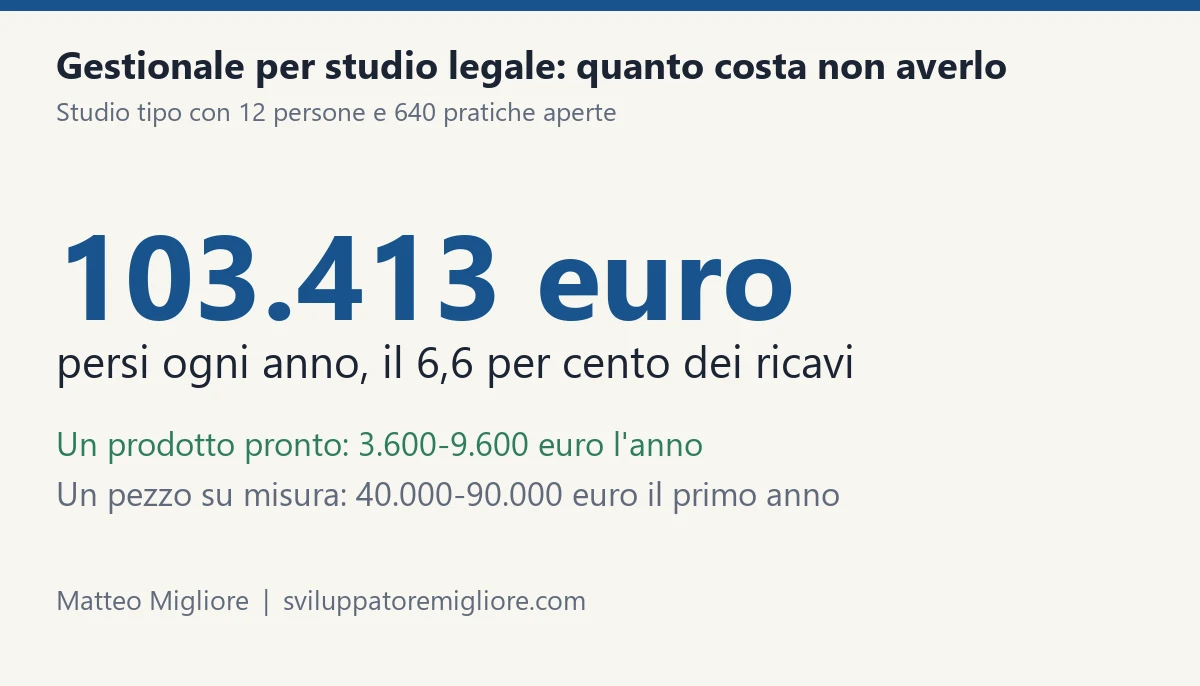
With a realization rate above 92 per cent a shared calendar and a time sheet are enough; between 82 and 92 per cent software pays for itself within the year; below 82 per cent you almost certainly need it. In a firm of 12 people and 1.56 million euros of revenue, the six items of working with calendars, sheets and folders cost about 103,400 euros a year, 6.6 per cent of revenue. A ready-made product costs between 3,600 and 9,600 euros a year, a custom piece between 40,000 and 90,000 in the first year and pays off over a product above 3.1 million euros of revenue or with several offices and fee rules of its own.

It is seven o'clock on a Thursday evening in late July, and in an Italian law firm of twelve people a secretary is checking the week's list of deadlines for the third time. Three are written in the shared diary, two in the spreadsheet the senior partner uses, and one in a note on a colleague's phone. A ruling notified on Monday by certified email (PEC) sets a deadline that, with the August suspension in the middle, someone has calculated one way and someone else another. Nobody made a mistake. But the firm lives off a trade in which a date written in two different places is a date that sooner or later gets lost, and when that happens the damage is not an annoyance: it is professional liability.
Law firm management software exists to take this evening away, but not every firm needs it, and those that do often buy the wrong program first. Here you will find what the term really means, how much it costs every year not to have it, the number that tells you whether you need it, how a deadline should live inside a system, how to keep time, expenses and fees together without anyone rebelling, when a ready-made product makes sense and when to build something, and where artificial intelligence helps without doing harm.
An honest preface. I have been building software for companies since 1999, and I know the trade of law firms from the inside: I built LegalDesk, a program for law firms, and grew it until I sold it. I am not a lawyer and I will not tell you how a rule applies: calculating a deadline, a professional ethics obligation or a legal requirement remains your responsibility and that of the people who advise you. I will tell you how a system should behave around those decisions. The case I use throughout the article is a typical firm, built from orders of magnitude I have seen in similar projects and from industry averages: it is not a client's data and I do not want to pass it off as such. It serves to show the method, and you can redo the method with your own numbers in an afternoon.
What is law firm management software, and what is it not?
Law firm management software is a system that keeps in one place the things a firm handles every day: the register of clients and opposing parties, the file for each matter, deadlines and hearings, documents and communications, hours worked, expenses advanced, fees and payments received. The value does not lie in any one of these functions on its own. It lies in the fact that each one reads what the other has written: when a hearing is postponed the deadline changes, when an hour worked is recorded the matter is updated, when a phase is closed the invoice is ready with the expenses already in it.
It is not the program for drafting documents and Italian electronic court filing (processo telematico). That one, which usually comes from a large legal publisher, is for writing, signing and filing, and for reading the electronic case file. A firm that has it already has an important part of the trade under control, but that program does not know what the matter cost or whether the invoice has gone out. It is not the invoicing program: it issues electronic invoices and nothing more, and usually ignores the relationship between hours worked, expenses advanced and the agreed fee. Nor is it the shared diary with a spreadsheet for time, which works very well as long as there are sixty open matters and two people using it, and stops working when there are six hundred matters and twelve people.
The difference shows with two questions. The first: "on this matter, right now, what is the next deadline and who is answerable for it?". The second: "on this matter, how much have we worked and how much have we invoiced?". If answering requires opening the diary, two network folders and the time sheet, and trusting the memory of whoever follows the work, what you have is a set of tools, not a management system. That is not necessarily bad: a firm with three lawyers handling sixty matters can live perfectly well with a shared diary and a fee template, and further on you will find the threshold below which nothing else is worth it.
The term covers different trades, and it helps to tell them apart. The generalist firm, with civil, employment, family and debt recovery work, has many small matters and a high volume of deadlines. The specialist firm in corporate or commercial law has few large matters, high hours and clients who ask for a detailed statement. The debt recovery firm lives on numbers: thousands of positions, standard times, fees tied to the outcome. The in-house legal department of a company does not bill anyone, and its problem is contracts, disputes and budget. The right system for each is different, and a product designed for mass litigation rarely holds up in a firm that lives on advisory work.
What if you already have a program?
This is the most frequent case, and the answer is almost never "throw it away". Before changing, measure what it does and what it does not do. If the system you have calculates deadlines, alerts the person in charge and their deputy, keeps time tied to the matter and prepares the invoice with the expenses, the problem is not the tool but how it is used. If instead every answer requires an export and a spreadsheet, you have an archive, not a management system. In that case the cheapest route is often a small piece alongside what you have, which reads the data and produces the list of deadlines without an owner and of closed matters without an invoice, without touching the drafting program and the accounting.
One last calculation, which sellers do not make: the cost of changing your mind. A product is left behind with a data export and a month of nuisance; a custom piece has an owner, and that owner is you. Before signing any contract, ask how client records, files, deadline history, time and fees are exported, and in what format. For a law firm there is one more reason: that data contains professional secrecy, and where it sits and who can read it is a question you do not ask after signing.
Why does money get lost in a law firm between the work done and the invoice?
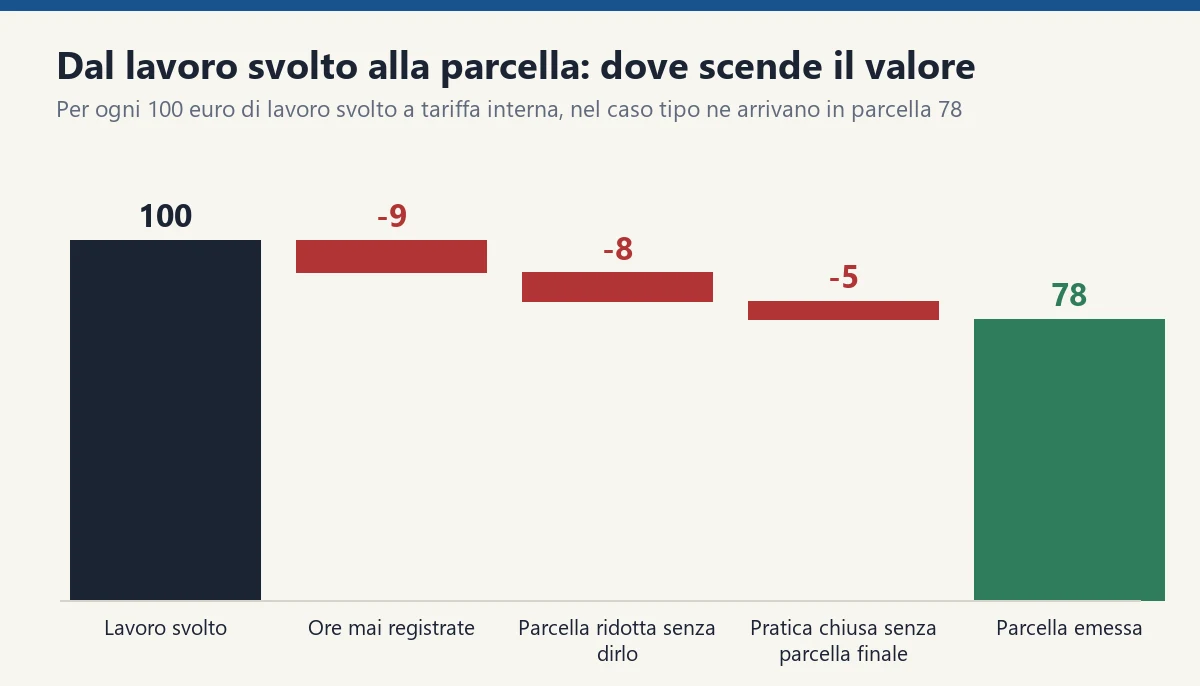
It gets lost because a lawyer's work is made of small pieces, and each piece has a moment when it has to be written down. A ten-minute phone call with the client, twenty pages of documents read, research on a precedent, a forty-minute hearing after two hours waiting in the corridor, a long email. None of these pieces, taken alone, is worth an invoice. Together they are the firm's work, and if half of it is not written down, the final invoice tells the story of a lighter matter than the real one.
The first point of loss is the hour that is never recorded. The professional works, moves on to something else, and in the evening cannot remember whether they spent an hour or three quarters of an hour on that matter. Between the three things to note and the time to note them, time wins. The second point is the invoice reduced without saying so: the partner looks at the total, finds it high compared with what the client expects, and takes something off. Giving a discount is a legitimate choice, but if nobody writes down that it is a discount and why, the firm learns nothing and the cost figure for the matter no longer exists.
The third point is the matter that closes and is not invoiced. The ruling has arrived, the client says thank you, the file goes to the archive, and the final invoice, the balance one, stays in intentions. It happens more often than firms admit, and it happens in different ways: the matter with an advance received at the start looks fine, but the advance covered the first phase and the rest was never requested. The fourth point is delay: even when the invoice goes out, it goes out late, and between the end of the work and the payment months pass in which the firm finances the client.
None of these points has a culprit, and that is why they cost. A system that merely prints an invoice does not see them. One that keeps time, expenses and fees linked to the same matter brings them out one by one, with a line and an amount. The practical rule I use with clients is simple: if answering "how much is the work done on this matter worth and how much of it have we invoiced" takes more than ten minutes and more than one person, the relationship between work and invoice is not under control.
How much does it cost every year to run the firm with a diary, spreadsheets and folders?
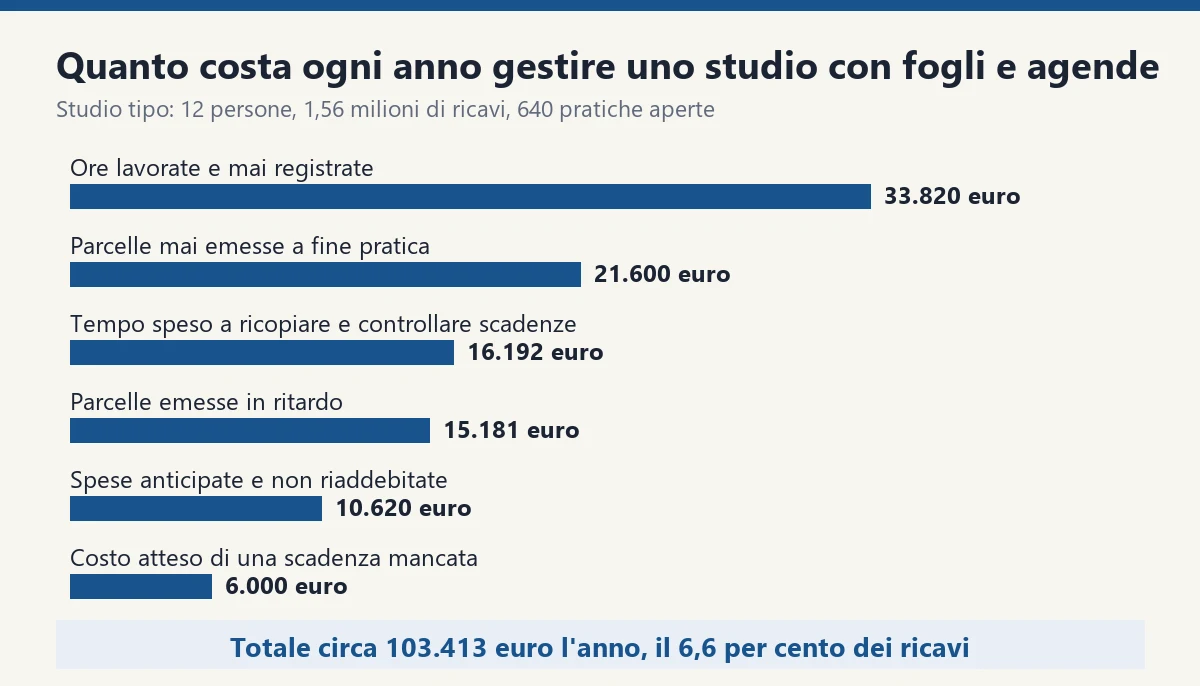
It is calculated in six items, each measurable with data the firm already has. The typical case is a firm of twelve people: seven lawyers, two trainees and three administrative staff. It handles 640 open matters, opens about 310 a year and closes about 280. It has 1.56 million euros in revenue. Every year it advances about 118,000 euros in expenses on behalf of clients, among fees, stamps, searches, travel and expert reports. The realised hourly rate, meaning what the firm actually collects for each hour invoiced, is 95 euros.
The first item is hours worked and never recorded. In the typical case the nine people who work on matters write down on average two hours a week less than they actually do, for forty-four weeks a year: 792 hours. Of these, 45 per cent would have been billable, that is 356 hours, which at 95 euros come to 33,820 euros. It is the most underestimated item, because it leaves no trace: no invoice, no deadline, just a matter that seems to have cost less. You measure it over two weeks by having everyone write down what they do and comparing it with what they had recorded.
The second item is matters closed without a final invoice. In the typical case there are nine a year, with an average forgotten balance of 2,400 euros: 21,600 euros. You find it by taking the list of matters closed in the last twelve months and checking, one by one, that there is an invoice or a note explaining why there is not. Almost always, the first afternoon you do this round, two or three matters turn up for which the client never received the request.
The third item is the time of whoever copies and checks the deadlines. Every document that arrives has to be written in the diary, in the lawyer's spreadsheet and in the file, and every week someone rereads the list to be safe: about eleven hours a week between administrative staff and professionals, for forty-six weeks, at an hourly cost of 32 euros: 16,192 euros. It is the time of capable people, spent photocopying a date. The fourth item is invoices issued late. 60 per cent of billings go out with an average delay of 74 days compared with when they could have gone out, with a cost of money of 8 per cent: 15,181 euros.
The fifth item is expenses advanced and not recharged, or recharged late: 9 per cent of the 118,000 euros, that is 10,620 euros. They are the 98 euros of a search, the 540 of a trip, the expert report paid for and never put on the statement. The sixth item is the most delicate, and it is an expected cost, not a bill paid: the missed or nearly missed deadline. If in a firm like this, working the way it does today, once every two years there is a mistake that costs on average 12,000 euros between time to fix it, fees returned and the insurance deductible, the expected cost is 6,000 euros a year. I mark it as an estimate, and you only know yours if you count the near misses of the last three years.
The sum comes to about 103,400 euros a year, 6.6 per cent of revenue. I have run the test with several firms and the rule of thumb I took from it is this: below 2 per cent the disorder is a nuisance and not a priority, between 2 and 4 it is worth a close look, above 4 you almost certainly need something. Here 6.6 per cent is more than a partner's salary. Two warnings. Not all the items are recoverable: no system gives you back the 103,400 euros, and anyone who promises it is selling you something. What a good system recovers, in the projects I have seen, lies between 40 and 70 per cent, because unrecorded hours and forgotten invoices are only recovered if there is a place to write them down right away. And the items must be recalculated with your numbers: in a debt recovery firm delay and time weigh more, in a specialist firm hours weigh more.
What is the number that decides whether you need law firm management software?
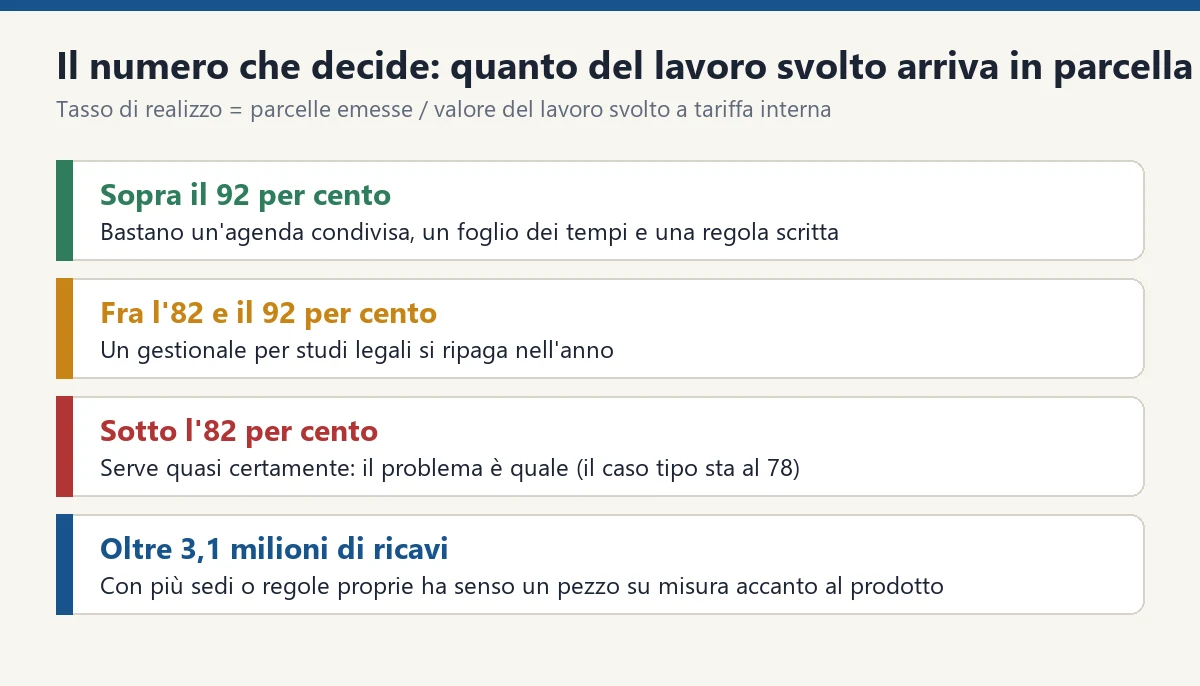
It is not how many matters you handle. The deciding number is the realisation rate: how much of the work you have done, valued at your internal rate, actually reaches the invoice. The reason is simple. The points missing from realisation are the sum of all the things a management system should see: unwritten hours, unexplained discounts, forgotten balances. If realisation is high, the process holds even with poor tools. If it is low, no spreadsheet saves you.
In the typical case the work done, valued at internal rate, is worth about 2.0 million, and the invoices issued are 1.56 million: realisation is 78 per cent. You measure it like this, in an afternoon. Take the last twenty closed matters, add up the work done using the hours recorded and those the person estimates they did not write down, multiply by the internal rate, and divide the invoiced amount by this figure. If the firm works on fixed fees and not by the hour, the calculation is done all the same: you value the time with an internal rate and compare it with the fixed fee collected.
I use four thresholds. With realisation above 92 per cent a shared diary, a time sheet and a written rule are enough: no matter closes without an invoice or a note. Between 82 and 92 per cent a product for law firms makes sense, with deadlines, time and fees linked: it pays for itself within the year. Below 82 per cent a management system is almost certainly necessary, and the problem becomes which one. Above 3.1 million euros in revenue a year, with several offices or fee rules of its own, a piece built to measure alongside the product starts to make sense.
For those who love numbers, here is the extraction I use when the client already has a database of time and invoices. It is an example query: the table names are invented, the method is not. For each matter closed in the last year it gives the value of the work, the amount invoiced and the realisation as a percentage.
SELECT
    p.Codice,
    p.Cliente,
    ROUND(t.OreRegistrate * 95, 0)                      AS ValoreLavoro,
    ISNULL(f.Fatturato, 0)                              AS Fatturato,
    ROUND(100.0 * ISNULL(f.Fatturato, 0)
        / NULLIF(t.OreRegistrate * 95, 0), 1)           AS RealizzoPercentuale
FROM Pratiche p
JOIN (SELECT PraticaId, SUM(Ore) AS OreRegistrate
      FROM TempiLavorati GROUP BY PraticaId) t
    ON t.PraticaId = p.Id
LEFT JOIN (SELECT PraticaId, SUM(Imponibile) AS Fatturato
           FROM Parcelle GROUP BY PraticaId) f
    ON f.PraticaId = p.Id
WHERE p.Stato = 'Chiusa'
  AND p.DataChiusura >= DATEADD(YEAR, -1, GETDATE())
ORDER BY RealizzoPercentuale ASC;
If you have no database, the same calculation is done with a spreadsheet and twenty rows. The number that comes out is not a grade: it is a threshold. And like all thresholds it has another side, which is the map of where realisation falls. In almost all the firms I have seen, two or three types of matter do more than half the damage, for example long cases with many phases or recoveries that end in a settlement. Knowing where realisation falls is already half the cure.
And the other two numbers?
There are two that go with the first and serve as a cross-check. The first is how many deadlines, in the last year, were discovered less than five days before the due date: above three or four, the problem is not someone's distraction, it is that the alert system does not exist. The second is the share of matters closed without a final invoice or without a note explaining why: above 2 per cent, there is money on the table. With high realisation and these two numbers good, change nothing.
What should a management system do with a deadline, before anything else?
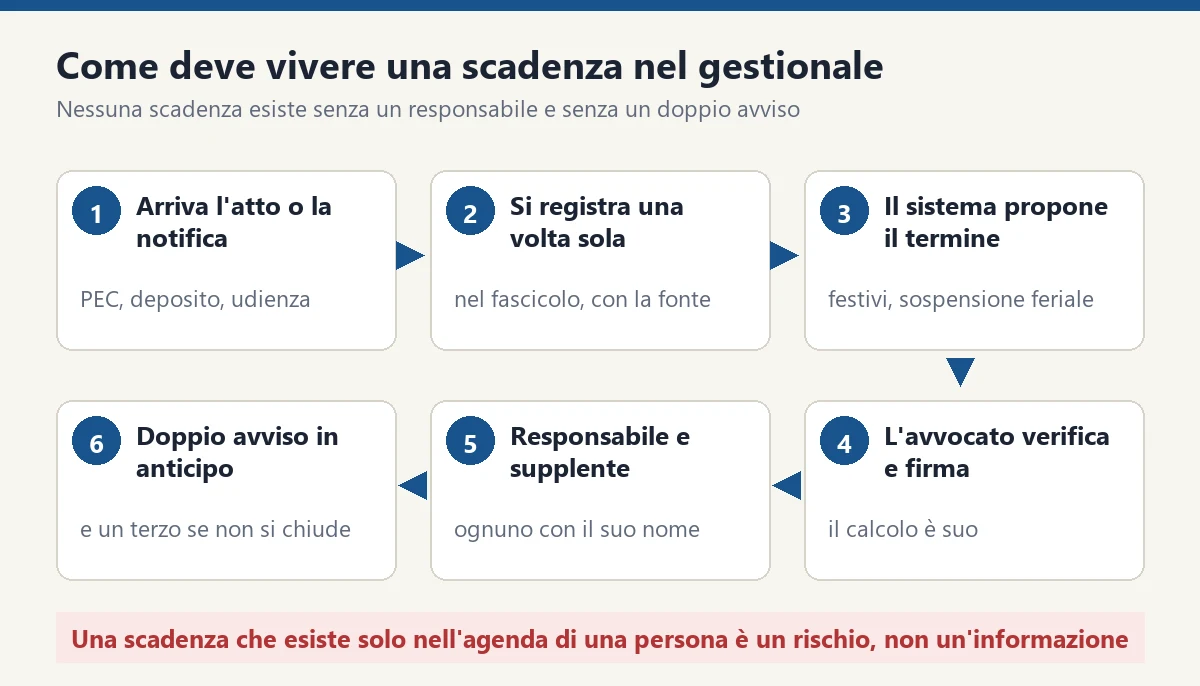
It must treat it as the one piece of data in the firm that cannot exist in two places. In LegalDesk the rule, from which I started for everything else, was this: no deadline can exist without a person in charge, and that person is alerted early, and then again before it becomes urgent. It sounds like little. It is what separates an archive of dates from a system that protects the firm.
The path is told in six steps. In the first the document arrives: the PEC notification, the ruling, the hearing summons. In the second it is recorded only once, in the file, with its source: the PEC address, the notification date, the document. Whoever copies the date into a diary and a spreadsheet creates three dates, and three dates are an accident waiting to happen. In the third the system proposes the deadline, taking into account what it knows: public holidays, the suspension of deadlines during the court recess, which in civil matters runs from 1 to 31 August, and deadlines counted backwards from the hearing and not forwards from the notification.
The important word is "proposes". In the fourth step the lawyer checks and signs off the calculation, and the system keeps a trace of it: who confirmed it and when. Calculating deadlines is a professional responsibility, and software that presents the result as certain takes away from the lawyer the only check that matters. A good system saves the work of counting and leaves the decision to the professional. In the fifth a person in charge and a deputy are named, each by name: without the deputy, a deadline that falls during someone's holiday has a person in charge on the beach. In the sixth the double alert goes out, spaced in time, and a third alert goes to whoever coordinates the firm if the deadline is not yet closed.
Two details that products rarely show and that make the difference. The first is the deadline that moves: a postponed hearing or an extension changes the date, and the system must also move the alerts and the backward-counted deadlines that depend on it, keeping the history of what was there before. The second is the distinction between deadline and target date: the deadline is the last day, the target date is the one on which the firm decides to have the document ready, and in an orderly firm there are days of margin between the two written in the system and not in someone's head.
In a firm like this the deadlines do not need to be many, they need to be all in the same place. If even one lives in a personal diary, the system cannot protect it, and the rest of the investment loses its meaning. It is the condition I set for every client before starting: the personal diary is closed, and every date goes through the file.
How do you keep the file, documents, PEC and electronic court filing together?
You keep them together by deciding what the home of each document is, and this is a choice before it is a purchase. A firm produces and receives every day documents, rulings, receipts, emails, scans, expert reports, contracts. If everyone saves them where it suits them, finding a document takes the memory of whoever saved it. The rule that works is a single one: the document lives in the matter's file, with a name built by the system, and everything else is a link.
The delicate point is the relationship with the Italian electronic court filing tools. The firm already has a program for drafting and filing, which talks to the justice system, and that program is almost always irreplaceable. A management system must not redo it. It must read what comes out of it: the filing receipt, the notified ruling, the hearing date, and turn them into deadlines and documents in the file. This is why the question to ask whoever sells you a management system is not "do you have electronic court filing?", but "how does what arrives from the PEC and from the filing get into the file and the deadlines, and with how many manual steps?".
The PEC deserves a chapter of its own, because for a firm it is the most important channel and the least governed. Notifications arrive in a shared mailbox, each person reads them when they can, and the implicit rule is that "if there is something urgent someone will notice". A serious system sorts the PEC messages by matter, records who has read them and who has worked on them, and ensures a notification can never stay unread for a week. In the typical case the average time between a notification arriving and the deadline being recorded was two and a half days: it sounds like little, until you remember that some deadlines are twenty days.
Then there is search. When a client phones, whoever answers must see within ten seconds the state of the matter: last activity, next deadline, who follows it, what has been charged. These are not ten functions: it is one page. If answering means opening four programs, the call becomes a promise to call back, and promises to call back are the first item of lost time. This is why, in a good system, the matter page is the most carefully designed screen of all, and the others exist to fill it.
Conflict of interest, anti-money laundering, privacy and professional secrecy: what must the system handle?
It must make it easy to do the things the profession already requires, without claiming to replace the lawyer's judgement. There are four areas, and for each it helps to know what to ask. A preface I always repeat: I am not a lawyer, and every legal or ethical obligation must be verified with someone who has the competence. Here I talk about how a system helps you not to forget it.
The conflict of interest is the most concrete. Before accepting an engagement the firm must check that it has not already assisted, or does not now assist, an opposing party, and this check is done on names, companies, shareholders, relatives. With an archive of thousands of matters, doing it from memory is a risk. A system that lets you search a name across all the records, including opposing parties and connected persons, and keep the outcome of the check with the date and the person who did it, turns an obligation into a thirty-second gesture. This is one of the functions I ask for in every project, because it costs little and protects a lot.
The anti-money laundering rules concern lawyers only in certain cases, when they assist the client in operations of a certain kind, and here too the judgement on whether the obligation applies belongs to the professional. Where the obligation exists, you need verification of the client's identity, retention of documents for the required time and a risk assessment. A good management system offers a record with the documents collected, the update deadlines and a history that cannot be edited, and leaves to the firm the decision of when to use it. The risk, in this area, is not having no software: it is collecting the documents and losing them.
The privacy area is the third. A firm handles personal data of every kind, including data on health, convictions, family and financial situation. Whoever handles this data must know where it is, who can read it and how long it is kept. In practice you need permissions per matter (not everyone sees everything), an access log, a way to export a person's data and to delete what no longer has to be kept. If a supplier of the system is external, the firm appoints it as data processor and knows where the servers are.
Professional secrecy is the fourth, and the simplest to state and the hardest to guarantee. It means that what the client has confided to the lawyer must not leave the firm, and therefore must not end up in an external service nobody has examined. I often see it with the new tools for transcription, translation and summarising: very convenient, and with a question behind them that nobody asks, namely where the texts end up. Before uploading a document or an email to a service, the firm must know who receives it, where, and whether it keeps it or reuses it for something else. I deal with it more calmly in the part on artificial intelligence.
How do you record time, expenses and fees without anyone rebelling?
You record them by making the recording smaller than the annoyance. Lawyers hate the time sheet for a reasonable reason: it feels like control, costs effort and gives nothing back. A system that asks you to fill in forty fields for every activity will be bypassed within a week. One that lets you write "read opposing brief, 45 minutes" in five seconds, from the phone or from the program used to write the document, will be used. The difference is not in the technology, it is in the friction.
Three measures that work. The first: suggest instead of asking. The system knows there was a hearing this morning, that two documents were written, that four emails arrived on the matter; it proposes the activities, and the person confirms or corrects them. The second: show the writer the return. When each professional sees their own realisation, meaning how much of their hours reached the invoice, and sees it every month, writing time stops being an obligation and becomes a mirror. The third: a simple rule on the deadline. Hours are written by Friday, and on Monday the system flags who has empty weeks.
For expenses advanced the rule is even simpler: the expense is recorded at the moment it arises, with the matter, and goes automatically into the next statement. The unified court fee paid today is already on the record when the client comes to collect the copy. The search, the trip, the revenue stamp each have a line, with an amount. In the typical case 9 per cent of expenses were not recovered precisely because they arose outside the matter, on a person's credit card, and reached the administrative staff three weeks late.
For fees a basic choice is needed: by phase, fixed fee, hourly, success-based, or a mix. The system does not decide for you, but it must remind you of the choice made. If you agreed with the client a fee by phases (study, filing, evidence, decision), each closed phase generates an invoice reminder; if it is a fixed fee with advances, the advance deadlines are in the matter; if it is hourly, the monthly statement writes itself. The invoice that goes out, like the electronic invoice and the items of cash and withholding, remains something the accounting program does better, and the management system passes it the data.
One last observation, on transparency toward the client. More and more corporate clients ask to know what is being done and what it costs. A system that lets you show, on one page, the state of the matter, the next dates and the fee accrued saves phone calls and builds trust. And it reduces disputes over invoices, which almost always arise from surprise and not from the amount.
What changes between a generalist firm, a specialist firm, debt recovery and an in-house legal department?
The centre of the system changes, and that is why the product "for everyone" works badly for each. For the generalist firm the heart is deadlines and volume: many matters, many hearings, many documents. Here the system is worth it if it makes you forget the diary, and the rest comes after. For the specialist firm in corporate or commercial law, with few large matters and clients who read invoices with a ruler, the heart is time and the statement: every hour must have a description, and the note must be readable by a finance director.
For the debt recovery firm the centre is numbers. Thousands of positions, standard times for each phase, amounts recovered, fees tied to the outcome. The work is repetitive and the margin lies in automation: letters, reminders, serial documents, checking payments. Here the comparison with specialised products must be made with the utmost honesty: they are often already good enough, and it makes sense to build only the bridge with accounting and with the client portal. A management system designed for complex cases, on the contrary, drowns under the volume.
For the in-house legal department of a company there is no invoice, and the problem changes. You need contracts with their deadlines and renewals, disputes with outside counsel, budget and costs per matter, advice to departments. The value is in seeing how much litigation costs, to which firms it is assigned and with what outcome. It is the case in which the system is closer to a contract management system than to a law firm one, and in which it makes sense to look at the two together.
A useful observation for everyone: the trades differ more in how they get paid than in how they work. Whoever sells hours runs the risk of unwritten time, whoever sells fixed fees runs the risk of the matter that drags on, whoever works on results runs the risk of the client who does not pay if they lose. The management system must protect against your risk, not a generic one. That is why, before looking at the features, ask yourself where you lost money and where you risked missing a deadline in the last twelve months.
How much does law firm management software cost: product, broad system or custom?
It costs far less than not having it, and the difference between the routes comes down to two numbers. A product for law firms usually costs between 3,600 and 9,600 euros a year for a team of twelve people, with a set-up between 1,500 and 5,000 euros to import client records, open matters and deadlines. A broader system, with document management, client portal and statements, runs between 9,000 and 18,000 euros a year. A custom piece alongside a product, which takes care of the rules no product knows, costs between 40,000 and 90,000 euros the first year and about 15 per cent every year after, between maintenance and small changes.
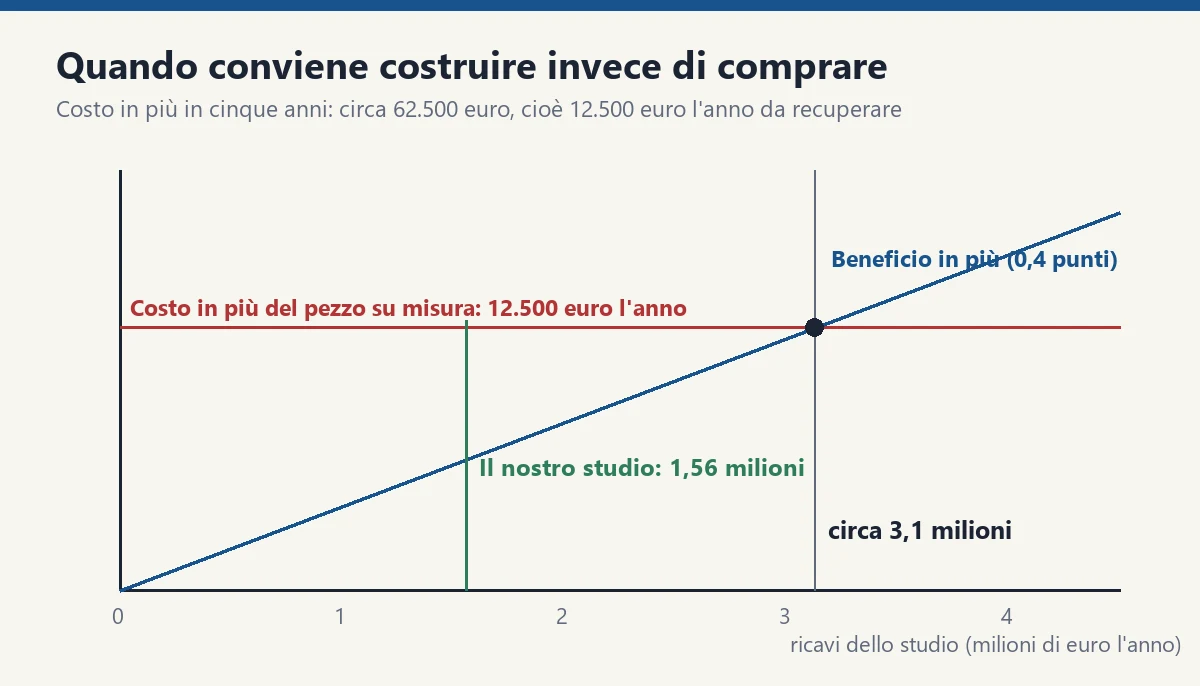
The comparison for the typical case: the product costs 6,000 euros a year plus 3,500 of set-up, that is 9,500 euros the first year and about 33,500 over five years. The benefit, even if only 40 per cent of the six items is recovered, is about 41,400 euros a year: the return comes in under three months. The custom piece, at 60,000 euros the first year and 9,000 the following years, costs about 96,000 euros over five years: 62,500 more than the product. To justify itself it must recover, on top of what the product recovers, at least 12,500 euros a year.
How much more can it give? It depends on how different your rules are from the product's. In my experience, a system built around your way of working recovers about 0.4 points of revenue more than a standard product: fee rules by client type, deadline calculation with your internal procedures, integrations with your drafting program and your accounting. I state clearly that this is a hypothesis, and yours must be checked. With 0.4 points, the custom piece yields 12,500 euros a year when revenue is 3.1 million. Below this threshold the product wins; above it, or with several offices, very particular fees and volumes large enough to make every point count, the custom piece starts to win.
The typical case, with 1.56 million, sits below. It means that for that firm the reasonable choice is a product, possibly with a small bridge to accounting of about 5,000 euros. If however the same firm merges with another, opens a second office or changes its fee model, the calculation changes, and that is why the threshold should be rewritten every year. It is worth repeating it with the same criteria: so as not to change your mind out of fashion, but by numbers.
What if the product "almost" fits?
It is the most common situation, and the one in which a small piece alongside the product pays more than a large one in its place. A real case: a firm that uses a good program for documents and deadlines, but cannot see realisation, because time lives in a spreadsheet and invoices in the accounting. The solution is a view that reads the two sources, attributes them to the matter and shows every Monday the matters with more hours than invoices. Cost: a small application that reads the data and produces a page. Benefit: the item "matters closed without an invoice" falls within a few weeks. This piece is not a management system, it is a dashboard on the management system you already have, and it is often the right answer.
Where artificial intelligence helps in a law firm, and where it does not
It helps where it prepares work for a person who then checks it, and it must never decide on its own where professional secrecy or responsibility for a document is involved. In the legal world the line is sharp, and it is worth drawing before buying something that promises miracles.
It can summarise a three-hundred-page file into an orderly summary, with parties, dates, questions and open points. It can prepare a draft of a formal demand letter or an opinion starting from the firm's templates, which the lawyer corrects. It can compare two versions of a contract and flag the differences. It can extract dates and obligations from a hundred-page contract and propose the deadlines to record. It can classify mail and PEC messages by matter. And it can flag an anomaly: a matter with many hours and no invoice, a deadline with no person in charge.
It must not decide a deadline or set one without a confirmation. It must not cite a ruling nobody has verified: language models invent references with disarming confidence, and in several countries professionals have already been sanctioned for filing citations of rulings that did not exist. The firm's rule must be written down: every legal reference produced by a tool is checked against the source, every time. Nor must it receive clients' documents, emails or files on an external service without the supplier having been assessed: the content of a file is the clearest case of data you do not give away.
The criterion for every "intelligent" function is only one: who answers for the error? If the answer is "the lawyer who checked", fine. If it is "nobody, the system decided", it is not. An artificial intelligence service that receives clients' names, facts and documents is a supplier that processes personal data covered by secrecy, and must be regulated as such: a contract, an indication of where the data sits, a ban on reusing it to train other models. The less data you put in the hands of an external tool, the less you have to explain, and it is worth reminding whoever, in a week of deadlines, wants to go fast.
What mistakes should you avoid and where do you start in thirty days?
There are six mistakes, and I have seen almost all of them more than once. The first is buying the program before measuring: you choose the product with the nicest features and discover later that realisation was being lost elsewhere. The second is importing everything as it is: duplicate records, matters closed twenty years ago and old deadlines enter the new system and make it unreliable from day one. The third is not naming a person: a management system without an owner who looks after it and checks realisation every month grows old in three months.
The fourth is letting personal diaries live on. If even one partner keeps writing their hearings in their own calendar, the system does not see part of the dates and gives a false sense of security, which is worse than none. The fifth is starting in the worst month: September, with hearings resuming and deadlines piled up, is not the time to try a new system; you start when the week is quiet. The sixth is not testing plan B: what does the firm do if the system does not respond for an hour on a filing day? A weekly printout of the deadlines, kept in the office, is worth more than a support contract.
Where you start, in thirty days, is this. In the first seven you take the last twenty closed matters and calculate realisation, marking which data are measurements and which are estimates, and count how many deadlines in the last year were discovered less than five days before the due date. In the second week you ask everyone to write down their time for ten days, even in a spreadsheet, to see how much is missing. In the third you ask for two or three demonstrations from products, bringing a real matter and the case of a postponed hearing with three backward-counted deadlines. In the fourth you choose, ask how the data is exported, decide who closes the personal diaries and set the start for a quiet period.
If after six months realisation has not risen, the fault is not the program's, or not only: someone is still writing time outside the system. That is why the measurement is repeated, with the same method, and shown where everyone sees it. A system that costs six thousand euros a year and returns forty or fifty thousand in invoices is a result you see in the accounts, and that the firm's accountant notices before you do.
What if the number says it is not your problem?
It may be that, once measured, realisation is above 92 per cent, the deadlines discovered late are few and the closed matters all have their invoice. That is good news, and it is worth saying clearly: in that case you do not need a management system, or you need a well-made shared diary and a time sheet, and whoever tells you otherwise is selling you something.
In that case the bottleneck, if there is one, is almost always elsewhere. If the matters are many but profits do not grow, the problem is the starting price: you are accepting engagements at fees that do not cover the time, and a program does not negotiate them for you. If clients do not come back or do not refer you, the problem is the relationship with them, and there you need a good CRM system, or simply a telephone used more often. If you are always in court and never in the office, you do not need a system: you need one more colleague, and then the system.
And there is a case in which software is not the answer even with ugly numbers: when low margins depend on an activity the market no longer pays for. A firm that still does mostly repetitive work at rates from ten years ago does not have a management system problem, it has an offer problem, and low realisation is only the thermometer that signals it.
If you have read this far, you probably have your own late July evening in mind. Before looking at any demonstration, take the last twenty closed matters and compare the work done with the invoice issued. Then count how many deadlines, in the last year, were discovered close to the due date. If realisation is below 82 per cent, if the deadlines discovered late are more than three, or if knowing a date means asking one particular person, you already have the answer. The rest is a project, not a product choice.
If you want a second look at your case, the route is software consulting. And when the right solution is a piece built around your way of working, for a network of offices, a group of firms or a fee model no product can handle, you will find it explained on the page about custom software. For the pieces around a law firm, you will also find the contract management system, the document management software, the quotation software and the CRM system to follow relationships with clients.
Frequently asked questions
It depends on the road. A product for law firms usually costs between 3,600 and 9,600 euros a year for a team of twelve, with a setup between 1,500 and 5,000 euros. A broader system, with document management and a client portal, sits between 9,000 and 18,000 euros a year. A custom piece next to a product costs between 40,000 and 90,000 euros in the first year and about 15 per cent every year after. The cost should always be set against the cost of not having it, which in the typical case is about 103,400 euros a year.
You count three numbers: the realization rate on the last twenty closed matters, meaning invoices issued divided by the value of the work done at internal rate; the deadlines found less than five days before the limit in the past year; and the share of closed matters with no final invoice or no note explaining why. With realization above 92 per cent and few incidents a shared calendar is enough; below 82 per cent you almost certainly need software.
Six items: hours worked and never recorded, matters closed without a final invoice, time spent retyping and checking deadlines, invoices issued late, expenses advanced and not recharged, and the expected cost of a missed deadline. In a typical firm of twelve people and 1.56 million euros of revenue they add up to about 103,400 euros a year, 6.6 per cent. A good system recovers between 40 and 70 per cent of it.
No. The program for drafting and filing documents, which usually comes from a large legal publisher, is for writing, signing and filing. Management software keeps file, deadlines, time, expenses and invoices linked. It does not replace it: it must read what comes out of that program and from certified email (PEC) and turn it into deadlines and documents in the matter file.
It can prepare the work, not decide. It summarises files, proposes drafts from the firm's templates, compares versions of a contract, extracts dates and obligations, sorts mail and flags anomalies. It must not compute a deadline without confirmation, must not cite rulings nobody has checked at the source, and must not receive clients' documents on an unvetted outside service: the content of a file is covered by professional secrecy.
For almost every firm a ready-made product, which already has deadlines, time and invoices. The custom piece pays above about 3.1 million euros of annual revenue, with several offices or groups of firms, or when you have fee rules or internal procedures no product knows. Before deciding, export the data from your current system: if you cannot, the problem is something else.
Leave your details in the form below