Which number decides whether medical practice software will save you money?
With a share below 4 per cent an online diary with reminders and a waiting list on a sheet are enough; between 4 and 7 per cent software pays for itself within the year; above 7 per cent you almost certainly need it. In a clinic with 14 people and 1.38 million euros of revenue, the six items of running on diaries, till and spreadsheets cost about 123,600 euros a year, 9.0 per cent of revenue. A ready-made product costs between 3,000 and 9,000 euros a year, a custom piece between 45,000 and 95,000 in the first year, and it beats a product above 2.4 million of revenue or with several sites and their own fee rules.


It is ten past eight on a Monday in October. In a private multi-specialty clinic with eight specialists, the receptionist has three things open in front of her: the online calendar, the sheet with the phone bookings, and the notebook where the orthopedist handwrites the visits he adds at the last minute.
At a quarter past nine the dermatologist is waiting for a patient who does not show up. At half past nine her slot is still empty, because nobody knew that the other patient on the waiting list would gladly have taken it.
Nobody made a mistake. But the clinic has just lost an 86 euro visit, and this happens dozens of times a month.
Medical practice management software exists to get rid of this Monday. Not every practice needs it, and the ones that do often buy the wrong product first.
Here you will find what the term really means, how much it costs every year not to have it, the number that tells you whether you need it, how an appointment should live inside a system, what the system must do with health data, how professionals' fees are calculated, when a ready-made product is enough and when to build something, and where artificial intelligence helps without doing damage.
An honest premise. I have been building software for companies since 1999, and I know confidential data from the inside: I built LegalDesk, a program for law firms where professional secrecy is the rule of every screen, and I grew it until I sold it.
I am not a doctor, and I will not tell you how to treat anyone or how to apply a healthcare regulation. The clinical side, consent and compliance remain your responsibility and that of your advisors. I will tell you how a system should behave around those decisions.
The case I use throughout the article is a typical multi-specialty clinic, built with orders of magnitude I have seen in similar projects and with industry averages. These are not a client's data, and I do not want to pass them off as such.
They are here to show the method, and you can redo the method with your own numbers in one afternoon.
What is medical practice management software, and what is it not
Medical practice management software is a system that keeps in one place the things a practice touches every day: patient records, the professionals' calendars, reception, the services delivered, the clinical file and reports, payments and insurance agreements, and the fees of the people who work in the practice.
The value is not in any one of these functions alone.
It lies in the fact that each one reads what the other has written: when a visit is cancelled the slot becomes available again, when the patient arrives reception already knows what must be paid, when the service is delivered the professional's fee is already calculated.
It is not an electronic health record program. That one is for the doctor, to write the history, diagnosis and therapy, and to produce reports. A practice that has one already has the clinical side under control, but that program usually does not know how many slots stayed empty or whether the service was actually paid for.
It is not an online calendar with automatic reminders either: that reduces no-shows and it is a good first step, but it knows nothing about the specialist's fee or about insurance agreements.
Nor is it a billing program, which issues invoices and nothing else, and usually ignores that part of the amount belongs to the professional and part to the facility.
You can feel the difference with two questions. The first: "for this specialist, next week, which slots are still free and which are at risk of staying empty?" The second: "this month, how much did we collect and how much do we owe each professional?"
If the answer requires opening the calendar, the cash register and a spreadsheet, and trusting the memory of whoever sits at reception, what you have is a set of tools, not a management system.
That is not necessarily bad: a doctor with a single practice and ten visits a day lives perfectly well with a calendar and a payment ledger, and further down you will find the threshold below which nothing else is worth it.
The term covers different trades, and it helps to tell them apart. A solo practice has one doctor, a part-time secretary and a time problem. An associated practice has a few professionals who share costs and revenue with a rule written once and never revisited.
A multi-specialty clinic has many specialties, many calendars and a different fee arrangement for each professional. A dental or physiotherapy practice sells courses of sessions and staged quotes, and its problem is following the patient over time.
The right system is different for each, and a product designed for a solo practice rarely holds up in a clinic with fifteen calendars.
What if you already have a program?
This is the most frequent case, and the answer is almost never "throw it away". Before changing, measure what it does and what it does not do.
If your current system manages the calendars, notifies patients, fills free slots, links service, payment and fee, and tells you at month end who owes what to whom, the problem is not the tool but how it is used.
If instead every answer requires an export and a spreadsheet, you have an archive, not a management system.
In that case the cheapest route is often a small piece next to what you have, which reads the appointments and produces the list of empty slots, services without payment and the month's fees, without touching the clinical file.
One last calculation, which sellers do not make: the cost of changing your mind. A product is left behind with a data export and a month of annoyance; a custom piece has an owner, and that owner is you.
Before signing any contract, ask how patient records, appointment history, services, payments and clinical files are exported, and in what format.
For a medical practice there is one more reason: this is health data, and where it lives and who can read it is a question you do not ask after signing.
Why does a clinic lose money between the calendar and the cash register?
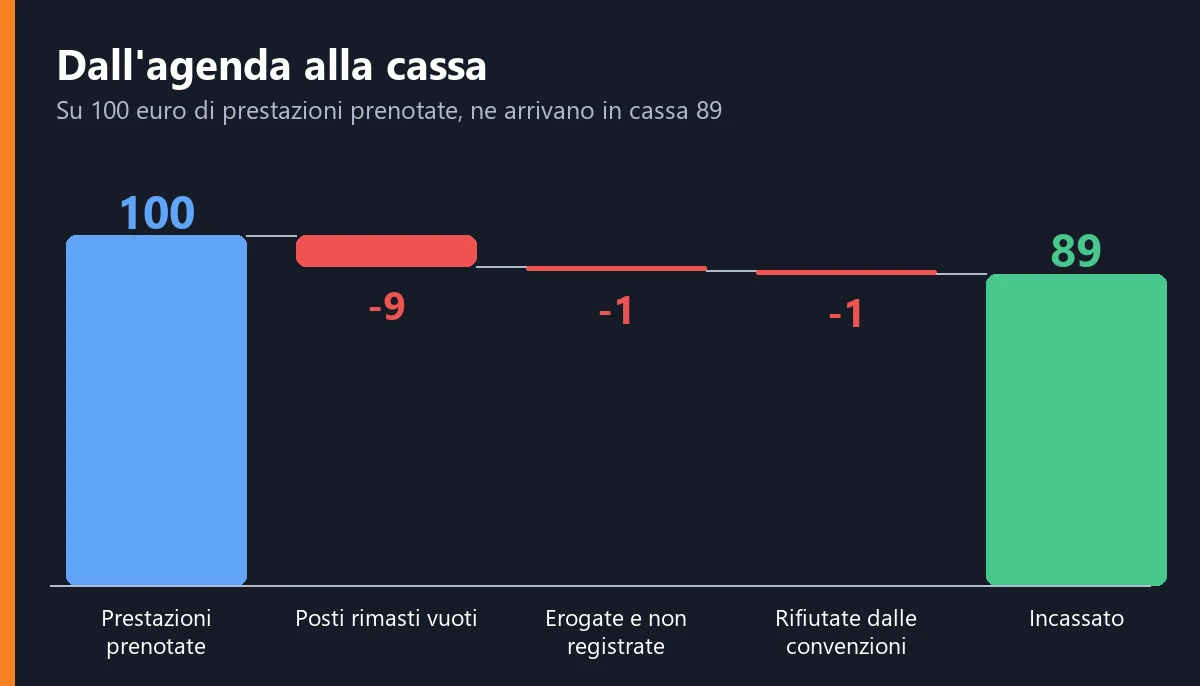
It loses money because a visit passes through four pairs of hands, and at each step there is a moment when something has to be written down.
Whoever books writes the name. Whoever receives the patient writes that the patient has arrived. The doctor writes what was done. Whoever is at the cash register writes how much was paid. If any of the four does not write, or writes in a different place, the visit exists but its value does not.
The first point of loss is the empty slot. The patient does not show up, or cancels an hour before, and nobody has time to phone whoever is on the waiting list. The doctor is there, the room is there, the nurse is there, and the revenue is not.
In the average of the clinics I have seen, the share of empty slots is between 6 and 12 percent, and almost nobody measures it: people know that "now and then someone does not come", not how many euro that adds up to in a year.
The second point is the additional service. The patient comes for a visit and the doctor, rightly, also does an ECG or a dressing. Nobody booked it, so nobody records it, and at the cash register the patient pays only for the visit.
The third point is the insurance agreement. A service provided on behalf of an insurer or a health fund requires an authorization, a code and a document. If any of the three is missing the claim comes back, and resubmitting costs time and sometimes the entire amount.
The fourth point is the time of the people in the office: the same information retyped from the calendar to the cash register, from the cash register to the fee sheet, from the sheet to the invoice. Every retyping is an hour and a chance of error.
None of these points has a culprit, and that is exactly why they cost so much. A system that merely shows a calendar does not see them. One that keeps appointment, service, payment and fee linked to the same visit brings them out one by one, with a line and an amount.
The practical rule I use with clients is simple: if answering "how many visits did we lose last week and what were they worth" takes more than ten minutes, the relationship between calendar and payment is not under control.
How much does it cost each year to run the clinic with calendars, cash register and spreadsheets?
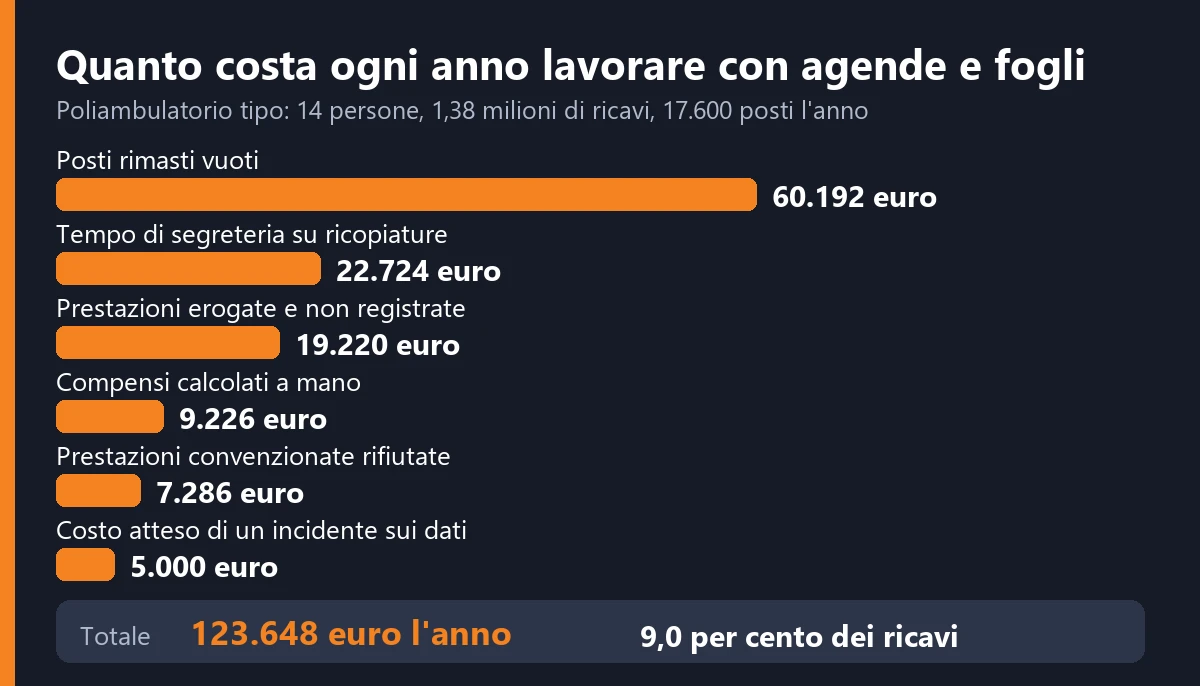
The typical case is a private clinic with fourteen people: eight freelance specialists, four reception staff, one administrator and a part-time medical director.
It offers 17,600 slots a year in the calendars, with an average payment of 86 euro per service, of which 38 stays with the facility and 48 goes to the professional. Revenue is 1.38 million. Twenty-two percent, about 303,600 euro, comes from insurance agreements and health funds.
Here are the six items that working with calendars, cash register and spreadsheets costs every year.
| Cost item | How it is calculated | Euro per year |
|---|---|---|
| Empty slots | 9% of 17,600 slots × 38 euro that stay with the facility | 60,192 |
| Office time on retyping and confirmations | 26 hours a week × 46 weeks × 19 euro | 22,724 |
| Services delivered and never recorded | 310 services × 62 euro | 19,220 |
| Professionals' fees calculated by hand | 16 hours a month × 12 × 28 euro, plus corrections of 0.5% on 770,000 euro | 9,226 |
| Rejected insured services | 2.4% of 303,600 euro | 7,286 |
| Expected cost of a data incident | one event every four years at 20,000 euro | 5,000 |
| Total | 9.0% of revenue (1.38 million) | 123,648 |
A few notes, because every line is a choice and you must be able to challenge it.
The empty slots are valued at 38 euro and not 86 because the 48 that go to the professional, in this arrangement, are not paid if the visit does not happen. If your specialists get a fixed fee for being present, the item is higher, not lower.
The 310 unrecorded services are a little over one per working day, and 62 euro is the average value of an extra exam or dressing. You only know the right number by counting, for two weeks, the services done and the services paid.
The office time is the item nobody wants to see, because nobody ever "lost" those hours: they are hours of salary, already paid, spent on work the system could do by itself.
The expected cost of a data incident is an estimate, not a fact: an unauthorized access, a report sent to the wrong person, a missing consent found in an inspection. It is not a mandatory figure, but in a medical practice this item cannot be zero.
The total, 123,648 euro, is 9.0 percent of revenue. A good system does not recover all of it: in similar projects it recovers between 40 and 70 percent, that is between 49,000 and 86,000 euro a year.
The rest stays, because the person who does not show up will sometimes keep not showing up, and because a system does not remove the effort of those who work, it shifts the weight to more useful things.
What is the number that decides whether you need medical practice management software?
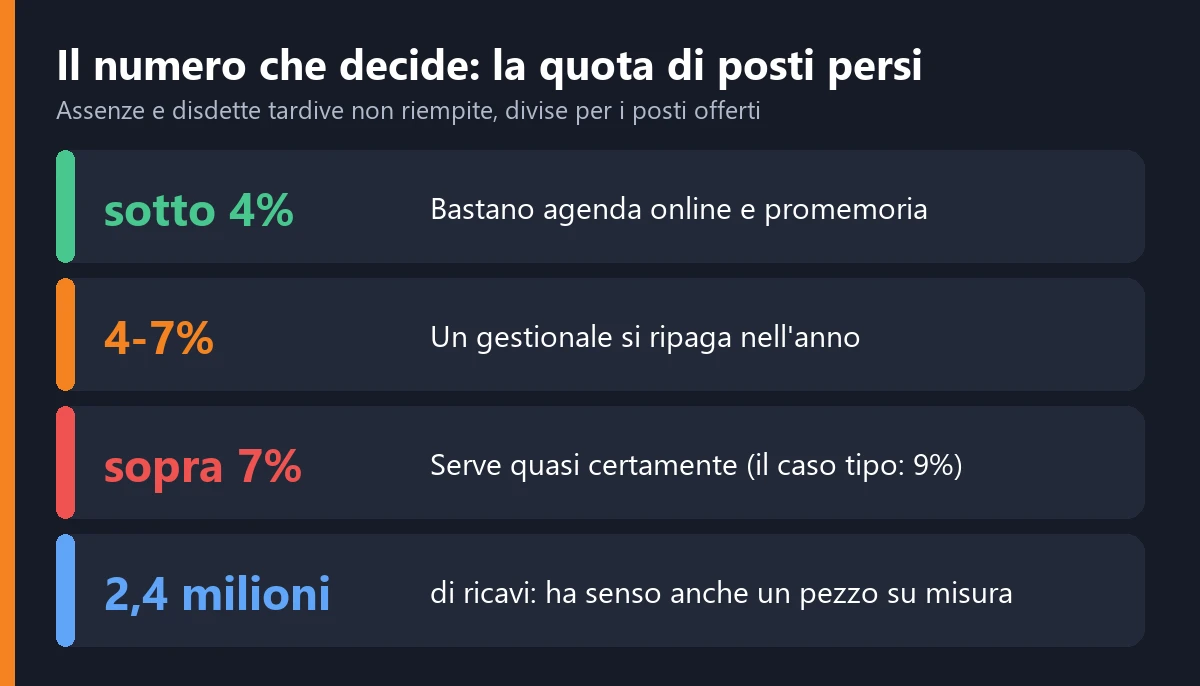
It is not how many patients you have, or how many specialists. It is the share of lost slots: no-shows and late cancellations that nobody refilled, divided by the slots offered in the calendars.
Why this one? Because it is the point where everything else converges. A lost slot says that the calendar does not talk to the waiting list, that the reminder is missing or not enough, that whoever is at reception has no time to make phone calls. In a single number, it says how far the current system is from what it should do.
The thresholds I use, valid for practices with more than one professional:
- Below 4%: an online calendar with automatic reminders, a sheet for the waiting list and a written rule are enough.
- Between 4% and 7%: medical practice management software pays for itself within the year.
- Above 7%: you almost certainly need it, the problem is which one (the typical case sits at 9%).
- Beyond 2.4 million in revenue: with multiple sites or your own fee rules, a custom piece next to the product makes sense.
One percentage point of lost slots, in the typical case, is worth 6,688 euro a year: 176 slots times 38 euro. That is why above 4 percent even a product at 6,000 or 8,000 euro a year starts paying for itself.
How to calculate it in half an hour
From your management systems and calendars, extract the list of appointments for the last twelve months with their status. If you have a database, this query gives, for each specialist, the slots offered, the slots lost and the percentage.
SELECT
    s.Cognome                                                   AS Specialista,
    COUNT(a.Id)                                                 AS PostiOfferti,
    SUM(CASE WHEN a.Stato IN ('NonPresentato', 'AnnullatoTardi')
              AND a.RiempitoDaAppuntamentoId IS NULL
             THEN 1 ELSE 0 END)                                 AS PostiPersi,
    ROUND(100.0 * SUM(CASE WHEN a.Stato IN ('NonPresentato', 'AnnullatoTardi')
                            AND a.RiempitoDaAppuntamentoId IS NULL
                           THEN 1 ELSE 0 END)
        / NULLIF(COUNT(a.Id), 0), 1)                            AS PercentualePersi
FROM Appuntamenti a
JOIN Specialisti s ON s.Id = a.SpecialistaId
WHERE a.DataOra >= DATEADD(month, -12, GETDATE())
GROUP BY s.Cognome
ORDER BY PercentualePersi DESC;
If you have no database, the same count can be done with a spreadsheet and twenty rows, counting for four weeks. The number that comes out is not a grade: it is a threshold. And like all thresholds it has another side, which is the map of lost slots.
In almost every practice I have seen, two or three time bands cause more than half of the damage: Monday morning, the first slot after lunch, visits booked more than three weeks ahead. Knowing where slots are lost is worth more than the average number, because that is where you act.
And the other two numbers?
There are two that go with the first and serve as a cross-check.
The first is how many services, out of every hundred delivered, never reach the cash register: you count them for two weeks by comparing the doctor's register with the payments. Above 1 percent there is money on the table, and above 2 the problem is not someone's distraction but the absence of a mandatory step.
The second is the share of insured services rejected or pending beyond ninety days: above 2 percent, the rules of the agreements live in the head of a single person, and sooner or later that person goes on holiday.
With high lost slots and these two numbers low, the trouble is the ability to fill the calendar. With all three high, the trouble is structure, and a management system is the first step.
What must the software do with an appointment, before anything else?
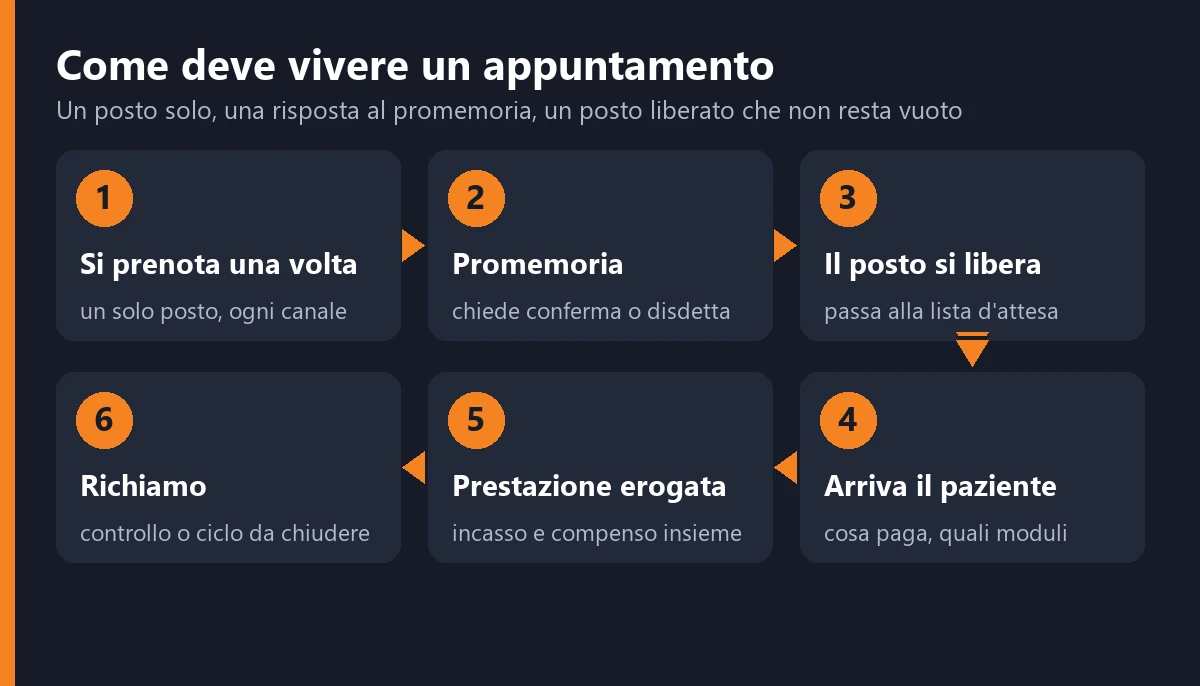
The first thing the software must do is keep an appointment in one place only. It sounds trivial and it is not: in a practice with three booking channels, phone, website and word of mouth, the same slot can be assigned twice and the patient finds out at the door.
Then comes the reminder. Sending it is not enough: it must ask for a reply. "Do you confirm?" reduces no-shows far more than "remember", because it turns a passive deadline into a small decision. Anyone who has not replied by the day before must be called, and the system must say who.
The step that makes the difference is the slot that frees up. When someone cancels, the system must offer that slot to whoever is on the waiting list for the same specialist, in the right order, with a message that can be accepted with one tap. If the receptionist has to remember to do it, she never does it at ten past eight on a Monday.
When the patient arrives, reception must see three things without searching: what was booked, what is due or which insurance agreement applies, which forms are missing, starting with consent.
When the service is delivered, and only then, the system generates the payment and the fee. The doctor does not fill in an extra form: if they add a service, they choose it from a list, and the line reaches the cash register.
And then there is the recall. A course of sessions, a six-month check-up, an exam to repeat: the patient who does not come back is not a closed case, it is a calendar that is emptying. The logic is the same as for members who stop coming to the gym without anyone calling them: the signal is there, someone just has to see it.
Five rules that remove trouble before it starts
- One slot for each appointment, with a single source of truth across the booking channels.
- The reminder asks for a reply, and silence triggers a phone call.
- The freed slot goes to the waiting list automatically, with a maximum response time.
- The service is recorded on the spot, by the doctor, chosen from a list.
- No payment without a service, and no service without a payment or a reason: the difference is a list that someone reviews every evening.
These are simple rules, and a good product follows almost all of them. The trouble is that products are sold with a feature list and not with these rules: ask whoever is pitching it to show you, in a demo, what happens when a patient cancels at half past seven for eight o'clock.
Health data, consent and privacy: what must the system handle?
Health data is a special category of personal data: the European data protection regulation (GDPR) treats it with stricter rules, and a mistake in this field weighs more than in any other.
Let me repeat the premise: I am not a legal consultant. What follows is the list of what a system must make possible, to be checked with your privacy consultant and with the data protection officer, if you have one.
The system must:
- Grant access by role. Reception sees appointment, patient record and payment, not the diagnosis. The doctor sees their own files, not those of colleagues, unless a written rule says otherwise. Administration sees the amounts, not the contents.
- Record who read what. A retained, queryable log of access to the clinical file is the first thing an authority asks for after an incident and the first thing practices do not have.
- Keep consent and the privacy notice. For each patient, which version they signed, when, and which processing it refers to. An expired or missing consent must show up at reception, not in an inspection.
- Separate clinical content from administrative content. A clinical file and a patient record in different tables and with different permissions, so that a breach in one does not open the other.
- Encrypt data, at rest and in transit, and allow backups that can actually be restored. A backup that nobody has ever tried to reopen is a hope, not a backup.
- Know where the data lives and who the hosting provider is. When the service is external you need a written data processing agreement, and the answer to "in which country are the servers" cannot be "I don't know".
- Retain and delete according to the required timeframes, with a rule for the archive of patients who no longer come.
Two things that save a lot of time for anyone starting out.
The first: before choosing a vendor or building anything, ask whether you need a data protection impact assessment. For large-scale processing of health data the answer is often yes, and doing it at the start costs less than doing it later.
The second: the problem of apps and services for online booking. Many practices use an external calendar service without knowing what it does with the data. If the appointment shows the name of the visit, "psychological consultation" or "oncology check-up", that information is already health data.
It is the same issue you meet in a law firm, where the content of a case file is covered by professional secrecy: the system must not only work, it must be able to prove how it protected what was entrusted to it.
How do you handle the clinical file, reports, Sistema Tessera Sanitaria and the health record?
Here the management system does not have to do everything: it has to know who to talk to.
The clinical file belongs to the doctor and to their specialist program. If the practice already has a good one, the rule is not to touch it: the management system reads from the clinical program what was done (the service, not the diagnosis) and turns it into payment and fee.
The point of contact is always the same: a service code. The doctor picks "abdominal ultrasound", and the system knows the price list, the agreement and the specialist's share. The clinical content stays where it was born.
Mandatory submissions, such as sending health expense data to the Sistema Tessera Sanitaria (STS, the Italian national system that collects medical expenses for the patients' tax returns), are another thing the system must do on its own. Whoever fills them in by hand at year end gets them wrong, and an error reflects on the patient's tax return.
The criterion is just one: every payment for a health service produces its data to transmit at the moment it is recorded, and at the end of the period there is a list of those still to be sent or rejected.
The same goes for reports and for the links with the regional or national electronic health record (the Italian "fascicolo sanitario elettronico"): these are integrations the management system must be able to feed, not replace. The rules change with regions and years, which is a good reason not to build by hand what a product already keeps up to date.
I have seen only one way to get this wrong: demanding that the management system also become the clinical file. A system that does everything does neither well, and changing a management system is a far less painful operation than changing ten years of clinical files.
For the documents around all this, consent forms, signed quotes, agreements with insurers, document management software keeps order without entering the clinical file.
How do you calculate fees, agreements and invoices without anyone rebelling?
Professionals' fees are the most delicate part of a clinic, because they touch people. A specialist who does not trust the count leaves, and takes the patients along.
The rule that works is line transparency: every service has a line with date, patient (even anonymized for the professional), amount, share to the specialist, share to the facility. At month end the fee is the sum of their lines, and the specialist can see them.
Shares are almost never uniform. They change by specialty, by type of service, by agreement, by time band. A rule like "55 percent on visits, 40 on instrumental exams, 70 if they bring the patient" must be written in the system, not in a spreadsheet that only the administrator knows how to update.
For agreements and health funds three things matter:
- the authorization must be requested before the service, and the system must block reception if it is missing;
- the price list is per agreement, and it changes: each list needs a validity date;
- the reimbursement claim must go out with all the documents inside, and rejected claims must come back in a list with the reason.
Agreements are contracts: deadlines, rates, obligations. To keep them in order there is contract management software that warns you before expiry and compares conditions.
Invoicing, at that point, is the last link and the easiest: a summary per patient or per agreement, with the services already inside. For private patients the electronic invoice, or the document required, must be issued, with the recourse fee and the stamp duty where needed. What matters, again, is that nobody retypes it.
A test of seriousness when you look at a product: ask them to show you how a fee that was already paid is corrected. A system that cannot do it leaves the practice with a parallel spreadsheet, and the parallel spreadsheet is exactly what you wanted to remove.
What changes between a solo practice, an associated practice, a clinic and a dental practice?
Almost everything, and that is why comparing with other practices is misleading if you do not look at the shape of the work.
The solo practice has one calendar, one doctor and a couple of hours a day of secretarial work. Here the management system is often a clinical record program with a calendar and invoices. The number of lost slots matters, but the cost of a bigger system exceeds the benefit.
The associated practice has few professionals and a rule for dividing costs. The knot is the allocation: who pays the rent, the secretary, the equipment. A good spreadsheet holds up to four or five people, then the count becomes a source of tension.
The multi-specialty clinic is the case in our example: many calendars, different fees, agreements, often different sites or hours. It is where the management system has its maximum value, and where products designed for the solo practice break.
The dental practice and the physiotherapy practice sell pathways: a treatment plan worth 3,000 euro, a course of ten sessions. The number that matters changes: not just lost slots, but the share of treatment plans started and never completed, because that is where the real value is. Here you meet the logic of quotes, well explained in quotation management software: a quote that goes out late, or never goes out, is a lost patient.
A small network of practices with multiple sites has one more problem: the same patient record in different places. A patient who books at two sites is one patient, and the system must know it without letting in anyone who has no right to the file.
Before comparing a product, write down which of these worlds you live in. The question "which is the best medical practice management software" has no answer: the answer is "which is best for a clinic with fifteen calendars and three agreements".
How much does medical practice management software cost: product, broad system or custom?
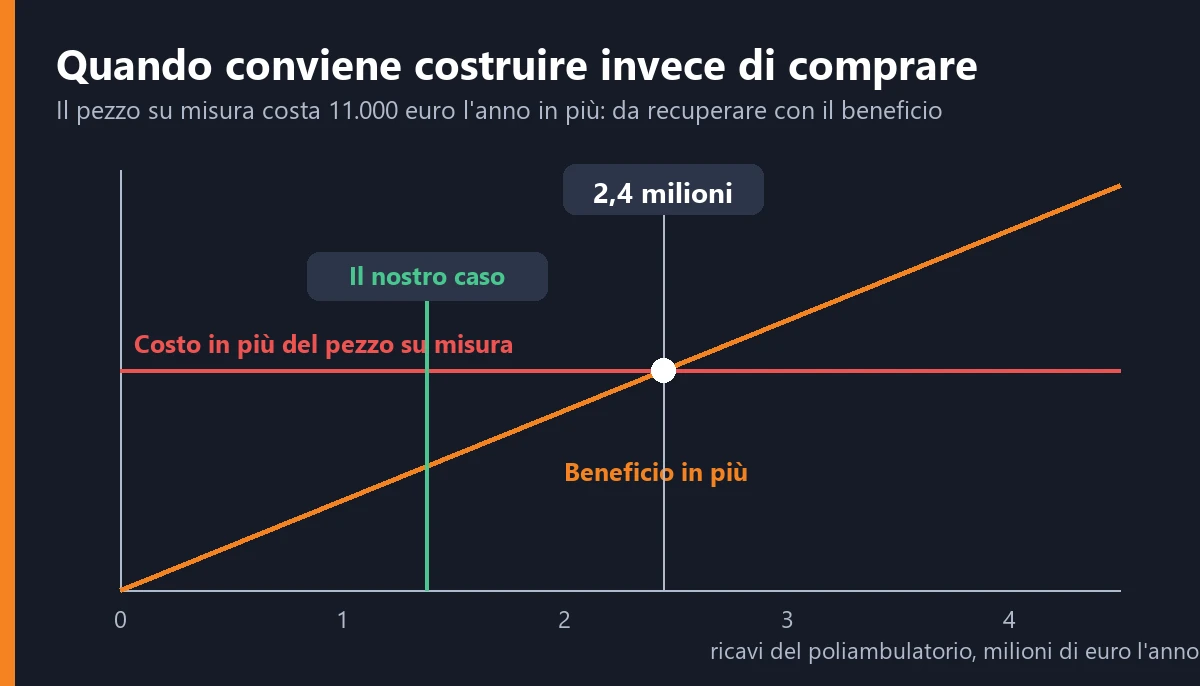
Three routes, and for our clinic with fourteen people the indicative figures are these.
| Route | First year | After |
|---|---|---|
| Ready-made product for medical practices (calendar, reception, payments, fees) | 4,500 to 15,000 euro (setup included) | 3,000 to 9,000 euro a year |
| Broad system with clinical file, reports, patient portal | 12,000 to 28,000 euro | 9,000 to 20,000 euro a year |
| Custom piece next to a product | 45,000 to 95,000 euro | about 15% a year |
These are orders of magnitude, not quotes: prices change with the vendor, the number of users and what the contract includes. They are for reasoning, not for running a tender.
The comparison must be made against the cost of not having it, 123,648 euro a year in our case. A product that recovers 40 percent of it gives 49,000 against a maximum cost of 9,000. The benefit exceeds the cost five to ten times, and that is why the right question is not "does it cost too much?" but "which one?".
A custom piece makes sense in three cases:
- the rules for fees, agreements or care pathways fit no product, and today they live in spreadsheets that only one person knows;
- the practice has several sites, or a network of practices, with patient records and permissions to keep together;
- revenue exceeds the threshold, about 2.4 million in our calculation, beyond which the extra benefit of a piece built around your way of working exceeds its extra cost.
The threshold calculation is simple. Over five years the custom piece costs about 55,000 euro more than a product, that is 11,000 a year. If it brings an extra benefit of 0.45 percent of revenue, it breaks even at 2.44 million. Below that, the product wins. Above it, it is worth a look.
And if the product "almost" fits?
It is the right question, and it is the most frequent case. The answer is neither "take it" nor "build".
Take it if the "almost" concerns things you can change yourself: a name, a form, the way reception records. Leave it if the "almost" concerns how fees are calculated, because that is not changed with a setting: you live with a spreadsheet forever.
The middle way is a product ready for 80 percent of the work and a small piece next to it for the 20 percent that makes it yours, for example the waiting list that fills slots or the fee calculation. If that is the idea, a well-configured CRM can already track recalls and waiting lists without building anything.
One last piece of advice: always ask the exit cost. A product at 5,000 euro a year that requires 15,000 euro to export your data does not cost 5,000.
Where artificial intelligence helps in a medical practice, and where it does not
Artificial intelligence in a medical practice is a subject where the risk of talking nonsense is high on both sides. I will tell you where I see it as useful and where not.
- It can: reduce office work, classify requests that arrive by email and phone, suggest the best time to someone who cancels, write the recall message, flag services without payment, prepare the summary of an agreement.
- It can, with care: transcribe a consultation and propose a draft note, which the doctor reads, corrects and signs. The responsibility stays with them, and the text must never enter the file without a human step.
- It must not: decide a diagnosis or a therapy, answer a patient about a symptom without a professional, or receive identifying data on an external service that nobody has assessed.
There is a point that is often overlooked: software that provides clinical suggestions can be considered a medical device, with obligations of its own. If a vendor offers you an "intelligent" function that interprets exams or proposes therapies, ask whether it has the required certification (the CE marking as a medical device). This is not a detail: it is the difference between a tool and a risk.
The rule I give clients is the two-level rule. On administrative work, artificial intelligence works with spot checks. On clinical work it proposes and a professional decides, always, and everything it proposes stays traceable.
And then there is the question about data. If a model runs on an external service, what information leaves the practice? For administrative tasks you can often work with anonymized data: the time, the type of visit, the status. The patient's name is not needed to predict a no-show.
A concrete, low-risk use: a model that reads the appointment history and estimates, for each booking, the probability of a no-show. Whoever has the highest probability gets an extra reminder or a phone call. It changes nobody's care, and it reduces lost slots.
Which mistakes to avoid, and where do you start in thirty days?
The mistakes I see most are six.
- Starting from the program and not from the number. People watch demos before counting lost slots, and buy the one with the most features.
- Asking for everything on day one. Calendar, clinical file, portal, invoicing and fees in a single release: the first month is chaos and the practice goes back to spreadsheets.
- Forgetting the office staff. The people who use the system eight hours a day are at reception, and they are involved last. If you do not win them over, the system gets used at 40 percent.
- Not writing down the fee rules. Every specialist has a verbal agreement, and the system brings them all to light at once, in a meeting nobody wants to hold. Better to hold it before.
- Neglecting privacy until the end. Roles, logs and backups are designed at the start, not added later.
- Not measuring afterwards. If the lost-slot number is not recalculated after three months, nobody knows whether the system works.
Where to start, in thirty days.
Week one: the numbers. Calculate lost slots over the last twelve months, count for two weeks the services done and the services paid, list the agreements with their rules.
Week two: the rules. Write down, on two pages, each specialist's fees, the waiting list rules and who has access to what. Then check with the privacy consultant what is required for health data.
Week three: the choice. Look at two or three products with a demo based on your own cases: the last-minute cancellation, the service added by the doctor, the claim rejected by a fund.
Week four: the pilot. Start with a single specialist and reception, for a month, and decide based on that month's lost-slot number, not on impressions.
A small pilot is the cheapest way to find out what does not work. A mistake found on one specialist costs an afternoon; the same mistake found on eight costs a month.
For those coming from spreadsheets and calendars I recommend one more thing: keep the old system read-only for three months. If something does not add up, you have somewhere to check.
And if the number says it is not your problem?
It happens, and it is good news. If lost slots are below 4 percent, unrecorded services below 1 and rejected agreements almost never, your practice does not have a management software problem.
In that case the bottleneck, if there is one, is almost always elsewhere.
If the calendars are full but profit does not grow, the problem is the price list: you are collecting for services at prices that do not cover time, room and staff, and a program does not negotiate rates for you.
If patients do not come back or do not recommend you, the problem is the experience, from the wait to the way a report is explained, and there you need a good relationship, not software.
If professionals come and go, the problem is the financial arrangement with them, and no management system solves it: it only shows it far more clearly.
And there is a case where software is not the answer even with bad numbers: when empty slots depend on an offer that does not meet local demand, for example a specialty with too many calendars and too few requests. That is a problem of what you offer, and the lost-slot number is only the thermometer that signals it.
If you got this far, you probably have your own October Monday in mind. Before watching any demo, count the lost slots of the last twelve months. Then count, for two weeks, the services done and the services paid.
If lost slots are above 7 percent, if unrecorded services exceed 1 percent, or if calculating fees takes more than a day a month, you already have the answer. The rest is a project, not a product choice.
If you want a second look at your case, the way to go is software consulting.
And when the right solution is a piece built around your way of working, for a network of sites, a group of practices or a fee model that no product can handle, you will find it explained on the page about custom software.
For the pieces around a practice you will also find contract management software for agreements, document management software, quotation management software and CRM software for recalls and waiting lists.
Frequently asked questions
It depends on the route. A ready-made product for medical practices usually costs between 3,000 and 9,000 euros a year for a clinic of fourteen people, with a set-up between 1,500 and 6,000 euros. A broader system with clinical records, reports and a patient portal runs between 9,000 and 20,000 euros a year. A custom piece next to a product costs between 45,000 and 95,000 euros in the first year and about 15 per cent every year after. The cost should always be compared with the cost of not having it, which in the typical case is about 123,600 euros a year.
You count three numbers. The share of lost slots over the last twelve months, meaning no-shows and late cancellations nobody refilled, divided by the slots offered. The services delivered and not collected, counted over two weeks. The share of insured services rejected or pending beyond ninety days. With lost slots below 4 per cent an online diary and reminders are enough; above 7 per cent you almost certainly need software.
Six items: empty slots, secretarial time spent retyping and confirming, services delivered and never recorded, professionals' fees calculated by hand, insured services rejected, and the expected cost of a data incident. In a typical clinic with fourteen people and 1.38 million euros of revenue they add up to about 123,600 euros a year, 9.0 per cent. A good system recovers between 40 and 70 per cent of it.
No. Clinical record software lets the doctor write history, diagnosis and therapy and produce reports. Management software links diary, reception, services, payments, insurance agreements and fees. It does not replace it: it must read which services were delivered and turn them into payment and fee, leaving the clinical content where it was born.
It can help with administrative work: sorting requests, proposing a slot to someone who cancels, writing recall messages, flagging services without payment, estimating the chance a booking becomes a no-show. On clinical work it proposes and a professional decides, always. Software that gives clinical suggestions can be a medical device, with its own obligations, and no identifying data should leave for an external service nobody has assessed.
For most practices a ready-made product is the answer. A custom piece next to a product makes sense when fee rules, insurance agreements or care pathways fit no product, when there are several sites whose records and permissions must be kept together, or when revenue exceeds about 2.4 million euros. Below that threshold the extra cost of the built piece is not recovered.
Leave your details in the form below