What is the number that decides whether real estate management software will save you money?
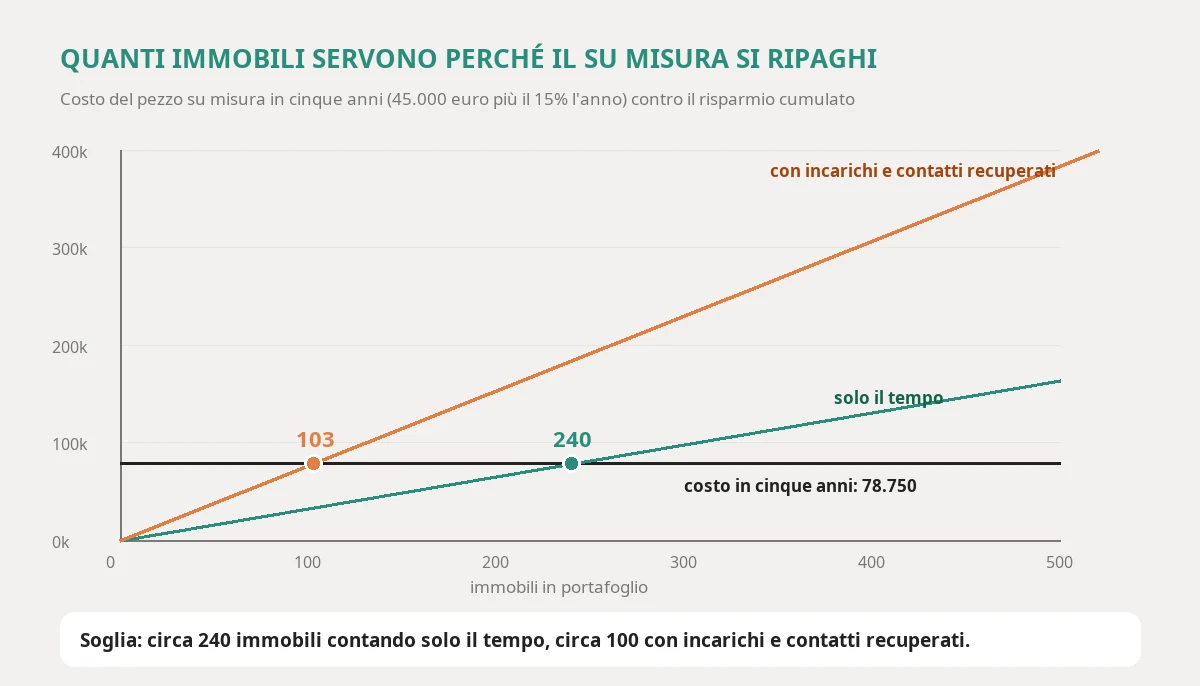
Below 25 per cent a well kept shared spreadsheet is enough; above 50 a system pays for itself. In an agency with 25 employees and 400 properties the share was 72 per cent, only 31 per cent of enquiries were answered within the hour, and the five costs of managing by hand came to about 140,000 euros a year, 4.7 per cent of revenue. A product costs between three and thirty thousand euros a year, the custom piece with a single record, callback queue and deadline calendar between thirty and sixty-five thousand euros. Counting time alone the two roads cross at around 240 properties, and with mandates and enquiries recovered the threshold drops to about 100.


The owner of a real estate agency in northeastern Italy, twenty-five employees and three million euros in revenue between commissions and management fees, has a ritual everyone knows: at half past eight on Monday he opens three things, one after the other. The spreadsheet of mandates, where a red column says which ones expire this month. The inbox that collects the property portal enquiries, with forty-seven messages that arrived over the weekend. And the agents' WhatsApp group, where someone has written "Mr Ferrari wants to see the house on via Mazzini, who has it?". Three mandates expired on Thursday. Nineteen enquiries have had no reply. Nobody knows whether the house on via Mazzini is still for sale, because on the second portal the price is still the old one.
Real estate management software exists to take that Monday morning away, but not everyone needs it, and those who do often buy the wrong thing. Here you will find what the term really means and what it is not, the two numbers that tell you whether you need it or whether a better kept shared spreadsheet is enough, the calculation of what it costs every year to manage listings, enquiries and deadlines by hand, the checks that cost nothing, the price difference between a product, a module and a custom piece, and the threshold above which building makes sense. The case that follows is a typical case, reconstructed from situations I have seen in agencies and in firms that manage other people's property, with rounded numbers.
An honest premise: I built and sold LegalDesk, a program for law firms where a missed deadline is not an annoyance but damage, and in twenty-six years in the trade I have learned that an agency's problem is the same as a law firm's. It is not the lack of activity. It is the thread that holds the deadlines together, which today lives in the head of whoever is in the office that day.
What real estate management software is, and what it is not
Real estate management software is a program that keeps in one place the properties, mandates, enquiries, viewings, offers and contracts of an agency or of someone who manages property for others, and reminds each person what to do and by when. It is not a listing portal, not accounting and not a simple archive of records.
The search brings together very different tools, and whoever picks the wrong one finds out six months later, when the agency is still using the spreadsheet. It is worth separating them straight away, because each solves one piece and leaves others uncovered.
The first is the real estate CRM, the program that organises the properties on the books, customer contacts and viewings. It does the records well, the matching between who is looking and who is selling, and the publishing of listings on portals. The point of view of someone who sells and has to call back is the same as in the CRM software article: the value lies in never leaving a contact without a next step.
The second is the portal publishing program, which sends listings to several sites from a single entry. It is useful and often included in the CRM, but it solves only one problem: identical data everywhere. It does not know that the mandate expires in ten days.
The third is the lettings and administration software: contracts, rents, receipts, registrations, reporting to owners. It serves those who manage other people's property, and there the deadlines are fiscal and contractual, with the consequences everyone knows. A well built contract archive looks like the one described in the article on contract management software, with dates, renewals and warnings before it is too late.
The fourth is the condominium administration program, which is a different trade, with its own meetings, allocations and budgets. If you are a condominium administrator, the right search is another one. Here we talk about agencies and about those who manage rental portfolios.
The fifth, and the one that interests the reader, is the set of rules and memory that sits between the moment a property comes in and the moment the file is closed: who follows it, when the mandate expires, who answers the enquiries, what the client was told, which price is published where, when the rent must be adjusted. This is not a module. It is a process, and it has a time, a cost and an error rate that can be measured.
Mandate, listing, enquiry, offer, contract: five objects, not one
In everyday speech "the file" is everything. In the system it helps to distinguish. The mandate is the owner's instruction, with a duration, a price and possibly exclusivity. The listing is the shop window, which lives on several portals. The enquiry is a person asking for information. The offer is a buyer's written bid, with a deadline of a few days. The contract is the managed lease, with its dates. Each has its own deadlines, and almost all the trouble starts when they are merged into a single spreadsheet row.
What it must be able to do, one line per function
A useful system holds six things together: the single property record, the mandate with its date, the queue of enquiries with a callback rule, publishing on portals from that single record, the contract deadline calendar and the log of who said what to whom. Every product on the market does two or three of these well. Almost none keeps all six in the same place, and for the lettings side it often stops at accounting.
Why mandates, enquiries and contracts get lost when nobody makes a mistake
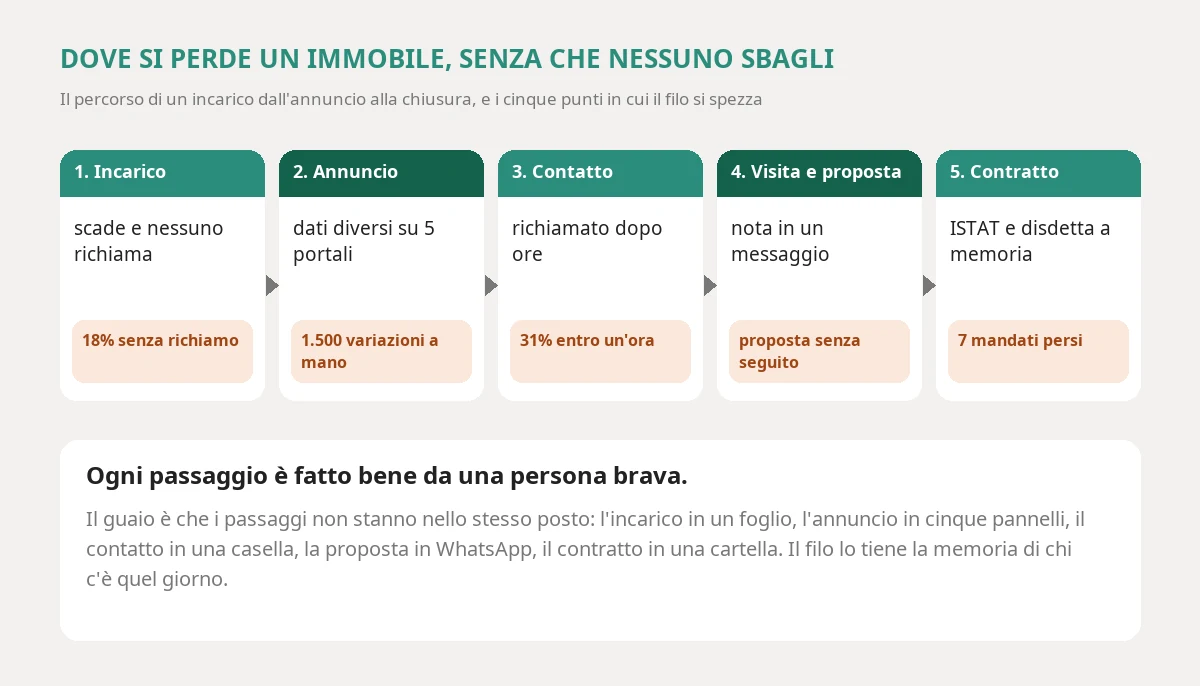
In the agency I am describing, nobody worked badly. The fourteen agents knew the areas, the owners trusted them and the front desk answered the phone on the second ring. Every single gesture was correct. What did not work was the number of different places in which the same property had to be remembered.
We followed it over a year of data. The portfolio held 400 properties: 250 with an active mandate for sale or rent and 150 lease contracts that the agency managed on behalf of owners. The mandates lived in a shared spreadsheet, but each agent also kept their own, with the real notes. Listings were on five channels: three portals, the agency website and a social page. Enquiries arrived in two inboxes, on the office phone and on the agents' phones. The contracts had a deadline calendar in a file, kept up to date by a colleague who went on maternity leave in June.
Every step is a small bet on memory. An expiring mandate is a row that turns red only if someone looks at that sheet on the right day. A reduced price is a change to be made five times, and at the fourth portal it gets forgotten. A Saturday night enquiry is a message that stays where it is until Monday, when another agent sees it and assumes the colleague has already dealt with it.
The three points where the thread breaks
The first is the deadline nobody owns. A mandate has a date, but no owner with a written task: "call the owner sixty days before, propose the renewal, update the price". If the task does not exist, it is done by whoever remembers. In the case, 18 per cent of mandate expiries went by with no call before the date, and almost always the property reappeared with another agency.
The second is the data that lives in five copies. Price, square metres, condition, energy class, availability: every portal has its own. A change made on four portals is enough for a property to cost 235,000 euros in one place and 245,000 in another. And when the property is sold, the listing stays online until someone goes round the five panels. In those days the agency receives calls about a house that no longer exists, and someone explains that it has already been sold.
The third is the enquiry nobody answers in time. Someone looking for a home writes to three agencies within the same quarter of an hour. The first to call back wins, not the price. In the case the median time to first callback was 3 hours and 40 minutes, and only 31 per cent of enquiries got a reply within the hour.
All three points show up in a day if the data is in one place, and in a year if it is in the heads of twenty-five people. That is the difference real estate management software must produce: not to make agents work faster, but to give each property a single record, give every deadline a name and stop the thread depending on who is in that day.
How much does it cost every year to manage listings, enquiries and deadlines by hand?
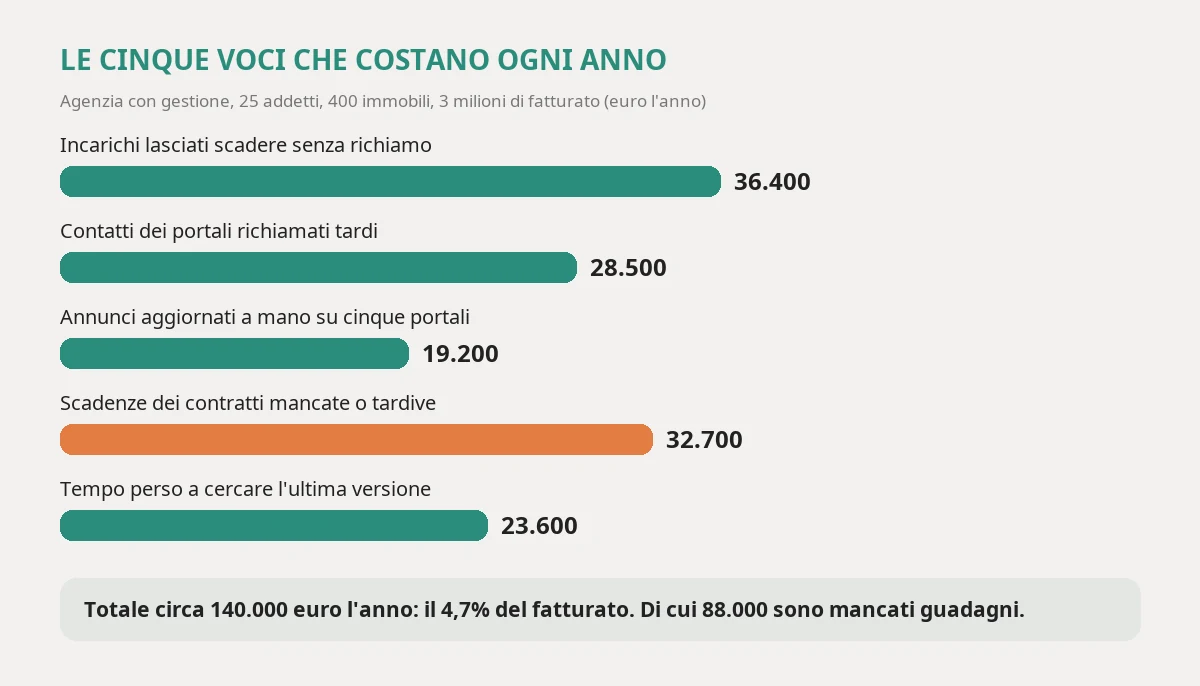
In the agency's case, managing listings, enquiries and deadlines by hand cost about 140,000 euros a year, 4.7 per cent of revenue. The calculation has five items, and it is worth redoing it with your own numbers before talking about software, because the money is real and the biggest part appears in no accounts.
The premises are few. The agency had 25 employees: 14 agents, four people for lettings and administration, three for operations and listings, two owners and two at reception. An hour of work cost 32 euros on average, everything included. A sale brought the agency 5,700 euros on average, after the agent's share. Portal enquiries were 6,000 a year.
Mandates left to expire. Mandate expiries were about 360 a year, because the 250 active mandates lasted a little over eight months on average. Eighteen per cent, 65 mandates, passed the date with nobody calling. Of these, about four in ten, that is 26, were still renewable: the owner still wanted to sell and would have signed. A renewed mandate leads to a sale one time in four, and a sale is worth 5,700 euros: about 1,400 euros of expected value per mandate. Twenty-six times 1,400 is 36,400 euros a year.
Enquiries answered late. Out of 6,000 enquiries, 69 per cent, that is 4,140, got a reply after more than an hour. Someone called back within the hour books a viewing in 10 per cent of cases, the others in 6. Four points on 4,140 is 166 fewer viewings. About three transactions close every hundred viewings: five transactions, at 5,700 euros, make 28,500 euros a year.
Listings updated by hand. Of 250 published properties, there were on average six changes a year: price, photos, description, status, negotiation, availability. That is 1,500 changes, each to be redone on five channels, at six minutes each: 750 hours. With a single record about 270 would be needed, so 480 hours are avoidable. To these add 120 hours a year of calls and explanations for listings with different data or already sold. Six hundred hours at 32 euros make 19,200 euros a year.
Contract deadlines. For 150 managed contracts, the calendar in a file cost about 450 hours a year in checks, document searches and rent adjustment calculations, and 300 are avoidable: 9,600 euros. Then there is the real price, the owners who leave. In a year seven withdrew the management, citing a forgotten adjustment, a notice given too late or a late registration. A management mandate is worth about 550 euros a year in fees and lasts on average another six years: 3,300 euros, so seven make 23,100. The total is 32,700 euros a year.
Time lost searching. Sixteen people lost an hour a week looking for the latest version of a mandate, who had made an offer, which viewing had already been booked. One hour for 46 weeks for sixteen people is 736 hours: 23,600 euros.
The total is about 140,400 euros a year, 4.7 per cent of 3 million. Two honest warnings. First: 88,000 euros are missed earnings, not expenses, and the rest, 52,400, are hours, which are recovered only if someone uses them to do something else. Second: the items overlap a little, because a lost enquiry is often also search time. If, redone with your numbers, the total is below 1.5 per cent of revenue, real estate management software is not a priority. If it exceeds 3, it almost certainly is.
How to redo the calculation in an afternoon
You need five data points. The mandate expiries of the last year and how many went by without a call, which can be rebuilt from the spreadsheet. The portal enquiries, with arrival time and reply time, which the portals themselves keep. The number of listing changes, which can be estimated in an afternoon with the listings staff. The adjustments and deadlines missed on contracts. And the average margin of a sale, which your accountant knows. The real time is almost always double what you think, and the lost enquiries are more than the remembered ones, because only those that ended up with a competitor are remembered.
What is the number that decides whether you need real estate management software?
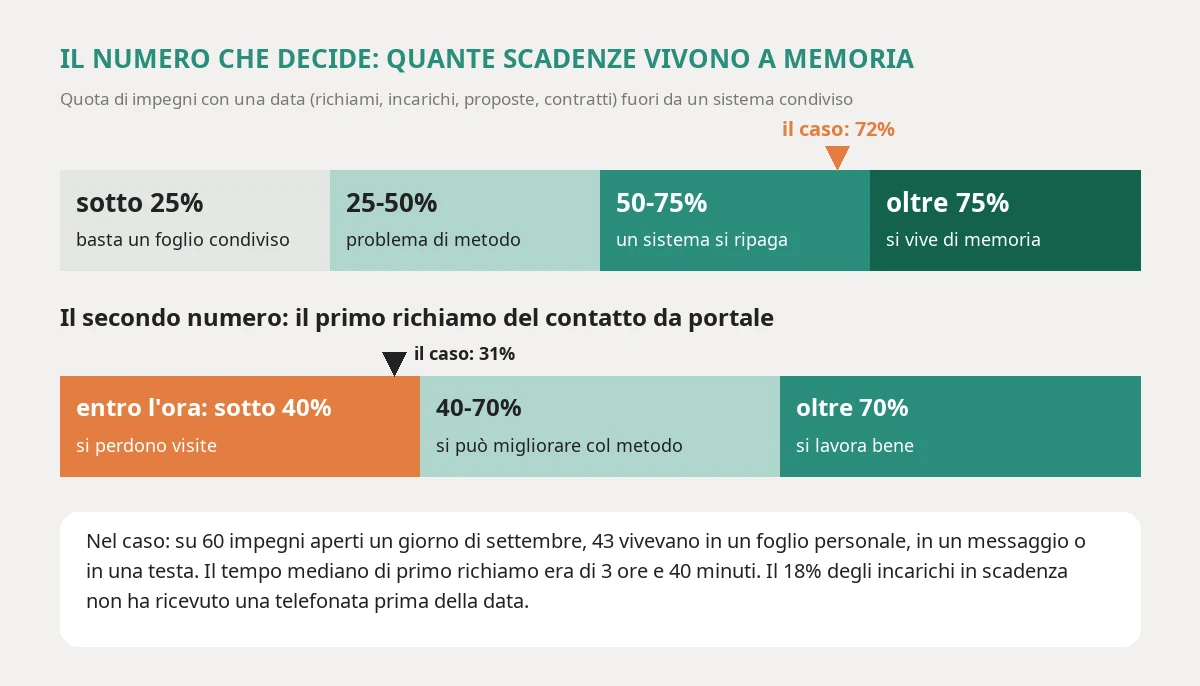
The number that decides is not how many properties you have or how many agents, but the share of dated commitments that live outside a shared system: callbacks, mandate expiries, offers waiting, contracts to adjust or terminate. The higher it is, the more the agency depends on the memory of whoever is in that day.
It can be measured in half an hour. On any day, take all the open commitments with a date: mandates expiring in the next sixty days, enquiries to call back, offers waiting, contracts with an adjustment or notice coming up. For each, ask: where can you see that it exists? If the answer is "in the system, with a name and a date", it counts as tracked. If it is "in my spreadsheet", "on WhatsApp", "I know it", it is from memory. In the case, out of 60 open commitments on a day in September, 43 were from memory: 72 per cent.
The thresholds I use are four. Below 25 per cent the situation is under control: a shared spreadsheet is enough, with one person looking at it every morning, and a common calendar. Between 25 and 50 the problem is one of method: before writing code you need to decide who owns each deadline and where it is written. Between 50 and 75 a system pays for itself, because the delay is structural and no discipline removes it. Above 75 the agency lives on memory: the most valuable work, that of people who know the owners, is remembering dates.
The second number: first callback within the hour
The second number is the one the customer sees before any other: the percentage of portal enquiries answered within an hour during working hours. Above 70 per cent you are doing well. Between 40 and 70 the method can be improved with simple rules of rota and cover. Below 40 you lose viewings every day. In the case it was 31 per cent, with a median time of 3 hours and 40 minutes: the problem was not the agents' willingness, but the fact that nobody knew whose enquiry it was.
The third number: mandates that expire with no call
The third comes from the archive: the share of expiring mandates that did not receive a call at least thirty days earlier. Below 5 per cent is fine. Above 15 the agency is handing mandates to competitors, and in the case it was 18. These three numbers are simple to read and say more than any software demo: if the first is below 25 and the other two are good, your problem is not software.
Why counting properties is not enough
An agency with 400 well organised properties is better off than one with 120 kept in a drawer. Size matters only because it multiplies the commitments, and with them the chances of forgetting one. The right number is not size, it is the share of commitments from memory.
How do you stop an exclusive mandate from expiring with nobody calling?
You stop it by giving every mandate a date, an owner and a sequence of tasks that start by themselves: call the owner sixty days before, bring an analysis of enquiries and viewings thirty days before, propose the renewal with a revised price. If the task exists in the system, it no longer depends on whoever remembers.
The exclusive mandate is an agency's most valuable asset, because it is the only moment when the owner has said "you sell". When it expires without a call, the owner does what anyone would do: asks another agency why nobody has been in touch, and often signs elsewhere. In the case, the 26 mandates lost in a year were worth 36,400 euros, but the damage is greater, because with the mandate you lose the property and the owner's word of mouth.
A simple sequence works better than a complex one. Sixty days before expiry a task appears for the agent: phone the owner, summarise what has happened in these months. Thirty days before, if the call has not been made, the task goes up to the area manager. Fifteen days before, to the owner of the agency. It is not a system for monitoring employees, it is the same rule with which a good office keeps its deadlines: whoever has the commitment sees it, and if they do not do it, someone who can help sees it.
What the mandate record must contain
The mandate record is not a scanned contract. It holds the start and end dates, the type of mandate, exclusive or not, the agreed price and the date it was last reviewed, the commission percentage, who follows it and who covers when they are away. It also holds the number of enquiries, viewings and offers received in the period, because those are the numbers you take to the owner. Saying "in three months we had 41 enquiries and 6 viewings, and the price needs revising" gets a mandate renewed. Saying "it has expired, shall we renew?" does not.
Purchase offers: a short deadline that weighs
An offer is valid for a few days, often seven or fifteen. In that time the owner must reply, the agent must call and the buyer must know how it went. When the offer stays in a message, the deadline passes, the buyer cools off and the deal fades without anybody saying no. The logic is the same as for quotations, which I covered in the article on quotation management software: a document with a validity date and a reminder task is far more useful than a document alone.
Renewal as a conversation, not a formality
The system brings the task, it does not write the conversation. What the owner says, "I do not want to reduce", "I have changed my mind", "I need to sell by Christmas", goes in two lines in the record, because it is the information the next agent cannot guess.
How do you answer a portal enquiry within the hour, every time?
You answer within the hour by giving every enquiry, as soon as it arrives, an owner and a deadline: the person on duty for the area, with a cover if they do not reply within twenty minutes. The rule matters more than the tool. Without a written rule every enquiry belongs to the colleague who seems closest, that is, to nobody.
A portal enquiry costs the agency between 8 and 25 euros, between subscription and cost per listing, and is worth a few minutes of attention from someone who is writing to three agencies. In the case, enquiries arrived in two mailboxes, on the phones of five agents and at the switchboard. When one of them was out on a viewing, the message stayed where it was. On Monday morning the owner saw nineteen enquiries without a reply and did not know whom to ask.
The first thing to build is a single list of enquiries, with arrival time, portal, requested property and the person it is assigned to. It is not a sophisticated program: it is the same list that one agent opens in the morning and another in the evening. The second is an assignment rule. By area, by shift, by type of property: each works if it is written and someone knows who changes it. The third is time: a task that turns red after thirty minutes and goes up to the manager after an hour.
What gets written after the call
A contact called back is not a closed contact. After the call an outcome appears: viewing booked, looking for something else, no answer, not interested. With two lines of notes. The value lies in the fact that the March contact, "looking for a three-room flat with terrace, budget 280,000, wants to wait for the sale of their own home", reappears three months later when a three-room flat with terrace comes in. Almost all agencies have this data in the heads of their agents, and when the agent leaves, it leaves with them.
The case of the contact who writes to three agents
It happens that the same buyer writes to two colleagues about two different listings. Without a single list, both call back, and the customer forms an unprofessional idea of the agency. A check on the phone number or email flags the duplicate and assigns it to whoever answered first.
The minimum rules that work in a month
A single list. A written rota. A maximum of twenty minutes before the enquiry passes to the cover. A mandatory outcome after each call. The rest, scoring, automatic campaigns, bulk messages, comes later, and only if the first callback numbers are already good. An automatic message saying "we have received your request" does not replace the call, and the customer understands this immediately.
How do you publish a property once on five portals?
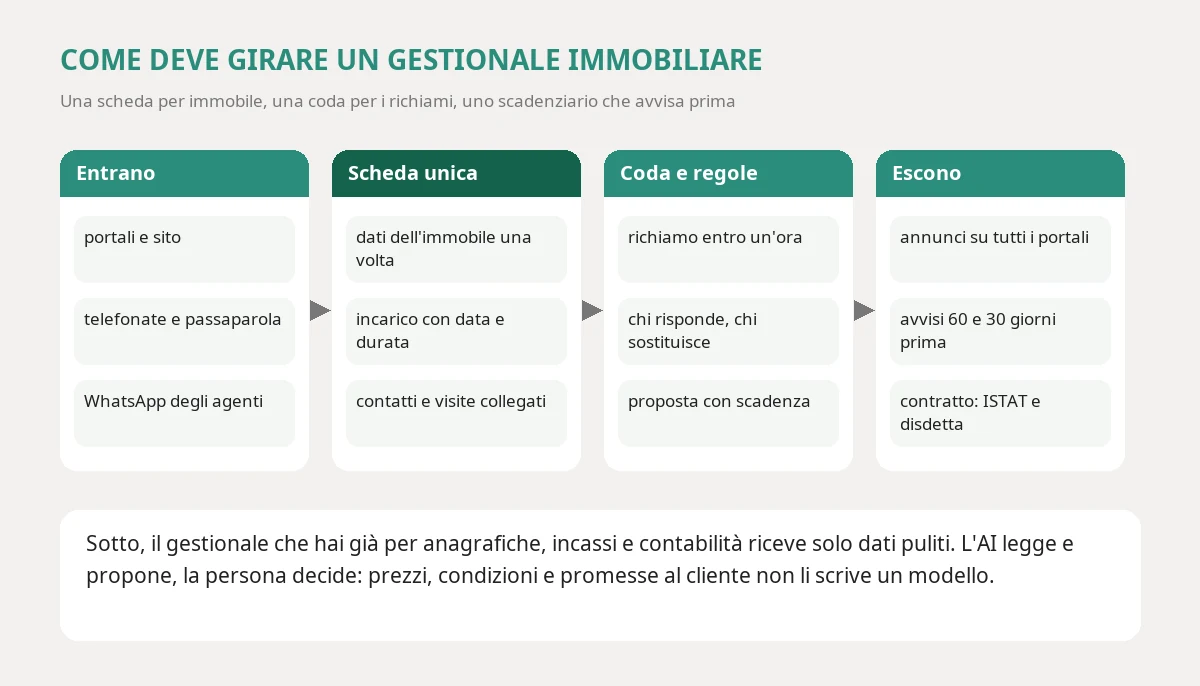
You publish once by keeping the property data in a single record and sending the listings from there to every portal, which receives them in an agreed format. Corrections are made in the record, once, and arrive everywhere. The price can no longer differ from one portal to another.
Property portals accept listings in two ways: manual entry on the panel and automatic upload from a management program, with a data feed in a shared format. Almost all the main portals offer the second, and almost all agency management programs use it. If your agency still enters by hand on three or four panels, the first thing to do is ask each portal how a program connects, and how much it costs. It is often already included in the subscription.
The property record must have the data the portals ask for, and some more that the agency needs. Among the first are type, surface area, rooms, floor, condition, price, address with the level of precision the owner has accepted, photos and, by law, the data of the energy performance certificate: the class and the index must appear in the listing. Among the second, the mandate with its dates, the owner, private notes, the price history. A record that mixes the two levels is dangerous: private notes must never reach the portal.
What happens when the property is sold
The most delicate moment is not publication, it is withdrawal. When a property moves to "sold" or "under offer", the listing must disappear or change status on all portals within the same hour. With five different panels, a full withdrawal takes on average a day, and in that day enquiries arrive for a house that is not there. In the case there were about 85 enquiries a year, each with a phone call of explanation.
Photos, descriptions and back office time
Photos and descriptions are the longest part. In the agency three back office staff prepared the listings, and the work was not the entry on the portal but cropping the photos, writing the texts and adapting to the different formats of each channel. With a single record the photos are uploaded once, in one format, and a program adapts them to each portal.
Clean data: the problem the program does not solve
Before connecting the portals, the data must be clean. If the surface area is calculated in three ways, if the energy classes are not up to date, if the prices are those of six months ago, the program publishes them just the same, only faster. In the case, cleaning 250 records took two days of work by one person at the front desk and an afternoon with each agent for the doubtful cases. It is the effort you make once and that no software makes for you.
How do you keep lease contract deadlines under control?
You keep them under control with a calendar that works out by itself the dates that matter for every contract, registration, annual payment, rent adjustment, notice and end, and sends a warning sixty and thirty days before to whoever has the task. Your accountant checks the rules, but the date must no longer depend on a colleague's memory.
Whoever manages other people's property lives on deadlines, and every missed deadline has a precise cost. The rules in general are these, to be checked case by case with an accountant or a tax adviser, because they change over time and depend on the type of contract. A lease is registered within thirty days of signing. If the flat rate tax option is not chosen, the registration tax for each year is paid within thirty days of the anniversary. With the flat rate tax the annual tax is not paid, but the landlord gives up rent adjustments, including the one linked to inflation, and must communicate the option to the tenant with a letter. The inflation adjustment, where the contract provides for it, has to be requested: it does not trigger by itself, and applies from the moment of the request.
Then there are the notice periods. In many residential contracts notice at the first expiry has to be given six months before, in many commercial ones twelve. If the term passes, the contract renews, and the owner who wanted to sell the property vacant finds it let for years more. In the case, seven owners withdrew the management citing exactly one of these missed dates.
What the calendar must calculate
For each contract the system keeps the start date, the duration and type, the flat rate tax option, the rent and the date of the last adjustment, the notice deadline and the tenant. From here it calculates the dates and creates tasks: "request the inflation adjustment from the tenant by 15 March", "pay the annual registration tax by 30 April", "ask the owner for the choice on termination by 31 May". The calculation is not difficult, but it is made of exceptions, and that is why it is worth writing once and letting it do the work every day.
The link with accounting
The accounting program, the one that issues receipts, records payments and reports to owners, stays where it is. It is not replaced, it is flanked. The calendar passes it the dates and updated amounts, and receives the payments to know who is late. A contract that has a calendar, a document archive and accounting that talk to each other is what is described in the article on contract management software, applied to leases.
A lesson from a law firm
In LegalDesk, the program for law firms that I built, the rule was that no deadline could exist without an owner, and that the owner was warned early and again earlier than it was urgent. The same logic applies to a lease. The day the deadline falls is not the day you work: you work forty days before, and the system exists to make it appear on someone's screen.
How much does real estate management software cost: product, module or custom?
Real estate management software costs from 3,000 to 30,000 euros a year if it is a ready-made product, from 4,000 to 15,000 euros if it is a module of a system you already have, and from 30,000 to 65,000 euros plus maintenance if it is a custom piece. The price depends on how many people use it and how many of your own rules it has to know.
The ready-made product, that is an agency program paid by subscription per user, usually costs between 60 and 100 euros a month per person. For twenty-five users that is about 25,000 euros a year, with a setup between 1,000 and 8,000 euros. It is the right road for small agencies, because it already has the enquiry list, the property record and the portal connection. The limits are two: rules that are only yours, such as the callback sequence of a mandate or the management deadlines, fit badly; and the data archive sits elsewhere, on the terms of whoever sells the product.
The module of the system you already have, if your accounting and lettings program has one for properties, costs between 4,000 and 15,000 euros in licence and configuration. It does lettings and accounting well, the commercial side less so: enquiries, callbacks, sales mandates. It is often the starting point for the contract management part.
The custom piece sits alongside what is there: it holds the single record, the enquiry list with callback rules, the calendar of mandates and contracts, and passes clean data to the portals and to accounting. In the case it cost 45,000 euros, plus 15 per cent a year for maintenance. A complete system built from scratch, with portals, administration and an owners' portal, sits between 110,000 and 200,000 euros and makes sense for groups of a certain size, not for an agency of twenty-five people.
The threshold, with numbers
The custom piece cost 45,000 euros and 6,750 a year in maintenance: over five years, 78,750 euros. The saving depends on how much is recovered. Counting only the 52,400 euros of hours, and assuming half becomes real value, the saving was 26,200 euros a year, or 65 euros per property. Over five years the piece pays for itself above 240 properties. Adding 40 per cent of missed earnings recovered, 35,200 euros, the saving rises to 61,400 euros a year, 153 per property, and the threshold drops to about 100 properties. With 400 properties, the piece pays for itself in about fifteen months.
Below a hundred properties, or below eight or ten employees, the threshold is not reached: a product or, even before that, a shared spreadsheet with a rule and a person who looks at it is enough. The assumptions are prudent but they are assumptions, and must be redone with your numbers. Whoever is weighing up an off-the-shelf package or having something built to measure will find the broader reasoning in the article on business management software, off the shelf or custom.
Questions to ask whoever proposes a product
Ask whether the data is yours and how it is exported in a readable format. Ask which portals are connected and with what kind of update, and how much each connection costs. Ask whether callback sequences and contract warnings can be configured or need a paid intervention. Ask how you leave, and how long it takes. And ask to see, in the demo, your worst case: the mandate that expires, the Saturday night enquiry, the contract with the flat rate tax option.
Where artificial intelligence helps in real estate management software, and where it does not
Artificial intelligence helps to prepare: write the draft of a listing from the property features, summarise a phone call, suggest properties to match an enquiry, flag a contract with an unusual clause. It must not decide prices, terms or promises. It prepares, and a person checks and signs.
The first useful use is the text of the listing. From the record, with surface area, rooms, floor, condition and strong points, a model writes a draft in correct language, in the agency's tone. The agent reads it, removes what is not true and publishes. In the case, the work of the three back office staff on texts halved. The rule is simple: the model does not invent features that are not there. If the record does not say "balcony", the listing does not say it.
The second is matching who is looking with what is available. A contact who writes "looking for a three-room flat near the station, 250,000 at most" has a profile that the system compares with the portfolio, and it proposes three properties to the agent to show. The third is the summary of conversations: a ten-minute call becomes two lines in the record, which the agent corrects. The fourth is reading documents: a scanned lease, from which the model extracts dates, rent and clauses, which a person checks before they go into the calendar.
Where it must not decide
The price of a property is a professional estimate, with knowledge of the area, and in some cases requires a formal appraisal: a model can give an indication from the data, but it is not a valuation. A promise to a customer, an offer to the owner, a reply to a complaint: these remain a person's. And the calculation of a deadline is not made by a model that estimates. It is made by a written rule, checked and tested, because a plausible but wrong date is worse than no date.
People's data
Contacts are personal data, and processing has precise rules: someone who wrote to ask about a property has not agreed to receive marketing messages, and data should not be sent to external services without knowing where it ends up. When a model is used, you choose a service with a contract that excludes use of the data for training and you send only what is needed. It is not a brake, it is the same care you would ask of a colleague.
The criterion for telling them apart
If the error is seen immediately and costs little, like a text to correct, the model is fine. If the error is seen late and costs a lot, like a date or a price, a rule decides and a person checks.
Which mistakes should you avoid when changing how an agency works?
The five most expensive mistakes are: choosing the program before the method, loading dirty data, not involving the agents, trying to replace everything at once and not measuring first. They are avoided by deciding first who owns each deadline and starting from the piece that loses the most money.
The first is choosing the product before the method. You look at three demos, choose the one with the prettiest colours and only afterwards ask who calls back the enquiries. The product does not change the method: it makes it faster, good or bad. The second is loading dirty data: 400 records with surface areas calculated in three ways, owners with three phone numbers, contracts without the date of the last adjustment. The program will work, and will show wrong things with an air of authority.
The third is not involving the agents. Agents work on commission, their time is money, and a system that asks them to write five more fields, with nothing in return, will not be used. The test of a good system is that the agent opens it because they need it: they see the enquiries to call, the matches, the deadlines of their owners. If they open it only because the owner of the agency asks, after a month they are back to their spreadsheet.
The fourth is wanting to do everything at once: portals, contracts, accounting, an owners' portal. The bigger the project, the longer before anyone sees the effect, and the easier it is for enthusiasm to fade. The fifth is not measuring first. Without the three starting numbers you do not know whether the system worked, and the first person who says "it was not needed" will be right, because nobody can prove otherwise.
The move from old to new
For a month you work in parallel: the spreadsheet stays, but every novelty is also written in the system. When the numbers match, the spreadsheet is archived. Nothing is deleted: the history of a mandate or an owner is an asset of the agency, and is worth more than it seems when an agent leaves.
Who owns the data
For each piece of information there must be one place where it is written, and only one. A property's price is changed in the record, not on the portal. A contract is updated in the calendar, not in a message. When a correction made elsewhere is accepted, the system has already lost.
The cost of small delays
Every month in which nothing changes, in the case, costs about 11,700 euros, one twelfth of 140,400. It does not mean you must rush. It means "let us talk next month" has a price, and that it is better to choose the start date than to wait for Monday morning to decide it.
Where do you start: the first release in thirty days
You start from the piece that costs most and finish in a month: the single record with the mandates and their expiries, and the enquiry list with the first callback rule. They are the two biggest items, 64,900 euros out of 140,400, and the effect shows by the end of the first week.
The first week is for measuring and cleaning. You calculate the three starting numbers: the share of commitments from memory, first callback within the hour, mandates expired without a call. You clean the 250 records of active mandates, one person at the front desk and an afternoon with each agent. You decide who owns each deadline and who covers whom.
In the second week the single record is loaded and the mandate calendar starts with the three warnings at sixty, thirty and fifteen days. In the third the enquiry list goes live with assignment by area and by shift, and the task that goes up to the manager after an hour. In the fourth week you work in parallel and look at the numbers: enquiries answered within the hour, mandates with an open task, incomplete records.
What is left for later
Left for later are automatic publishing on portals, if the product you use already has a connection that works, and the contract calendar, which is a second release of two or three weeks. Scoring, campaigns and automatic messages are also left for later. Not because they are useless, but because they produce value only on a list that works.
How to measure that it worked
After thirty days the three numbers are redone. If the share from memory has dropped below 40, if first callbacks within the hour exceed 60 and if no mandate has expired without a call, the first release worked, and the others are planned knowing what each is worth. If the numbers have not moved, the problem is one of method or habit, and it is better to know before spending more.
What to ask whoever builds it
Ask to see a small release in a month, not a plan for a year. Ask that the data stays yours, in a format you can export. Ask who answers when a date does not fire, and how quickly. And ask that the system can be switched off without losing the archive, because trust comes from knowing you can leave.
What if the number says it is not your problem?
It may be that, once measured, the share of commitments from memory is below 25 per cent, that enquiries get a reply within the hour in 70 per cent of cases and that no mandate expires without a call. That is good news, and it is worth saying clearly: in that case custom real estate management software is not what you need, and whoever tells you otherwise is selling you something.
In that case the bottleneck, if there is one, is almost always elsewhere. If enquiries arrive but viewings do not turn into offers, the problem is in the price, in the selection of properties or in the way the viewing is run, and a program does not solve it. If mandates are renewed but properties stay unsold for a year, the problem is the initial valuation, often inflated to get the signature. If the contracts are few and large, thirty or forty commercial premises of high value, you do not need a system: you need a person who follows them one by one.
And there is a case in which software is not the answer even with bad numbers: when the starting data is such that no program could use it, with owners who do not reply, properties without documents and contracts never correctly registered. There the problem is regularity, and a program helps only if you have first put it in order, often with the help of a professional.
If you have read this far, you probably have your own Monday morning in mind. Before looking at any demonstration, take the last sixty dated commitments you have open and write, for each one, where it can be seen to exist. Then look at the mandates that expired in the last year and count how many received a call before expiry. If more than half the commitments sit outside a shared system, or if more than one mandate in ten expired in silence, you already have the answer. The rest is a project, not a choice of product.
If you want a second look at your case, the way is to get in touch, and when the right solution is a piece built around the way you work, the same page also covers custom software development. For the method of reading the margin of a whole company, from above, there is the article on management control software.
Frequently asked questions
It depends on the road. A ready-made agency product usually costs between 60 and 100 euros a month per user, that is between three and thirty thousand euros a year depending on headcount, with a setup between one and eight thousand euros. The property module of a system you already have costs between four and fifteen thousand euros in licence and configuration. A custom piece that sits alongside what you have, with a single record, callback queue and a calendar of mandates and contracts, costs between thirty and sixty-five thousand euros, plus fifteen per cent a year for maintenance. A complete system from scratch sits between one hundred and ten and two hundred thousand euros and suits large groups.
You calculate three numbers. The share of dated commitments that live outside a shared system, counting callbacks, mandate expiries, offers and open contracts on any given day. The percentage of portal enquiries answered within an hour. The share of mandates that expired without a call in the thirty days before. Below 25 per cent of commitments from memory a shared spreadsheet is enough, between 25 and 50 the problem is method, between 50 and 75 a system pays for itself, above 75 the agency lives on memory.
Five items: mandates left to expire with no call, portal enquiries answered late, listings updated by hand on several portals, missed contract deadlines and time lost searching for the latest version. In an agency with 25 employees, 400 properties and 3 million euros in revenue they were worth about 36,400, 28,500, 19,200, 32,700 and 23,600 euros, about 140,000 euros a year in all, 4.7 per cent of revenue. Much of it is missed earnings. Below 1.5 per cent of revenue the problem is not a priority, above 3 it almost certainly is.
No. The portal is a channel: it publishes listings and brings enquiries. The CRM organises contacts and viewings. Real estate management software covers the whole journey: a single record per property, the mandate with its expiry, enquiries with a callback rule, publishing from a single entry and, for those who manage other people's property, the calendar of lease contracts. Many products do two or three of these well and almost none keeps all of them in the same place.
It can prepare, not decide. It helps write the draft of a listing from the record, summarise a call, suggest properties that suit an enquiry and read a scanned contract, always with a person checking. It must not decide price, terms or promises to the customer, nor calculate deadlines: a plausible but wrong date is worse than no date, and deadlines are calculated by a written, tested rule. Contact data is personal data and must be handled with care.
In most cases a mixed road: a product for listings and portals, the accounting system you already have for payments, and a custom piece for the rules that are only yours, such as the callback sequence for mandates and the contract calendar. Counting time alone the custom piece pays for itself above 240 properties in the portfolio; with mandates and enquiries recovered the threshold drops to about 100. Below a hundred properties a product or a shared spreadsheet with a rule is enough.
Leave your details in the form below