

Over the years, much of the developer community has chased one dream: to create software capable of understanding human beings.
At the beginning it seemed like an almost impossible task.
No algorithm really seemed capable of deciphering what is as fragile, contradictory and changing as language.
Over time, however, a further truth emerged.
Machines don't have to understand people, they must understand the meaning.
The turning point came when, for the first time, a model returned a consistent response.
It wasn't a fluke: it was proof that the machine could reflect thoughts instead of repeating words, like a mirror reflects light.
Behind every "intelligent" answer lies not magic, but numbers.
And those numbers emulate a structure that belongs to human beings.
It's the same invisible logic with which every man connects ideas, emotions and intuitions, often without realizing it.
And this is where the subtlest trap arises: the more you try to explain how a machine thinks, the more the way the human being thinks emerges.
Language models do not invent, but amplify.
They explode, with implacable precision, connections that already existed in the mind of those who created them.
This is why semantic research is not just a technology, it is a reflection of the mind of those who design, write code and model its meaning.
Understanding it means intuiting, at least for an instant, something much deeper: how the mind that made it possible thinks.
I've been through every technological transition in this last quarter century.
I've written code, founded companies, trained developers, and led teams that have built systems that are now taken for granted.
And I can tell you with certainty: those who understand semantics do not learn a technology, change your way of thinking.
The real revolution in artificial intelligence is not that machines learn to speak like us.
It's that we learn to think in a new way, closer to theirs.
It's not about imitation, but about understanding.
Not of language, but of the structure of thought.
And this is not a technical article full of formulas and acronyms.
It is a tool for look at semantics from a different angle, clearer and more concrete.
The limit of my language means the limit of my world.
Ludwig Wittgenstein – Philosopher of language (1889 – 1951)
Not like a manual to study, but like a mirror that, once passed through, changes the way you read and interpret words.
Semantic search explained in simple words
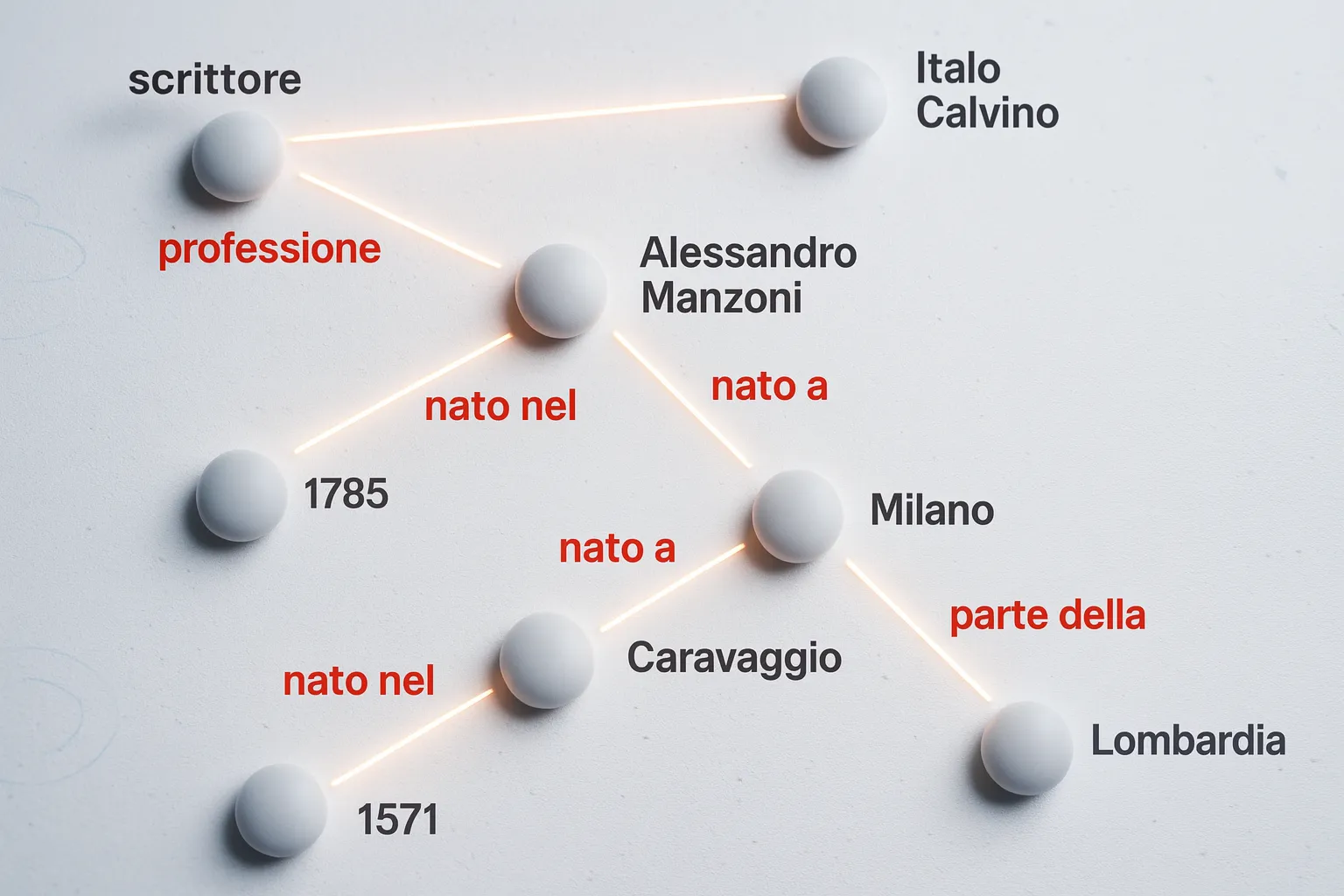
The first time you hear about "semantic research" you might think of a fashionable term, one of those that disappear with the wave of the moment.
But that's not the case.
The difference compared to traditional engines is profound: it's not about finding words, but meanings.
And when you really start to understand it, you can no longer look at language with the same eyes.
Imagine searching for something in a large, messy archive.
If you write “fast car,” a traditional system will only show you documents that contain exactly those words.
A semantic system, however, will also find “sports car”, “high performance vehicle” and “powerful engine”.
He doesn't read the letters, understands the meaning.
Don't look for what you said, look for what you wanted to say.
This ability does not arise from a trick or a set of predefined rules.
It arises from the way embeddings represent each concept as a position in space.
When you write a sentence, the machine does not look for literal correspondences, but for meaning relationships.
And this allows it to grasp nuances, synonyms and contexts that a keyword-based engine completely ignores.
In practice, semantic search works like an interpreter.
He doesn't receive commands, he listens to intentions.
He is able to recompose scattered fragments of meaning and give you consistent results even when your request is incomplete, ambiguous or imprecise.
Embeddings are the map that makes all this possible.
They define where each concept lives, how close it is to another and what part of the meaning they share.
When you start to understand it, the line between human language and artificial intelligence starts to thin out.
Because the machine no longer reacts to a string of text, but recognizes a thought.
It is no longer a blind, mechanical search, but a dialogue between what you intend and what exists in your data.
And in that dialogue precision does not arise from a rigid syntax, but from ability to grasp connections that give shape to meaning.
Because semantic search is superior to keywords

For years we assumed that finding the right word was the key to getting the right answer.
It was a simple deal: formulate the query well and the engine will take you exactly where you want.
But that pact no longer holds.
Words are not enough, because they don't capture everything we mean.
Keywords are rigid tools: they look for literal matches and ignore nuances, contexts and relationships.
The biggest problem with communication is the illusion that it has happened.
- Synonyms and unexpected linguistic variations
- Phrases phrased imprecisely or ambiguously
- Concepts that require context to understand
- Implicit intentions that do not coincide with the exact words
They only work well when you already know what you're looking for.
But reality doesn't always bend to that logic.
Often you are looking for something that you can't formulate it precisely, and that's when semantics become key.
Semantic search doesn't just locate a sequence of terms, it interprets the space between those terms.
He understands that “sports car” and “fast car” belong to the same conceptual universe, even though they do not share any identical words.
And in that universe the distance is not random: it is pure meaning.
The difference is radical.
With keywords you move on a track, with semantics explore a network.
The former react to what you write, the latter responds to what you mean.
Keywords take you to a specific point; semantics orients you, even when your direction isn't entirely clear.
Behind every word there is one constellation of concepts, mental images and implicit connections.
When you say “coffee,” you don't just think of a dark liquid in a cup; you think of a break, an aroma, a specific moment of your day.
Semantic search works right there, in the invisible territory that keywords cannot reach.
For software developers it is a paradigm shift, not a technical detail.
It means moving from systems that react to systems that understand, from search engines that they perform to interpreters who know their way around.
It's the difference between getting a list of results and getting what you're looking for, even if you haven't expressed it precisely.
The true superiority of semantics is not in the quantity of results, but in their relevance.
It gives you consistent answers, not because you said them well, but because he really understood you.
And it is precisely this type of conceptual leap that we teach in ours Programming course with AI : not a manual to browse, but a practical path to learn to design systems who truly understand, capable of interpreting before executing.
Don't settle for trying better, learn to understand earlier and deeper than anyone else.
Discover how semantics can let you read your users' minds before they even speak.
How semantic search works with AI embedding
Maybe you wouldn't say it, but machines don't talk: they listen.
They don't do it with their ears, but through the space that separates the words.
It is precisely in that distance that AI embedding is born, the level at which language stops being sound and becomes geometry.
An embedding does not interpret sentences like a human would.
It doesn't need grammar, emotions or linguistic rules.
He works in a numerical space where concepts are not read but measured, and where implicit relationships count more than the external form of words.
Every word, phrase or idea becomes a point in a vector space, and the distance between these points tells about their connection.
Imagine a musician recognizing the mood of a note without having to hear the entire melody.
Embeddings do something similar: they perceive relationships, not letters.
They find coherence even when surface language is messy or incomplete.
Two sentences close in space express the same intention, while two distant sentences speak of worlds that do not meet.
When a semantic search engine processes a query, it transforms the question and the entire text corpus into vectors, then calculates which points are closest to the original intention.
It is a geometric operation, not a grammatical one.
And that's what allows you to return relevant answers even when the words used are not perfect.
This logic represents a profound change for software developers.
It is no longer a question of writing rigid rules, but of building systems capable of recognizing contexts and nuances.
It's like moving from a static vocabulary to a living map, which adapts to the real meaning of the words.
Many developers initially feel disoriented when faced with this approach.
They are no longer faced with a rigid and predictable algorithm, but an interpreter who recognizes contexts and similarities.
Yet, there is nothing mysterious in all this.
It is the same mechanism that governs the human mind when it connects ideas in a natural and spontaneous way.
When you say “sun,” you don't just think of a yellow sphere suspended in space.
You think of light, heat, an idea of energy and movement.
The machine does not feel emotions, but passes through that same invisible network of connections.
Understanding embeddings means learning to read this language clearly, like observing a well-drawn map.
It's not magic, it's not artificial intuition.
It is pure structure.
And those who master it stop perceiving AI as a mysterious entity and start using it as a concrete extension of one's ability to think.
Concrete benefits of semantic search for companies

Every company generates a quantity of information that grows faster of his ability to manage them.
Reports, technical documentation, tickets, emails, knowledge bases and internal messages form an enormous asset that often remains buried and unused.
Semantic search was also created to make this value accessible.
With a traditional keyword-based engine, internal search is slow, fragile and inefficient.
If you don't remember the exact word, the system fails, if the terms are ambiguous, it returns irrelevant results.
With semantic search, however, you just need to remember the idea.
Formal precision is not needed, but the meaning counts.
This profoundly changes the way an organization works.
With semantic search, a company can:
- Retrieve information even with imprecise requests
- Reduce the time to access internal knowledge
- Eliminate information silos and improve collaboration
- Make faster, more informed decisions
Knowledge becomes more accessible and fluid.
It is no longer necessary to "search carefully", but to know what you want to know.
The strongest advantage is not only operational, but strategic.
This type of research transforms corporate knowledge from a static resource to a living network, available in real time.
Eliminate information silos, speed up decisions and reduce errors.
Teams can focus on taking action instead of hunting for information.
And it is precisely here that a real advantage arises: those who master these tools do not simply search better, but guide strategic decisions, anticipate problems and constructs answers before they even become necessary.
It is exactly this approach that we teach in ours programming course with AI : a practical path to transform semantics into a measurable competitive advantage, in real projects and not on slides.
In a market where the speed with which you access data determines your ability to react, semantics becomes a concrete advantage, not a technological embellishment.
It is a cognitive infrastructure that it makes the company smarter, faster and more effective.
Companies that adopt this logic do not simply optimize processes.
They change their mentality.
They move from guarding knowledge to sharing it, from defending it to using it to grow.
Those who dominate semantics no longer manage information: they govern it.
If you want your business to stop chasing data and start driving it, now's your chance.
Semantic search and RAG the essential link

Semantic search shows all its power when becomes an integral part of a broader strategy.
This is where RAG, Retrieval Augmented Generation, comes into play.
Together they form a mechanism that does not simply find information, but integrates it intelligently within the generation of content.
A RAG system uses semantic search to precisely identify the most relevant documents with respect to a question.
It then passes them to a generative model, which builds the answer by combining the extracted knowledge with its own linguistic ability.
It's a synergistic cycle: semantics provides the context, the model generates the final text.
This approach resolves a structural limitation of traditional linguistic models: the tendency to “invent” answers when they do not have updated or specific information.
With RAG, the model does not rely only on internal memory but interrogates the real context and builds answers anchored to the actual data of the organization.
The advantage is obvious.
You get consistent, verifiable and updated answers without having to constantly train new models.
AI becomes more reliable, more precise and much more useful in business use cases, where correct information matters more than linguistic creativity.
For a developer, this means building architectures where semantics becomes the gateway and the generative model the final interpreter.
Together they allow you to create systems that do not simply return results, but respond in a contextual and reasoned way, reducing errors and increasing user trust.
RAG is not a simple technical tool, it is a bridge between knowledge and language.
Between information and decision.
And it is precisely on this bridge that the most effective and long-lasting AI applications are built.
How to integrate it into software development

Integrating semantic search into software development means introducing a whole new level of application intelligence.
It's not just about improving the user experience, but transforming the way systems access, understand and use information.
The first step is to build a textual archive that represents useful knowledge for the application context.
The key steps to integrate semantic search are:
- Create a vector space that represents the meaning of the contents
- Connect a semantic search engine to query the data
- Orchestrate interaction with other application modules
- Scale gradually as the project grows
This vector space becomes the basis on which semantic search operates, replacing simple word matching with meaning-based recognition.
Subsequently, a semantic search engine is integrated that allows you to query this data in natural language.
The user does not need to know the internal structure of the system.
He can formulate requests in his own language and receive relevant answers, even if the words used do not coincide with those present in the documents.
The most delicate phase is interaction with other software components.
A well-designed architecture connects semantic search to business intelligence modules, chatbots, web interfaces and decision-making systems.
In this way, semantics becomes a transversal layer, capable of improving every part of the application without forcing you to rewrite everything from scratch.
This integration does not require proprietary models or complex infrastructures.
This is where the real difference arises between those who chase closed technologies and those who build solid and autonomous systems.
In ours programming course with AI we teach exactly how to create semantic pipelines independent of proprietary stacks, with modular, scalable and production-ready architectures.
It's not theory: it's concrete planning, step by step, up to make semantics an internal asset and not an external service.
It can be built with accessible tools and already tested APIs, gradually scaling as the project grows.
It is an incremental and pragmatic approach, which allows you to obtain real results in a short time.
When semantics enters the application flow, the software stops just performing commands and begin to understand contexts.
Users no longer search for “keywords”, users get answers.
And the difference, in a modern system, is not marginal.
It's transformative.
Don't just write code, build systems that understand.
Semantics are the key to creating applications that anticipate intent and multiply impact.
Practical examples of semantic search

To truly understand the value of semantic search, it helps to watch it in action.
Practical examples show better than any theory how much the interaction between people, data and systems can transform.
This is an already mature technology, capable of solving real problems, not an abstract concept.
Imagine a pharmaceutical company with a vast technical archive.
With a traditional keyword-based search, a researcher should remember titles, specific names or formulas for finding a document.
With semantic search, however, you can write a question in natural language such as "which studies demonstrate the effectiveness of this molecule in pediatric patients?" ed get the most relevant texts immediately, even if the words don't match exactly.
Or think of a customer service with thousands of tickets, FAQs and technical manuals.
Operators no longer have to remember the precise title of an article or the exact formula used in the past.
They can simply type an intention and receive the most relevant solution.
This reduces response times, increases accuracy and improves the overall experience for customers and internal teams.
In the legal field, semantic search allows you to navigate between regulations, sentences and contractual clauses without knowing codes or numbers by heart.
An attorney can ask a complex question and immediately receive the most relevant references, speeding up a job that previously took hours.
Similar examples multiply in every sector: healthcare, education, engineering, finance.
Wherever there is a rich but fragmented information heritage, semantic search becomes a multiplier of efficiency and precision.
It does not replace human work, but enhances it.
It does not impose a new language, but adapts to the one we already use every day.
It is precisely this flexibility that makes it one immediate impact technology, capable of generating tangible value right from the first implementations.
Common mistakes to avoid when using semantic search

Semantic search is powerful, but like any truly transformative technology, may become ineffective if applied superficially.
Many errors arise not from technical limitations, but from incorrect expectations or incomplete implementations.
The most frequent mistakes to avoid are:
- Treat semantics as a simple extension of keywords
- Neglecting the quality and consistency of underlying data
- Overestimating the "intuitive" capabilities of AI
- Isolate semantics without integrating them into operational flows
Recognizing them in advance means avoiding frustrations and building solid solutions.
When semantics are reduced to a simple extension of keyword research, the results become flat: it does not respond to rigid logic nor does it tolerate mechanical combinations of terms.
If it is designed as an “improved traditional engine”, it ends up returning mediocre results.
Instead, it should be set up as a true interpreter of meaning, capable of grasping nuances and contexts.
However, the quality and consistency of data remain fundamental: without a solid basis, accuracy weakens.
This research cannot extract value from messy, redundant, or inconsistent content.
If the information base is not structured with a minimum of logic, the results will be fragile and inconsistent.
Accuracy does not arise only from embeddings, but also from the cleanliness and clarity of the material on which they operate.
Then there is the risk of overestimating technology: a semantic engine is not an omniscient mind.
It does not understand emotions, unexpressed intentions, or implicit logic that is not contained in the data.
If the information is missing, the answer will also be missing.
Treat her like an oracle inevitably leads to disappointment.
Finally, many underestimate the importance of integration.
Semantics are at their best when they become part of the operational flow, not when they remain an isolated component.
It is at this point that the difference between an experiment and a strategic lever comes into play.
To avoid these structural errors, in our programming course with AI we show how to integrate semantics into real projects, maintaining a balance lucid between technical power and architectural control.
This is where technology stops being an accessory and becomes a supporting structure.
Connecting it to chatbots, knowledge management systems or business processes means transforming it into a strategic lever, not a marginal experiment.
Avoiding these mistakes does not mean mastering magic formulas, but building a solid foundation on which semantic research can express its true potential.
It means understanding that semantic search is not a trick to search better, but a different way of interrogating knowledge.
Who treats it with this awareness obtains solid and long-lasting results.
Every transformation begins at the same point: a choice that separates those who observe from those who act.
Semantic search is not an elegant addition to your digital ecosystem, it is the lever that shifts the center of gravity of your way of working.
It's not just about improving efficiency, but about building an environment where information becomes an active part decisions and not an obstacle to get around.
While many will continue to multiply tools without changing perspective, few will begin to build architectures capable of thinking together with them.
Those few will be the first to reap the results, not because they will have more resources, but because they will have chosen first.
Whether you develop solutions or lead an entire team, don't stand by as others seize the opportunity that's already in front of you.
Every extra day in the old model is a day lost in competitiveness, speed and strategic clarity.
Fill out the form in a few seconds and schedule a call with one of our tutors: we will show you how to transform dispersed knowledge into a structure.
Leave your details in the form below