How much does a Software Architect earn in Italy in 2026?
The gap compared to a Senior Developer is real and measurable: 20-35% more on average, rising further for those working as freelancers (500-1,000 euros/day) or in highly compensated sectors such as fintech and strategic consulting.
The skills that truly make the difference are not only technical. Technical leadership, ability to communicate with the business, and experience with cloud-native architectures are the factors that separate those who stop at 60,000 from those who exceed 90,000 euros.


You want to know how much a Software Architect earns. In Italy, in 2026. With real numbers.
Short answer: considerably more than you are being paid right now. In almost every case.
The last time someone asked me this question directly, it was a senior developer with twelve years of experience, two certifications, and a salary that had not moved in four years.
He was not an isolated case.
The data and reasoning in this article are useful for any developer who wants to understand where they stand in the market for architectural roles.
The problem was never a shortage of data. The problem is that the available data is unreliable.
Glassdoor collects self-reported figures from people who either want to appear important or have no idea what they are actually worth.
Industry surveys lump together profiles that have nothing in common beyond a job title. The professional taboo around discussing salaries means that honest comparisons between colleagues are rare and almost always incomplete.
I gave up expecting salary transparency from this market twenty years ago.
Instead, I started gathering data from verifiable sources: job listings with stated salary ranges, recruiters who tell you the truth when you ask directly, colleagues who have made the transition recently.
The figures in this article come from those sources, not from an anonymous form filled in at random.
There is one thing the numbers will not tell you: they tell you where others have arrived, not where you can go.
They do not tell you that you are already doing the work without being paid for it.
I have seen too many developers leave tens of thousands of euros on the table every year for exactly this reason.
Keep reading only if you are ready to stop giving away skills that are worth twice what is landing in your account.
Software Architect or Senior Developer: why the market pays them differently
Let us start with the first lie that circulates in the industry.
A Software Architect is just a Senior Developer with more years of experience.
I have heard this in dozens of companies. It is wrong, and it costs those who believe it dearly.
A Software Architect is not a linear progression from the senior developer role. It is a role with qualitatively different responsibilities, and the market knows it.
I have a client who leads a team at a mid-sized manufacturing company and has been doing this work for five years.
He defines the architecture, coordinates with the business side, and manages the long-term scalability of the system.
His contract says Senior Developer. His pay says Senior Developer.
He does the work of an Architect and leaves at least €20,000 gross per year on the table.
This situation is the norm, not the exception.
Companies of moderate size have flat structures where the most experienced developer absorbs architectural responsibilities without any change in title.
The result is an army of unofficial Architects paid as Senior Developers.
The distinction matters when you want to understand where you stand in the market.
If you make architectural decisions, translate business requirements into technical solutions, and are responsible for the scalability and maintainability of the system, you are already doing an Architect's job.
The market, however, compensates you based on what is written in your contract, not on what you actually do.
It is unforgiving, but that is how it works.
The Software Architect's responsibilities
The Software Architect works at a higher level of abstraction than the Senior Developer.
Their time horizon is considerably longer: they make decisions that shape the project for months or years.
In an enterprise .NET context, this is the person who decides whether a system should evolve towards microservices or remain on a well-structured monolith.
They evaluate when to introduce a message bus such as Azure Service Bus and when the added complexity is not justified.
They choose the most appropriate persistence pattern based on specific business requirements, not on what happens to be fashionable.
The competency that truly distinguishes an Architect from a Senior Developer is not purely technical.
It is the ability to move between the language of business and the language of engineering.
I have seen technically brilliant developers fail in the Architect role because they could not translate business requirements into architectural constraints.
I have seen less technically brilliant Architects do excellent work because they understood what the business needed and knew how to achieve it.
The Software Architect is also responsible for the long-term technical health of the system: from managing technical debt to planning migrations.
The goal is to ensure that today's decisions do not become traps two years from now.
The responsibility gap between the two roles is substantial: the market reflects this economically with a differential of €12,000-25,000 gross per year.
| Dimension | Senior Developer | Software Architect |
|---|---|---|
| Decision horizon | Sprint / iteration | Months / years |
| Primary output type | Working code | Documented system decisions |
| Typical stakeholders | Development team | Business, management, technical team |
| Working language | Technical | Technical and business |
| Responsible for | Correctness of implementation | Long-term maintainability and scalability |
| Market differential (Italy) | Baseline | +€12,000-25,000 gross/year |
The move from Senior Developer to Software Architect is a genuine change in the nature of the work.
So before asking for a pay rise, ask yourself whether you have already changed the nature of your contribution.
If you are already carrying this level of responsibility, the question is not whether you are worth more.
The question is how to stop being read by the market under the wrong title.
If you are already making architectural decisions without the title that recognises them, the problem is not technical. It is a positioning problem.
In the Software Architect AI Course, this is exactly what we work on: not the concepts you already know, but the way you read your own contribution, document it, and make it visible to the market.
On your code, in your context, with Matteo Migliore: 27 years of enterprise architecture on real systems for Il Sole 24 Ore, NATO, Fiat, and GSK.
Software Architect salary in Italy in 2026: real market ranges
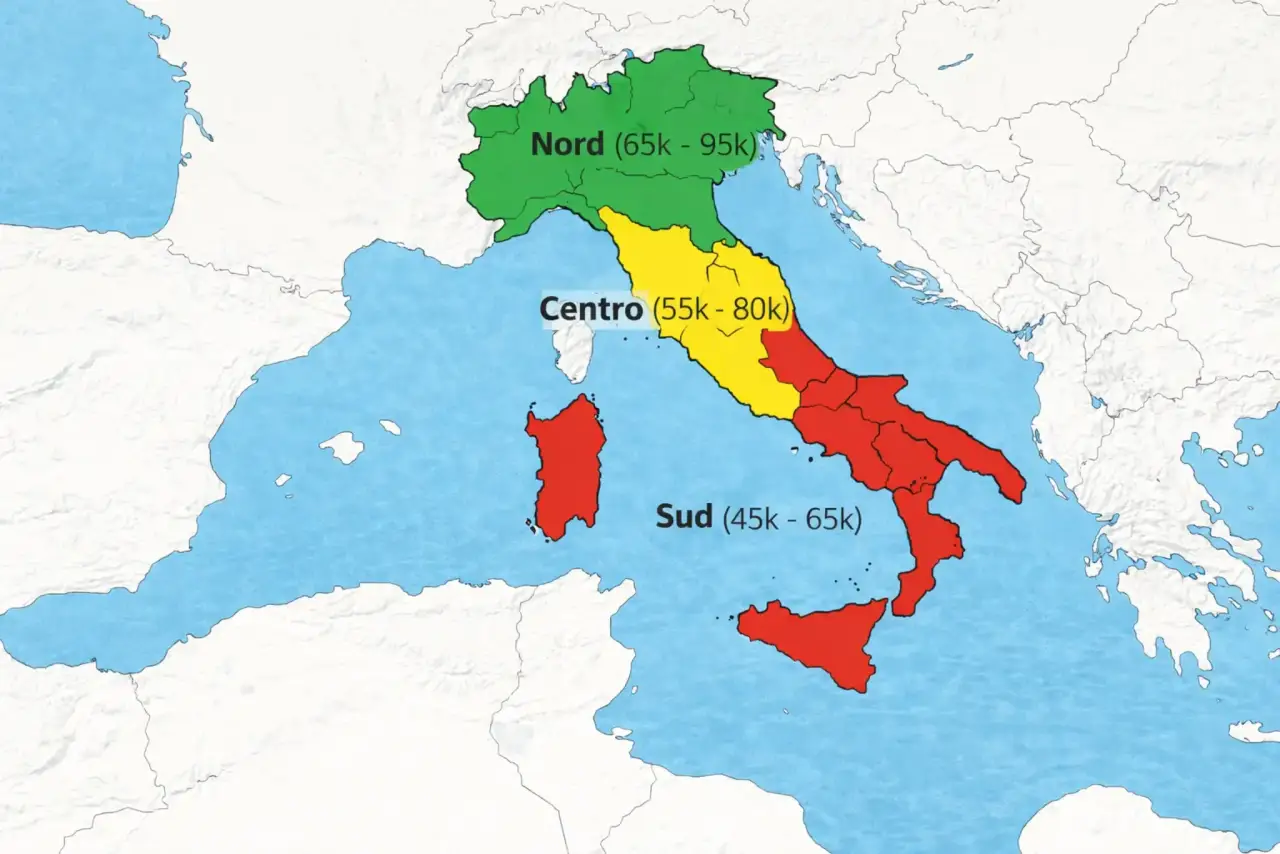
The most common question I receive is the wrong one.
How much does an Architect earn in Milan? Is it worth being in Rome? As though your salary ceiling depended on your postcode.
It does not.
I have met Architects with impressive salaries working from places nobody would ever put on a list of tech hubs.
And colleagues sitting two streets away from the financial district, stuck at €55,000 for years.
Location is a factor. It is not the factor.
The variables that truly matter are two: which type of company you can access, and what skills you bring to the table.
The data below refers to Software Architects with at least three years specifically in the role, with demonstrable architectural responsibilities. Not total years of career.
All figures are gross annual salaries for permanent employees.
Before discussing numbers: the range depends on four variables, and geography is only one of them. The other three are:
- The sector (fintech and healthcare consistently pay more)
- Depth of experience in the role and the quality of your results track record. An Architect who can articulate their decisions with precise numbers can command 30-40% more than someone with equal seniority who cannot demonstrate their impact.
- Precise positioning: the higher rate is a consequence of how you present yourself, not of seniority alone.
The Italian market: what to expect at the top
The Italian market operates at two speeds.
One where the conversation is about €50,000 or €55,000. And one where the numbers are €80,000-100,000.
Focus only on the second. The first should not be your reference point.
A Software Architect with three to five years in the role positions between €65,000 and €80,000 gross per year. With five to eight years and a demonstrable track record, the range rises to €80,000-95,000.
Peaks above €100,000 exist but are not the norm.
They concentrate in three specific contexts:
- Large multinationals with international salary policies
- Fast-growing companies with significant funding
- Principal Architect positions in the most mature organisations
Outside these contexts, the real ceiling is lower. Knowing where the ceiling is helps you choose which room to enter.
Demand for senior .NET profiles with Azure experience is consistent in the Italian enterprise market and frequently unmet.
If you have this profile and are actively searching, excluding the top-tier companies means conducting an incomplete search.
Those who work in the Microsoft .NET ecosystem on Azure, integrated with Microsoft Dynamics in manufacturing or services contexts, start with a natural advantage.
Not because it is objectively the best technology in every scenario: because it is where demand concentrates in the market you operate in.
Remote work for UK, Swiss and US companies: where compensation enters a different category
Then there is the segment that most articles treat as a footnote. I put it centre stage: it is the only one where the rules of the Italian domestic market no longer apply.
Italian Software Architects working remotely for British, Swiss, or American companies position at completely different levels:
- UK (primarily London): €80,000-120,000 equivalent per year
- Switzerland: contracts in CHF, often equivalent to €120,000 or more
- USA: range between €100,000 and €150,000 for senior profiles in premium sectors
Northern European companies tend to apply more standardised bands, generally between €80,000 and €110,000. American companies pay more for profiles with superior expertise.
The differential over the Italian domestic market is €20,000-50,000 gross per year. This is not an exaggeration. It is the market.
The profile that gains access to this segment meets precise requirements across three areas:
- Technical: verifiable architectural experience on distributed, cloud-native, or microservices systems, with a portfolio of documentable decisions. "I contributed to the architecture" is not enough. Real systems, measurable results, and explainable choices are required.
- Communication: the ability to conduct architecture reviews in English, present alternatives with clear trade-offs, and engage with non-technical stakeholders without losing precision.
- Operational: the discipline of asynchronous work in teams distributed across time zones. This is not an optional soft skill. It is frequently the deciding factor between those who thrive in this context and those who do not last three months.
If you have the skills and are willing to build the ability to work in distributed teams, the differential over the domestic market is substantial.
The skill gap can be closed. The physical distance no longer exists.
The tax implications of this path require an accountant with cross-border expertise. Do not improvise on this front.
Freelance Software Architect in Italy: rates and market in 2026
The freelance market for Software Architects is growing strongly.
Not because companies have become more generous, but because they can no longer find and retain senior profiles as permanent employees.
External consulting has grown as an almost obligatory alternative.
Mid-sized companies cannot afford a full-time Architect. But they need that expertise for a cloud migration, the rewrite of a system that has been running for years, or the design of a new platform.
Project-based consulting lets them access it without the commitment of a permanent hire.
For an Architect working independently, this translates into concrete and well-paid opportunities.
I have a client who has been working as a freelance consultant for three years. He did something simple and effective.
He stopped presenting himself as a Software Architect with .NET experience.
He started presenting himself as an Architect specialising in Azure migrations for manufacturing companies running Microsoft Dynamics.
In six months he raised his rate by 35% without changing his skills at all.
He simply changed his positioning.
Rates do not grow automatically: they depend on the perceived value you are able to communicate to a potential client.
Accelerating this path requires vertical specialisation. A generalist Architect competes with many. An Architect with specific expertise in .NET and Azure competes with very few.
Daily rates in 2026
| Band | Daily rate | Typical profile |
|---|---|---|
| Entry freelance | €500-600/day | Generalist consulting, non-premium sectors, early independent experience |
| Mid-range | €650-800/day | Sector-specific experience, demonstrable references, 2+ years independent |
| Upper range | €800-1,000/day | Verifiable impact on complex projects, high-value sectors, solid network |
| Principal / Specialist | >€1,000/day | Rare expertise: critical systems security, high availability in regulated sectors, big tech background |
Calculating net income: stop looking only at gross figures
Over 160-180 working days per year, gross revenue falls between €80,000 and €180,000.
Comparing this with employment must be done on a net basis, not by comparing gross figures that measure entirely different things.
You need to account for social security contributions for self-employed workers (around 26% in Italy), progressive income tax, operating expenses, and the absence of paid leave, sick pay, severance entitlements, and company welfare benefits.
Once these items are converted into their monetary equivalent, the gap narrows considerably.
Italy's flat-rate tax scheme (regime forfettario), available to self-employed professionals with annual revenue below €85,000, is the most tax-efficient structure at the outset.
With a flat tax of 15% (or 5% for the first five years if you meet the eligibility requirements), the total tax burden can be significantly lower than that of an employed professional on an equivalent gross salary.
Above €85,000 in annual revenue, the switch to the ordinary tax regime changes the equation materially.
Plan ahead, not after the fact.
A net comparison between an employee on €80,000 gross and a freelancer billing €120,000 produces figures that are closer than they initially appear.
The freelance advantage exists, but it is often more modest than the first impression suggests.
Those who choose the independent path purely for the money are frequently disappointed.
Those who choose it for the variety of projects, the ability to select their clients, and faster professional growth almost never go back.
There is one more advantage that does not appear in any spreadsheet: the freedom to work from anywhere with an internet connection.
Not just from home. From places that others visit on holiday once every three years, if they are lucky.
Failing to factor this in is throwing both money and freedom away.
Which skills genuinely increase a Software Architect's salary in 2026

Not all skills carry equal weight in salary negotiation.
Some are implicit prerequisites: knowing how to design a distributed system, understanding the main architectural patterns.
Anyone aspiring to the role is expected to have these: they earn you no extra points. Their absence, however, rules you out.
Others are genuine differentiators that justify a move to a higher salary band.
Understanding the difference is the first thing to do before investing your time.
A recruiter specialised in senior IT profiles looks first at the title and the industry background, then at the cloud provider of choice, then at the sectors you have worked in.
Certifications appear as a secondary filter.
Leadership skills and the ability to communicate with the business side emerge only in in-depth interviews.
But these are often what determines the final outcome and the level of the offer.
Verifiable cloud experience: not "I know Azure" but "I designed this"
"I have experience with Azure" is a phrase recruiters hear at least two hundred times a week.
It distinguishes no one.
What distinguishes you is something different: "I designed the architecture of a cloud-native system that handles 50,000 transactions a day with a documented availability of 99.9%."
Certifications such as Azure Solutions Architect Expert or AWS Solutions Architect Professional validate knowledge of the provider's specifics. They function as an entry signal, not as definitive proof.
In senior interviews, substance emerges through trade-off questions: why did you choose Event Hub instead of Service Bus in this scenario?
How did you manage data consistency between these two services?
How did you design the disaster recovery strategy for a full regional outage?
Azure commands the highest demand in the Italian market, driven by Microsoft's strong presence in the enterprise and SME segment.
Those working in the .NET ecosystem start with a natural advantage, because Azure is typically the reference cloud for C# and ASP.NET Core applications.
Deep knowledge of Azure services is built by working on real cloud-native .NET projects. It does not come from a twenty-hour course on YouTube.
Applied Domain-Driven Design: reasoning about the domain
DDD is the shared language between a Software Architect and the business.
Those who have mastered it in practice, not only in terminology but in the concrete work of defining bounded contexts and mapping the relationships between them, have an advantage in any structured enterprise environment.
The salary differential for those with hands-on DDD experience on production systems is estimated at €8,000-15,000 gross per year above profiles with purely technical skills.
In practice, applying DDD means being able to run event storming sessions with domain experts, identify bounded contexts and their boundaries, and establish a shared language with the business.
On a .NET stack, this translates into structuring a project with clearly separated layers for domain, application, and infrastructure: not on paper, on real systems, with the complications of the real world.
I have seen developers who could recite DDD from memory struggle when asked to apply it to a real accounting domain, with years of accumulated business rules layered on top of one another.
Theory is free. Practice takes effort. The market distinguishes between the two.
AI integration in production systems: the 2026 differentiator
Knowing how to design a system that integrates LLM models, RAG architectures, or AI agents in a reliable, scalable, and observable way has become a concrete differentiator in 2026.
This is not about being a data scientist or an ML engineer.
It is about understanding how these components fit into a software architecture with all the constraints of quality, latency, cost, and maintainability that entails.
Those who have already shipped production systems with AI components have a profile that is genuinely difficult to find.
The estimated differential is €10,000-20,000 gross per year above profiles with equivalent architectural experience but without this competency.
AI integration in production typically runs through Semantic Kernel and the Azure AI ecosystem: Azure OpenAI Service for model access, Azure AI Search for relevant data retrieval in RAG systems, Application Insights for monitoring AI pipelines.
The architectural challenges that separate those who have taken AI to production from those who have only prototyped it include:
- Managing non-determinism: an AI system does not produce the same output for every call. The architecture must account for this with validation logic, selective retries, and deterministic fallbacks.
- Fallback system design: what the system does when the model is slow, unavailable, or returns unusable output. The answer to this question is not optional in production.
- API cost control at scale: the economics of a RAG system in production are radically different from those of a prototype. A strategy for caching, throttling, and context optimisation is essential.
- Pipeline observability: logging the input, output, and latency of every model call for debugging, auditing, and continuous optimisation. Application Insights on Azure is the starting point, not the destination.
- EU AI Act compliance: transparency, logging, and accountability requirements that vary according to the risk category of the system, and that are already appearing in public procurement specifications today.
An Architect who has already dealt with these challenges on real systems has an advantage that a competitor cannot recover in a short time.
Technical leadership: the competency that does not appear on the CV
Leading a team of five to fifteen people, conducting strategic reviews, defining architectural standards, and building the consensus needed to have them adopted: these are not optional accessories to the role. They are the central part of it.
Your CTO has discovered a new framework they want to adopt. The team is divided between enthusiasts and sceptics, and delivery timelines are already tight.
The Architect's role is not only to evaluate the framework: it is to manage the conflict, assess the impact, decide whether this is the right moment, and bring the team to a shared direction.
This is not something you learn on an online training platform.
Technical leadership is demonstrated by narrating how you guided architectural decisions in contexts involving different stakeholders, resistance to change, and pre-existing technical constraints.
A well-prepared interview on these episodes is worth more than any certification.
Those who remain in the comfort zone of pure coding, without ever participating in planning discussions or presenting solutions to management, do not develop this competency regardless of the quality of their technical work.
Regulated sectors: rare profiles, consistently well paid
Finance, healthcare, and government: these sectors carry specific regulatory constraints that create precise demand for Architects with vertical experience.
The rarity of the profile translates directly into high compensation, without negotiation.
The regulatory learning curve is steep and companies prefer not to load it onto someone coming from outside the sector.
In financial services, the competencies the market rewards include knowledge of DORA (the EU Digital Operational Resilience Act, in force since 2025), experience with PSD2-compliant architectures, and the ability to design systems with strict audit trail requirements.
In healthcare: HL7/FHIR interoperability, GDPR compliance for health data, and critical infrastructure security.
Those who meet these requirements do not negotiate the price: they set it.
At this level, knowing a little about everything no longer counts.
What counts is understanding which competencies genuinely move you into the band the market reserves for rare profiles.
In the Software Architect AI Course this translates into hands-on work on real systems: Semantic Kernel integrated into existing DDD architectures, RAG on Azure AI Search, pipeline observability with Application Insights.
Not prototypes. Systems that go into production.
One of my students, the Head of IT at a certified software house, wrote after completing the programme: "From a programming standpoint, he is one of the greatest experts I have ever encountered in my career."
This is not a courtesy remark. It is the assessment of someone who knows exactly how to tell the difference between those who teach and those who truly know.
Comparison with Senior Developer: is the leap really worth it?
A Senior .NET Developer with eight to ten years of experience in the Italian market typically falls between €48,000 and €65,000 gross as a permanent employee.
A Software Architect in the same context earns on average 20-35% more.
In absolute terms: between €12,000 and €25,000 gross more per year.
Over ten years of career, the cumulative differential runs into hundreds of thousands of euros.
You read that correctly. Hundreds of thousands.
And yet there are people who wait another three years before making the move when the conditions are already right.
Not out of laziness, but out of fear of making the wrong call, uncertainty about timing, and the professional taboo around salary discussions I mentioned at the start.
The value of the leap is not confined to the immediate salary differential. The trajectory matters too.
An Architect with a solid track record gains access to opportunities that a Senior Developer of equal seniority simply cannot reach: Principal Architect, Head of Architecture, CTO of a growing company.
The C-level technical market is almost exclusively accessible to those who have followed the Architect track.
The calculation many keep putting off: the cost of delay
A developer with six years of experience who waits another three years before making the leap, when the conditions were already right, foregoes three years of salary differential.
If that differential is €18,000 gross per year, that is €54,000 gross not earned.
In net terms, approximately €30,000-35,000. This is not a calculation designed to manufacture urgency.
It is a calculation to help you make the decision with the data in hand.
If the architectural responsibilities you are already carrying are not reflected in your title and pay, the time to act is now.
The market rewards responsibilities held, not seniority alone.
The paths that accelerate the change are:
- Negotiating a title change with your current employer, by making your architectural contribution visible
- Using your informal experience as leverage to seek an Architect role elsewhere
- Moving to a smaller organisation where your contribution is immediately visible
When the leap is not the right move
The Software Architect role changes the nature of your daily work: less coding, more high-stakes decisions, more interaction with non-technical stakeholders.
It is not the right path for those who find their greatest satisfaction in technical implementation.
I say this not to be diplomatic.
I say it because I have seen excellent Senior Developers become mediocre and unhappy Architects because they chased the money instead of understanding what they actually wanted to do.
They went back to Senior Developer after two years, with a bruised ego and none of the extra money they had expected.
The Distinguished Engineer or Principal Engineer track, which maintains a deep technical focus without leadership responsibilities, is a valid alternative and comparably well compensated in organisations that recognise it formally.
The signal that the market already sees you as an Architect is not that you write less code.
It is when you are consistently the person others turn to for architectural decisions. At that point, the title and the salary need to align.
If they do not, change company.
| Senior .NET Developer (8-10 years) | Software Architect (same context) | |
|---|---|---|
| Gross annual salary (employee) | €48,000-65,000 | €65,000-90,000 |
| Annual differential | - | +€12,000-25,000 |
| Cumulative differential (10 years) | - | +€120,000-250,000 gross |
| Access to C-level roles | Indirect path | Direct: Principal Arch., Head of Arch., CTO |
| Nature of daily work | Primarily implementation | System decisions, leadership, stakeholder management |
Software Architect salary by sector
The industry sector is one of the most significant factors in determining salary, often more influential than geography for those with flexibility in their choices.
Two Architects with the same experience and the same stack, one in fintech and one in traditional retail, can have salaries that differ by 30-40%.
The logic is always the same: how much does architecture matter to that specific business?
In sectors where a solid architecture is directly linked to operational continuity or regulatory compliance, companies pay to have the right expertise.
In sectors where IT supports the business rather than being the core of it, the premium placed on architectural profiles is more modest.
Fintech and banking: the highest-paying sector
The financial sector remains the most remunerative market for senior architectural profiles.
A Software Architect with experience in payment systems, trading, or core banking consistently positions at the high end of the range, with salaries that exceed €100,000 gross even as a permanent employee.
The reason lies in the cost of failure: a bug in a payment or trading system has immediate and measurable financial consequences.
Fintech companies pay for the experience that reduces that risk. It is straightforward.
In Italian fintech, the highest-paying contexts are digital banks, payment platforms, online brokers, and the IT divisions of traditional banks undergoing transformation.
In these environments, knowledge of .NET on Azure combined with experience on high-concurrency transactional systems is the most sought-after combination.
The recruiting cycle in fintech is slower and more selective: technical interviews are thorough and often include system design sessions with use cases specific to the financial domain.
Those who want to enter this sector must prepare with knowledge of the relevant regulations (DORA, PSD2, GDPR applied to financial data) and with architectural scenarios that address typical domain requirements.
Arriving unprepared on DORA in 2026 is like walking into a banking interview without knowing what Basel III is.
Enterprise and system integrators: the broadest market
The Italian enterprise landscape and IT consulting world represent the largest market for Software Architects.
IT consulting firms offer structured career paths for architectural profiles, with rapid progression in the early stages.
The trade-off is enforced mobility between projects and clients. This can be an advantage for those who want to build a varied portfolio, but it becomes draining for those who prefer sustained focus on a single domain.
Decide which type you are before applying.
Large enterprise organisations have internal IT structures with well-defined architectural roles.
Salaries generally fall in the mid-range, with room to grow for those who develop specific sector expertise.
Stability and the quality of projects, often systemic ones with impact on millions of users, partially offset the gap with fintech.
Startups and scale-ups: risk and potential
Early-stage startups rarely pay in line with the senior market for architectural roles.
They compensate with equity of uncertain value and opportunities for rapid professional growth.
Scale-ups in growth mode that have already raised significant capital align with standard market ranges.
For a Software Architect, the startup context offers professional advantages that are hard to find elsewhere:
- The opportunity to design the system architecture from scratch, without inheriting years of accumulated technical debt and without having to convince anyone to let you do the job properly.
- Fast feedback on your own work that simply does not exist in the enterprise world: you see within weeks whether architectural decisions hold up under real growth, rather than in simulations.
- Full visibility across the entire stack, without the technological silos or organisational boundaries that prevent you from understanding the system as a whole.
Those who join a startup expecting rapid financial gain through equity are disappointed in the vast majority of cases.
Those who join for accelerated professional growth are usually satisfied. Be honest with yourself about which type you are.
Public sector: stability in exchange for lower pay
The Italian public sector has increased demand for senior architectural profiles, driven by investment through Italy's National Recovery and Resilience Plan (PNRR), funded by the EU's post-pandemic recovery programme.
Salaries remain below the private market for senior profiles.
The security of the contract and the predictability of the career path are factors some people value: it is a legitimate choice, provided it is made with full awareness.
The most interesting projects involve migrating public administration systems to the cloud, developing the national government services app (IO.gov), evolving Italy's digital identity system (SPID) and digital identity card infrastructure (CIE), and building interoperability between public bodies.
These projects have an impact on tens of millions of citizens and offer an architectural visibility that is difficult to replicate in the private sector.
For an Architect who measures their work partly in terms of social impact, the public sector can be a coherent choice.
Not for the bank balance, but for the intrinsic value of the work.
Benefits and variable components: what goes into the total package

The base salary is only one part of the total compensation package.
In many contexts, the supplementary components are worth between €10,000 and €30,000 equivalent per year.
Ignoring them when evaluating an offer means comparing things that are not the same.
Turning down an overall better offer because the base salary is lower is one of the most common mistakes I see developers make.
The trend in 2026 at structured companies is towards increasingly customisable packages: the employee chooses how to allocate welfare between supplementary pension provision, private health insurance, mobility benefits, and training.
Fringe benefits up to certain thresholds are not subject to social security contributions or income tax.
For a senior Software Architect, knowing how to read and compare these packages is part of the negotiation competency itself.
Performance-linked variable components
Annual bonuses linked to the achievement of individual, team, or company objectives are increasingly common even for senior technical roles.
A target bonus of 10-20% of base salary is standard at structured companies.
The critical point in bonus negotiation is the definition of objectives.
A 15% target bonus on vague or uncontrollable objectives is worth less than a 10% target bonus on measurable objectives within your sphere of influence.
Before signing a contract with a variable component, ask these questions explicitly, and insist on answers with numbers:
- On which specific metrics is target achievement assessed? Objectives expressed as "team contribution" or "client satisfaction" are not measurable and are not negotiable.
- What percentage of employees hit their target in the past three years? A company that cannot answer with a precise figure is already telling you something about the real value of that line item.
- How is the variable component handled in a difficult year for the company? The answer distinguishes a structural bonus from a discretionary reward that disappears at the first sign of a revenue downturn.
If they do not answer with precise numbers, that variable is worth nothing.
Equity and stock options
Fast-growing companies and funded startups often offer stock options or restricted stock units (RSUs) as a significant component of the package.
The value of these instruments is uncertain and depends on the company's eventual exit from private ownership.
Evaluating them correctly requires specific knowledge.
You need to consider: the current valuation and the exercise price, the vesting schedule, the liquidation preferences of institutional investors, and the realistic probability of an acquisition or stock market listing.
The technology acquisition market in Italy is significantly less active than in the United States or the United Kingdom.
They told you your shares are worth a million? In twenty years I have seen two that were actually worth something.
Do the maths with your feet on the ground, not with your head in the clouds.
Training budget and conferences
For a Software Architect, the annual training budget is both a financial benefit and an investment in maintaining competitive capability.
Budgets of €3,000-8,000 per year for conferences, courses, books, and cloud certifications are standard at companies that understand the value of up-to-date architectural expertise.
A preparation course for the Azure Solutions Architect Expert certification can translate into a gross annual salary increase of €3,000-5,000 at the next negotiation.
The return is significantly higher than the equivalent amount received as cash, net of tax.
Conferences carry an additional value that goes beyond their technical content.
NDC London, DDD Europe, and .NET Conf are events where the best professionals in the ecosystem gather. The networking at these events produces more career opportunities than any optimised LinkedIn profile.
Negotiating the budget to attend these conferences is as important as negotiating the base salary.
Failing to do so means cutting yourself off from the informal network through which the best opportunities move.
Structured remote work
Remote work, whether full or hybrid, has a measurable economic value: it eliminates commuting costs and time, opens access to more remunerative labour markets, and improves quality of life.
In 2026, the most common model at structured companies involves partial office attendance: two to three days per week.
Full remote remains available for those working with foreign companies or in environments that explicitly provide for it.
| Item | Estimated annual saving / value |
|---|---|
| Transport pass or fuel costs | €800-2,000 |
| Meals outside home | €1,500-3,000 |
| Professional clothing | €300-600 |
| Time freed from commuting (200h/year x €50/h) | ~€10,000 equivalent |
| Estimated total economic value | €5,000-15,000 equivalent/year |
Failing to account for this is throwing money away.
Salary negotiation: how to negotiate without leaving money on the table
Salary negotiation is still treated as a taboo by many developers, not only in Italy.
It is a costly mistake in a market where demand for senior profiles exceeds supply.
Failing to negotiate is leaving money on the table and signalling uncertainty about your own market value.
I stopped being surprised by this years ago. But it still frustrates me to see a professional with ten years of experience accept the first offer without so much as a second thought.
Companies making an offer expect a counter-proposal. Recruiters know the initial offer is never the maximum available.
The candidate who does not negotiate either leaves money on the table or signals that they do not know their market value. Either way, you lose.
For a senior Software Architect, negotiation is also a professional positioning act.
Someone who arrives with market data, precise arguments, and reasoned requests conveys the same analytical competency expected in an architectural role.
Someone who accepts the first offer without discussion conveys a willingness to operate without data.
That is a negative signal for a role that requires evidence-based decision-making.
Come with a number, not a range
The first rule is to bring a specific figure to the interview, not a range.
Ranges are read at the lower end by the other party. €70,000-80,000 becomes €70,000 in the recruiter's mind.
Every time.
Do preliminary research using multiple sources and bring the figure as the outcome of that research.
"Based on current market rates for this profile, my expectation is X" is more effective than "I would like to earn X."
You are describing a market reality, not expressing a wish. The framing changes everything.
The figure must be calibrated with precision: too low and you leave money on the table; too high without supporting arguments and you risk exiting the process.
The right reference point is the 75th percentile of the range for your specific profile (technology stack, sector, years in the role), not the median.
You are asking for the value you bring, not the average market value.
Build a narrative around your impact
The second critical element is preparing a narrative of the architectural decisions you have made and their measurable impact.
"I led the migration from a monolith to a microservices architecture that reduced release times by 60% and allowed the team to scale from 8 to 25 developers without losing productivity" is worth vastly more than "I have experience with microservices."
Value is demonstrated, not declared.
Before every senior interview, prepare three or four structured episodes following the STAR framework (Situation, Task, Action, Result) adapted to an architectural context.
The Situation describes the technical and business context. The Task clarifies your specific responsibility: not "the team decided," but "I was responsible for the decision on X." The Action describes your reasoning. The Result measures the impact with concrete numbers.
The most effective episodes involve situations of pressure or resolved conflict: when you said no to an architectural choice the management wanted, backed by solid arguments; when you managed accumulated technical debt without blocking delivery; when you led a complex migration while keeping the system in production.
Negotiate the package, not just the base salary
If the base salary is constrained by company salary bands, there is often room to move on other components: target bonus, training budget, remote work days, timing of the next salary review, official job title.
An offer at €72,000 gross with full remote, €5,000 training budget, and a 15% bonus target has a total economic value comparable to an offer at €80,000 gross fully in-office in a high cost-of-living city.
Do the maths before you respond.
Whoever responds with "I just want more" has no negotiating position. Whoever presents a total value analysis comes to the table as a professional.
The point is not to learn how to ask for more.
The point is to arrive at the negotiation with market data, documented architectural episodes, and measurable impact from your decisions: a position the other party cannot dismantle because it is not an opinion, it is evidence.
This clarity is not built by reading another book on patterns. It is built by working on real systems with someone who shows you exactly where your reasoning is convincing and where it breaks down.
That is what we do in the Software Architect AI Course: mentoring with Matteo Migliore, on your code, with output that goes into production and architectural documentation you bring to your next interview.
The path to a Software Architect salary: where to start

Knowing the market numbers is useful but not sufficient.
The open question for those who want to reach those ranges is: where do I start?
The path has no universal timeline.
It depends on the context you work in, the opportunities you have or are able to create, and the investment you make in architectural skills beyond day-to-day coding.
The most reliable signal that the transition is ready is not the number of years of experience. It is the type of conversations you find yourself drawn into.
When colleagues seek you out for difficult decisions, when your manager involves you in architectural choices, and when you are consulted on systems beyond your own project, the role has already changed.
The next step is to convert that perception into a consistent title and salary.
If you do not do this yourself, nobody will do it for you.
The three levers that accelerate the transition
There are three concrete levers that accelerate this move. Ignoring them is the fastest way to stay exactly where you are:
- Internal visibility on architectural decisions. Ask to participate in discussions about system choices even when you are not formally responsible. Propose alternatives in writing with your reasoning. Review the design of systems you are not implementing. Those who are not involved in architectural decisions are not perceived as Architects, regardless of their technical competency.
- Targeted training in architectural reasoning. Reading books about patterns is not enough. The difference between knowing patterns and being able to apply them to your domain's problems is built through guided practice, feedback on architectural designs, and exposure to systems with different characteristics. Structured training programmes that include mentoring from experienced Architects accelerate this phase in ways that self-study alone cannot replicate.
- An external technical network. Conferences, communities, meetups: the senior job market moves through reputation and word of mouth. Those recognised as reference figures on architectural topics gain access to opportunities that never appear on job boards. Those outside this circuit depend entirely on job boards, and that makes them the weakest candidate at the table.
An Architecture Decision Record (ADR) is a brief document that describes the context of a decision, the alternatives evaluated, the choice made, and the expected consequences.
Creating these documents for significant decisions in your project builds visibility in a systematic way.
After six months of well-written ADRs, your architectural contribution is documented, verifiable, and presentable in an interview with concrete evidence.
For the external network, the most effective approach is to contribute to technical communities with architectural content: present at meetups, write technical articles about architectural decisions from your own work, participate actively in developer communities.
Those who do this consistently for twelve to eighteen months build a reputation that the senior job market recognises.
That reputation brings inbound opportunities instead of having to chase every position on job boards.
I have seen developers follow this path in eighteen months and receive offers they would not have imagined two years earlier.
I have seen others wait for the right moment to arrive on its own.
The right moment does not arrive on its own. You build it.
By this point, you probably no longer lack a picture of the market. What you lack is the decision about whether to keep being paid for what you write or for what you are already deciding.
Because the point is not how much a Software Architect earns. The point is that many people are already doing that work without having ever said it to themselves directly.
They are making decisions that shape years of development. They are speaking with the business when the choices become critical. They are carrying the weight of technical consequences without the title that recognises them.
When this is the case, the leap is not changing job. It is changing how you read yourself in the market.
The Software Architect AI Course is built for those who are already halfway there: making architectural decisions, engaging with the business, carrying the technical consequences. And not yet able to turn all of this into a title, a salary, and a market positioning that others can read clearly.
You work with Matteo Migliore, 27 years on enterprise systems for Il Sole 24 Ore, NATO, Fiat, and GSK. On your code, not on academic exercises. With a goal agreed before you start and a guarantee: if you do not reach it, the programme continues.
Not to become something new. But to stop being paid as something you no longer are.
Frequently asked questions
In 2026, a Software Architect employed in Italy earns on average between 55,000 and 90,000 euros gross per year. The range varies significantly based on geographic area (North vs South), industry sector (fintech, enterprise, startups) and specific experience in the role.
On average 20-35% more. A Senior .NET Developer with 7-10 years of experience in Northern Italy earns around 50,000-65,000 euros gross. A Software Architect in the same area rises to 65,000-90,000 euros, with peaks above 100,000 euros in enterprise contexts or as a freelancer.
Yes, on average a freelance Software Architect bills between 500 and 1,000 euros per day in Italy, equivalent to 80,000-150,000 euros gross per year on 160-180 working days. The economic advantage must be balanced against tax management, absence of company benefits and income variability.
The competencies with the greatest salary impact in 2026 are: experience with cloud-native architectures (Azure, AWS), knowledge of Domain-Driven Design, ability to lead technical teams, experience with integrated AI systems, and background in regulated sectors such as finance or healthcare.
Cloud certifications (Azure Solutions Architect, AWS Solutions Architect) are useful as a signal and validate specific competencies, but do not substitute practical experience on real systems. The market values demonstrable results and architectural reasoning above certifications alone.
Leave your details in the form below