What is the number that decides whether supplier management software will actually make you spend less?
In manufacturing companies that never measured it, the share of spend leaving without an order issued before delivery often sits between twenty and forty five per cent, and on that part the average price paid is seven per cent higher: with six and a half million a year in purchases, the five costs of disorder add up to between fifty and three hundred and forty thousand euro a year. A subscription platform costs between twenty and seventy euro per user a month plus setup, a custom system starts at thirty thousand euro. Below fifteen thousand euro a year of spend the product or the ERP module almost always wins, and written terms always come before the portal.
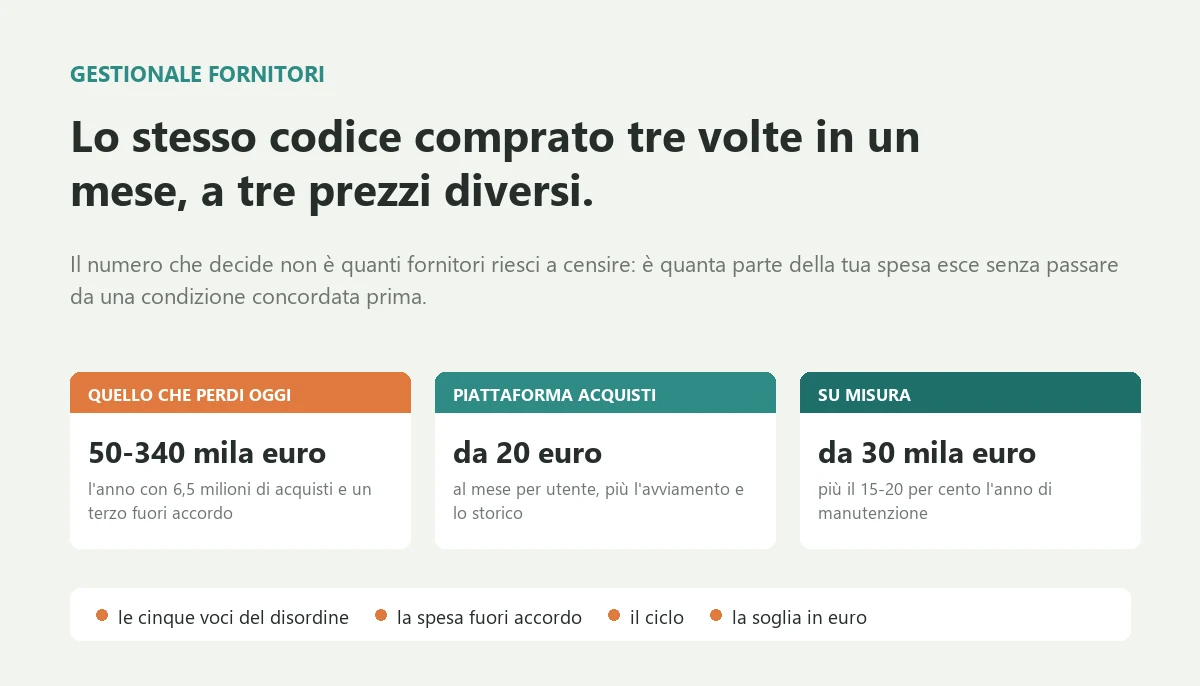

The owner of a packaging machinery builder, ninety five employees and eighteen million in revenue, called me after discovering something trivial by accident: the same bearing, in the same month, had been bought from three different suppliers at three different prices, and between the most expensive and the cheapest there was twenty two per cent. It was nobody's mistake. Purchasing, two and a half people, had ordered from the list price supplier; the engineering office had ordered from another one because it was needed for a prototype; the shop floor manager had bought the third on a Friday afternoon because the machine shipped on Monday. Three reasonable decisions, none of them wrong on its own, and nobody in the company able to see them together. That is the problem supplier management software is supposed to solve, and it is also the one no software solves on its own.
If the scene sounds familiar, this article gives you the real cost of a supplier base nobody governs, the single number that tells you whether a purchasing system will actually make you spend less or just file your orders more neatly, how to keep the cycle connected from demand to a reconciled invoice, how far the supplier spreadsheet and the document folder can take you, the three different things vendors all call by the same name, the real price ranges between the purchasing module of the ERP you already own, a subscription platform and a custom system, and the threshold in euro beyond which the maths flips.
I have been writing software since 1999 and I have seen purchasing departments work, and fail, in many ways: machinery builders buying hundreds of different part numbers for every job, food companies that must know which lot of which supplier every ingredient came from, installation contractors buying materials and subcontracts on the same order, distributors who live on terms negotiated and renewed every year. I have also built and sold a software product used by many companies, and on the other side of the table I have been the supplier myself: I know how easy it is, for whoever is selling, for a disorganised customer to pay more without noticing.
What I have learned, and no vendor says during a demo, is this: the number that decides is not how many suppliers you manage to catalogue, it is how much of your spend leaves the company without passing through terms agreed beforehand. A complete supplier register, with forms filled in and documents attached, is the part that sells best and saves least. The money sits in orders issued after the goods have already arrived, in prices nobody compared and in delays nobody saw coming.
What supplier management software is, and what it is not
Supplier management software is the system that holds in one place everything about the people who sell you something: which suppliers you are allowed to use and what they are qualified for, the terms you agreed to buy at, how a purchase requisition is raised and approved, how it becomes an order with a price and a date, who confirms, who chases, what actually arrived and in what condition, which invoice matches which delivery, and what that supplier is worth at the end of the year judged on facts rather than on sympathy.
You will find it under many names, and here too the confusion suits the seller. Supplier management, vendor management, approved vendor list, supplier portal, procurement, e-procurement, purchase order management, supplier rating. These overlap only in part, cost very different amounts and solve different problems. A portal that lets a supplier upload a certificate knows nothing about what you are paying for that material compared with last year, and a module that prints purchase orders does not know the supplier delivered late eleven times out of twenty.
The difference between paying a supplier and governing one
Almost every company that writes to me already has part of the problem covered, and that is why they keep postponing. They have the ERP, which issues purchase orders, records delivery notes and posts invoices. They have a spreadsheet of agreed prices, kept by the purchasing manager, updated when there is time. They have a shared folder with contracts, company records and certifications. And they have one good person who knows every supplier by name, knows who delivers on time and who has to be chased on Tuesdays, and rebuilds by hand, before every negotiation, how much was bought last year.
The point is that these pieces answer different questions from yours. The ERP answers how much I owe. The spreadsheet answers what we had agreed. The folder answers whether our paperwork is in order. Your question is another one: could this purchase have been made better, and if so what did not knowing cost me. None of the three sees it, because the answer lies in the comparison between what was agreed and what actually happened, and today that comparison exists only in the purchasing manager's head, for the suppliers they personally follow.
Then there is timing, and in manufacturing that is where the damage is done. Demand is born in engineering or in production, and it is born late, once the bill of materials has been released and the job already has a delivery date. Purchasing receives a request that is already urgent, and urgency kills the two things that save money: comparing and negotiating. You buy from whoever has the part in stock, at their price, with express freight. Then you find out the same part number was needed for the next two jobs as well, and buying them together would have cost eighteen per cent less.
The three families of companies that look for it, and want different things
Companies buying many different part numbers for every job. Machinery builders, steel fabricators, panel builders, engineer to order businesses. Hundreds of part numbers per machine, suppliers changing from one project to the next, a lot of outsourced machining. Here the value is in not re-buying at a premium what you were already buying, in tying purchases to the job, and in knowing in advance which supplier will push the delivery out. This is the family where off-contract spend is highest, because it is the one where every purchase looks like a special case.
Companies buying the same things, in volume. Series production, food, distribution. Few part numbers, large volumes, annual contracts with price lists and volume breaks. The value is in terms being respected, in automatically checking that the invoiced price is the agreed one, in handling breaks and year end rebates. Here two percentage points recovered on price pay for the whole system, but the data has to be precise: the saving is proven line by line.
Companies answerable for what their suppliers do. Installation and maintenance contractors, public procurement, food and medical supply chains. Subcontracts, materials to trace, mandatory documents that expire, joint liability. The value is in not letting a contractor with an expired certificate through the site gate, and in proving in an audit, in five minutes, that every supplier was qualified when they worked. The document side weighs as much as the commercial one, and I covered it at length in document management software.
The three families buy products with the same name and use different parts of them. Before looking at any demo, decide which one you are in, though most companies sit in two. Most of what follows applies to all of them, because the purchasing cycle is the same; where it changes, I will say so.
The real cost of a supplier base nobody governs
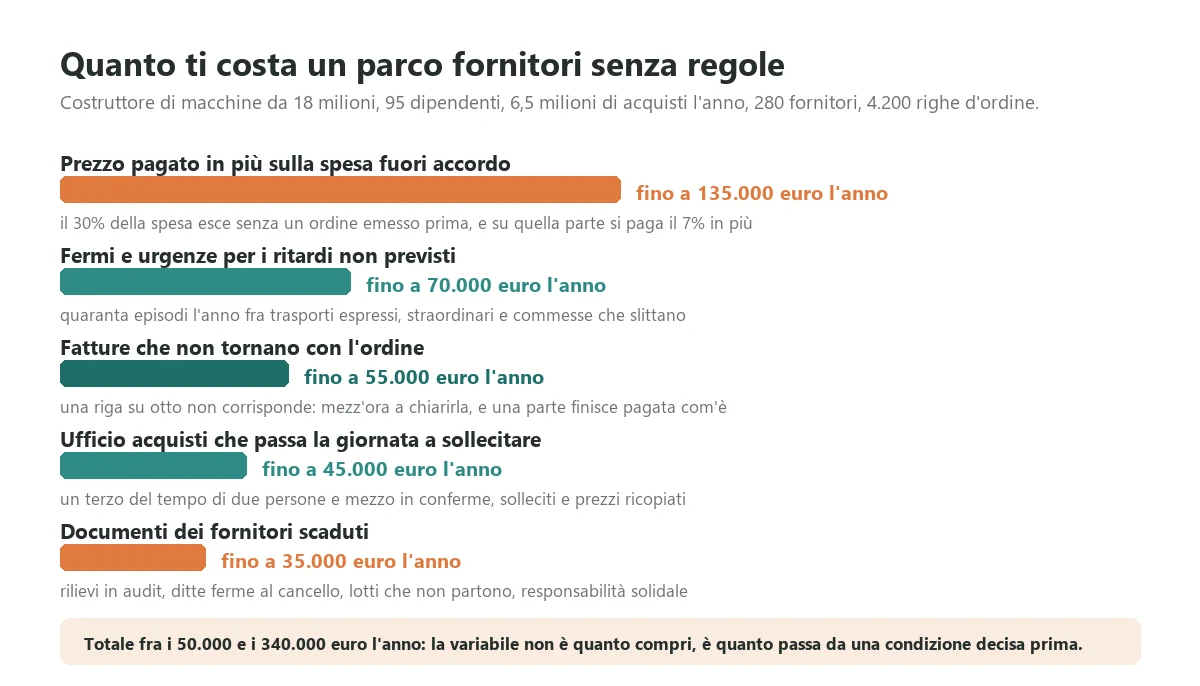
This is the calculation almost nobody does in full, because none of these costs has a line in the accounts: the premium paid sits inside cost of goods sold and looks normal, downtime is shop floor hours, chasing is salaries, and risks are written nowhere. My reference is a machinery builder with eighteen million in revenue, ninety five employees, six and a half million a year in purchases across materials, bought-in components and outsourced machining, two hundred and eighty active suppliers of which ninety account for ninety per cent of the spend, around four thousand two hundred order lines a year and a purchasing team of two and a half people. It is a very common size among the people who write to me, and the numbers scale reasonably well with purchase value.
One warning before we start. The cost that matters here is not the whole gap between what you pay and the best price on the market: part of that gap is service, proximity and reliability, and whoever buys on price alone finds out the hard way. What matters is the part you pay without having chosen it, meaning the part where you compared nothing because you had no time or did not know you could. So the calculation uses only that, and stays conservative.
The premium paid on off-contract spend
This is the largest cost and the most invisible, because it produces no unusual document: the invoice arrives, it matches the delivery note, it gets paid. In the reference company around thirty per cent of the spend, one million nine hundred and fifty thousand euro, leaves without an order issued before delivery or on terms other than the agreed ones. On that part, the average price paid exceeds by about seven per cent what the same company obtains when it buys with an order and a negotiation: one hundred and thirty five thousand euro a year.
Seven per cent is not an optimistic estimate, it is what you almost always find by comparing two columns of the same archive: the price paid on planned purchases and the price paid on urgent purchases of the same part number, in the same year, from the same supplier. The supplier is not cheating you: they are applying list price to someone who asked for nothing, and adding express freight for someone who wants it tomorrow. They are doing what you would do. In some categories, spares, fasteners, urgent machining, the gap comfortably reaches twenty per cent.
Careful with one mistake I often see with this number: cutting off-contract purchases does not by itself bank it. Part of those purchases happened that way because it was the only way to hit a delivery date, and the saving would have turned into a penalty. The part you really recover is the one where the urgency was foreseeable a few weeks earlier, and in my experience that is a good half.
Downtime and rush costs from delays nobody predicted
The second cost comes from a figure almost no company keeps: the real on-time performance of each supplier, measured against the confirmed date and not the hoped-for one. Without it, production planning works on dates with no foundation, and every week somebody discovers that the part needed on Monday arrives on Thursday. From there come express shipments, overtime to catch up, machines assembled out of sequence, and every so often a penalty to a customer or an incomplete early shipment.
In the reference company that is around forty significant episodes a year, costing anything from a few hundred euro of express freight to five thousand for a week of slippage on a job: up to seventy thousand euro a year. Not all of it is recoverable, because late suppliers stay late, but knowing in advance who will be late changes everything: you chase earlier, you move the sequence, you warn the customer while it still helps. The connection with planning is direct and I described it in production management software.
Invoices that do not match the order
Across four thousand two hundred order lines, in a company without automatic matching, between ten and fifteen per cent of invoice lines do not reconcile: a price different from the order, a quantity different from the delivery note, freight that was not agreed, a minimum order charge, an increase applied without notice. Each discrepancy costs between twenty and forty minutes across accounts, purchasing and a phone call to the supplier, and some of them end up paid as they are because chasing them costs more than the difference.
That is roughly five hundred lines to sort out a year, which at half an hour each is two hundred and fifty hours, plus the differences nobody recovers: up to fifty five thousand euro a year in time lost and money left on the table. It is also the cost that automates better than any other, because comparing order, delivery note and invoice is mechanical work that a person does badly and a system does well. But it works on one condition: the order must exist and contain the price. Without that there is nothing to compare, and you are back to the first cost.
A purchasing team that spends the day chasing
Two and a half people, and in my experience between thirty and forty per cent of their time goes into three activities that decide nothing: chasing order confirmations, chasing delivery dates, and copying prices and terms from an email into a spreadsheet. That is around one thousand six hundred hours a year, which at a fully loaded thirty five euro an hour is fifty six thousand euro. Half of that work disappears when confirmations arrive and get recorded on their own and reminders go out before the due date without anyone having to remember: up to forty five thousand euro a year.
The real cost, though, is not the hour, it is what purchasing does not do while chasing. Spend categories never reviewed, new suppliers never sought, annual negotiations rushed on last year's price plus inflation. A purchasing team that spends the day on the phone becomes a team that records prices instead of setting them.
Expired documents, and risks that have no invoice
The last cost is the hardest to estimate and the most dangerous. Expired system certifications, declarations of conformity that never arrived, lapsed insurance, safety data sheets two revisions old, subcontracting authorisations. As long as nothing happens it costs nothing, which is why nobody owns it. Then comes an audit finding, a contractor stopped at the site gate, a lot that cannot ship because the material certificate is missing, a customer asking for the full chain and finding a hole in it.
In the reference company, between hours lost recovering documents, delays and a couple of serious episodes a year, this reaches thirty five thousand euro. And that excludes the real risk, which is joint liability on a contract or losing qualified status with a customer worth a slice of your revenue. This cost has no reliable range: it has a low probability and a high price, and it is treated the way you treat insurance.
The total, for a company with six and a half million in purchases, sits between fifty thousand and three hundred and forty thousand euro a year, and no company hits all five costs at the top of the range. The range is wide because the real variable is not how much you buy: it is how much of what you buy passes through terms decided beforehand. Do the sum with your own numbers, roughly, on a single sheet. If your total is below twenty thousand euro a year, software is not your most urgent problem, and further down I will tell you what is.
Off-contract spend: the number that decides
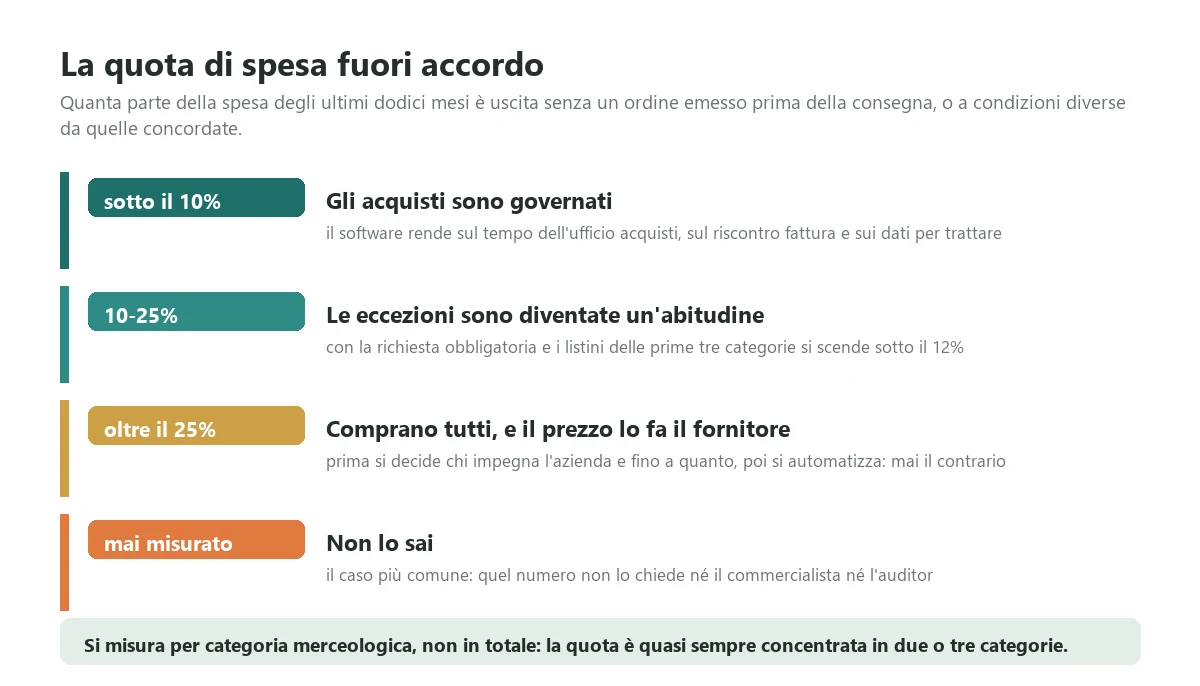
If I had to keep one number from this whole article, I would keep this one: how much of the last twelve months of spend left without an order issued before delivery, or on terms different from those agreed with that supplier. I call it the off-contract share. It decides everything, because every feature of supplier management software, from the approved requisition to the contracted price list to invoice matching, works to reduce that number, and if you do not know where you start you cannot know whether the system you bought is reducing it.
The reason this number matters more than the supplier count, the average order value or the saving claimed by the purchasing manager is that it tells you whether the company decides beforehand or suffers afterwards. The supplier count on its own misleads: a company with few suppliers can be held hostage by those few. The claimed saving misleads even more, because it is almost always calculated against last year's price, which was already wrong. The off-contract share, by contrast, is hard to fake: either the order existed before the delivery note, or it did not.
How to measure it, in a day
You need two things, and the good news is that both are almost always there. The first is the purchase invoice archive for the last year, better two, with supplier, date, amount and where possible the reference to the order and the delivery note. It sits in the ERP, because invoices have to be posted. The second is the purchase order archive with the issue date. That is there too, and this is where the first interesting discovery happens: in many companies a share of the orders has an issue date later than the delivery note, meaning they are orders written to make the accounts balance, not to buy anything.
If the data sits in a database, the measurement is a query. This is the shape I use on SQL Server. Your table names will be different, the substance will not:
-- Off-contract share: invoice lines with no order issued before delivery,
-- or with a price different from the agreed one
WITH lines AS (
    SELECT i.SupplierId,
           i.Category,
           il.NetAmount,
           il.UnitPrice,
           pl.AgreedPrice,
           po.IssueDate,
           dn.DeliveryDate
    FROM InvoiceLine il
        INNER JOIN PurchaseInvoice i ON i.InvoiceId = il.InvoiceId
        LEFT JOIN DeliveryNoteLine dnl ON dnl.DeliveryNoteLineId = il.DeliveryNoteLineId
        LEFT JOIN DeliveryNote dn ON dn.DeliveryNoteId = dnl.DeliveryNoteId
        LEFT JOIN PurchaseOrderLine pol ON pol.OrderLineId = dnl.OrderLineId
        LEFT JOIN PurchaseOrder po ON po.OrderId = pol.OrderId
        LEFT JOIN AgreedPriceList pl ON pl.SupplierId = i.SupplierId
                                    AND pl.ItemCode = il.ItemCode
                                    AND dn.DeliveryDate BETWEEN pl.ValidFrom AND pl.ValidTo
    WHERE i.PostingDate >= DATEADD(MONTH, -12, CAST(GETDATE() AS date))
)
SELECT Category,
       SUM(NetAmount) AS TotalSpend,
       SUM(CASE WHEN IssueDate IS NULL OR IssueDate > DeliveryDate
                  OR (AgreedPrice IS NOT NULL AND UnitPrice > AgreedPrice * 1.02)
                THEN NetAmount ELSE 0 END) AS OffContractSpend,
       SUM(CASE WHEN IssueDate IS NULL OR IssueDate > DeliveryDate
                  OR (AgreedPrice IS NOT NULL AND UnitPrice > AgreedPrice * 1.02)
                THEN NetAmount ELSE 0 END) * 100.0
         / NULLIF(SUM(NetAmount), 0) AS OffContractPercent
FROM lines
GROUP BY Category
ORDER BY OffContractSpend DESC;
If the agreed price list exists in no table, and in most companies it does not, the first half of the condition is more than enough: the share of spend without an order issued before delivery is already a number that starts an argument in a management meeting. You add the second half next year, once you have written the price lists.
Then comes the second pass, and that is the one that tells the truth: take the twenty highest value off-contract lines and ask whoever bought them why it went that way. You almost always get one of four answers: it was needed immediately, the list price supplier did not have it, engineering ordered it directly, we have always done it this way. None of the four is a fault, they are all descriptions of a process that does not exist. Count how many of the twenty had a demand that was foreseeable at least three weeks earlier: that is the part a system, with the right method behind it, can recover. At the bearing company it was fourteen out of twenty.
And there is a third calculation, the most convincing one when you have to explain the project to a partner: take the ten most purchased part numbers and, for each, the minimum and maximum price paid in the same year, regardless of supplier. List the difference multiplied by the quantities bought at the worst price. It is not a guaranteed saving, because part of that difference has a reason, but it is the most concrete figure you can put on the table, and it is made of your data rather than a vendor's.
Three clarifications, because the measurement is easy to distort without meaning to. Do not exclude small categories because they are pennies: fasteners and consumables often have the highest off-contract share of all, and the worst ratio between the cost of ordering and the value bought. Do not count recurring services, energy, rent, insurance, together with materials: they are governed differently and they pollute the measurement. And measure by category, not in total: the share is almost always concentrated in two or three categories, and knowing which ones tells you where to start.
In manufacturing companies that have never measured it, the result usually sits between twenty and forty five per cent. Engineer to order businesses sit at the top, series producers at the bottom.
The four thresholds, and what you can do at each
Below ten per cent: purchasing is governed. You are in a minority, and you have already done the hard part, even if you do not call it that: terms exist, orders are issued beforehand, exceptions are exceptions. Here software pays back mostly through purchasing time, automatic invoice matching and better data to negotiate with. You can skip much of what follows and go straight to the choice.
Ten to twenty five per cent: exceptions have become a habit. This is the most common band among companies that work well. The process exists but collapses whenever there is a rush, and the rush has become normal because demand arrives late. With mandatory requisitions, written price lists for the top three categories and two weeks more notice on demand, the share drops below twelve per cent within a year, and almost all the saving comes from there.
Above twenty five per cent: everybody buys, and the supplier sets the price. This is usually not disorder, it is a company that grew fast where asking for approval would have stopped the work. Here buying software before deciding who can commit the company and up to what amount is the quickest way to spend thirty thousand euro and change nothing: the system becomes a register somebody fills in the next day. First three rules, then automation.
Never measured: you do not know. This is the most common case, and it is not a fault: nobody asks for that number, not your accountant and not your auditor. It is also the best case, because measuring it costs a day and tells you, before you spend a euro, whether you have a thirty thousand or a three hundred thousand euro a year problem.
The purchasing cycle: where software earns its keep and where it is not enough
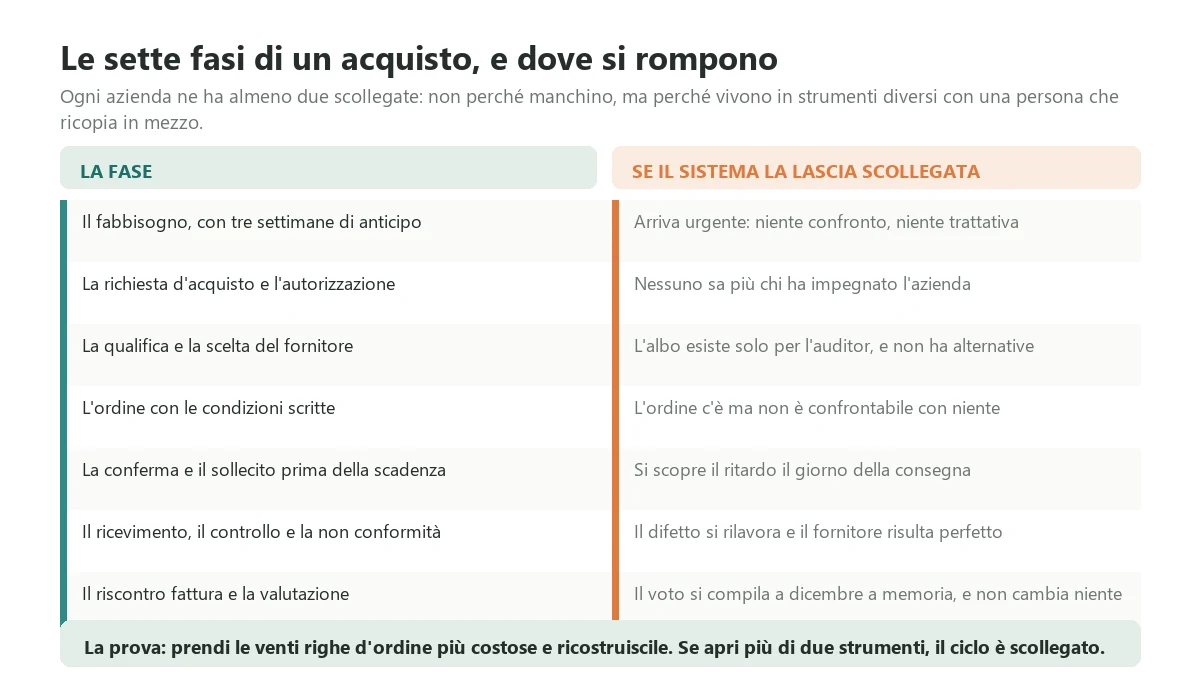
Supplier management software is worth as much as its ability to stop a step being skipped. There are seven, and every company has at least two of them disconnected: not because they are missing, but because they live in different tools that do not talk to each other, and between one and the next there is always a person retyping.
Demand. This is the step nobody considers part of purchasing, and it is the one that sets the price. If demand reaches purchasing three days before it is needed, you have already lost: no negotiation is possible. If it arrives three weeks earlier, you can compare, consolidate, plan. The lever is not in the purchasing module, it is in the link to the bill of materials and to planning, which is why supplier management software disconnected from production solves half the problem.
Requisition and approval. Who can ask for what, up to what amount, with whose approval. In companies under a hundred employees this step is often an email to the purchasing manager, and that is perfectly fine while three people buy. The problem starts when they become eight and nobody knows who committed the company to that payment. Rule of thumb: two levels are enough, and the threshold has to be high enough not to clog the day.
Qualification and supplier choice. This is where the approved vendor list lives, meaning who may supply what, with which valid documents and which evaluation behind them. It serves two purposes: keeping out whoever must stay out, and giving the buyer a ready alternative when the first supplier does not answer. A list that exists only for the auditor serves nobody; a list with two qualified suppliers for every critical category saves you money the day one of the two raises the price.
The order with written terms. Price, quantity, requested date, delivery terms, packaging, penalties where they exist. Almost every ERP covers this step, which is why almost everyone believes they already have a purchasing system. Having it alone is worth little: an order is only useful to the extent that it can be compared with what happens next.
Confirmation and chasing before the due date. The order confirmation is the moment the supplier tells you the real date, which is almost always different from the one you asked for. Companies that record the confirmed date and chase before it falls due have half the emergencies of the others. It is the step with the best ratio of effort to result in the whole cycle, and it needs no sophisticated software: it needs somebody to look at a list every Monday morning.
Receiving, inspection and nonconformity. What arrived, how much, in what condition, and what happens when it is not right. It is the contact point between purchasing, the warehouse and quality, and the point where most data is lost: material comes in, the defect is reworked on the spot and nobody records it, so at year end that supplier looks perfect. How the receiving side connects is described in warehouse management software, and the nonconformity side in quality management software.
Invoice matching and supplier evaluation. The three way match between order, delivery note and invoice, and at the end of the year the score: on-time performance, quality, price, responsiveness. An evaluation built on facts recorded during the year takes ten minutes and is credible. One filled in from memory in December takes an hour and is a formality, and the supplier knows it.
The test that tells you where you stand: take the twenty most expensive order lines of the year and try to reconstruct, for each, who asked for the material and when, why that supplier was chosen, which date they had confirmed, when it actually arrived and whether the invoice matched. If doing that means opening more than two tools or asking more than one person, the cycle is disconnected, and the point where you get stuck is the one worth starting from.
How far the supplier spreadsheet takes you
Here I have to say something that costs me work: in most companies below five million a year in purchases, a well kept spreadsheet of agreed prices, together with the order module of the ERP you already own, is an honest solution. Replacing it with a platform before fixing the process produces a result I have seen many times: you keep buying the way you did, but now there is also a system to keep updated.
The spreadsheet stops being enough when at least three of these five conditions hold. Order lines exceed two thousand a year or active suppliers exceed one hundred and fifty, because beyond that nobody keeps track of who does what. More than three people buy and they sit in different offices, so the spreadsheet has several versions. Agreed prices have volume breaks, validity dates and revisions, and a spreadsheet with validity dates becomes unreadable after a year. Supplier documents expire and somebody has to notice before they do. Or customers, or the law, demand traceability of what came in from whom, and the answer has to come out in minutes.
With two conditions you are at the limit and you have time: fix the process and measure again in six months. With none or one, stay where you are, measure the off-contract share and write the price lists for the top three categories. You gain more from those two jobs than from any purchase.
There is one case, though, where the spreadsheet has to go immediately, even with a single condition, and that is when the spreadsheet lives with one person. The purchasing manager who knows everything by heart is the biggest and least insured risk a manufacturing company carries: the day they retire or change jobs, the company loses the terms of two hundred suppliers in a week, and buys them all back at list price.
ERP module, supplier portal and purchasing platform: three things with one name
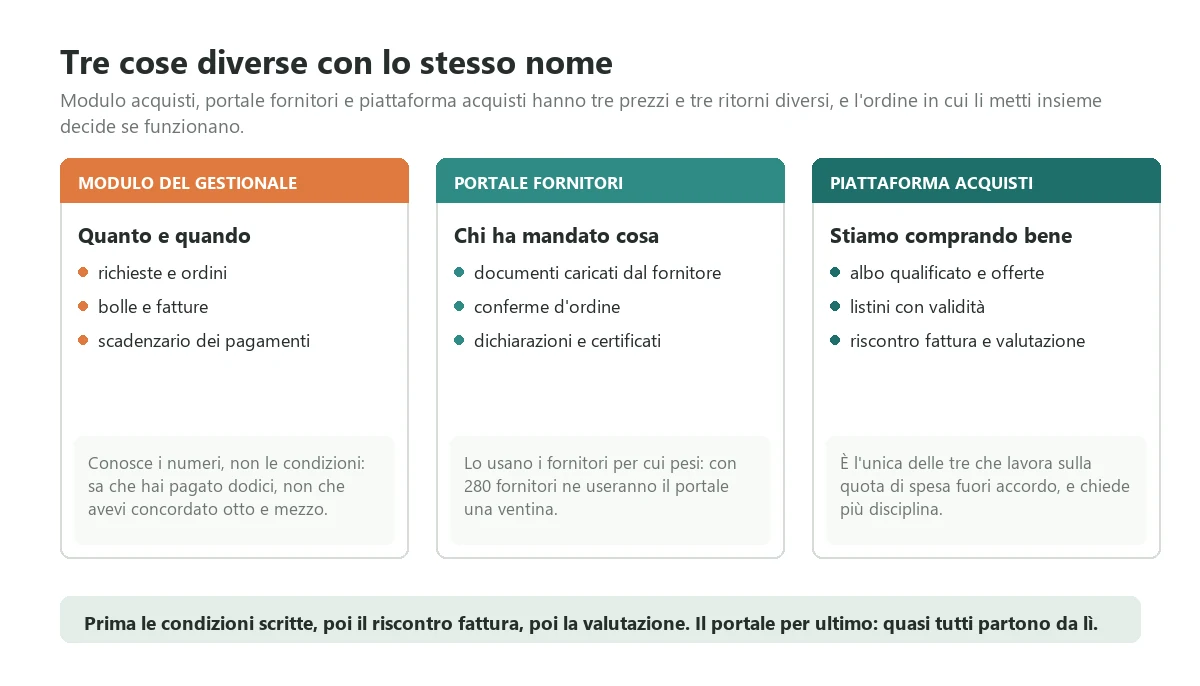
When you ask for supplier management software you get offered three profoundly different things, with three prices and three returns, and the order in which you put them together decides whether they work.
The purchasing module of the ERP answers how much and when: requisitions, orders, delivery notes, invoices, payment schedules. It knows the numbers perfectly and the terms not at all: it knows you bought a hundred pieces at twelve euro, it does not know you had agreed eight fifty for orders above five hundred. It is the piece almost everyone already owns and almost nobody uses fully, and in most cases the right first move is to make it actually used, not to replace it.
The supplier portal answers who sent what: documents uploaded by the supplier, order confirmations, declarations, sometimes invoices. It takes the chasing away from purchasing and puts responsibility for a document on whoever has to produce it. It has a structural flaw worth knowing: it works if suppliers use it, and suppliers use it if you matter to them. With two hundred and eighty suppliers, twenty will use the portal, and they are the ones you weigh most with. That is fine, as long as you know it beforehand and do not buy a portal for everyone.
The purchasing platform answers the question the other two cannot see: are we buying well. Approved vendor list, comparable requests for quotation, contracts and price lists with validity, automatic invoice matching, supplier evaluation built on recorded data. It is the only one of the three that works on the off-contract share, and it is also the one that costs most and demands the most discipline to pay back.
The order that works is this: first written terms and orders issued before delivery, which is almost all process and hardly any software; then invoice matching, which pays for itself; then supplier evaluation, which only makes sense once a year of data exists; the portal last, and only for the suppliers that matter. Almost everyone starts with the portal, because it is the visible part and it makes a good demo.
Supplier evaluation: how to build a score that is worth something
Supplier evaluation is the feature every product puts on its front page and almost no company actually uses, because in most cases it is a formality born for the audit: a form filled in in December, with scores from one to five given from memory, that ends up in a binder and changes no order. Done that way it is wasted time, and the supplier knows it perfectly well: no consequence has ever reached them from that score.
An evaluation worth something has three characteristics, and none of them is about software. First: it calculates itself, from the data the cycle produces anyway during the year. Second: it uses few numbers, and they are numbers of facts, not of impressions. Third, the one that makes the difference: it has a consequence written beforehand, meaning everyone knows in advance what happens to whoever falls below a given threshold.
The four numbers that are enough
On-time performance against the confirmed date. How many deliveries arrived within the date the supplier themselves confirmed, not within the one you asked for. This is the most important distinction of all: a supplier who always confirms two weeks later and then keeps to it is far more useful than one who confirms your date and misses it half the time. Measure it on lines, not on orders, and look at average lateness too, because two days and twenty days are not the same thing.
Conformity of what arrives. How many deliveries generated a nonconformity, counting the ones fixed on the shop floor without opening anything, which are the ones that distort everything. This is where supplier evaluation leans on the quality system, and if the two worlds do not talk the score is always excellent. The link is the one I described in quality management software.
The gap between ordered price and invoiced price. How many invoice lines from that supplier did not match the order, and for how many euro. This is the number nobody puts in evaluation forms and the most revealing of all: a supplier who systematically errs in one direction is not erring.
Response time. How many days pass between order and confirmation, and between a request for quotation and the quote. It measures something that in an emergency is worth more than price, namely how far you can count on that supplier the day you need an answer the same day.
Four numbers, weighted however you like, give a score that holds up in a negotiation because it is made of facts the supplier can verify. Add a fifth, sixth and seventh, typically commercial availability and flexibility, and you are back to impressions and you lose the defensible part.
The consequence written beforehand
A score only counts if something happens. The consequences that work in smaller companies are three, in order of severity. Below one threshold, the supplier leaves the preferred list and the buyer has to ask for at least one other quote. Below a worse threshold, a letter goes out with the numbers and a request for a recovery plan, which in my experience is the most effective move of all, because almost no supplier has ever received data from a customer. Below the third threshold, an alternative gets qualified and you start buying from two.
One thing I always recommend and almost nobody does: send the evaluation to the supplier, every year, including the good ones. It costs an email and produces two effects. To good suppliers it says somebody is watching, and they become more careful with you specifically. To struggling ones it gives a chance to correct wrong numbers, and it happens: sometimes the delays are yours, because they send the confirmation and you record it two weeks later. That conversation is the cheapest way I know of discovering the problem was at home.
What supplier management software costs: module, product or custom
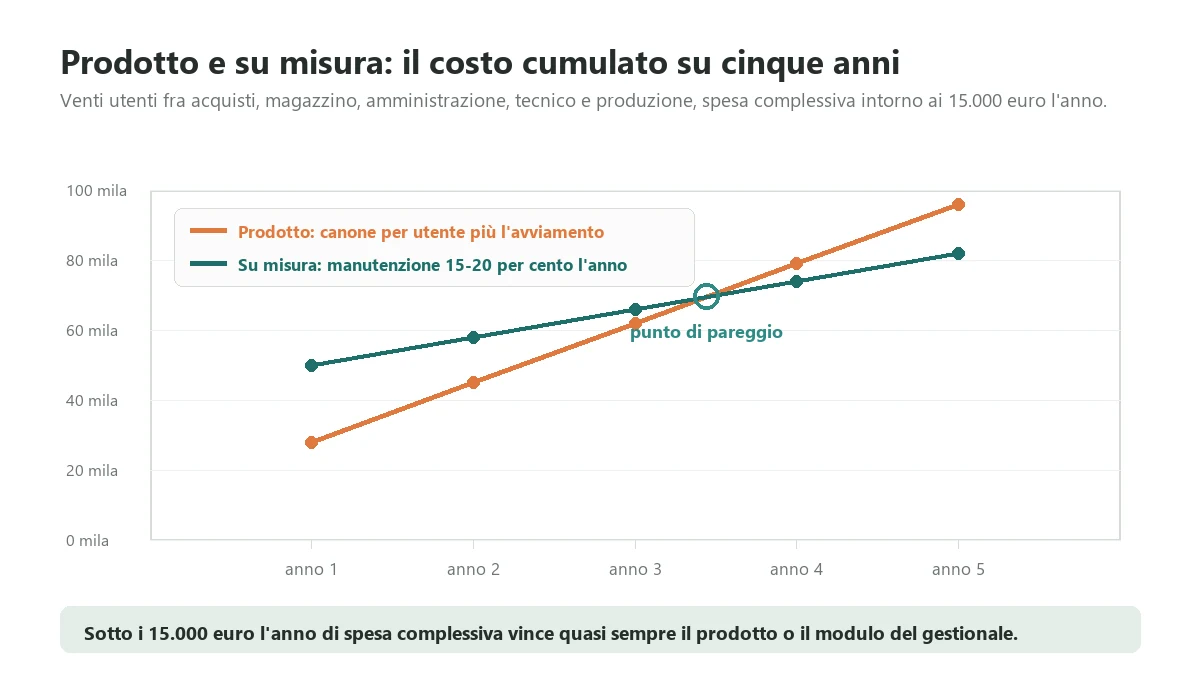
The figures that follow are the ones I see on the Italian market for companies between twenty and two hundred employees, and they are complete figures: not the list price, but what a company actually pays out in the first year, setup and data included.
The purchasing module of the ERP you already own
Between six and twenty five thousand euro, and almost all of it is configuration: clean master data, categories, price lists loaded, approval flow, invoice matching switched on. The software is often already paid for inside the fee you pay. It is the cheapest route and the most overlooked, because nobody proposes it: your ERP vendor earns more selling you a new module than making you use the one you have. Ask explicitly what your ERP does about agreed price lists, three way matching and document expiry, before looking anywhere else.
A subscription purchasing platform
Between twenty and seventy euro per user a month, and here the definition of user changes everything: some count only buyers, some also approvers, some the connected suppliers as well. With twenty real users across purchasing, warehouse, accounts, engineering and production you sit between five and seventeen thousand euro a year. On top comes setup, between eight and thirty five thousand, which is almost entirely two jobs: bringing in the purchase history and connecting the platform to the ERP, because suppliers, items and invoices go on living there.
Ask three things before signing, and get them in writing: what happens to your data if you cancel, what the ERP connection costs in year two, and whether the per user price changes as connected suppliers grow. The third is the one that surprises people most two years in.
A custom system
It starts at thirty thousand euro for the core that actually matters: a qualified supplier register with documents and expiry dates, requisitions with approval, orders with terms pulled from a price list, confirmation and chasing, three way matching, all connected to the ERP that remains the source of accounting data. It reaches one hundred and twenty thousand with comparable requests for quotation, a portal for the main suppliers, links to production planning and goods receiving, automatic evaluation and contract signing. Add fifteen to twenty per cent a year for maintenance, and put it in the plan from the start: a custom system without maintenance is a debt that falls due in three years.
The threshold in euro
The rule I use, and it holds for most companies under two hundred employees: below fifteen thousand euro a year of total purchasing system spend, the product or the ERP module almost always wins. Above that the maths flips quickly, as the chart shows: with twenty users the break-even between the two routes falls between year three and year four, and from year five the gap widens.
But the threshold alone is not enough, and there are three cases where custom wins below it too. When the data you need lives in systems no product reads without customisation, typically the ERP, production planning and the configurator together: the integration costs the same either way, so you may as well build the rest the way you need it. When users are many because twenty people in the shop and on site raise requisitions, and the per user fee grows faster than the value. And when the ERP you have works and should be kept, because the project is not replacement but building the missing piece around it; I wrote about this at length in management control software, where the same tension shows up from the margin side.
And there is one case where the product always wins, even above the threshold: when nobody in the company has the time and the authority to follow a project for three months. A custom system without someone inside making decisions does not end well, and it costs twice the licence you did not buy.
The questions to ask before signing, and the fifty line test
Demos are built to show what the product does well. Six questions move the conversation from the product to your problem, and it is worth asking them in order.
How do you load an agreed price list with volume breaks and validity, and what happens when it expires? If the answer is that you update it by hand item by item, with three hundred items and twenty suppliers nobody will do that job after month three, and without price lists invoice matching does not exist.
How does demand get into the requisition? If the answer is that you type it in, the system governs the purchases you already make and never touches the step where the money is made.
What does three way matching compare, and with what tolerance? Ask to see the awkward case, not the clean one: an invoice with a partial quantity across two delivery notes, a price one per cent off, freight added. Everyone handles the clean case.
What happens when a supplier document expires? Something has to happen before, not after, and it has to happen to someone who can act: a warning at sixty days to the buyer is worth ten times a red list on a page nobody opens.
How does it connect to the ERP, in which direction and how often? Ask who owns the supplier master data. Two systems that can both create a supplier will produce two hundred duplicates and an unusable archive within six months.
If I stop tomorrow, what do I take with me? An Excel export is not enough: you need price history, price lists with their validity, documents and evaluations, in a reusable format.
Then comes the test I always recommend and almost nobody runs. Give the vendor fifty real order lines from the last year, picked among the most awkward you have, including two tiered price lists, an invoice that does not match, a supplier with an expired document and an order issued after the delivery note. Ask them to load them and run the cycle with one of your buyers. Then watch three things: whether the system, when the mismatched invoice arrives, stops it by itself and says why; whether a buyer can issue an order with the right terms unaided; and whether the price history of that part number is visible while ordering, rather than in a separate report.
It is not a functionality test, it is a method test: you watch how many questions they ask about how your demand arises, which fields they propose removing and how long they take. If the fifty lines pass the cycle and the buyer manages alone, you have found your vendor. If they do not pass, you have found where the problem is before paying for it, and the problem is hardly ever the software: it is price lists that do not exist or an approval nobody in the company wants to give.
The three things to fix before buying anything
There are three jobs that cost little, take a few weeks and without which any supplier management software returns half as much: classify the spend, write the terms for the top categories, and decide who can commit the company. They come first, not after, because afterwards the project has started and the decisions get made by whoever configures it, meaning a consultant who has never watched your purchasing team work.
Spend classification. Take last year's purchase invoices and assign each line a category from a list of twenty five or thirty, not two hundred. Then sort the categories by value. You will almost always discover two things: that five categories make seventy per cent of the spend, and that one of the five had never been looked at because it is made of many small purchases. It is two or three afternoons with the purchasing manager and accounts, and on its own it changes the year's priorities.
Written terms for the top three categories. Not a lawyer's contract: one sheet per supplier with prices, volume breaks, validity, agreed lead times, delivery terms and packaging. Three categories, not thirty. The mere act of writing them and sending them to the supplier for confirmation almost always produces a price revision, because it puts the supplier in front of numbers they had never seen lined up either. It is the highest returning of the three jobs, and it is free.
Who can commit the company, and up to how much. A ten row table: who can request, who can order, up to what amount, who approves above it. Written, shared, and above all realistic: if the threshold is so low that it blocks the work, within a month everybody works around it and you are back where you started, but now with a broken rule that makes the rest optional.
One more way of starting, which is not a job but a choice: begin with a single category, the biggest one, and run it for two months before extending. Companies that start with every category, every supplier and every approver at once reach month three with engineering ordering on its own again and purchasing recording orders after the fact. The second attempt is much harder, because by then everyone knows that thing did not work.
If your total across the five costs was below twenty thousand euro a year, here is your most urgent problem: it is these three jobs, not software. Do them, measure the off-contract share again after six months, and only then look at products.
Where to start
You start with a small first release, because governing purchasing is not an IT project: it is a project that moves a decision from the moment of urgency to the moment when there is still time, and decisions move well when they move a little at a time. The first release that almost always works is this. One category, the biggest. Agreed price lists loaded for the five main suppliers in that category. Requisitions with a single approval above a threshold. Orders that take the price from the price list and flag it when there is none. The confirmed date recorded, and a list of chases to run on Monday. Invoice matching that stops whatever does not reconcile. One report, the first Monday of the month, with the off-contract share for that category, the top ten price gaps and the on-time performance of the five suppliers. Nothing else.
With that scope you are running in a few weeks with a product, in two or three months if you build custom. From then on you measure the off-contract share every month, first on that category and then on all of them. If it falls, the project is working. If it does not, the problem is demand arriving late, price lists that do not exist or an approval nobody enforces, and no extra feature will fix it. Everything else, the portal for the main suppliers, comparable quotations, automatic evaluation, the link to planning, gets built on top of a cycle you can trust, and costs less because by then you know what you actually need.
The owner of the bearing story, in the end, bought nothing for the first three months. He classified a year of invoices into twenty eight categories, discovered that fasteners and pneumatic components, considered pennies, made four hundred thousand euro a year with the highest off-contract share of all, and wrote the terms for the top three categories. Simply sending those sheets to the suppliers for confirmation brought a price revision in two categories out of three. The system came afterwards, built around the ERP the company already owned, for one category only. In ten months the off-contract share fell from thirty four to fifteen per cent, and the price saving, measured part number by part number, paid for the project in the first year. The price spreadsheet is still in the shared folder, and nobody opens it.
If you are doing this calculation now and want to know which side of the threshold you are on before spending anything, send me two pages: how purchasing is organised today and who actually buys in your company, which categories weigh most and which systems orders, delivery notes and invoices come out of, plus the two numbers from the test, meaning the value of purchases over the last twelve months and how much of it left without an order issued before delivery. In half an hour I will tell you whether yours is a problem of terms to be written, of demand arriving late, of a subscription product, of the ERP module you already own or of a custom build. In the cases where the problem is the process and not the software I will say so anyway, because a customer who buys the wrong thing comes back angry. You can get in touch to run that calculation together.
If you are still framing the problem, three readings that sit around this one. Where the late demand comes from, meaning planning and production releases, is in production management software. What happens to material once it arrives, across receiving, lots and stock, is in warehouse management software. And if you want to know how much purchase cost really weighs on the margin of each job before deciding where to start, the answer is in management control software.
Frequently asked questions
It depends on the route. The purchasing module of the ERP you already own costs between six and twenty five thousand euro, almost all configuration. A subscription purchasing platform costs between twenty and seventy euro per user a month, plus setup between eight and thirty five thousand euro that is almost entirely purchase history and the ERP connection. A custom system starts at thirty thousand euro for a qualified supplier register, requisitions, orders carrying agreed terms, confirmations and three way matching connected to the ERP, and reaches one hundred and twenty thousand with comparable quotations, a supplier portal, links to planning and automatic evaluation, plus fifteen to twenty per cent a year in maintenance.
They are three different pieces often sold under the same name. The purchasing module of the ERP knows how much and when: orders, delivery notes, invoices, payments. The approved vendor list says who you may use and for what, with valid documents and an evaluation behind them. The portal is where suppliers upload documents and confirmations, and it works only with suppliers you matter to, usually twenty out of two hundred. What actually governs spend is a fourth piece, the purchasing platform: agreed terms with validity, invoice matching and evaluation built on recorded data.
Take the purchase invoices of the last twelve months, better twenty four, and for each line check whether an order existed before the delivery date and whether the price matches the agreed one. The sum of the amounts failing either condition, divided by total spend, is the share. Measure it by category rather than in total, because it is almost always concentrated in two or three categories. Then take the twenty highest value off-contract lines and ask whoever bought them why it went that way: the answers tell you how much was foreseeable three weeks earlier, and that is the recoverable part.
When at least three of these five conditions hold: order lines exceed two thousand a year or active suppliers exceed one hundred and fifty, more than three people buy and sit in different offices, agreed prices have volume breaks and validity dates, supplier documents expire and someone must notice beforehand, or traceability of what came in from whom has to be produced in minutes. With two conditions you are at the limit and have time. There is one case, though, where the spreadsheet has to go immediately: when one person keeps it, because the day they change jobs the company loses the terms of two hundred suppliers in a week.
With three jobs that come before any purchase: classify a year of invoices into twenty five or thirty categories and sort them by value; write the terms for the top three categories, one sheet per supplier with prices, breaks, validity and lead times, and send it to the supplier for confirmation; and decide, in a ten row table, who can request, who can order and up to what amount. Then a first release on one category only, with price lists for the five main suppliers, the confirmed date recorded and invoice matching switched on. The portal and comparable quotations come later.
Below fifteen thousand euro a year of total spend the product or the ERP module almost always wins. Custom makes sense in three cases: when the data you need lives in systems no product reads without customisation, typically the ERP, production planning and the configurator together; when users are many because twenty people in the shop and on site raise requisitions and the per user fee grows faster than the value; and when the ERP you have works and should be kept, building the missing piece around it. With twenty users the break-even between the two routes usually falls between year three and year four.
Leave your details in the form below