What is the number that decides whether time attendance software will give you anything back?
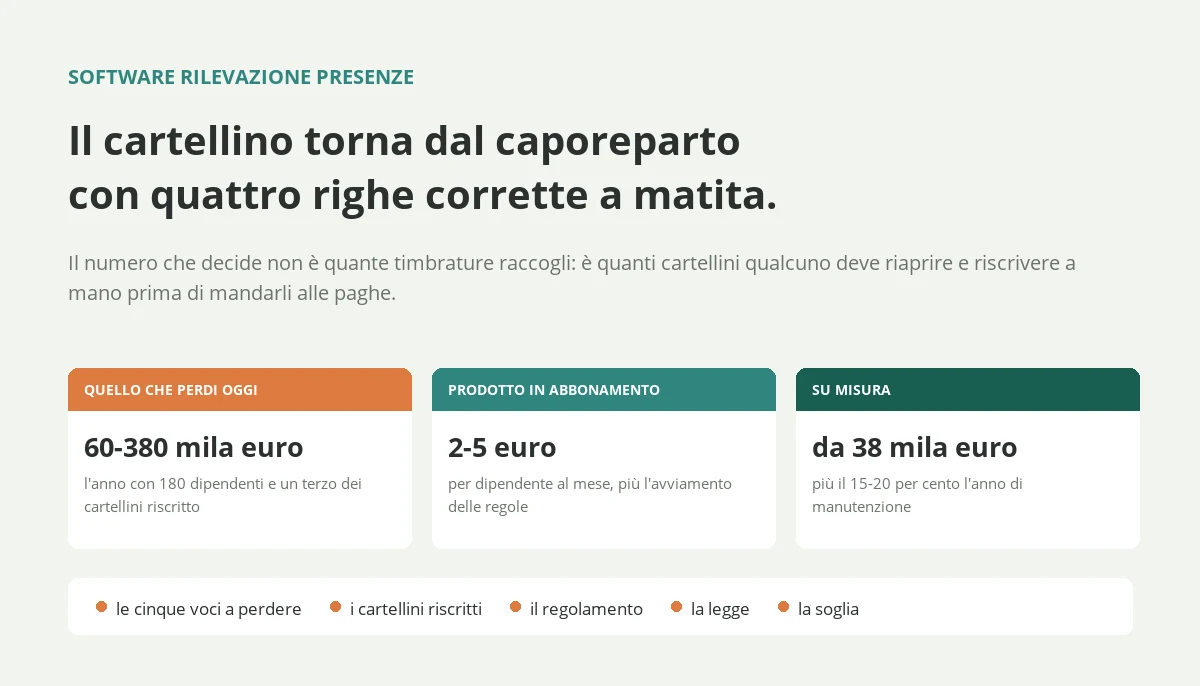
Under five per cent you are buying convenience, not margin; over fifteen the problem is your rules, and no product will write them for you. With 180 employees and 7.5 million of payroll, the five costs of attendance run on paper timesheets come to around 230,000 euros a year, three per cent of payroll. A subscription product costs between two and five euros per employee per month plus setup, a custom system starts at thirty eight thousand euros. Here the product wins more often than anywhere else: custom is justified for shift planning and site work, almost never for clocking in.

The HR manager of a metalworking company near Verona, one hundred and eighty employees and three production shifts, showed me what her last week of the month looks like. She prints one hundred and eighty timesheets, splits them into six bundles and walks them over to the supervisors. The supervisors correct them in pencil: this one is missing a clock in after lunch, this permit was two hours and not three, this man was on site in Mantua and never went through the turnstile, this one did two hours of overtime nobody had asked for but that were needed. On Thursday they come back. On Friday she retypes everything into a spreadsheet and sends it to the payroll bureau. Out of one hundred and eighty timesheets, sixty one came back with at least one correction.
If you recognise the scene, this article gives you the real cost of running attendance on paper timesheets and spreadsheets, the single number that tells you whether time attendance software will give you anything back or only a tidier archive, why the project is not the clock in but the rulebook and why most companies find that out in month three, how people actually clock in when you have production, offices, building sites and remote work in the same company, what Italian law lets you do and what it does not, the real price bands between your payroll bureau's portal, a subscription product and a custom system, and the threshold in euros beyond which the arithmetic changes.
I have been writing software since 1999 and I have seen and built a fair number of systems that count people's time: manufacturers with three shifts and an assembly crew permanently on the road, service cooperatives with seven hundred people spread over eighty sites, professional firms where hours have to be charged to a job before they reach the payslip, installation companies where the engineer clocks in from a basement with no signal. I also built and sold a software product used by many companies, and from the selling side I learned the thing that applies here too: attendance software is sold by showing the turnstile and the colourful dashboard, and it is used or abandoned because of ten boring rules nobody mentions during the demo.
What I have learned, and what explains why so many companies buy a new system and a year later are still correcting in pencil, is this: the number that decides is not how many clock ins you manage to collect, it is how many timesheets somebody has to reopen and rewrite by hand before sending them to payroll. Every rewritten timesheet is a piece of time the system could not work out on its own, and it is also a point at which the number stops being a fact and becomes somebody's opinion. If your rewritten timesheet rate is high, a good system brings it down within a couple of month end closes and pays for itself. If it is already low, what you are buying is convenience, not margin, and it should be bought from a different budget.
What time attendance software is, and what it is not
Time attendance software is the system that turns raw events, clock ins and declarations, into a monthly timesheet that stands up in front of three different audiences: the employee, who has to recognise their own hours in it; the payroll bureau, which has to build the payslip and the statutory payroll ledger from it; and, should it come to that, a labour inspector who has to be able to reconstruct what happened. If one of the three does not hold, you do not have an attendance system: you have a collection of times.
The difference from a plain clocking device is not cosmetic, it is structural. A clocking device records the event: at 7:58 badge 214 went through gate 2. An attendance system applies a body of rules to that event and produces a payroll fact: that day the person worked seven hours forty five minutes of ordinary time, thirty minutes of authorised overtime and one hour of paid leave. Between the two sit rounding, tolerance, breaks, flexible bands, the overtime threshold, the absence justification and the approval. You buy the clocking device; you do not buy the rules. Those already exist in your company, they are simply not written down anywhere.
Clocking device, attendance system, HR system: three different things
This is where the confusion starts, and it is expensive, because you end up buying the tool for somebody else's problem. The clocking device is the hardware and its minimum software: badge, turnstile, kiosk, phone app. It solves collection and never touches the rules. Time attendance software proper is the engine that applies the rules and closes the timesheet: that is what you need if your problem is the month end close. An HR system is the larger set that also holds recruiting, training, appraisals and objectives: it solves a people management problem, not an hour counting one.
Most Italian small and medium companies need the second, get sold the first because it is cheap and looks sufficient, and occasionally get sold the third because it presents better. Before you watch any demo, write one line: what do I want to stop happening. If the answer is "I want to stop correcting timesheets in pencil", you are looking for the second one, and the questions to ask the supplier change completely.
The four kinds of company that look for it, and look for different things
The first family is shift based production, manufacturing and food: people concentrated in a few places, rigid hours, and the number one problem is the shift changeover, the night premium and reconciling the shift plan with what actually happened. The second is companies with dispersed staff, installation, maintenance, cleaning, services: the number one problem is that attendance has to be recorded where there is no gate, often with no connectivity, and then attributed to a site or a job. The third is offices and service companies with flexible hours and remote work: the problem is no longer counting hours but handling holidays, leave and hour banking so that the employee sees the same balance the company sees. The fourth is companies that must charge hours to jobs, from steel fabricators to engineering practices: attendance is only half the work, because the same hour has to land both in the payslip and inside a job cost, and those two counts almost never match.
All four families type the same thing into Google and get the same ten results, but they only buy well if they know which family they are in. A product designed for shift production handles the gate beautifully and has no idea what to do with a fitter spending eight days in Vicenza. A product designed for dispersed staff is excellent on the phone and cannot calculate a night premium across midnight.
The real cost of running attendance on paper timesheets
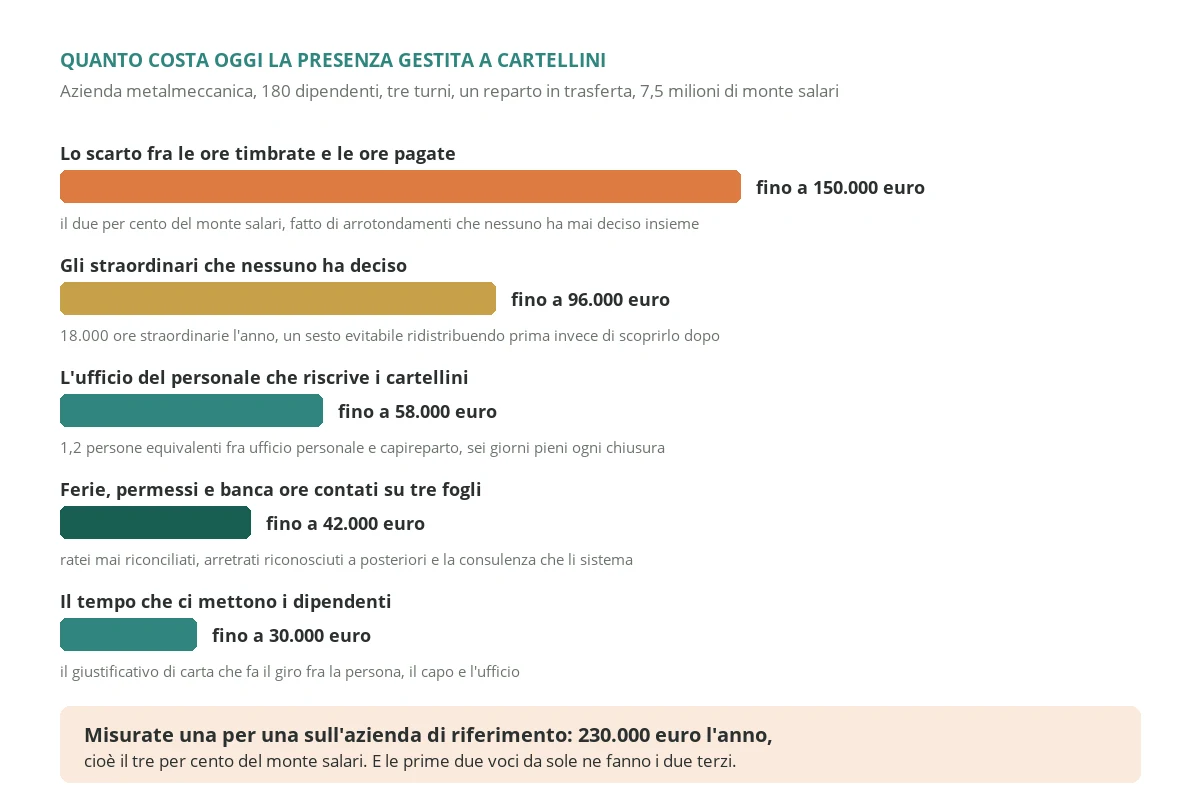
I will take this article's reference company, the one with the pencil corrections, and keep it throughout so the numbers stay comparable. One hundred and eighty employees, of whom one hundred and fifteen in production on three shifts, twenty two in an assembly department working on customer sites, forty three across engineering, sales and administration on flexible hours with two days of remote work a week. Payroll seven and a half million, average full cost forty two thousand euros per head. Three hundred thousand hours worked a year, of which eighteen thousand are overtime. Two thousand one hundred and sixty timesheets closed each year, one per person per month.
These five costs do not appear as lines in the accounts. They have no ledger account, no cost centre, and the payroll bureau will never flag them, because from where they sit the work is done properly: they correctly process what you send them. The point is that what you send them has already been through six pencils.
The gap between clocked hours and paid hours
This is the big one and the most uncomfortable, because there is nobody to blame. The mechanism is always the same: between the clock in and the payslip line sits a chain of decisions nobody ever took together. Someone arriving at 7:52 starts at 7:45 in one department and at 8:00 in another, because two different supervisors decided two different things ten years ago. The meal break is deducted always, including on days when the shift ran through and the person ate standing up. Missing clock ins are replaced with the theoretical schedule, which is an elegant way of saying that on that day the data does not exist. Verbally authorised overtime is rounded to the half hour, rounded up in one department and down in the other.
In companies with no written rulebook, the algebraic sum of these gaps almost always sits between one and a half and three per cent of payroll. For the reference company, on seven and a half million, two per cent is one hundred and fifty thousand euros a year. The first reaction is always the same: that cannot be right. It can, for a precise reason: no single decision is large, so no single decision ever gets discussed. Seven minutes a day for one hundred and fifteen people over two hundred and twenty days is two thousand nine hundred hours. And mind the direction: the gap does not always run in your favour, and when it does it is worse, because those are hours worked and not paid, which in a dispute you give back with interest and revaluation.
The overtime nobody decided
In most companies overtime is not decided by whoever organises the work: it is decided by whoever stays late. Without a system that shows the running total while the month is still going, overtime is discovered after the fact, when it has already been worked and has to be paid. The result is that the same hours are badly distributed: one department where three people do four hundred hours each, and the department next door where the load could have been handled by moving two people for a fortnight.
The reference company runs eighteen thousand overtime hours a year, six per cent of total hours, which at twenty eight euros an hour including premium and contributions comes to well over half a million. Not all of it is avoidable, and it should not be: part of it is physiological and part of it is how you hold a delivery date. But in companies that start seeing the running total in time, the share recovered by redistributing or banking hours sits between a sixth and a quarter, that is up to ninety six thousand euros a year. The remedy is not a ban: it is that on Wednesday the shift leader can see that two of his people are already at the limit, while he can still do something about it.
The HR office rewriting timesheets at month end
This is the most visible cost and the one nobody counts, because these are salaries you would pay anyway. Closing the month for one hundred and eighty people with three shifts and a crew on the road takes the HR manager six full days, and takes six supervisors about two hours a week each in corrections, phone calls and reconstructions.
That is roughly fifty eight thousand euros a year of people's time, equivalent to one and two tenths of a person. The part that hurts is not the cost: it is that those six days are always the same six days, the last week of the month, so everything useful the HR office should be doing, from recruiting to training to contracts, slides a week every month. Over a year that is a month and a half of qualified work that does not exist.
Holidays, leave and hour banking counted on three different sheets
In almost every company I visit, remaining holiday exists in three versions: the one on the payslip, which is the formal truth; the one on the HR office spreadsheet, which is up to date as of whenever somebody had time; and the one the employee carries in their head, which is usually the most optimistic of the three. Hour banking, when it exists, is normally in none of the three: it is on a spreadsheet of which exactly one copy exists.
The cost is the back pay you end up recognising, the advisory hours spent putting accruals back in order, the settlements made at termination to close a discussion you cannot win without data, and the holiday that expires without anyone noticing. For a company of this size that is up to forty two thousand euros a year, with the peculiarity that it does not arrive spread out: it arrives in two or three concentrated episodes, usually when somebody who had been there fifteen years leaves.
The time it takes the employees
The last cost is carried by the people, which is why nobody measures it. The paper holiday request that travels between the employee, the manager and the office; the fitter reconstructing the week's worksheet from memory on Sunday evening; the person who has to walk over and ask how many hours they have banked because there is nowhere to look; the twenty calls a month to the HR office that all start with "sorry, but I make it different".
Four requests a year each, twenty minutes of actual round trip across everyone involved, plus the worksheet time of the twenty two fitters, comes to up to thirty thousand euros a year. The five costs at their individual maximums add up to three hundred and seventy six thousand, but they never all peak in the same year: for the reference company, measured one by one, they came to about two hundred and thirty thousand euros a year, three per cent of payroll. In smaller companies, under fifty employees with a single work schedule, the same measurement gives numbers between twenty and forty thousand. But look at where the weight sits: two thirds is in the first two costs, and both depend on the same thing, the absence of written rules.
The rewritten timesheet rate: the number that decides
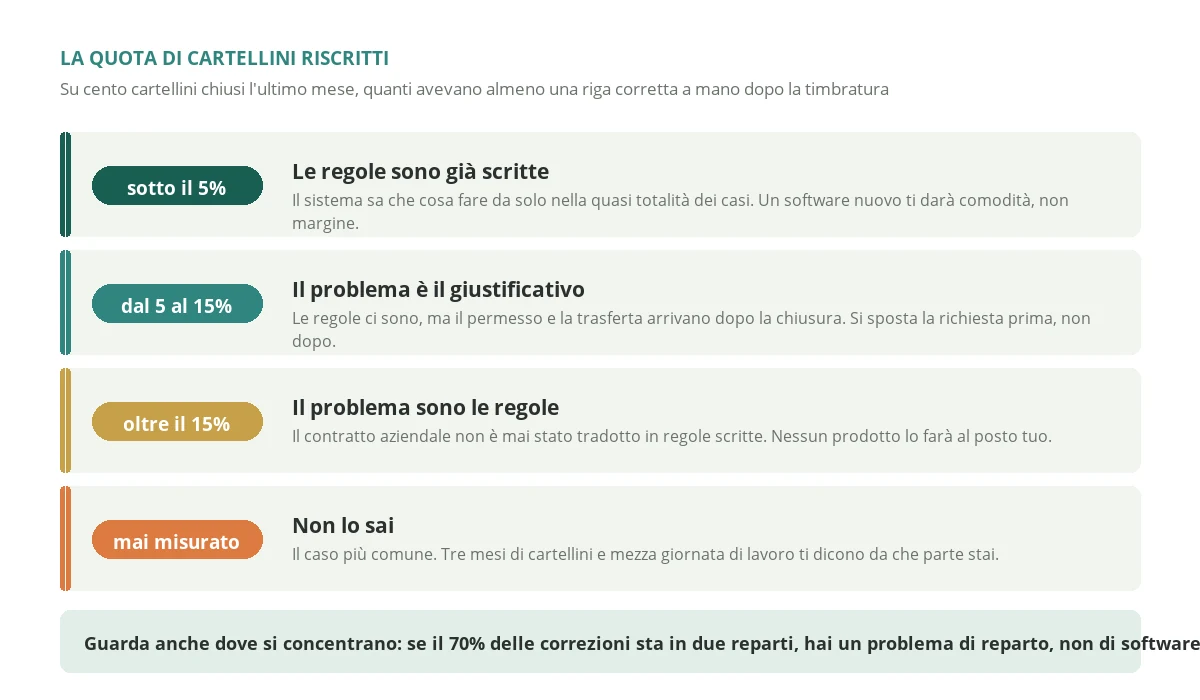
The exact definition, because that is what makes the number useful rather than evocative: out of a hundred timesheets closed last month, how many had at least one line entered or modified by a person after the clock in. The reason does not matter: a forgotten clock in, leave agreed verbally, a site visit with no gate, overtime authorised afterwards, a last minute shift swap. All of these are points at which the system did not know what to do on its own, and that is exactly what you want to know before buying a new one.
How to measure it, in half a day
If attendance already sits in a system, however ugly, the measurement is one query: you need the movements table with an indication of who entered each line and how. This is the shape I use on SQL Server, over three months because a single month may be the holiday month or the stocktaking month:
-- Rewritten timesheet rate: out of a hundred closed timesheets, how many have
-- at least one line entered or modified by a person after the clock in
WITH righe AS (
    SELECT m.IdDipendente,
           m.Mese,
           CASE WHEN m.Origine <> 'Timbratura' OR m.ModificatoDa IS NOT NULL
                THEN 1 ELSE 0 END AS Riscritta
    FROM MovimentoPresenza m
    WHERE m.Mese >= DATEADD(MONTH, -3, EOMONTH(GETDATE(), -1))
),
cartellini AS (
    SELECT IdDipendente,
           Mese,
           MAX(Riscritta) AS Riscritto,
           SUM(Riscritta) AS RigheRiscritte
    FROM righe
    GROUP BY IdDipendente, Mese
)
SELECT Mese,
       COUNT(*) AS Cartellini,
       SUM(Riscritto) AS CartelliniRiscritti,
       SUM(Riscritto) * 100.0 / COUNT(*) AS QuotaRiscritti,
       SUM(RigheRiscritte) * 1.0 / NULLIF(SUM(Riscritto), 0) AS RigheMediePerCartellino
FROM cartellini
GROUP BY Mese
ORDER BY Mese;
If the timesheets are on paper, as in the reference company, you do not need to digitise anything: take the last three months of bundles, count the ones with at least one pencil mark and write next to each the reason in a single word. Two people, half a day. The number that comes out is already useful, but the reason column is more useful still, because it tells you where to act: if half the corrections say "missing clock in" the problem is where people clock in, if half say "leave" the problem is when people ask for it.
What each threshold tells you
Under five per cent your company's rules are already written down somewhere and the system applies them: new software will bring convenience, continuity when people change and less dependence on the one person who knows everything, but it will not give you margin. Between five and fifteen the problem is usually not the rules but the justifications: leave, site work and shift swaps exist, but they reach the system after the close rather than before. You fix that by moving the request upstream, and within two or three closes the number falls. Over fifteen per cent, which is where the reference company sat with its thirty four, the problem is the rules: the company agreement, the departmental arrangements and the customs were never translated into something a machine can apply, and no product will do that for you. If you are here and you buy a system without doing the rules work first, a year from now you will be correcting the same timesheets on a screen instead of with a pencil.
Then look at where they cluster. In the reference company seventy per cent of the corrections came from two groups only: the twenty two fitters on the road, who simply had no way of clocking in, and the night shift, because of a midnight rule nobody had ever clarified. Forty five people out of one hundred and eighty were generating two thirds of the closing work, and that is the right scope for the first release.
The project is not the clock in, it is the rulebook
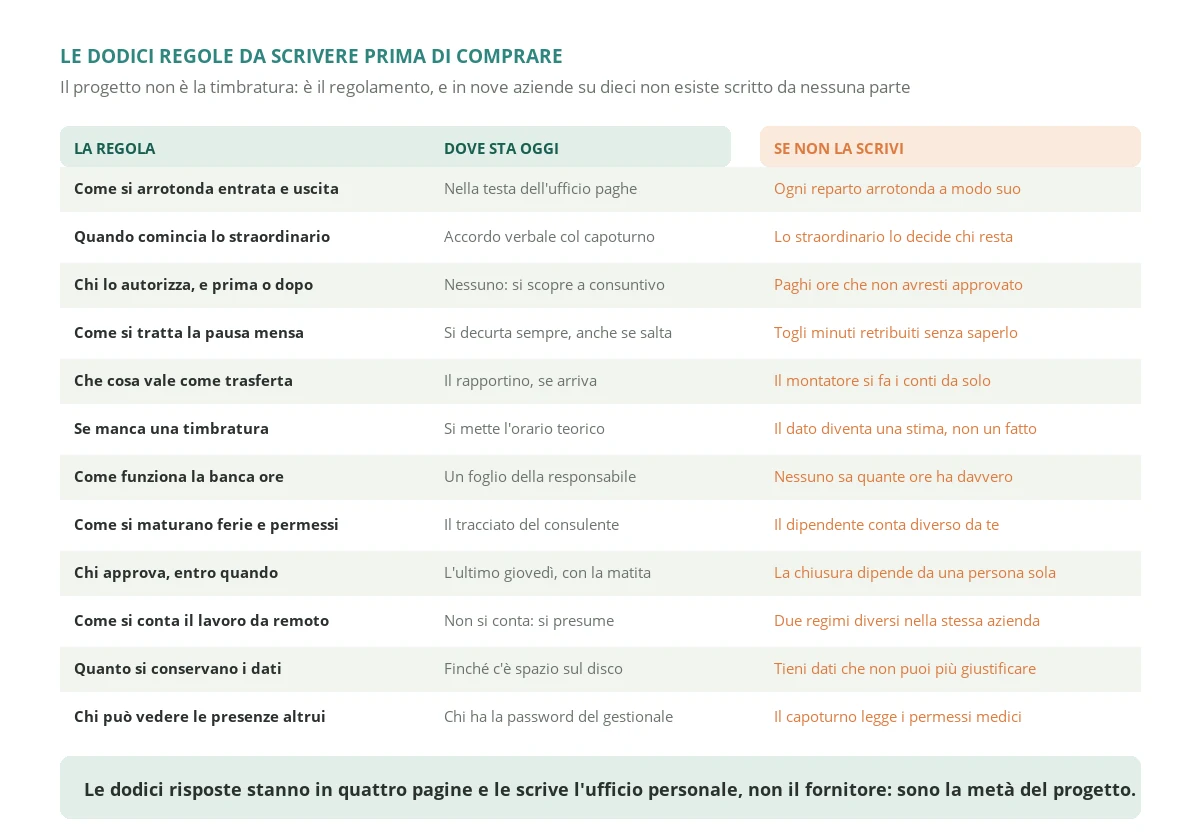
This is the part that sends most projects over time and over budget, and it is also the part no supplier has any interest in raising before signature. The reader at the entrance is the tip: it is cheap, it installs in a day and it does one thing. The real project is the rules engine, and the rules are yours. In nine companies out of ten they are not written anywhere: they live in the payroll clerk's head, and they got there by accretion over fifteen or twenty years.
The twelve rules to write before you buy
These are the twelve, and the answers fit in four pages. How entry and exit are rounded, with what unit and in which direction. When overtime starts and who authorises it, before or after. How the meal break is treated when the shift runs through. What counts as site work and from what hour. What happens when a clock in is missing. How hour banking works, with what ceiling and what expiry. How holiday, leave and statutory allowances accrue. Who approves the timesheet and by when. How remote work is counted. How long the data is kept. Who may see whose attendance. And the twelfth, the most forgotten: what happens when two rules contradict each other, for example when somebody clocks in late on a day for which leave had already been approved.
Take the first one, because it is the textbook case. Rounding looks like a detail for programmers and is in fact a contractual choice with economic and legal consequences. In code it is trivial, and that is exactly the point: the direction has to be a declared parameter, the same for everybody, not a silent behaviour chosen by whoever wrote the function.
public enum Verso { Entrata, Uscita }

// The unit and the direction come from the company rulebook, not from the code.
// Always rounding in your own favour means taking away paid minutes:
// in a dispute those minutes come back, with interest and revaluation.
public TimeSpan Arrotonda(TimeSpan timbratura, Verso verso, TimeSpan unita)
{
    var passi = timbratura.TotalMinutes / unita.TotalMinutes;
    var arrotondati = verso == Verso.Entrata
        ? Math.Ceiling(passi)
        : Math.Floor(passi);

    return TimeSpan.FromMinutes(arrotondati * unita.TotalMinutes);
}
Twelve lines of code, and behind them a decision worth tens of thousands of euros a year which today in your company is taken differently from department to department. The real work of the project is writing the twelve rules, and it has to be done by the HR office together with the supervisors, not by the supplier. It takes three or four meetings, costs nothing in software, and is worth half the result. There is a good side effect too: almost always, while writing them, you discover that two or three customs were simply wrong, and you fix them before cementing them into a program.
Why the standard product "does not fit", and why that is usually not the product's fault
The sentence I hear most often is that standard products do not fit our reality. In the great majority of cases that is not true: good products have a rules engine far richer than a one hundred and eighty person company needs. What is missing is not the feature, it is the decision. The supplier asks how you want to treat the break when the shift runs through, nobody in the company knows because until now the supervisor decided case by case, and the configuration stalls there. After three weeks of waiting the product default gets picked, which is a decision somebody else made for a company that is not yours, and from that moment the timesheets start coming back with pencil on them.
The test that exposes all of this costs one day and should be done before signing: take three real months of already closed timesheets, pick the twenty most complicated people you have, and ask the supplier to regenerate those timesheets with their system. Then compare line by line. If the system reconstructs ninety per cent of what was actually decided by hand, you have found the right product. If it reconstructs sixty, it is not that the product is bad: it is that you are missing the rules, and that number is telling you how much work lies ahead before the software is of any use. It is the same logic by which every package should be weighed against custom development, and I set out all the criteria in business management software, package or custom.
How people actually clock in: badge, kiosk, phone, declaration
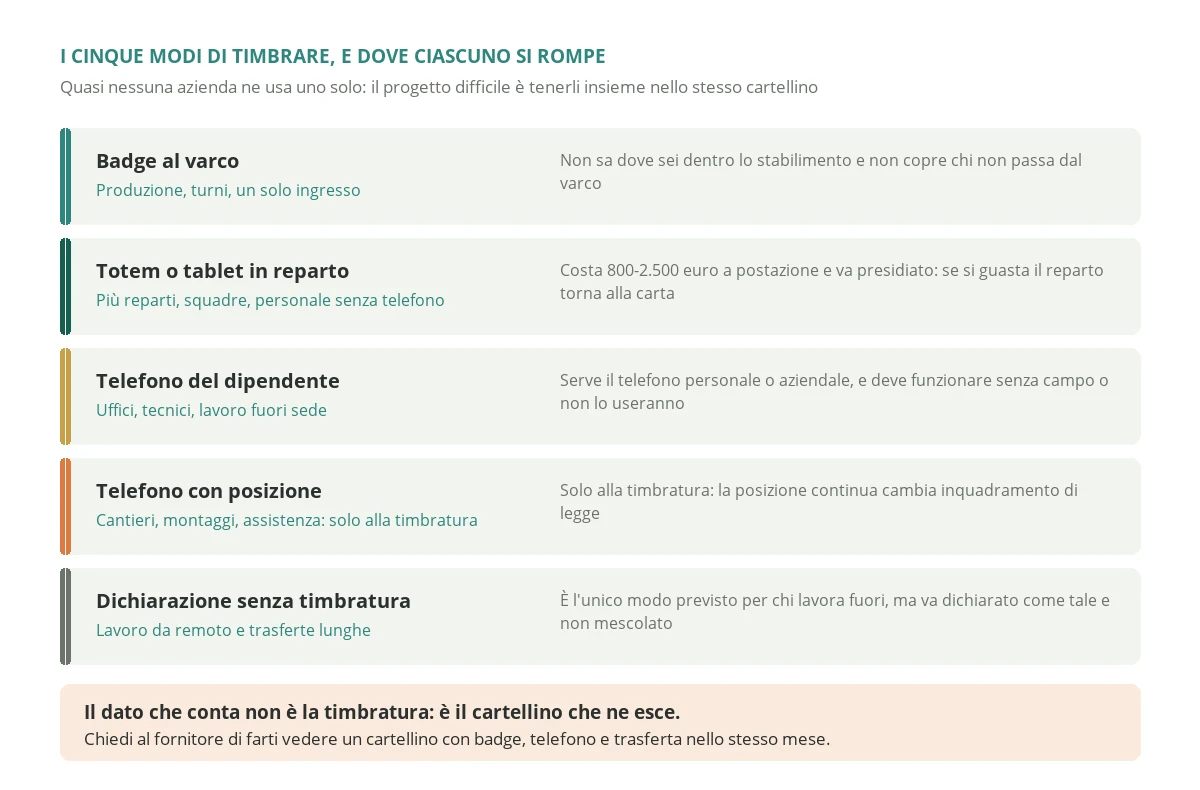
No company with more than fifty people uses a single way of clocking in, and the hard part of the project is not making one of them work: it is holding them together inside the same timesheet, under the same rules, without the employee having to know which one they are using.
The badge at the gate is the most solid and the cheapest for people who enter and leave a fixed place: production, the warehouse, the office. Its limit is that it does not cover whoever does not pass the gate, which is precisely the group that generates the corrections. The kiosk or tablet in the department is what you need when there is more than one clocking point or when part of the workforce has no company phone: it costs between eight hundred and two thousand five hundred euros per station and needs looking after, because the day it breaks that department goes back to paper and stays there. The employee's phone is the answer for offices and engineers, and it is also the most delicate from an industrial relations point of view: if you ask people to use a personal phone you have to say so, explain what the app collects, and offer an alternative for those who will not or cannot.
Site work and travel: where most systems break
The twenty two fitters of the reference company generated forty per cent of all corrections on their own, and the reason was not bad will: they had no way of clocking in. A system that works away from base has three non negotiable properties. The first is that it must work offline: in a basement, a steel clad shed or a substation there is no signal, and the clock in has to be recorded on the phone and synchronised later, carrying the real time and not the synchronisation time. Somebody who has lost a clock in twice will never open that app again, and will go back to a scrap of paper.
The second is that it must cost a few seconds: open, pick the site from the three likely ones, clock in. If clocking in means searching for a job among four hundred, at seven in the morning in front of a gate, it will not happen. The third is that location, if you use it, must be captured only at the instant of the clock in and never continuously: besides being the only thing you actually need, it is also the line between two different legal regimes, which I come to two sections from now. The broader question of how you put a system into the hands of people working away from base I covered in field service management software, where the engineer with no signal is exactly the same problem.
Remote work: the attendance with no entrance
For remote work the right question is not how to make people clock in, but whether it should be recorded as attendance or declared. For the vast majority of roles the sensible answer is the declaration: the person declares the day worked, the manager approves, and the system collects nothing else. Installing software that monitors activity on a home computer is a road that leads straight into the wrong side of article 4 of the Italian Workers' Statute, and on top of that it does not measure work: it measures mouse movement.
The practical rule that works is that remote work carries the same rights and the same limits as work on site, that is the same overtime threshold, the same leave and the same right to disconnect, but a declarative way of recording it. Mixing the two regimes, for instance demanding a clock in from home but not counting overtime, is the fastest way to create two classes of employee in the same company.
What Italian law lets you do, and what it does not
This is the section worth reading the article for, because it is where projects stall and because sales presentations dispose of it with the word "compliant". What follows is the frame I use on these projects, not legal advice: before signing, the choices should go past your employment adviser and whoever looks after your data protection.
Article 4 of the Workers' Statute: the line that divides two worlds
Article 4 of law 300 of 1970, rewritten by legislative decree 151 of 2015, distinguishes two situations. The first paragraph covers plant and tools from which the possibility of remote monitoring of workers' activity arises: these may only be installed for organisational, production, workplace safety or asset protection reasons, and only after an agreement with the union representatives or, failing that, authorisation from the Labour Inspectorate. The second paragraph says that procedure does not apply to tools used by the worker to perform the work, nor to tools that record access and attendance.
In practice: plain clocking in falls under the second paragraph and needs neither agreement nor authorisation. But the second paragraph is a narrow exception, and you leave it more easily than you would think. You leave it when the system tracks location continuously instead of at the moment of the clock in. You leave it when it collects data describing performance rather than presence, for instance time spent on each individual operation with a name attached. You leave it when it produces individual productivity dashboards. In all of these cases you fall back under the first paragraph, and without a union agreement or authorisation the processing is unlawful.
So the question to put to the supplier, in writing, is a single very concrete one: what data does the system collect beyond the time and place of the clock in, and what individual dashboards does it produce. With that answer in hand the line can be drawn in ten minutes. And there is a third paragraph almost everyone forgets: the data collected may be used for all purposes connected to the employment relationship, including a disciplinary case, only if the worker has been given adequate information about how the tools are used and how checks are carried out, in compliance with data protection law. Without that notice you have a system collecting data you cannot use at precisely the moment you would need it.
Fingerprints: why the answer today is no
The fingerprint reader is what hardware suppliers have pushed hardest for twenty years, because it elegantly solves the badge handed to a colleague. Under the European data protection regulation a fingerprint is biometric data, a special category whose processing is prohibited save in specific conditions, and employee consent is not a reliable legal basis in an employment relationship because it is not freely given. The Italian data protection authority has repeatedly fined companies using biometrics for plain attendance recording, with the recurring reasoning that less intrusive tools were available for the same result.
Decree law 19 of 2 March 2024, converted into law 56 of 29 April 2024, then intervened explicitly, prohibiting the use of biometric data for access control and for recording working time. So if a supplier offers you a fingerprint reader or face recognition for clocking in today, the thing to do is ask in writing on what legal basis, and take the answer to your adviser. The borrowed badge problem is real, but it is addressed in other ways: a named badge with a photograph, a camera at the gate filming the area rather than the individual, spot checks, and above all a rules engine that flags anomalies instead of chasing people.
Notice, retention and who may see what
Three practical things that cost little and that almost nobody does. The first is a specific notice on attendance recording, saying what data is collected, why, for how long, who sees it and what happens when it is missing: it is a two page document and it goes out before the system is switched on, not after. The second is the retention period: raw clock in data is not needed for ten years, it is needed for as long as the timesheet and any challenge to it, while it is the consolidated timesheet and the statutory payroll ledger that carry their own retention obligations. Keeping five years of minute by minute clock ins because there was room on the disk is exactly the kind of accumulation you cannot justify in an inspection.
The third is visibility: by default, a supervisor should not be able to see the reason for their people's leave, particularly medical appointments, family care or statutory disability leave. They should see that the person is absent and that the absence is approved. That is a five minute configuration that almost nobody does, and in an inspection it is what distinguishes a system that was designed from one that was merely switched on.
The payroll link: where half the projects die
The attendance system is not the last stop for the data: it is the second to last. The last stop is the payslip, and in most Italian small and medium companies the payslip is produced by an external bureau on their own software. The breaking point of the project is almost always there, in an export format nobody had looked at beforehand.
The format for the payroll bureau
The question to ask your bureau before choosing any system is precise: what import format does your payroll software accept, with which pay element codes, and can you give me a sample file. If the answer comes back in a day, the project has a road. If the answer is that it has always been done by hand, you have just found a piece of project you had not budgeted, worth between three and eight thousand euros.
The real work is the mapping table between your absence types and the bureau's pay element codes: ordinary, day overtime, night, holiday premium, annual leave, statutory allowances, paid and unpaid leave, sickness, injury, parental leave, hours banked and taken, travel with and without overnight stay. There are between thirty and sixty entries and they have to be agreed one by one. It is boring and nobody wants to do it, but it is what determines whether the monthly export is a button or three days of somebody's time. It is worth writing it in a shared sheet with the bureau before watching any demo, because that sheet then becomes the acceptance test for whatever you buy.
The close: who closes and who approves
A system that works has a clean closing moment and one responsible person per level. The model I see working best has three steps with dates written in the calendar: the employee checks and flags by the third day of the following month, the manager approves by the fifth, the HR office closes and exports by the seventh. After the close the month is locked and adjustments go to the next month, traced.
The difference between a system that is used and one that is abandoned lies almost entirely in this rule. If the month never really closes, corrections keep arriving for weeks, the timesheet is never final and the HR office keeps its parallel spreadsheet to know how things really stand. And once a parallel spreadsheet exists, the official system is already dead: it has become a place where data is copied, not where it is decided. The same mechanism by which a business system turns into an archive rather than a tool I described, for cost data, in management control software.
What it costs: bureau portal, subscription product or custom
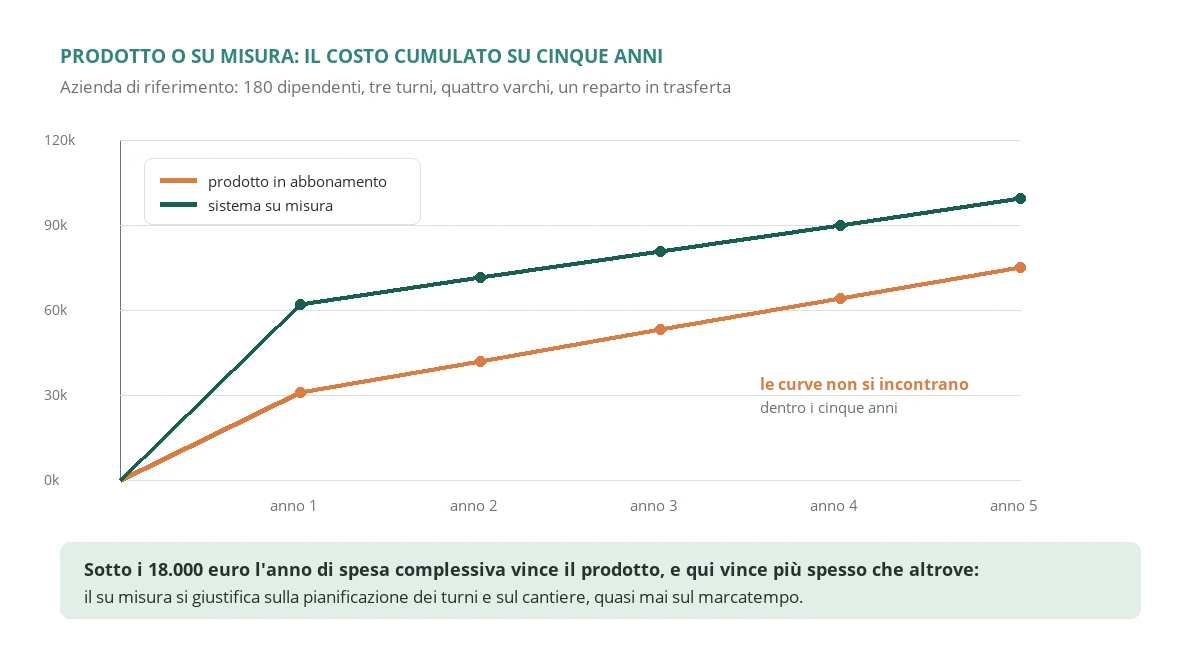
All three roads exist and taking the wrong road costs more than picking the wrong supplier. These are the orders of magnitude I see in the Italian market, for a company like the reference one.
Your payroll bureau's attendance portal. Many bureaux now offer a portal included in the fee or at one to two euros per employee per month, with phone clocking and holiday and leave requests. The advantage is large and underrated: the payroll link does not exist because it is the same system, and that is exactly the line that blows every other project's budget. The drawback is that these portals are built for collection, not for rules: they handle holidays and leave well, and shifts, shift swaps and complex premiums badly. If you have a single work schedule and no shifts, look here before looking anywhere else: it is the road I recommend most often and the one no supplier will mention.
A dedicated subscription product. Priced per employee, between two and five euros a month, so for one hundred and eighty people between four thousand three hundred and ten thousand eight hundred euros a year. Plus setup, between eight and thirty five thousand euros, which is mostly rule configuration, shift master data and the payroll export, and plus hardware: between eight hundred and two thousand five hundred euros for every gate or station. Good products exist, some very good, and in this field they are further ahead than in almost any other, because the rules engine has been refined for thirty years and because contractual updates arrive on their own.
A custom system. Starts at thirty eight thousand euros for people and shift master data, clock in collection, the rules engine, absence requests with approval, month end close and payroll export. Reaches one hundred and forty thousand with shift planning, an offline app for site work, hour banking, the employee portal and job costing of hours. Plus fifteen to twenty per cent a year of maintenance, which here is not optional: collective agreements change, and if the rules engine is yours you pay for the updates.
The threshold. Under eighteen thousand euros a year of total spend on running attendance, fees, amortised hardware and internal time included, the product almost always wins. And here I will add something I have hardly ever written in this series on business systems: in time attendance the product wins more often than in any other area, and pure custom is almost always the wrong choice. The reason is twofold: the domain is mature and heavily regulated, so the products are good; and the law changes, so a proprietary rules engine is a debt you pay every year. As the chart shows, for a company of this size the two curves do not even meet within five years.
There is however a fourth road, and it is the one I recommend in the vast majority of cases: a product for the clocking and the rules, a custom piece for the thing that sets you apart. In the reference company that piece was the fitters' app, which had to work with no signal and attach the hour to a job; in service cooperatives it is shift planning across eighty sites with contractual constraints; in steel fabricators it is the bridge between attendance hours and job hours, which are two different counts no product holds together well. The custom piece costs between twelve and forty thousand euros, hooks onto the product through its interfaces and does not force you to maintain a rules engine. Why this hybrid road almost always works better than either pure one I explained in custom software development.
Where to start: the first release in ninety days
The first release does not have to be complete, it has to be useful to somebody within three months. This is the order I use, and the first three steps cost little and are worth a lot because they happen before the software.
Week one: measure. Count the rewritten timesheets of the last three months and note the reason for each correction in one word. By the end of the week you need a number, a main cause and the two groups of people generating most of the work. With that number in hand every subsequent discussion, including the ones with suppliers, becomes concrete rather than a matter of principle.
Weeks two and three: the twelve rules. Three or four meetings between the HR office, the supervisors and the management, four pages of output. It is the most boring part of the project and it determines half of it, because it is the business logic of attendance. If you do not write it beforehand you will write it inside the program, which is the most expensive place to write it, and it will be written by somebody who does not know your company.
Week four: the payroll export. Ask the bureau for the format and build the pay element mapping. One week, mostly waiting, and it saves you the project's worst surprise.
From month two: the first release, on the worst group. Not on production, which is the part that already works: on the two groups generating seventy per cent of the corrections. In the reference company that was the fitters and the night shift, forty five people. Three things only: clocking that works where they actually work, absence requests made and approved from the phone, a timesheet the employee can see every day. No shift planning, no dashboards, no full portal.
Month three: the close from the system. One month genuinely closed, with the dates written down, managers approving and the export generated. The first month is run in parallel with the old method and the two results compared line by line: it is the only acceptance test that persuades the HR office to let go of the spreadsheet. Skip it and that spreadsheet will still be there in years to come.
One last piece of advice on what not to do first. The dashboard with absenteeism statistics by department is the feature that sells best and is needed last: if the timesheets are not reliable it produces numbers that start the wrong arguments, and if you open it before the rules are written you will spend six months explaining why two comparable departments come out different. It arrives later, and when it arrives it works.
If the number says this is not your problem
It happens, and it is worth saying because hardly anyone does. If your rewritten timesheet rate is under five per cent, if the month end close takes half a day and if the employee sees the same holiday balance you see, new attendance software will not give you margin: it will give you convenience, continuity when people change and less dependence on the person who knows it all by heart. Those things are worth having, and in a small company the second is worth more than it sounds, because there is almost always exactly one person who knows how the month is closed. But they are worth the price of a subscription, not of a project.
In that case the bottleneck is almost always elsewhere, and in manufacturing it is one of these three: planning, meaning the shifts are built on a spreadsheet with no regard for the constraints, in which case the subject is shift planning and not attendance; job costing, meaning the hours are there but nobody knows what they were spent on, which I wrote about in job costing software; or the hourly rate, meaning you count the hours well but value them with an average cost invented in 2019.
And there is a case where software is not the answer even when the numbers are bad: when the corrections come from a choice, possibly one never stated out loud. If the company has decided that for certain people certain things get a blind eye, no system will change that decision: it will only tell you precisely what it costs. Which, incidentally, is already an excellent reason to measure, because many concessions made to keep somebody are worth more than that somebody brings in, and until the number exists the discussion cannot even start.
If you have got this far you probably have your own bundles of timesheets in mind and a fairly precise idea of which of the five costs applies most to you. Count the rewritten timesheets of the last three months before watching any demo: it is half a day of work, it costs nothing, and it tells you whether you are buying margin or merely convenience. From there on the decisions are much simpler, and you take them yourself instead of leaving them to the most convincing quotation.
Frequently asked questions
It depends on the road. The attendance portal of your payroll bureau often costs one to two euros per employee per month, sometimes it is included in the fee, and needs no integration because it is the same system that runs payroll. A dedicated subscription product costs between two and five euros per employee per month, so for one hundred and eighty people between four thousand three hundred and ten thousand eight hundred euros a year, plus a setup between eight and thirty five thousand euros that is mostly rule configuration, shift master data and the payroll export, plus hardware between eight hundred and two thousand five hundred euros per gate. A custom system starts at thirty eight thousand euros for master data, clock in collection, the rules engine, absence requests, month end close and payroll export, and reaches one hundred and forty thousand with shift planning, an offline site app, hour banking and job costing of hours, plus fifteen to twenty per cent a year of maintenance.
You count rewritten timesheets: out of a hundred timesheets closed last month, how many had at least one line entered or changed by a person after the clock in. If attendance already sits in a system it is one query on the movements table; if the timesheets are on paper you take the last three months, count the ones with at least one pencil mark and note the reason in a single word, which takes half a day with two people. Under five per cent the software will give you convenience rather than margin, between five and fifteen the problem is absence requests arriving after the close, over fifteen the problem is rules that were never written down. Look at where the corrections cluster too: usually two groups of people generate seventy per cent of the closing work, and that is the scope of the first release.
Not for plain clocking in. Article 4 of the Workers' Statute, rewritten by legislative decree 151 of 2015, excludes from the union agreement or Labour Inspectorate authorisation procedure both the tools an employee uses to perform the work and the tools that record access and attendance. But it is a narrow exception: if the system tracks location continuously rather than at the moment of clocking in, if it collects performance data, or if it produces individual productivity dashboards, you fall back under the first paragraph and an agreement or authorisation is required. Adequate information to workers remains mandatory in any case, and without it the data cannot be used for purposes connected to the employment relationship, for example in a disciplinary case. Have your employment adviser check the choices before you sign.
Not today, in Italy. A fingerprint is biometric data, a special category under the European data protection regulation, and employee consent is not a reliable legal basis in an employment relationship because it is not freely given. The Italian data protection authority has repeatedly fined the use of biometrics for plain attendance recording, noting that less intrusive tools were available. Decree law 19 of 2 March 2024, converted into law 56 of 29 April 2024, then prohibited the use of biometric data for access control and working time recording. If a supplier offers it, ask in writing on what legal basis and take the answer to your adviser.
Almost always it is not the product that is missing, it is the decision. Good products have a rules engine richer than a one hundred and eighty person company needs. What stalls is the configuration: the supplier asks how to treat the meal break when a shift is skipped, nobody in the company knows because until now the supervisor decided case by case, and after three weeks the product default is chosen, which is a decision somebody else made for a different company. The test that exposes this costs one day: take three months of already closed timesheets, pick the twenty most complicated people and ask the supplier to regenerate them with their system. If it reconstructs ninety per cent you have found the right product, if it reconstructs sixty you are missing the rules.
Less often than in any other business software area, and it is fair to say so. Under eighteen thousand euros a year of total spend, fees, amortised hardware and internal time included, the product wins, and for a one hundred and eighty person company the two cost curves do not even meet within five years. The reason is twofold: the domain is mature and heavily regulated, so products are good; and collective agreements change, so a proprietary rules engine is a debt you pay every year. The road I recommend almost always is the fourth one: a product for clocking in and for the rules, plus a custom piece between twelve and forty thousand euros for the thing that sets you apart, which is usually the app for people working on site, shift planning, or the bridge between attendance hours and job hours.
Leave your details in the form below