Which number decides whether warehouse management software will actually help you?
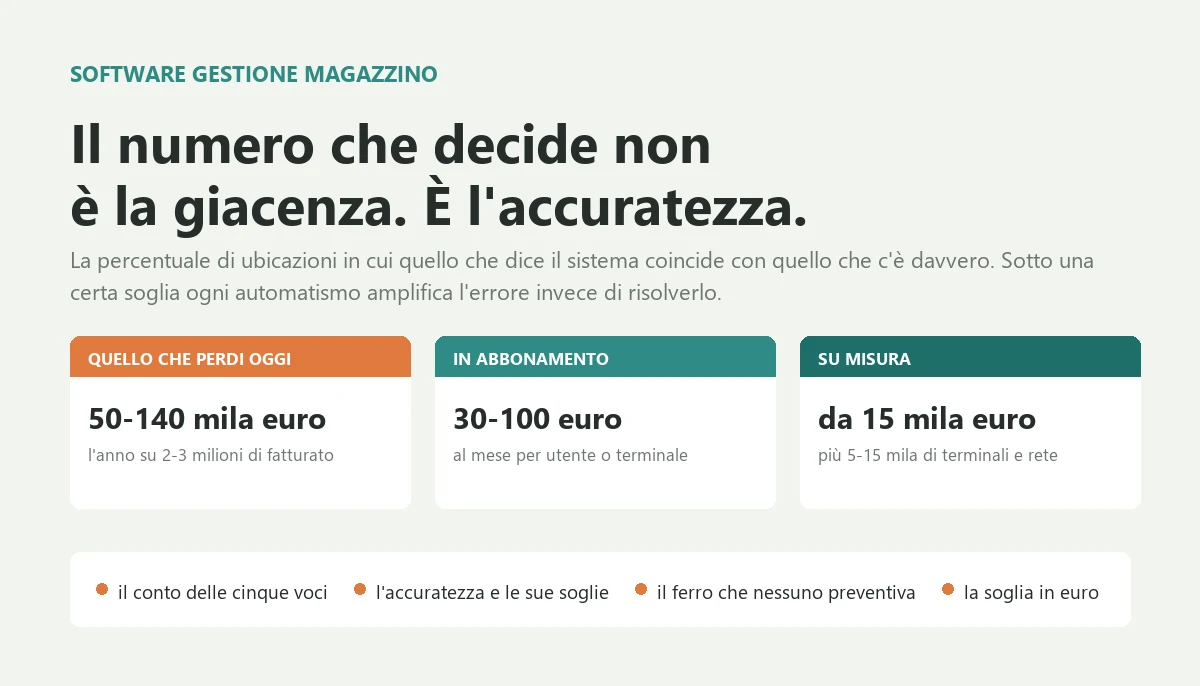
The numbers: an unmeasured warehouse costs fifty to a hundred and forty thousand euros a year in a two to three million euro company, between rush purchases, time spent searching, inflated safety stock, obsolescence and shipping errors. Subscription products run thirty to a hundred euros per month per user or terminal, a custom system starts at fifteen thousand euros, and on top of both sits the hardware: terminals, labels and network coverage are worth five to fifteen thousand euros that almost no quote includes. The practical threshold between the two routes sits around twenty five thousand euros a year of total spend.
Below eighty five per cent accuracy no automation makes sense, because it amplifies the error instead of fixing it. The first release that works is always the same: labelled locations, movements recorded from a handheld with a scan, cycle counting running, and one report, accuracy by zone.

The customer asks whether the fourteen pieces are available. The system says yes. Sales confirms, production plans around it, and three days later the warehouse operator walks back from the aisle with nine pieces in his hands and the face of a man who had already said so. Somebody phones the customer, somebody phones the supplier for a rush order at twenty per cent over list, and that is the end of it. It ends in no budget line, in no indicator, and next week it happens again on another part number.
If you recognise that scene, this article gives you the real cost of a warehouse you cannot trust, the single number that decides whether warehouse management software will genuinely help you or make things worse, the exact point where these projects fail, what the hardware costs that no vendor puts in the first quote, the real price bands between a subscription product and a custom system, and the threshold in euros where the arithmetic flips.
I have been writing software for twenty six years and a good part of that time has been spent inside real warehouses: spare parts, electrical components, food with expiry dates, building materials, companies that assemble to order. I have seen a company with twelve million in revenue run its warehouse on a spreadsheet the owner updated in the evening, and I have seen a company with three million buy a forty thousand euro warehouse system and carry on doing the August stock count with pen and paper, because nobody was recording the picks.
The thing I have learned, and that no vendor will tell you during the demo, is this: in a warehouse the number that matters is not the stock figure, it is accuracy: the percentage of locations where what the system says matches what is actually there. If you do not know that number, everything you build on top of the stock figure, from automatic reordering to the availability shown on your website, does not fix the error: it distributes it faster and in more places.
What warehouse management software is, and why the module you already have is not enough
Warehouse management software is the system that knows three things your accounting software does not: where every item physically sits, who moved it and when, and how much of what the system claims is actually true. It exists to answer one question, continuously: if I promise this material today, will I actually find it when it is needed?
You will find it on the market under different names, and the confusion helps the selling. The international acronym is WMS, warehouse management system. In Italy it gets called stock management, warehouse logistics, location management. Then there is the warehouse module of the accounting system you already own, which is a different animal, and it is worth knowing which is which.
The difference between knowing how much you have and knowing where it is
The warehouse module of an accounting system thinks in quantities and values. It can tell you that you have fourteen pieces of part R-4471, what they are worth, when you bought them and at what average cost. It is excellent at this, it needs to be for the year end accounts, and it has no intention of doing anything else.
It cannot answer any of these questions: which shelf those fourteen pieces are on; how many there were this morning before a technician took three for a repair; which of them belong to the batch expiring in two months; how many are already committed to a confirmed customer order and therefore not really available; who touched them last.
This is not a defect in your accounting system and there is no point asking it for one more feature. It is a difference of subject: stock accounting thinks in value and periods, physical management thinks in pieces and positions, and a piece moves twenty times between two year ends. Every unrecorded movement is a small lie nobody corrects until the annual count, and at the annual count the difference gets called an adjustment and goes to cost without anyone asking where it came from.
The three kinds of company that go looking for it, and want different things
Companies that sell and ship. Distribution, spare parts, wholesale, anyone with an online shop as well. The problem here is twofold: finding goods quickly, and not promising what is not there. The cost of a mistake is immediate and visible, because a return and a credit note arrive. Anyone with an online channel has one more problem, which is keeping stock aligned between the site and the warehouse, and it is why integrating an ERP with an online shop nearly always fails on the availability figure and almost never on the technical plumbing.
Companies that manufacture. Machine shops, assemblers, automation companies, anyone working to order. Here the cost of a wrong warehouse is not a return: it is a line standing idle or an assembly pushed back a week because a component that showed as in stock was not there. The warehouse serves production, not shipping, and the questions change: what am I missing to close job 2026-014, which materials are already committed, how much material is at the machine and therefore no longer in the warehouse but not yet consumed either.
Companies that install and maintain. Contractors, service companies with vans. Here the warehouse is not one place: it is the central store plus eight vans, each with its own miniature warehouse that nobody has ever counted. Material leaves the central store, enters a van, and from there disappears off the radar until it is missing. It is the same problem I described writing about maintenance management software, and indeed the two things get bought together and almost always in the wrong order.
How far a spreadsheet gets you, and where it breaks
Running the warehouse on a spreadsheet is not the enemy, and anyone telling you to throw it away immediately is selling something. It works perfectly well up to a point, and that point announces itself with four precise signals.
First: one person updates the file, and when that person is on holiday the numbers stop. Second: whoever picks writes nothing down at the time, and movements get reconstructed that evening or the next day from delivery notes and scribbles. Third: when someone asks whether an item is in stock, the most honest answer available is let me go and look. Fourth: the year end count produces adjustments nobody can explain, and they get accepted because that is how it has always been.
The spreadsheet breaks not because of the number of items but because of the number of people moving them. A three thousand item warehouse with two people going in, kept properly, works. Six hundred items with nine people picking without recording is already broken, and no software will fix it until those nine people record.
The real cost: what a warehouse you cannot trust is costing you today

Before looking at any product, run this calculation. It does two things: it tells you whether the problem justifies the spend, and it puts a number in your hand for when the vendor asks what budget you had in mind. There are five items and you can estimate them in an afternoon with your warehouse manager and your bookkeeper.
The five costs that sit outside the accounts
Rush purchases for material that showed as in stock. This is the easiest to measure and the most embarrassing to look at. Ask purchasing how many rush orders they placed last year, and what the urgency cost in surcharge, express freight and minimum order quantities. In companies with warehouse accuracy below ninety per cent this typically runs between one and three per cent of purchased value. On a million euros of purchases a year that is ten to thirty thousand euros, and most of it is a direct consequence of the system saying one thing and the aisle saying another.
Time spent searching rather than picking. In a warehouse with no coded locations, or with locations that exist only in the head of the person who has worked there for twenty years, searching accounts for twenty to thirty five per cent of a picker's time. Three warehouse staff at a fully loaded thirty euros an hour is thirty to fifty thousand euros a year of time paid for walking. The real damage is not the cost: it is that when that person is away nobody else can find anything, and the company discovers it has a single point of failure made of one human being.
Safety stock inflated out of fear. When the data cannot be trusted, everyone defends themselves the same way: they hold more material than they need. It is a rational response to false information, and it costs around twenty per cent a year of the value held, counting tied up capital, space, insurance, handling and obsolescence risk. In companies measuring for the first time, excess stock runs between fifteen and thirty per cent of warehouse value. On a five hundred thousand euro warehouse that is seventy five to a hundred and fifty thousand euros standing still, costing fifteen to thirty thousand euros a year simply to sit there.
Material that ages at the back of the shelf. Without a measure of turnover per item, obsolescence stays invisible until you need the space. In companies that do not measure turnover, three to eight per cent of warehouse value becomes unsellable, non compliant or expired every year. On five hundred thousand euros that is fifteen to forty thousand a year, and it occupies the space you needed for the goods that actually move.
Picking and shipping errors. Without barcode verification on the way out, errors typically run between one and three per cent of lines: wrong item, wrong quantity, wrong batch. With a scan at the point of picking it drops below three in a thousand. Each error costs thirty to eighty euros in return, reshipment, credit note and admin time, and far more in sectors where the batch matters. On fifteen thousand lines shipped a year, going from two per cent to three per thousand is roughly two hundred and fifty errors avoided, worth seven to twenty thousand euros.
How to run the calculation on your own company
You do not need a consultant and you do not need a week. Take twenty part numbers at random from the fast movers, walk into the warehouse with the stock list, and count them. Not twenty chosen by the warehouse manager: twenty at random, pulled from the system.
Then count how many of the twenty match exactly. Not how many are close: how many match. That percentage is your accuracy, and it is the most important number in this article. In companies that have never measured it sits almost always between sixty five and eighty five per cent, and the first reaction on seeing it is to assume the sample was unlucky.
The rest of the calculation you do at your desk: rush order surcharges from purchasing, search hours estimated honestly by the warehouse manager, stock value divided by annual consumption to get turnover, a list of items untouched for more than twelve months, the number of credit notes for shipping errors. In a company with two or three million in revenue and a half million euro warehouse, the five items together typically total between fifty and a hundred and forty thousand euros a year. That is the number to hold in your hand when someone quotes you, and it is also why this kind of project, done properly, pays back faster than almost any other business system.
Inventory accuracy: the number that decides whether the project makes sense
I have put accuracy at the centre of this article for a precise reason: it is the only number that determines which features you will actually be able to use. It is not a consultant's metric, it is a physical constraint. Below a certain level some functions simply do not work, however much you paid for them.
How you actually measure it
Accuracy is not the value discrepancy that comes out of the year end count. That is an accounting number and it always flatters, because errors in both directions cancel out: twelve pieces missing on one item and eleven surplus on another give a near zero value difference and a completely wrong warehouse.
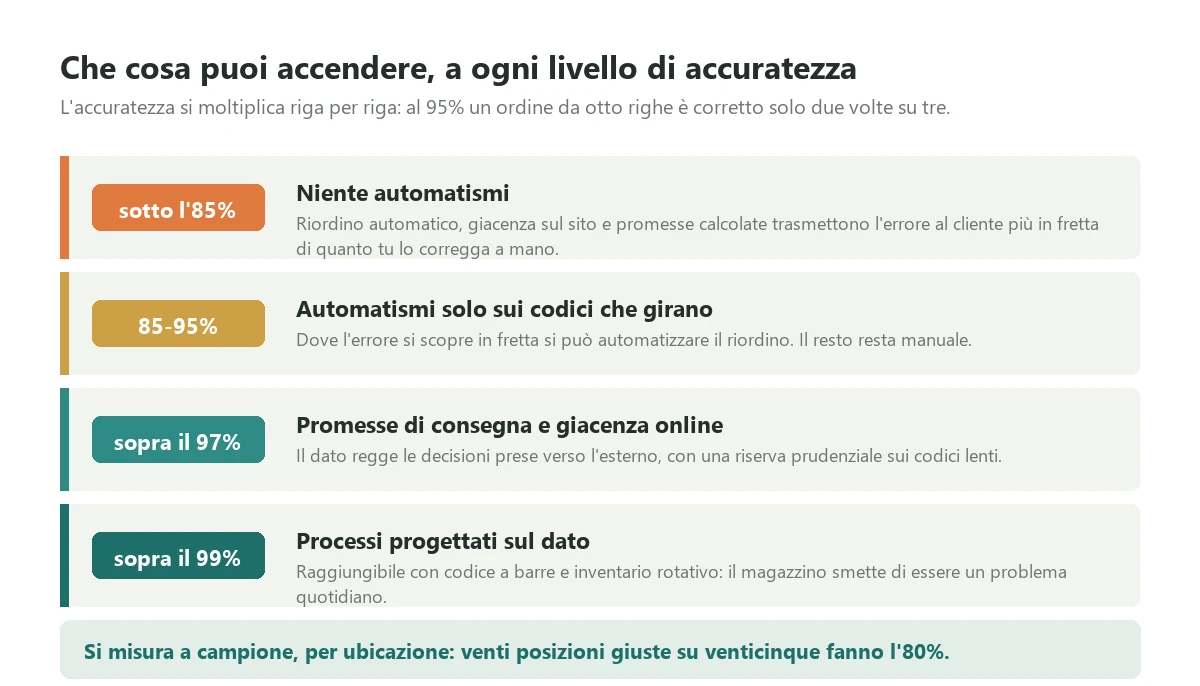
The right measure is taken per location, or per item if you have no locations, and it is taken in samples through the year. You count a handful of positions, compare with the system, and record how many match to the piece. Twenty positions correct out of twenty five is eighty per cent accuracy, regardless of what they are worth. This is cycle counting, and its real purpose is not counting: it is measuring how far you can trust yourself.
A warehouse with cycle counting running, ten or fifteen positions a day done by the people already working there, counts everything two or three times a year, never stops the company, and above all gives you a time series instead of an annual photograph. It costs one person twenty minutes a day. It is the single best value practice I know in the whole of warehouse logistics, and you can start tomorrow morning, before and regardless of any software.
Why ninety five per cent is not a good number
Ninety five per cent sounds fine until you multiply it. If each line of an order has a ninety five per cent chance of being right, an eight line order is right sixty six per cent of the time. That is one order in three with at least one wrong line. A warehouse at ninety five per cent is not a nearly right warehouse: it is a warehouse that gets one order in three wrong.
The practical thresholds, seen in the field, are these. Below eighty five per cent there is no point switching on any automation: not automatic reordering, not published website availability, not system calculated delivery promises, because every automation amplifies the error and passes it to the customer faster than you can correct it by hand. Between eighty five and ninety five you can automate reordering on fast movers, where mistakes surface quickly, and keep the rest manual. Above ninety seven per cent calculated delivery promises and published online stock start to make sense. Above ninety nine, which is reachable with barcodes and cycle counting, you can design processes taking the data as given, and that is where the warehouse stops being a daily problem.
The four things that drive it down
The unrecorded pick. This is the first and on its own it outweighs all the others combined. I deal with it in the next section because it deserves half the project by itself.
The return that comes back and does not. Material taken for a job, not used, carried back and put on the shelf with no paperwork. The system issued it and nobody receipts it back. In installation and service companies this is the second cause after the pick, and it has the peculiarity of generating positive errors, that is, material that exists and the system cannot see: which leads to rebuying things that are already sitting there.
The ambiguous unit of measure. An item bought in metres, held in rolls and picked in pieces. A pack of one hundred that somebody records as one. It looks like a master data detail and it produces half the large discrepancies I have seen in my career. Decide it once, print it on the label, never change it.
The wrong part number that looks like the right one. Two nearly identical items, one digit apart, shelves next to each other. Without a barcode scan the error is inevitable and the customer finds it for you. It is the strongest argument for labelling, far stronger than speed.
The piece that decides everything: how a movement gets recorded
You can have the best dashboard on the market: if a technician takes three pieces off a shelf at half past seven in the morning and writes it nowhere, the dashboard lies with great elegance. In the warehouse projects I have watched fail, the breaking point was always here, and never in the analytics.
Why the unrecorded pick is the rule, not the exception
Because the warehouse is designed for the office and used by production. The office wants the movement with item code, quantity, reason, job and cost centre. The technician, at half past seven, has a truck leaving at eight. Between those two needs the second always wins, and it wins in the worst way: you take the piece and say you will record it later.
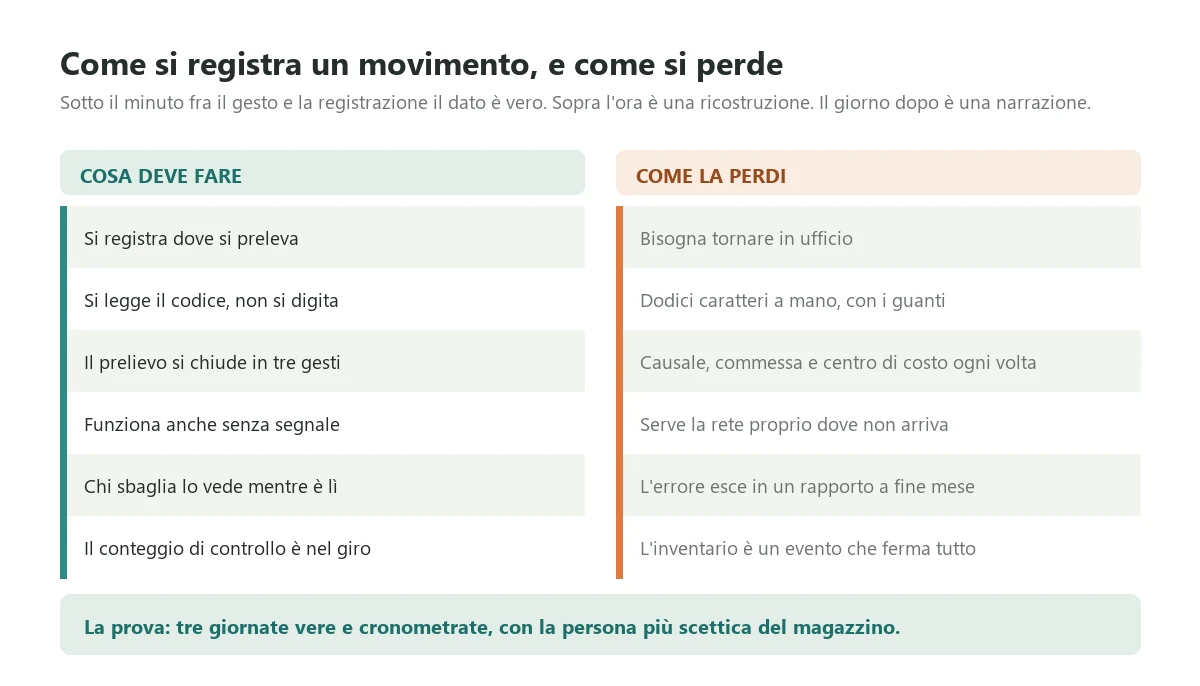
The result is not missing data, which would be honest and visible. It is false data that looks true, and that you then rest automatic reordering on. When I measure data entry in a warehouse I look at one indicator: how many minutes pass between the physical act and its recording. Under a minute the data is true. Over an hour it is already a reconstruction. The next day it is a narrative.
There is an even more expensive variant, the warehouse open to everyone. In many small companies anyone walks in and takes, because that is how it has always been and because locking it feels like an accusation. It is not a question of honesty, it is a question of measurement: a warehouse where thirty people can take without leaving a trace cannot be measured by any technology in existence. The first intervention, which costs a lock and a decision, is worth more than any licence.
Locations: few, readable, and not the ones in the warehouse manager's head
A location is the physical address of an item: aisle, rack, level, sometimes the bin. Without locations the software tells you how much you have but not where, and search time stays exactly what it was: you have bought a system and you have bought nothing.
Three rules work. The code must be readable by a new person with no explanation: A-03-2 makes sense, K7X9 does not. It must be printed large on the rack and not only held in the system, because a map that lives only in the computer drifts out of date within a month. And it must be fine enough to narrow the search but not so fine that every put away becomes a job: individual bins make sense for high value small parts, the shelf level is enough for nearly everything else.
Then there is the choice between fixed and random locations. Fixed, where every item always has its place, is easier to grasp and wastes space. Random, where the system tells you where to put and where to take, uses space better but is unforgiving: if one person moves something without telling the system, that material is lost until you stumble on it. In smaller companies starting now, fixed locations for the fast movers and random for the rest is nearly always the right answer, and anyone proposing random everywhere in the first release has not understood who they are working with.
The six conditions for recording to actually happen
You record where you pick, not where the computer is. A handheld terminal or a wall mounted tablet at the end of the aisle. If recording means walking back to the office, it gets recorded from memory, and from memory means wrong.
You scan, you do not type. A label on the location, a label on the item, two scans and a quantity. Typing a twelve character code wearing gloves is the most reliable way to make a project fail.
The most frequent movement takes three gestures. Picking for an order or a job: scan the location, scan the item, confirm. Everything else, reasons, notes, cost centres, is either inferred from context or asked only when it genuinely matters.
It works with no signal. In many warehouses coverage fails exactly where you need it, between metal racking. The application has to work the same and sync afterwards, without the user thinking about it. If the vendor says two more access points will fix it, ask them to prove it in your worst aisle before you sign.
Whoever makes a mistake finds out immediately. If you pick from a location where that item is not recorded, the terminal says so while you are standing there, not in a month end report. A correction made on the spot in ten seconds is worth ten made at a desk the following week.
The control count is part of the round, not an event. The system asks whoever is already in that aisle to count two positions. It is cycle counting done without stopping anyone, and it is how accuracy climbs and stays up.
The test worth more than ten demos
Take the person in the warehouse who complains most, hand them the terminal with no explanation and time three real days. Not a rehearsed demo: three real days, with the interruptions, the surprises and the truck waiting. Then compare what they recorded with what they actually did.
If after three days they have recorded without asking for help and the movements reconcile, the system will work. If they had to call someone, or if they stopped recording after the first difficult afternoon, you have just saved forty thousand euros. This test costs half a day and no vendor offers it unprompted: propose it yourself, and how they react to the proposal is already half the answer.
The hardware: terminals, labels and coverage, half the cost nobody quotes
This is the main difference between a warehouse project and any other business system project, and the reason the quotes you receive are not comparable. The software on its own does nothing: without a way to read labels it is an archive with better graphics.
What it really costs to equip a warehouse
The terminals. An industrial handheld with an integrated scanner, the kind that survives drops and lasts a full shift on a charge, costs between six hundred and twelve hundred euros. A smartphone with a case and a bluetooth scanner costs two to four hundred and works well in a dry, sheltered warehouse, much less well where there is dust, cold, or where phones actually get dropped. The practical rule: one terminal per person picking at the same time, plus one spare, because the day one breaks with no spare you go back to paper and you do not come back.
Labels and printers. An industrial label printer costs between four hundred and fifteen hundred euros. Location labels are printed once and must be large, durable and readable from three metres away for the upper levels: three hundred to a thousand euros for a mid sized warehouse. Item labels are the delicate chapter: if your supplier already applies a readable barcode you have saved half the work; if not, somebody has to label at goods in, and that time belongs in the budget because it never goes away.
The network. Covering a building so the signal does not drop between racks costs between two and eight thousand euros depending on floor area and materials. Do not economise here: poor coverage produces terminals that freeze, and frozen terminals produce people who stop using them within two weeks.
The total. For a smaller company's warehouse with three or four people picking, hardware runs between five and fifteen thousand euros one off. Anyone presenting you with a warehouse management quote without that line either has not understood your case or has decided you will discover it after signing.
The choices you live with for five years
The linear barcode, the classic one, is cheap and enough for the vast majority of cases. The two dimensional code, the little square, holds more information, still reads when partly damaged and costs the same: if you are starting now, start there.
RFID tags are the technology that will be presented to you as the future. They have one real and narrow use case: when you need to read many pieces at once without aiming at each, for instance counting a whole pallet by walking past it. They cost ten to fifty cents per tag plus readers, and in a smaller company's warehouse with low unit value items they almost never pay back. If someone proposes them for the first release, ask which specific count becomes impossible without them, and listen to the answer.
Vertical lift modules, the cabinets that bring material to the operator, deserve a separate note: they cost thirty to a hundred thousand euros, they genuinely save space and time, and they come with a constraint worth knowing in advance. They arrive with their own software, which wants to be in charge, and connecting it to your system is a project in itself that belongs in the budget from day one. I have seen them installed and used for two years as manual cabinets, because the integration was never planned.
Subscription product or custom system: where the threshold sits
This is the question I get most often, and I will give the honest answer straight away, even though building custom software is my trade: for most companies the subscription product wins. If your warehouse works like everyone else's in your sector, paying someone to rebuild that from scratch is waste. The full reasoning on choosing between the two routes is in the piece on custom software development; here I give only the warehouse specific numbers.
The real price bands
The module of the system you already own. Nearly every mid market ERP has a location and terminal module, and it costs between two and eight thousand euros one off plus an increase in the annual fee. This is the first route to evaluate, always, because it saves you the integration, which is the expensive part. There is one question to ask your current vendor, and it must be asked with the demo running: show me a pick from a handheld, with your module, on one of my real items. If the answer is that it can be done with a customisation, that customisation is a custom project in disguise and should be quoted as one.
The specialised subscription product. Warehouse management software on subscription typically runs between thirty and a hundred euros per month per user or per terminal, with a sharp difference between vendors who count users and vendors who count devices: the decisive question at the first meeting is how the bill changes if you hire three more warehouse staff. Add setup of three to twenty thousand euros one off for configuration, location mapping, master data loading and training, plus the hardware above. For a warehouse with four terminals the first year total typically lands between twelve and thirty five thousand euros.
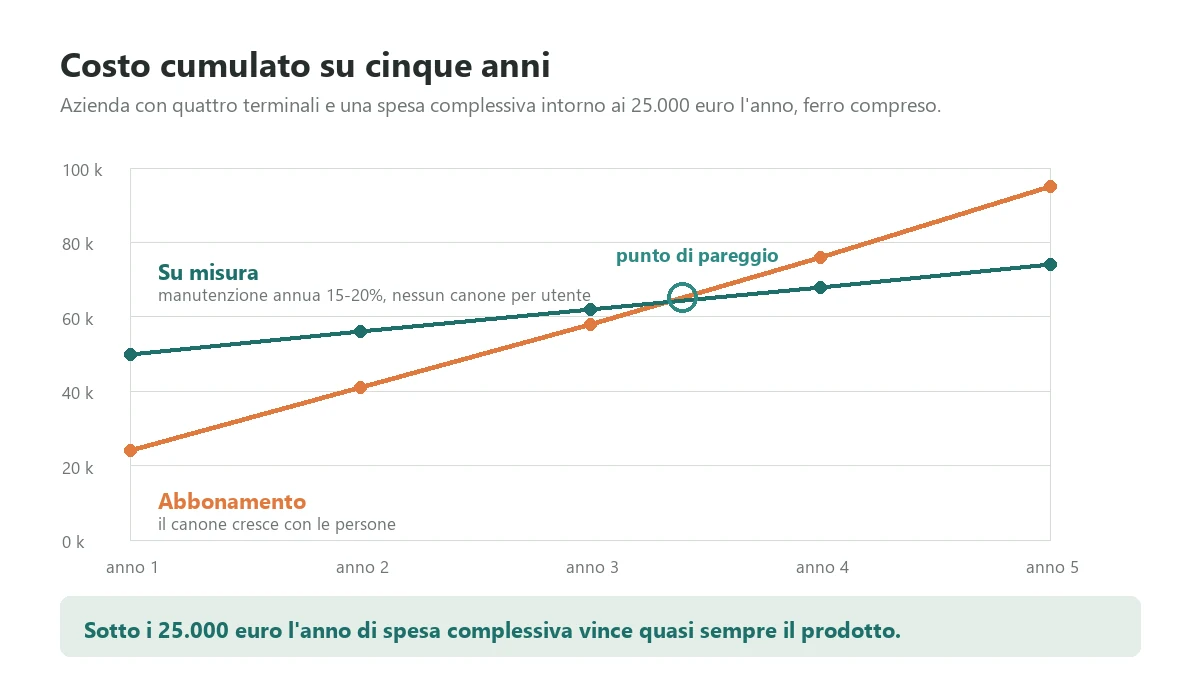
The custom system. Three bands. Fifteen to forty thousand euros for the core that genuinely matters: item master with locations, goods in and out from a handheld with scanning, cycle counting, material commitment against orders or jobs, and a one way link to the accounting system, in three or four months. Forty to eighty thousand with batches, expiry dates and serial numbers, multiple stores or vans, optimised pick lists, two way integration with the ERP and the online shop. Above eighty thousand when automated storage, PLC and machine interfaces or multiple plants with transfers come into it. Annual maintenance runs fifteen to twenty per cent of the initial cost and carries no per user fee, which is the point that changes the arithmetic as headcount grows.
Where the threshold sits, in euros
The practical threshold is around twenty five thousand euros a year of total spend, counting fees, setup amortised over three years, change requests and the hours still spent by hand putting the numbers back together. Below that figure the product nearly always wins. Above it, custom typically pays back between year three and year four, and from there the gap widens because the per user fee keeps climbing with headcount and maintenance does not.
There are three cases where custom wins even below the threshold. First: the way you run your warehouse is why customers choose you, for instance because you deliver same day what others deliver in three, and that advantage depends on how you move goods. Second: you have to connect to something of your own, a machine, an automated store already installed, a customer portal you built. Third: you have many people using the system lightly, and the per user fee becomes disproportionate to the value. The full argument on when building is worth it sits in the piece on software as an asset.
What they will sell you and you almost certainly will not use
Automatic pick path optimisation with routing algorithms: it makes sense in a ten thousand location warehouse with twenty pickers, not in a shed you cross in forty paces. Dynamic slotting based on turnover: interesting in year three, when you will have real data, useless now that you do not. Demand forecasting: without three years of clean history it produces good looking random numbers. Voice picking, that is, picking guided by a headset: it genuinely works, but in warehouses where one person does hundreds of lines a day, not fifteen.
All of these can make sense, but later. Putting them in the first release stretches the rollout by months and moves attention away from the only thing that has to work immediately: that movements arrive clean at the moment they happen.
Integration with the ERP and the website: who owns the stock figure
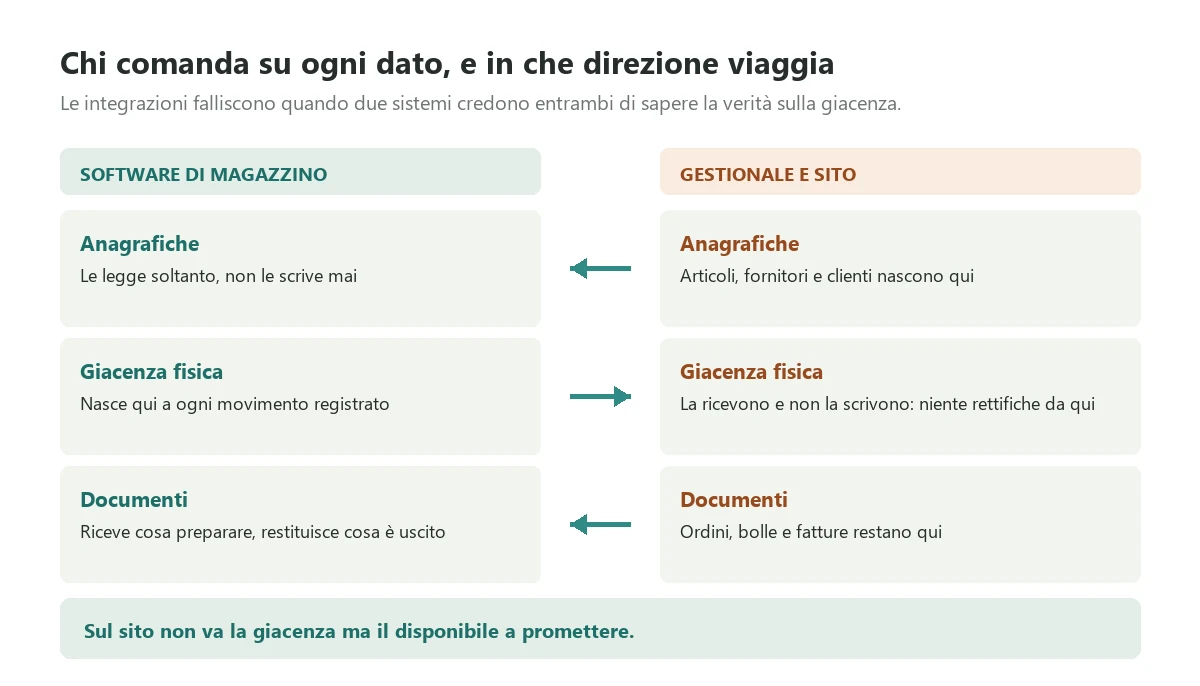
The question is not whether to integrate: it is who owns each piece of data and which way it travels. Warehouse integrations nearly always fail because two systems both believe they know the truth about stock, and nobody has decided who is right when they disagree.
The rule: one source of truth, and it is not the website
Master data, that is items, suppliers and customers, is born in the accounting system. The warehouse system reads it and never writes it. If you can create an item from a warehouse handheld, within six months you will have three records for the same part under different codes, and nobody will know which one carries the right stock.
Physical stock, on the other hand, is born in the warehouse and travels outwards. The ERP receives it, the website receives it, neither writes it. This is the rule most often broken, because it feels convenient to post an adjustment from the ERP when a discrepancy turns up, and every adjustment made there is an error the warehouse will never see and never be able to fix at source.
Documents, that is orders, delivery notes and invoices, stay in the ERP. The warehouse receives the list of what to prepare and returns what was actually picked, with the differences. The value sits in that return: you raise the note on what actually left, not on what you promised.
Available to promise, the number that goes on the website
The quantity you show a customer is not the stock figure. It is stock minus what is already committed to confirmed orders, minus what is physically there but not sellable because it is in inspection or awaiting a return decision, plus what is arriving by a date you actually trust. Calling it available to promise is not jargon: it is a reminder that it is a promise, and that if you get it wrong the customer notices.
In companies that also sell online this is where the warehouse and the shop fall out. The rule that works is to hold a prudential reserve on slow movers, that is, do not publish the last piece until accuracy is above ninety seven per cent, and to sync often rather than in real time: a sync every ten minutes on trustworthy data is worth infinitely more than real time on false data.
If you work to order
Companies manufacturing to order have one extra problem: material is not simply in stock or out, it is committed to a specific job. Without that distinction the stock figure says a hundred pieces available while eighty are already promised to the September assembly, and sales sells what is not there.
Linking warehouse to job is also the only way for material costs to land on the right job at the moment they leave, rather than at month end when the supplier invoice arrives. It is half the work needed to get a trustworthy margin, and I covered it in detail in the piece on job costing software.
How to choose in two weeks without calling five vendors
Calling five vendors is the surest way to lose two months and end up with five quotes you cannot compare, because each will include different things and none will include the hardware. The useful work happens first, and it happens in house.
Week one: measure what you have
Count twenty random part numbers and work out your accuracy. It is the first number, the one that determines everything else, and you have it in two hours.
Run the five item calculation on your real figures. You need a number, not a feeling, because it is what you will hold the quotes against.
Spend half a day in the warehouse watching how picking happens today, without an obvious notebook. Count how many times somebody takes something and writes nothing. Anyone who has never done this discovers more in half a day than meetings produce in a year.
Draw the warehouse on a sheet of paper and assign location codes. Aisles a letter, racks a number, levels a number. This is the most important decision in the whole project, you can take it now, for free, and it holds whatever software you buy afterwards.
Write one page, not thirty, on what has to happen from the moment goods arrive to the moment they leave. If you cannot write it in one page, the problem is not the software: it is that the process is not clear to you either, and no system will clarify it on your behalf.
Week two: test, do not watch demos
Two candidates, not five. The module of the system you already own and one specialised product, or, if the numbers put you above the threshold, one product and one custom proposal, so you compare two routes rather than two near identical products.
Run the three real days test with the most sceptical person in the warehouse, stopwatch in hand. It is the test described above and it is the one that decides.
Ask them to load twenty of your real items, with your units of measure and your pack sizes, and run a full circuit: goods in, put away, pick for an order, return. Not a sample warehouse: yours, with its mess.
Ask for the hardware quote inside the same document, on separate lines: terminals, printer, labels, network coverage, installation days. If the vendor says you can buy the hardware wherever you like, that is fine, but then get the exact models they have tested in writing.
Ask for the name of a customer in your sector and of your size, and phone them. Five questions: how long the rollout really took, how many extra terminals they had to buy, what accuracy they had before and what they have now, what they had to change in the way they work, what they would do differently.
Ask what happens if you rearrange the warehouse next year, because you will. If the answer is that it needs chargeable vendor work, put it in the threshold calculation.
The three things to fix before buying anything
There are three jobs that cost zero in licences and that, left undone, make any software useless. In order of importance.
Lock the warehouse and decide who can pick. Not out of distrust: because a warehouse anyone can take from without leaving a trace cannot be measured by any technology. You need a door that closes, a short list of authorised people, and a rule for what someone does when they need a part and the warehouse staff have gone home. That rule, written in three lines, is worth more than a software module.
Clean the item master before loading it. The duplicate, the code used for two different parts, the wrong unit of measure, the phantom item nobody has bought in eight years. Loading dirty master data into a new system is the most efficient way to spend forty thousand euros and have the same problems faster. In the companies I have worked with, cleaning takes two to six weeks of part time work by someone who knows the parts, and you can start today regardless of what you end up buying.
Start cycle counting by hand. Ten positions a day, a sheet of paper, twenty minutes. In a month you will have a series of measurements instead of an opinion, you will know where the errors concentrate, and when the vendor arrives you will hold the one number that makes it impossible to sell you the wrong feature. It is also the best way to find out whether you need software at all: some companies, having locked the warehouse, cleaned the master data and counted for three months, discover the spreadsheet kept properly will do for another year. That is an excellent outcome, and no vendor will tell you so.
Where to start
A warehouse management system is not an IT project, it is a discipline project, and discipline projects succeed when they start small and honest. The first release that nearly always works is this: locations coded and labelled, goods in and out recorded from a handheld with a scan, cycle counting running, and one report, accuracy by zone, looked at once a week. Nothing else.
With that scope you are operational in a few weeks with a product, in three or four months building custom, and from that moment you are collecting real data. Everything else, pick optimisation, batches and expiry dates, published online availability, automatic reordering, gets built on top of data you can trust, and costs less because by then you know what you actually need.
If you are running this calculation now and want to know which side of the threshold you are on before spending anything, send me two pages: how goods come in and go out in your company today, and the two numbers that came out of counting twenty items and from the five cost calculation. In half an hour I will tell you whether yours is a product problem, a custom problem or a method problem, and where it is a method problem I will say so, because a customer who buys the wrong thing comes back angry.
Frequently asked questions
There are three routes with three different economics. The location and handheld module of the ERP you already own costs two to eight thousand euros one off plus an increase in the annual fee, and it is the first route to evaluate because it saves you the integration, which is the expensive part. A specialised subscription product runs thirty to a hundred euros per month per user or per terminal, with setup of three to twenty thousand euros for configuration, location mapping, master data loading and training: for a warehouse with four terminals the first year typically lands between twelve and thirty five thousand euros. A custom system starts at fifteen to forty thousand for the core, rises to forty to eighty thousand with batches, expiry dates, multiple stores and two way integration, and passes eighty thousand with automated storage or multiple plants. To any of these figures add the hardware, which almost no quote includes: five to fifteen thousand euros between terminals, a label printer, labels and network coverage.
It is the percentage of locations, or of items if you have no locations, where the quantity the system reports matches what is actually there. It is not the value discrepancy from the year end count: that always flatters, because errors in both directions cancel out, and twelve pieces missing on one item with eleven surplus on another give a near zero value difference and a completely wrong warehouse. You measure it in samples through the year, counting a handful of positions and recording how many match to the piece: twenty out of twenty five is eighty per cent, regardless of value. To get a picture in two hours: pull twenty random items from the system, not chosen by the warehouse manager, go and count them, and see how many match exactly. In companies that have never measured, the answer sits almost always between sixty five and eighty five per cent.
Because accuracy multiplies line by line. If each line of an order has a ninety five per cent chance of being right, an eight line order is right only sixty six per cent of the time: one order in three has at least one wrong line. The practical thresholds are these. Below eighty five per cent there is no point switching on any automation, not automatic reordering, not published website availability, not calculated delivery promises, because every automation passes the error to the customer faster than you can correct it by hand. Between eighty five and ninety five you can automate reordering on fast movers and keep the rest manual. Above ninety seven, delivery promises and published online stock start to make sense. Above ninety nine, reachable with barcodes and cycle counting, you can design processes taking the data as given.
For most companies one of the first two, and that comes from someone who builds custom software: if your warehouse works like everyone else's in your sector, paying someone to rebuild it from scratch is waste. Always start with the module of the ERP you already own, because it saves you the integration, and ask your current vendor for concrete proof with the demo running: show me a pick from a handheld, with your module, on one of my real items. If the answer is that it can be done with a customisation, that customisation is a custom project in disguise and should be quoted as one. The practical threshold between product and custom sits around twenty five thousand euros a year of total spend, counting fees, setup amortised over three years, change requests and hours still spent by hand: below it the product nearly always wins, above it custom pays back between year three and year four.
Nearly always at the same point, and it is never the analytics: they fail because movements are not recorded at the moment they happen. A technician takes three pieces off a shelf at half past seven and says he will record it later: the result is not missing data, which would be honest and visible, it is false data that looks true and that you then rest automatic reordering on. There is one indicator to watch: how many minutes pass between the physical act and its recording. Under a minute the data is true, over an hour it is a reconstruction, the next day it is a narrative. There is an even more expensive variant, the warehouse open to everyone: a warehouse where thirty people can take without leaving a trace cannot be measured by any technology in existence, and the first intervention, which costs a lock and a decision, is worth more than any licence.
For a smaller company's warehouse with three or four people picking at the same time, hardware runs between five and fifteen thousand euros one off, and it is the line almost no quote includes. An industrial handheld with an integrated scanner, one that survives drops and lasts a full shift on a charge, costs six hundred to twelve hundred euros; a smartphone with a case and a bluetooth scanner costs two to four hundred and works well only in a dry, sheltered warehouse. The rule is one terminal per person picking at the same time, plus one spare, because the day one breaks with no spare you go back to paper and you do not come back. An industrial label printer costs four hundred to fifteen hundred euros, location labels three hundred to a thousand, and covering the building with a network that does not drop between racks costs two to eight thousand. Do not economise on that last item: poor coverage produces terminals that freeze, and frozen terminals produce people who stop using them within two weeks.
By deciding who owns each piece of data, because warehouse integrations fail when two systems both believe they know the truth about stock. Master data is born in the ERP and the warehouse only reads it: if you can create an item from a handheld, within six months you will have three codes for the same part. Physical stock is born in the warehouse and travels outwards: the ERP and the website receive it and never write it, and this is the rule most often broken, because it feels convenient to post an adjustment from the ERP when a discrepancy turns up, and every adjustment made there is an error the warehouse will never see. On the website, publish not the stock figure but available to promise: stock minus what is committed to confirmed orders, minus what is there but not sellable, plus what is arriving by a date you actually trust. A sync every ten minutes on trustworthy data beats real time on false data.
Leave your details in the form below