
Everything always starts with an image that buzzes in your head: that of yourself in front of a screen, capable of transform ideas into programs that really work, to give life to solutions that don't remain on paper but that someone out there uses.
It's a thought that it ignites enthusiasm and fear at the same time.
Enthusiasm, because programming seems like a door wide open to infinite possibilities.
Fear, because every door also hides the possibility of making the wrong entrance and finding yourself in a corridor that leads nowhere.
Many aspiring developers arrive at this moment with the same drive: the desire to learn, to prove to themselves that they can do it, to build something worthwhile.
But all it takes is bad advice or a path taken out of habit turn that enthusiasm into frustration.
And then the question changes shape: it is no longer "will I make it?", but "am I investing time in the right way or am I already slowing down before I even start?".
This is where everything is decided.
It's not a question of innate talent or willpower.
It's a question of choosing the terrain on which to learn to run because, if you start uphill, even the most decisive pace risks seeming too slow.
The C++ trap and the choice that changes everything

Have you ever wondered what becoming a developer really means: it doesn't just mean programming, but also building solutions that matter? If you want programming in C# with a professional method, choosing the right language is the first step.
Probably on the numerous forums and communities you've read advice that always sounds the same: "If you want to be taken seriously, start with C++. It's the basis of everything."
On the surface it seems like a logical, even noble, suggestion.
C++ has the reputation of being the "real" language, the hard one, the one that separates the "Sunday" programmers from those who "deserve the title".
Yet, behind this aura of prestige a series of challenges hide which have challenged, and often discouraged, thousands of aspiring developers.
At first you open a manual, copy a couple of examples, and everything seems under control to you.
The first steps are even exciting.
But after a few weeks the syntax becomes a labyrinth of incomprehensible symbols, memory management seems like a trap ready to punish you for the slightest mistake, and bugs multiply without a reason.
What was supposed to be the "most serious" way to enter the world of programming turns into an obstacle course which undermines self-confidence.
At that point it becomes an existential doubt, not just a technical challenge: "Am I really good at programming, or am I making a career mistake before I even start?".
The problem is not the intelligence of those who try, nor the lack of commitment: the problem is the tool that forces you to start uphill when the market asks you to run on the flat.
Many students and aspiring developers have experienced the same pattern: months spent on C++, constant freezes, the paralyzing feeling of having reached a dead end.
The point is that it's not the difficulty itself that makes you better, but what you can build.
Getting trapped in complexity doesn't bring you closer to the future, it takes you away from what the market is today is expected of you.
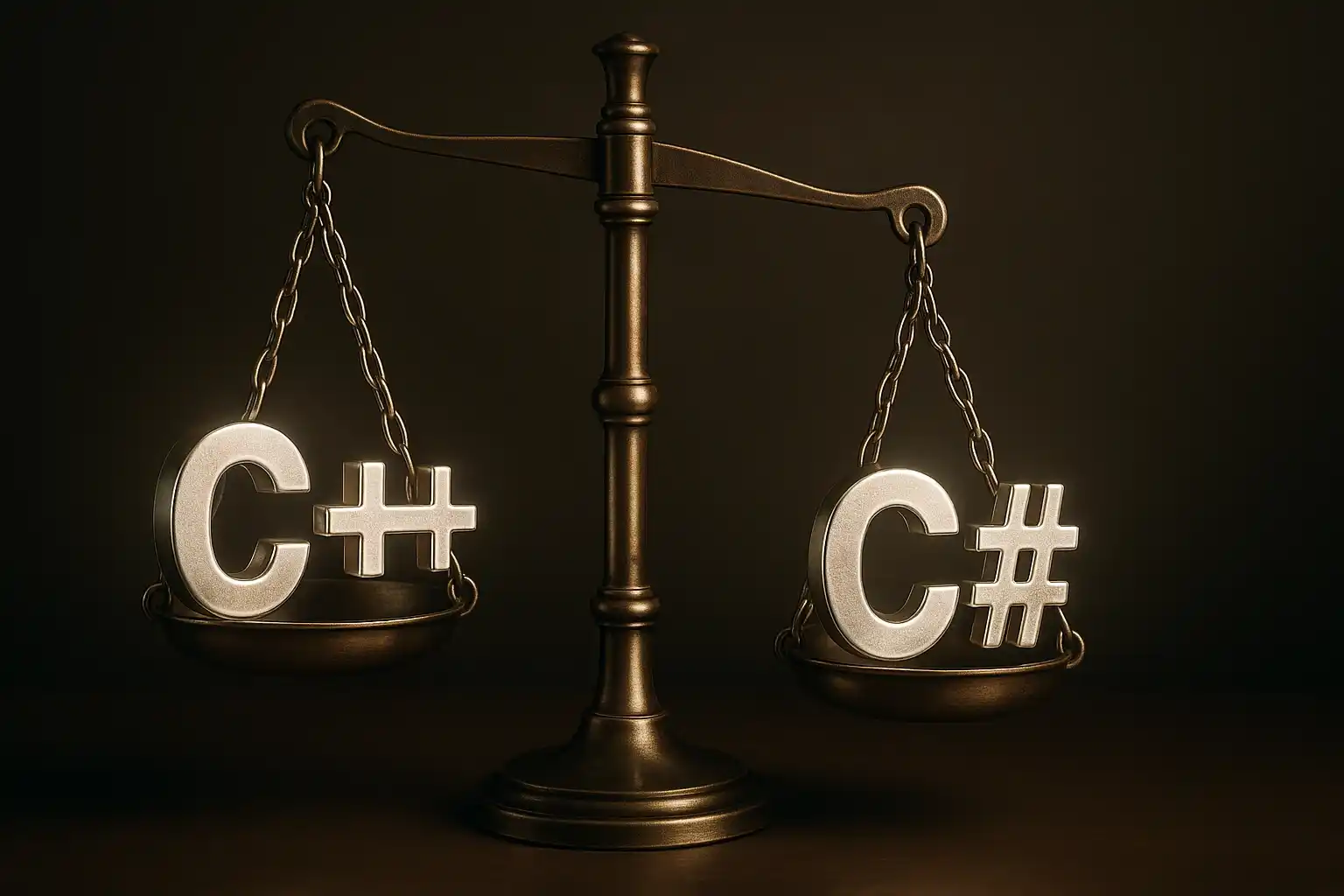
Two worlds compared but one looks to the future

The real problem isn't your perceived lack of talent; it's not even the idea that learning C++ automatically makes you a better programmer.
The problem lies in one toxic belief that endures: if something is difficult, then it must be worth more.
It's the same mentality that drives medical students to endure sleepless nights believing that suffering will make them better professionals.
But the reality is that difficulty in itself has no value.
C++ was born in a different era.
It was 1985: computers had less memory than a smart watch has today, and every byte had to be optimized manually.
In that world it made sense to force programmers to deal with every pointer and every piece of memory.
But today we live in a completely different context.
Smartphones and the cloud have more power than the supercomputers of thirty years ago.
Companies don't hire you because you know how to manually clear a buffer, they hire you because you know how to build solutions that solve real problems.
Here, then, is the difference between two philosophies.
With C++ you learn to survive, to get by with unnecessary complexities, to become an expert in problems that in 2026 you shouldn't even encounter anymore.
With C#, however, you grow and look to the future: you build applications that work, you learn to think in terms of modern architectures, you create value that the market recognizes immediately.
This is the choice that every aspiring developer faces: remain trapped in the logic of survival or embark on the path of growth.
And growth, today, is worth infinitely more.
The technical challenges that slow you down

You soon understand: it's not your intelligence that isn't enough, but... the walls that C++ puts up from the first steps.
There are three main obstacles that turn your learning into an obstacle course:
- Labyrinthine syntax that transforms each line of code into a puzzle, between brackets, operators and symbols that seem more like equations than instructions.A few days are enough for curiosity to turn into frustration.
- Manual memory management which becomes an unsustainable brake.Each created object must be freed by hand, and a single mistake results in inexplicable crashes.It's like driving with the handbrake on: instead of thinking about the road, you are forced to constantly check the pedals.
- Invisible bugs and infinite debugging that consume energy without providing answers.You fill it in, everything seems fine, but after ten minutes the app explodes for no reason.You spend hours looking for the cause and the more you search, the less you understand.
These three obstacles don't teach you how to code better, they only teach you how to survive mistakes; it's a minefield where you make one wrong move and everything shuts down.
C# takes a radically different approach:
- The syntax is readable, closer to the natural language with which you think about problems.
- Memory management is automatic, thanks to the garbage collector that frees up resources for you.
- Debugging tools are built-in and mature, capable of drastically reducing errors even before they turn into nightmares.
The result?
With C# you focus on the problem you want to solve, not about remembering if you closed the right parenthesis.
Growing quickly, building confidence and seeing concrete results is not a dream: it's what you can achieve from the first few weeks with our C# course, the path that transforms aspirants into market-ready developers, step by step.
Naturally, progress varies from person to person: the speed depends on commitment, time dedicated and starting points.
Why C# wins in the real world

Whenever we talk about C++ the same topic always comes up: performance.
They tell you that it's faster, which runs “closer to the iron” (language or a program works at a level closer to the hardware, therefore with fewer abstractions), which is the only choice if you want to squeeze out the last cycle of the machine.
And it's partly true: in extreme situations, C++ can be faster.
But most projects don't live by microseconds, lives on solutions that work.
When you work in a company they don't pay you to shave a decimal point on execution speed, they pay you to deliver reliable functions that users need.
The real bottlenecks are almost never in the language, but elsewhere:
- in connections to congested databases
- in calls to external services which introduce inevitable waits
- in the network, which is slow by nature and not due to the code
In these scenarios, the difference between C++ and C# becomes irrelevant.
What makes the difference is how long does it take you to write, testing and maintaining the code: if you spend weeks chasing milliseconds, but the project remains stagnant, you have not created value.
And this is where C# wins.
It puts you in a position to develop productively, to deliver features that work, to collaborate in teams without style wars.
Its readable syntax and built-in tools reduce friction and they allow you to grow as a developer, not an acrobat juggling complexities.
With C# you get to the point much sooner in which you are no longer a student who "fiddles around", but a programmer who builds solutions.
And this difference, in the world of work, weighs much more than any technical benchmark (reference point).
When C++ still makes sense

Let's be clear: C++ is not a language to throw away.
It is powerful, has a glorious history and in some sectors it remains the best choice, sometimes even forced.
There are contexts in which every millisecond counts, and there complexity is not a defect but a necessary characteristic.
- High-level video games, where you have to manage graphics and physics in real time with extreme performance.
- Critical medical software, such as pacemakers, where a single cycle more or less can make the difference.
- High frequency trading, where decisions made in microseconds mean millions of euros gained or lost.
In these scenarios, C++ is still the right tool today.
Its complexity becomes a weapon: it allows you to control every little detail, and that's exactly what you need.
The problem arises when you choose it for no reason.
When it is presented as a "serious language" for anyone who wants to start, or as a "mandatory step" to learn to program.
In fact, in most cases, it's a ballast that risks slowing you down and make you lose precious months.
Many companies still use C++ not by choice, but because they have to take care of inherited systems, preferring to maintain them rather than face a complex and risky migration.
Systems written twenty years ago (or more) continue to work, and rewriting them would be too expensive.
But get into it it means spending days extricating yourself in millions of lines of old, often poorly documented code, where bugs have been hiding for years.
C#, on the other hand, is present precisely in expanding sectors: cloud computing, enterprise solutions, modern web and desktop applications, mobile development.
In other words, what you learn today it can be spent immediately and remains valid tomorrow too.
The strategic choice for your future

After five months, spent between pointers, memory leaks and inexplicable crashes, comes the decision that changes everything: abandon C++
“So have I thrown away all these months?” you think.
It's a common mistake: continuing down the wrong path just because you've already invested time and energy into it, but when you switch to C#, the difference is immediate.
Build more working applications in a few weeks than you ever did in four months with C++.
It's simply the right tool for the right job, it's not magic.
Step by step projects become more complete, the features become more robust and trust grows along with the ability to face new challenges.
Each project works, solves a problem and can be shown to a potential employer.
The time you invest today determines the path of your career.
Continuing to insist on tools that slow you down means falling behind.
Get started today with C# course it means not wasting precious time and building solid foundations that can be immediately spent, transforming your desire to program into concrete results.
The decision that transforms your path

The complexity of C++ is not a springboard, it's a wall.
It forces you to waste energy on problems that are not required of you: manual memory management, tortuous syntax, invisible bugs that suddenly explode.
These are challenges that consume time and trust without giving you useful skills in return.
The market does not reward you because you know how to survive, but because you know how to deliver solid solutions that work.
This is the truth that many discover too late, after months or years wasted chasing academic complexities.
We need the courage to face reality: how many modern projects are really looking for junior developers who are experts in C++?
Very few.
How many companies today are looking for developers capable of working in .NET, with C# and related frameworks?
Lots of them, and in the fastest growing sectors.
It's not a matter of opinion, it's a question of question real.
The question does not look at those who know the most complex theory, but at those who know how to build useful, scalable and ready-to-use applications.
The decision before you is simple: continue chasing a myth that slows you down or choose the tool that allows you to advance immediately.
The next step: companies don't wait

If your goal is to really start working as a developer without wasting time on unnecessary complexity, the next step is clear.
Every day you put it off is a day someone else builds portfolios, signs contracts and takes the space that could have been yours.
You need a tool that allows you to create real, tangible applications to show people who can hire you, why the market does not reward those who remain stuck in the complexities but who brings concrete value right away.
The C# course it was designed to turn a beginner into an operational developer in the shortest time possible, becoming the direct bridge between sterile theory and real work.
It leads you to create working projects, concrete applications and skills that companies immediately recognize.
Not infinite theory but continuous, guided and progressive practice.
Growth times depend on personal dedication, but by tackling the path with consistency and continuous practice you obtain concrete results, thanks to a method that drastically reduces complexity useless and moves you forward in a constant and measurable way.
From the first few weeks, write working applications.
Start from small projects and grow them step by step; each project adds a piece and takes you a step closer to what the market demands.
The course doesn't just teach you the language: it shows you how to use it in contexts that companies are interested in.
It means working on:
- Web development with ASP.NET, to create scalable and professional applications
- Modern desktop applications, ready for real use
- Integration with databases and APIs, to connect data to functionality
- Cloud deployment, to bring your apps directly into production
Progression is meant to keep you moving forward steadily, without blocks or frustrations: see concrete results, gain confidence, build your portfolio.
And above all, you avoid the trap that has stopped so many before you: months spent on problems that no longer serve anyone.
The difference between remaining a spectator and becoming a protagonist lies not in talent or luck, but in the decision you make today.
By deciding now you enter the fast track, putting it off you're stuck watching others overtake you.
The future doesn't wait.
It's up to you to choose whether to stay put or take the step that will change your career.
Leave your details in the form below