

Test Driven Development represents a revolutionary paradigm in software development, which turns the traditional approach to programming on its head.
This methodology, particularly effective in the C# and .NET ecosystem, places emphasis on creating automated tests before writing functional code.
Such a reversal of the conventional workflow catalyzes a series of benefits that permeate the entire software life cycle.
At the heart of TDD is the Red-Green-Refactor cycle, an iterative process that guides the developer through well-defined phases of design, implementation and optimization.
Creating unit tests provides an invaluable safety net, allowing developers to make changes and additions with greater confidence, while significantly reducing the time spent debugging and troubleshooting late in the project.
The definition of TDD you really need to start using it

Test Driven Development is based on a fundamental principle: writing tests precedes writing functional code.
This method, initially counter-intuitive, leads to a series of significant benefits in the development process.
The developer begins defining a test that describes a specific functionality not yet implemented.
This test will initially fail, since the corresponding code has not yet been written.
Next, you write the minimum code needed to pass the test.
Test passed?
It's time for refactoring: you make the code clearer and cleaner, but without ever compromising the positive test result.
This system promotes modular and well-structured software design, as it forces developers to think in terms of interfaces and behaviors before writing code.
This often results in more effective use of interfaces, abstract classes and SOLID principles, leading to more flexible and easier to maintain code.
Adopting TDD in practice can be disorienting at first: Instead of starting from the solution, you start from the expected behavior.
Plus, it can feel like a waste of time, especially if you're used to "write and spin."
But after a few iterations, the advantage becomes evident: forces you to clarify the objective before writing a line, to avoid superfluous features and to reduce the risk in case of changes.
Because test driven development is not just a technique, but a way of thinking

Integrating TDD into C# goes far beyond simply applying a programming technique.
He is authentic paradigm shift that fundamentally transforms the way you think about software development.
It pushes you to deeply consider requirements and specifications, focusing on the observable behavior of the system, thus leading you to a deeper understanding of the problem to be solved.
TDD is a quality-oriented mindset that emphasizes the prevention of defects rather than their correction.
You are no longer simply writing code to solve a problem, but you are clearly and testably defining what your code should do.
This results in a cleaner design and more robust application architecture.
Testing acts as a safety net, allowing you to make changes or additions with greater confidence, knowing that any regressions will be immediately flagged by existing tests.
This significantly increases trust and allows freer experimentation and faster evolution of the software.
Applying TDD does not just mean changing technique: it means changing your approachIn fact, you no longer intervene when problems emerge, but you anticipate them even before they appear.
Input, output and interfaces: everything else comes later.
How TDD works in practice and why it seems counterintuitive at first

Test-Driven Development works according to a principle that may seem illogical: write tests for code that doesn't yet exist.
This reversal of process can be disconcerting for those used to the "first I write, then I check" approach and leads to the initial sensation of slowing down, of adding an unnecessary step.
Developers often ask themselves, "Why would I waste time writing a test for something I haven't implemented yet?"
Before writing any code, you need to define precisely what you expect what he does.
This also means getting to think about borderline cases, and even considering possible exceptions.
When you start new development with TDD, you go through an iterative cycle of small steps, progressively building both tests and code.
Each iteration adds functionality incrementally, immediately verifying its correctness.
It is a meticulous process that with practice it becomes natural and reveals its advantages.
In the eyes of those who grew up with a more spontaneous approach to writing code, TDD may seem like a cumbersome, even rigid, method.
Yet, it is precisely in these presumed rigidities that TDD reveals its strength: it channels development towards clear objectives, avoiding waste and making the code more solid over time.
In short: it forces you to do the right thing, at the right time.
Writing the test first forces you to do the right thing at the right time

It all starts with a test.
Writing the first unit test is the fundamental starting point in the TDD process.
In C# (our reference language), this means creating a test class using a unit testing framework like NUnit, xUnit, or MSTest.
Each test must be easy to read and free of unnecessary complexity and must describe a specific behavior that you want to implement, formulated in terms of expected inputs and desired outputs.
It is important that the test is focused on a single aspect of functionality.
When writing your test, you should think about the public interface of the class or method you are testing, not the internal development details.
This tactic helps design cleaner and more intuitive APIs.
Additionally, writing the test before implementation forces the developer to put themselves in the shoes of the user of the code, leading to a better usability and implicit documentation of the expected functionality.
Adopting this approach means planning carefully and acting with discipline, fully exploiting the power of the .NET ecosystem (our reference ecosystem) and modern tools for writing quality software.
TDD doesn't slow down development, it speeds it up in ways you can't imagine today

At the beginning it may seem like an extra step, one of those who steal time from an already busy day.
This is one of the most common resistances to its adoption: the idea that writing tests first is a waste of time.
But it is a short-sighted vision, which ignores the concrete benefits in the medium and long term.
TDD drastically reduces the time spent debugging (consequently also sleepless nights), prevents regressions and helps maintain high code quality as the project grows.
Bugs are found, and fixed, the exact moment they arise, not weeks later when it becomes more expensive and complicated to fix them.
This is it particularly advantageous in large projects, where complexity can quickly get out of hand.
In reality it slows down development only in appearance: it speeds up the overall cycle, leads to a faster time-to-market and a much more reliable final product.
The time invested in testing is largely recovered, and often exceeded, by the time saved in error management.
Your code becomes more stable, predictable and easier to evolve.
And that's not all: TDD naturally leads towards a tidy design, where each component has a clear role and communicates harmoniously with the others.
It is an initial effort that builds a solid foundation for everything that comes after.
What really changes between writing code and writing code with TDD

Effectively implementing Test-Driven Development requires carefully preparing your development environment, so that it can support you in every step.
This process involves selecting and installing the appropriate tools, choosing an appropriate testing framework and the optimal configuration of the project.
A well-structured environment not only makes it easier to practice but also improves the developer's overall productivity.
In our reality, the basis of this setup is a powerful Integrated Development Environment (IDE) such as Visual Studio, accompanied by the latest .NET SDK.
These tools provide the foundation you need to write, compile, and run C# code and tests efficiently.
The integration of a version control system such as Git allows you to manage the rapid iterations typical of TDD, allowing developers to experimentand knowing that you can always return to a previous state of the code.
The choice of testing framework is a critical aspect that can significantly influence the workflow.
Each framework, whether xUnit, NUnit, or MSTest, offers unique features that may better align with your specific project needs or team preferences.
Familiarity with the specific characteristics of each framework allows you to write more targeted tests and effective, making the entire development process much smoother.
Conversely, a slow, confusing or fragmented setup can turn even the best practices into a real obstacle.
However, when everything is in the right place, the write – test – refactor flow flows naturally: it becomes fast, intuitive, almost automatic.
To get off to a good start, create a solution with two distinct projects: one dedicated to application code, the other reserved for testing.
Give your test project a clear, descriptive name, like MyProgetto.Tests: it will help you maintain order and readability over time.
Finally, check that the type of project is fully compatible with the framework of tests you have chosen: you will avoid unnecessary headaches and you will be able to concentrate on the code that really matters.
Have you figured out that TDD is for you?
It's a good time to start writing code that doesn't break.
With my "Software Architect" course you learn TDD step by step, with real examples and continuous support.
Leave your details: we will contact you to give you all the information and understand if it is the right path for you.
The immediate benefits you have when you start test-driven development

The adoption of TDD radically transforms the development process, raising the quality of the code from the early stages.
The mental exercise you do by clearly defining the expected result, It forces you to think precisely.
The code therefore arises from a clear vision, not from improvised attempts.
The test suite becomes your parachute: modifying the code is no longer an act of courage, but a controlled process.
You can restructure, optimize and expand without fear, knowing that any regression will be reported immediately.
The architecture that emerges from this process is naturally more cohesive.
Components have well-defined responsibilities, because TDD pushes towards testable designs, which are inherently better.
Another often overlooked benefit is how TDD improves team collaboration.
When expectations are encoded in automated tests, discussions become more concrete and less subject to interpretation personal.
Ambiguous requirements are identified immediately, since it is impossible to write a clear test for poorly defined functionality.
On a psychological level, TDD offers continuous gratification.
The “red-green-refactor” cycle creates small moments of success that keep motivation high.
This prevents burnout and promotes a state of cognitive flow, where productivity and creativity reach optimal levels.
Finally, it means investing in quality from the beginning, avoiding the technical debt in software which builds up when the pressure to release quickly leads to compromises on the robustness of the code.
It's an approach that pays increasing dividends over time, transforming not only the software produced, but also the mindset of those who develop it.
The red green refactor cycle explained in a simple and concrete way
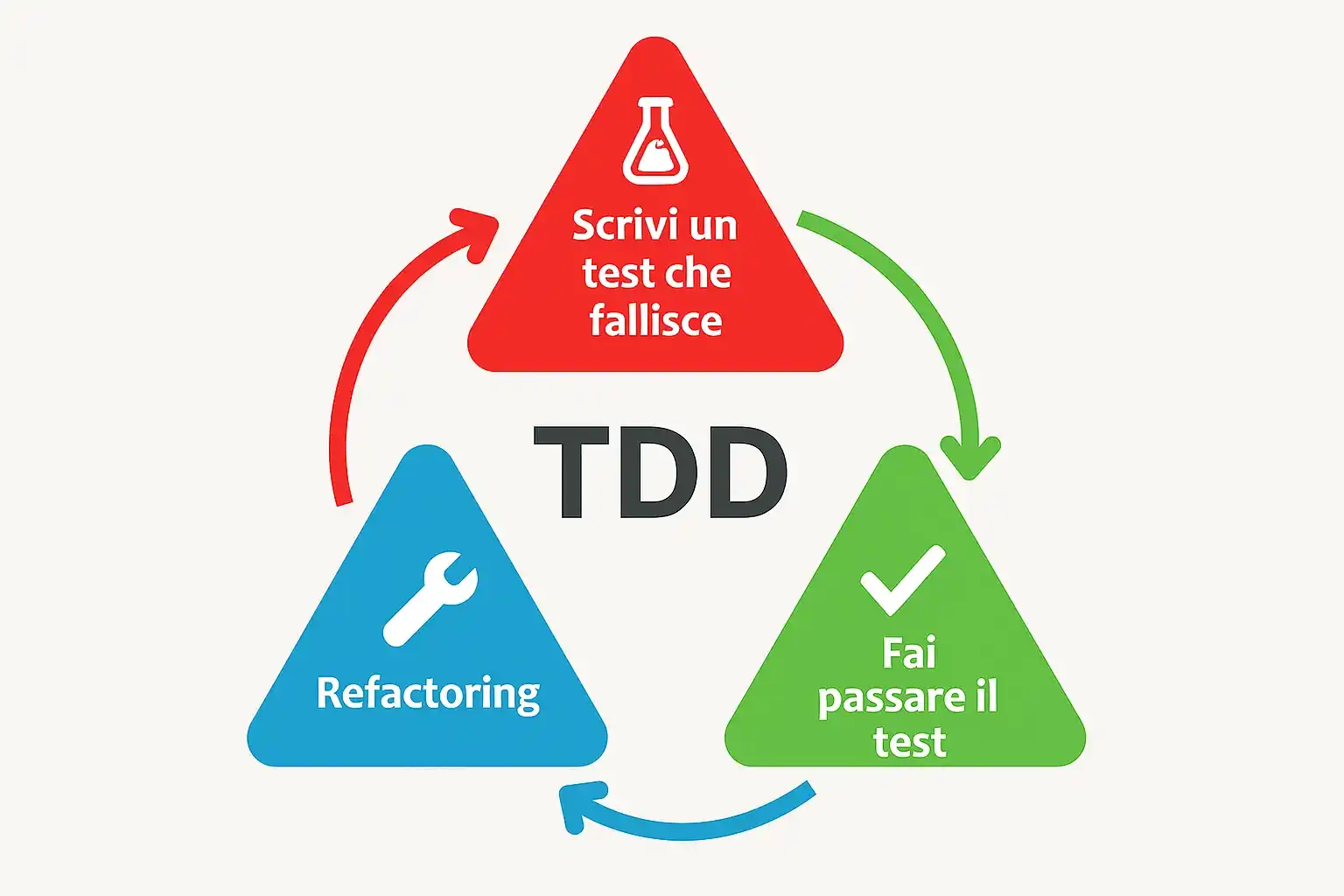
The beating heart of Test-Driven Development is the Red-Green-Refactor cycle, a three-step rhythm that guides the developer from design, through implementation, to code optimization.
This cycle transforms the creative process of development into a disciplined and productive dance.
- Phase 1: Red – The test that failsIt all starts by writing a test which defines a specific behavior that your code should have.In C#, this means creating a test method using attributes like [Fact] or [Theory] in xUnit, or [Test] in NUnit.For example, if you're developing a Calculator class, you might start by writing a test that checks whether the Add method correctly returns the sum of two numbers.Of course, the first time you run this test, it will fail: the Calculator class and Add method don't exist yet.And that's exactly what you want.The initial failure (the “red”) confirms that the test is indeed checking for something real and meaningful, and does not pass by chance.
- Phase 2: Green – The minimum code necessaryNow comes the time to pass the test by writing as little working code as possible.The goal here is not to write perfect code, but get the famous “green” in the test suite.In our example, you would implement a very simple version of the Calculator class with an Add method that returns the sum of the two numbers.That's all.The key concept is: "fake it till you make it".You get the test to pass first, then you worry about how to improve the code.
- Phase 3: Refactor – Improve without breakingWith the test passing (the “green”), it's time to improve the code without altering its functioning.At this stage you can:
- Improve readability by choosing clearer names
- Eliminate duplications with shared methods
- Apply design principles like SOLID
- Optimize where necessary
There is only one essential thing: after each change, all tests must continue to pass.
If something breaks during refactoring, the test fails will tell you right away where you went wrong, and you can fix it before the problem spreads.
This cycle repeats for each new feature or new behavior.
Over time, you build an increasingly comprehensive test suite, which becomes your lifesaver.
Each new loop adds visible value to the user, while protecting all the code you've already written.
What makes this approach so powerful is its simplicity combined with rigor: you can't skip a stage, you can't cheat.
But if you pace yourself, you'll write code that's much less prone to hidden bugs, gaining the trust of the team and the customer
Projects using TDD report up to a 70% decrease in defects compared to similar projects developed without.
Customers perceive it immediately the value of software with fewer problems, which leads to stronger, more profitable and lasting relationships.
Within the team, mutual trust increases and collaboration becomes more effective, as developers know they can rely on their colleagues' work, protected by a robust test suite.
TDD also improves communication within the team by auditably documenting what the code is supposed to do, making expectations clearer and reducing misunderstandings.
Also, the tests they make the code more accessible to new team members, facilitating onboarding and knowledge sharing.
From a project management perspective, TDD offers greater predictability; it becomes easier to estimate completion times and meet deadlines.
The impact on the careers of developers who adopt TDD is equally significant.
Experience with this methodology it is increasingly sought after by companies, and developers who master it are often perceived as more mature and knowledgeable professionals.
This can translate into better career opportunities and greater job satisfaction.
When it makes sense to apply TDD and when it is better to avoid it

Test-Driven Development, although a powerful methodology, it is not a universal solution for all development contexts.
To maximize its benefits, it is important to understand when to apply it and when to consider alternative approaches.
It is particularly effective in medium-long term projects, where maintainability and code evolution are priorities.
In these contexts, the initial investment in writing tests leads to significant savings in later stages.
Projects that require high reliability, such as financial applications, medical systems, or critical control software, benefit greatly from the TDD approach.
Even when working on an existing code base that needs significant extensions or changes, it can be applied incrementally, starting with new components and gradually increasing test coverage for legacy code.
However, there are situations where it may not be the optimal approach.
In very small projects or short-term prototypes, the initial cost of writing tests may not be justified by the long-term benefits.
It may also be less effective in extremely volatile domains, where requirements change constantly and radically.
In these situations, a lighter and more flexible approach to testing, focused on critical functionality, may be more appropriate.
It is also important to consider the culture and skills of the team.
The introduction of TDD requires a change in mentality and a adaptation period.
In a team without prior experience with TDD, it is advisable to start with pilot projects and provide adequate training before adopting this methodology on a large scale.
Finally, there are contexts in which applying TDD may be less straightforward: integrations with uncontrollable external systems, dynamic user interfaces, concurrent code, or legacy dependencies that are difficult to isolate.
In these cases, additional strategies are needed to keep the test-first approach effective.
In these cases, it may be necessary to combine TDD with other testing strategies or adopt variations such as Behavior-Driven Development (BDD) to achieve the best results.
Test Driven Development: Learn it with a step-by-step method

Now you can choose: continue chasing bugs, or learn to prevent them before they even exist.
We have seen that Test-Driven Development is not just a theory to be studied, but It also requires a lot of practice to be able to be applied immediately.
My name is Matteo Migliore and I have been living in the world of software for over 25 years.
My reference language is C#, my ecosystem is .NET, and my approach is that of someone who has made high-level programming a real philosophy of life.
Over the course of my career I have written thousands of lines of code, but most importantly I have learned to think differently.
Test-Driven Development is the lens with which I design, the method with which I create.
TDD changed my professional life.
It gave me control, clarity and confidence.
Today my goal is clear: to help other developers make the same leap in quality.
I have also been involved in training for years.
I work with aspiring developers, with professionals who want to raise the bar, but also with entire teams trying to create more advanced software.
I firmly believe that writing better code can change the trajectory of a career, and maybe even more.
Because, when you learn to program well, everything else starts to make more sense: projects become lighter, days less frustrating, results more solid.
And if today I share what I know, it's because I want you to experience it too.
You'll write less, but more robust code.
With my "Software Architect" course you learn this method that will change the way you develop forever, and is designed for those who want to make the definitive leap.
Registration is open, but places are limited to only 15 participants for this edition.
I prefer to work with small groups, because only in this way can I guarantee each participant the attention and support they deserve.
And the next cycle will be when the students in this class are at an optimal level of preparation.
The last edition sold out in less than a day.
Every day you put it off is a day you you could write better code.
This is not a promise.
It's a choice that can change the way you develop forever
Leave your details and we will contact you shortly.
We will schedule a call, where you can have all the necessary information regarding my course.
If you want to participate, now is the time: places are running out.
Act now!
Leave your details in the form below