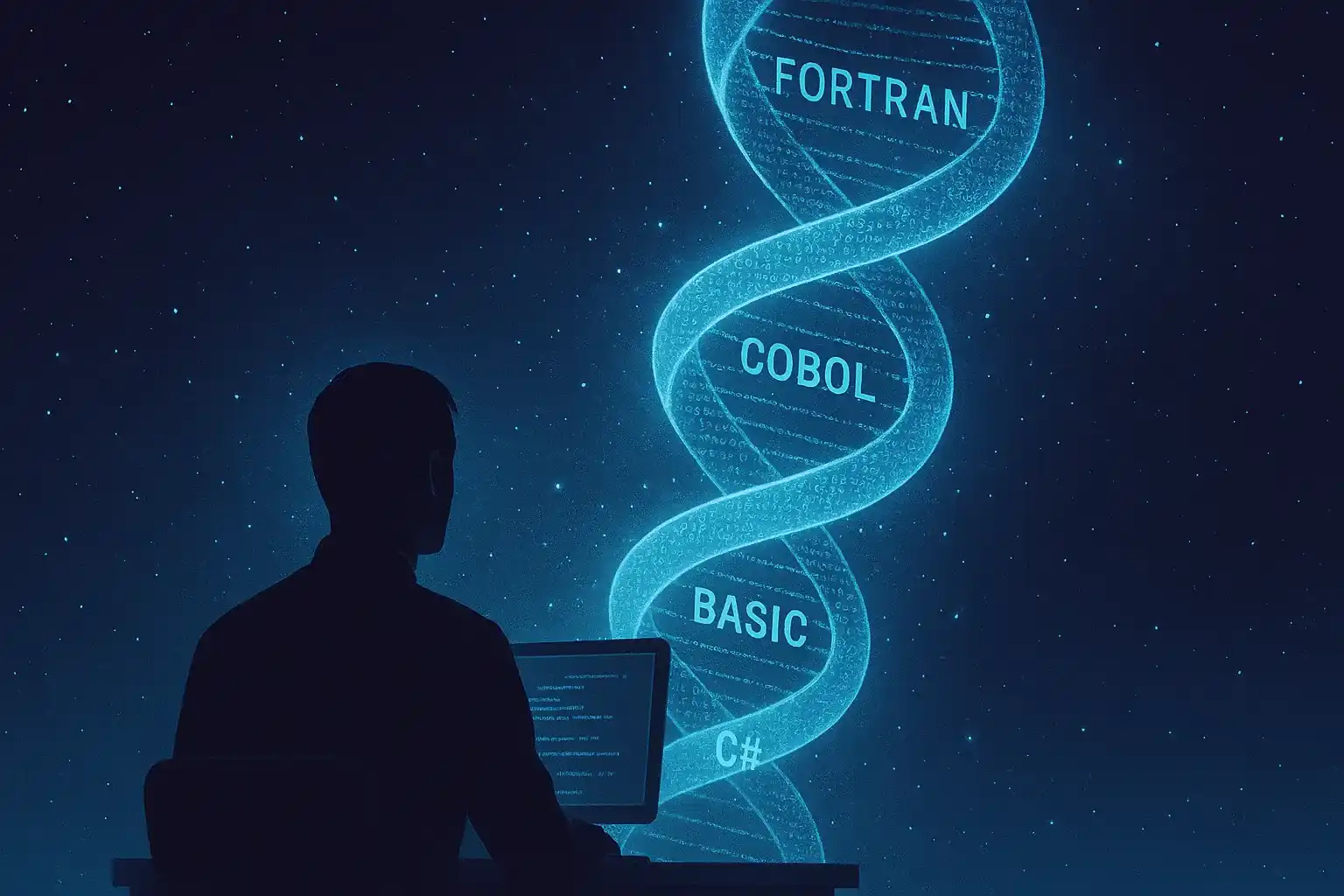

There is a story that pulsates behind every line of code, made up of brilliant intuitions, silent revolutions and languages that have changed the world without ever appearing on the front page.
Every modern developer, whether he knows it or not, is the fruit of digital eras that have overlapped, transforming the unthinkable into everyday reality.
But what was created did not remain immobile: every language of the past lit a fuse, a necessity, a hunger for progress.
And now, you are exactly at the point where that story can become yours.
Understanding the first programming languages is not for nostalgia, but for power: they show you the path that led to the language that will make you make up for lost time.
The moment is now, and the future has already chosen its heir: it's called C#.
What were the first programming languages: the pulse that ignited digital

Long before the idea of a graphical interface seduced minds, there was only the mathematical silence of machines and the visionary courage of those who knew how to listen to them.
I first programming languages they were not simple technical tools, but bold bridges between human abstraction and the imperturbable logic of silicon.
Fortran, Cobol, Lisp: names that today seem like distant echoes, but which once represented thresholds of access to entirely new universes.
Those who wrote in those languages did so like launching a rocket: calculating every detail, aware that one mistake would mean the failure of an entire mission.
Yet, in that rigor there was beauty, and in that beauty the first spark of what we now call modern development.
Understanding those languages is not just a historical exercise: it is a way to train our gaze to recognize evolution, to grasp the golden thread that has brought us to today.
Because if today you can launch an app with just a few clicks, it's because someone wrote thousands of lines in Assembly yesterday, with their heart beating faster than the processor.
The history of development is a long march between what was impossible and what is now ordinary, and each step has left behind a language as a testimony.
And you are here, right now, in front of that path, with the possibility of following it in reverse and regaining all its power.
The first programming languages are not relics: they are archetypes.
The language that couldn't be read: when speaking to the machine was an act of faith

Before it could even be understood what were the first programming languages, there existed a silent dialogue made of numbers, impulses and mental bets.
Writing code literally meant manipulating memory, building routines bit by bit, without any visual or grammatical aid.
There was no color, there was no intuitive syntax: there was only binary instruction and the human mind trying to translate an idea into something a machine could execute.
Every command was a formula, every operation a line in an esoteric ritual that few initiates had the courage to face.
In that era the programmer didn't try to express himself, he tried to control.
Languages like Assembly offered no consolation: they were cold, precise, ruthlessly faithful to machine logic.
Yet, in that apparent aridity the purest spark of digital creation was hidden.
Understanding where we started helps to give weight to where we are going: every curly bracket today comes from a hexadecimal table traced with sweat yesterday.
And when you look at a modern language like C#, what you see is the result of millions of lines written in the dark, by those who dared without editors, without IDEs, without help.
Every class, every method, every event that you compile with a click today is the direct result of that blind faith in programming as a revolutionary act.
From silent code to human language: the first revolution in software writing

It was only when languages like Fortran, Algol and Cobol were born that code really began to resemble something readable, thinkable, almost natural.
It wasn't just about writing more understandable commands: it was the first time a human could express a complex idea without translating it into pure numbers.
The code became logical narration, semantic construction, creative gesture guided by rules but open to interpretation.
For those who wonder today what were the first programming languages, the answer is not just a list of names, but a series of thresholds crossed with courage.
With Fortran, the world of automated scientific calculations opened up; with Cobol, corporate data processing took shape; with Lisp, artificial intelligence began to breathe.
Each of these languages has acted as a bridge: between blind control and conscious expression, between the machine that executes and the programmer that creates.
And in that transition lies the origin of the modern paradigm, the one that today allows languages like C# to combine technical power and expressive beauty.
Every variable declared today is the result of those first experiments, every function is an evolved echo of an intuition born in the laboratories of the 1950s.
And if there is something today that can truly take up that legacy in a powerful, modern and visionary form, that something is it C# course.
But to really understand it, you have to listen to the voice of those pioneers who wrote code as if they were drawing the first maps of a new continent.
What were the first programming languages? The past that inhabits the present
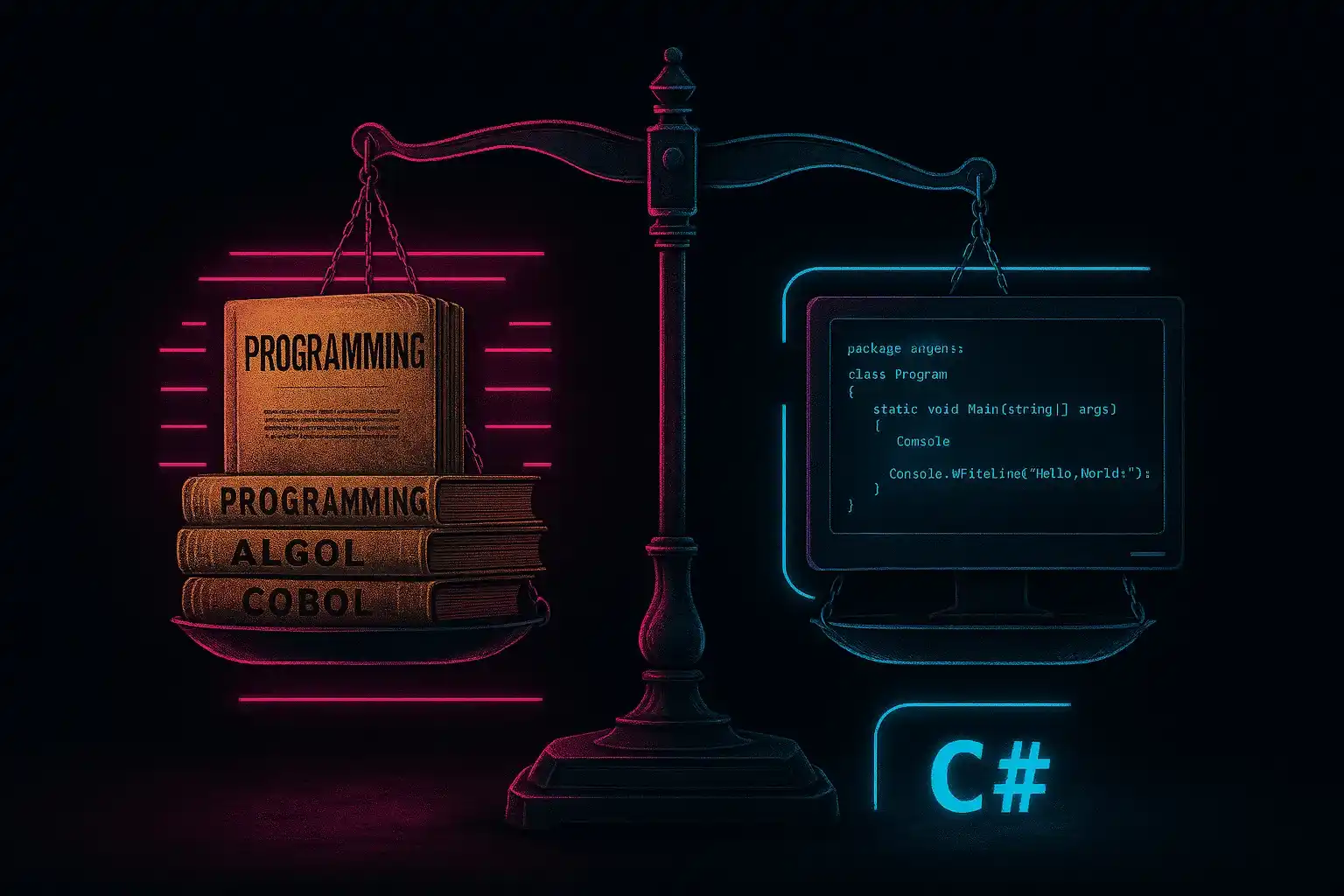
Not everything that appears modern really is: many recent languages carry with them the conceptual limits of an era that no longer exists.
They have more colorful syntaxes, richer IDEs, but within them survive paradigms designed for now extinct machines and thought models.
Anyone who studies what the first programming languages were discovers something disturbing: many of the logics of the time have never really been overcome, only disguised.
A for loop, a conditional statement, variable management: often only the symbols change, but not the essence.
And so a subtle trap is perpetuated: we learn to program on already outdated foundations, we teach the past as if it were the future.
This is why every new beginning requires a language that does not inherit the fears, but only the power of its predecessors.
And here C# comes into the picture: born to speak the language of modern architectures, designed to build complex applications with order, clarity and vision.
But learning C# alone is not enough: you need a method that guides you through the labyrinth of technique and takes you straight to the heart of efficiency.
This is where the C# course of Better Developer Method makes the difference: because it not only teaches you to write code, but to govern development with intelligence, speed and style.
When you choose the right language with the right method, what once seemed difficult suddenly becomes elegant, clean, masterable.
The necessary break: becoming a developer does not mean continuing what has been

Becoming a developer doesn't mean learning what everyone knows, but consciously deciding what is really worth learning.
For too many years, development has been confused with the simple use of standardized, repeated languages, imposed by obsolete corporate or educational logic.
But now that you know what were the first programming languages, you also have a duty to ask yourself whether you are building on progress… or habit.
True evolution is not repeating the past with new tools, but breaking with that past to build better tools.
And this break is not theoretical, it is concrete, daily, written line by line in every project you choose to tackle.
There is a time when every developer feels that they are just following a flow, copying syntax, implementing functions without really understanding the picture.
That moment is the crossroads: either you continue to adapt, or you decide to create.
And this is precisely why the C# course: not to teach you how to use a language, but to give you a key capable of opening the real architectures that matter today.
It's a choice that isn't just about code, but about your identity as a developer: Do you want to be part of the repetition or part of the transformation?
Who chooses the Better Developer Method he doesn't want a tutorial, he wants a new trajectory, a new signature in the world's software.
The new era: building today what early developers could only imagine

The pioneers blazed the trail, but they never had what is available today in a single development environment like C#.
Where they had to write thousands of lines for a single calculation, you can orchestrate an entire distributed architecture in a few well-written classes.
Who wonders today what were the first programming languages he does it to understand how much has been achieved, but above all how much still remains to be created.
And that potential for creation today is not a vague promise: it is a concrete reality for those who choose the right tools and rely on those who have already crossed the technical desert.
C# is not just a language: it is a synthesis of accessibility, efficiency, power and expressive beauty.
It's Microsoft's way of making the complexity of software engineering available to anyone with vision, ambition and method.
And that's why the C# course exists: to take all that power and put it in your hands in a clear, direct, transformative way.
But it's not just the language that makes the difference, it's the way you learn it, use it, transform it into results.
The Better Developer Method it's not a collection of lessons, it's an accelerated trajectory, a system that guides you from concept to solution.
Because today there is no longer any need to invent from scratch: we need to clearly choose what works, what accelerates, what really makes a difference.
From the first programming languages to your choice: spectator or heir?

You saw what were the first programming languages.
You recognized the greatness of those who dared to create in the dark, between punched cards, limited memory and instructions that today seem like relics.
You have understood that every line of code written today carries with it the digital blood of those silent revolutions.
But above all, you understood that the real point is not the past, but what you do with this awareness in your present.
History is never neutral: either you inherit it, or you forget it.
And if you've read this far, it's because something in you refuses to remain on the margins, to continue studying school languages without ever really touching power.
It's the moment when you no longer just want to understand how code works, but you want to write your code like someone who designs a living system.
This is the point where the Better Developer Method it becomes more than a choice: it becomes your answer to a life of dispersive, slow training, disconnected from reality.
Because knowing the theory isn't enough, knowing the names of the languages doesn't transform you, and following a few tutorials doesn't really prepare you.
You need a strategy.
We need a path built for those who want results in days, not years.
You need someone to tell you exactly what to learn, what to avoid, how to think like a software architect before you even write the first line.
If you really want to change your trajectory, if you want your name to appear among those who have decided to no longer be just a performer, then now is the time.
C# is the key.
The C# course it's the door.
The Better Developer method is the trajectory that will lead you to rewrite your present and your future.
The history of programming has brought you this far.
Now it's up to you to decide if it will be yours too.
Leave your details in the form below