Method, practice, and mentoring for learning software development with judgment
This category presents a different idea of IT training: method, practice, feedback, and a technical path that turns scattered study into skills that produce real outcomes.
The IT training that does not work and the kind that does
The IT training market is full of content that looks like training but is not.
Forty-hour YouTube tutorials showing how to build a Twitter clone in React.
Twenty-euro Udemy courses promising to make you a developer in thirty days.
Books that teach syntax without teaching reasoning.
The problem is not the content: it is the learning model.
Passive knowledge, the kind accumulated by watching someone else write code, does not transfer to work.
It is forgotten in weeks if unused, and when it is needed it is not available in the right form.
Training that works has three characteristics: it is active (you write code, solve problems, make decisions), it is contextual (the problem to solve resembles real work), and it has feedback (someone or something tells you whether you are going in the right direction).
This category treats training as a system, not as content to consume.
The result that matters is not having watched a course: it is being able to do something new, independently and reliably.
How to structure a technical growth path that produces results
A technical growth path without structure becomes scattered study: you learn a bit of everything, master nothing, and after six months cannot measure any concrete progress.
The structure starts with a diagnosis: what skills you already have, what is missing, which are most relevant to where you want to go.
You cannot improve on everything at the same time.
You choose one priority skill and work on it intensively until a measurable level of mastery, then move to the next.
The criterion for choosing what to study is expected return: how much does this skill increase my professional value in the short and medium term?
Studying the latest language features when OOP has not yet been mastered is a poor investment.
Studying software architecture when already working on complex systems and wanting to move to senior roles is a high-return investment.
Personal projects are the best context for active learning: they force you to make choices, find solutions to unexpected problems, and bring something to completion.
They do not need to be large or original: they need to be challenging enough to require stretching beyond current skills.
Mentoring and pair programming: the multipliers no course sells
Mentoring accelerates growth in ways no online course can replicate.
A mentor does not just teach what to do: they teach how to reason, what questions to ask, how to evaluate options, where your assumptions are wrong.
It is the difference between learning the answer and learning how to find answers.
Pair programming is the operational version of mentoring: two people working together on the same code, with roles alternating between who writes and who observes.
The value is not only the code produced; it is the transmission of tacit reasoning and patterns not found in books.
Those who say they have no time for mentoring or pair programming are almost always measuring productivity the wrong way.
Time invested in a junior developer who learns to work well returns value for years.
Time not invested returns a junior who keeps making avoidable mistakes, slows the team, and eventually leaves.
Finding a mentor is not simple.
The most effective path is building relationships in communities, contributing to open source projects where maintainers do code reviews, or investing in structured training programs with real feedback.
Training a technical team: what genuinely works and what wastes budget
Corporate training often has an incentive problem: the company wants specific skills immediately, the provider wants to sell the course, the employee wants a certificate to put on LinkedIn.
The result is a three-day course that nobody uses after the following week.
Training that produces change in the team has different characteristics: it is connected to a real problem the team must solve, it includes practice on the team's actual code, it has follow-up in the subsequent weeks, and it measures impact in concrete terms.
The most effective model I have seen work is structured on-the-job training: you identify a project or part of the codebase where the new skills will be applied, you train the team on that specific skill with short and intensive sessions, and you work side by side on the real application in the weeks that follow.
The trainer is not just an instructor: they are a consultant who accompanies the team through the practical transfer.
The certificate does not measure competency: it measures that someone attended a course.
The real measure of successful training is the ability to apply that skill independently on new problems, not on exercises specifically constructed for the purpose.
Analyses, cases, and articles on IT training, mentoring, and technical growth
3 articles found

Italy Training Tax Credit 4.0 in 2026: how to use it to train your tech team and save up to 70%
2026 guide to Italy's Training Tax Credit 4.0: rates, .NET and AI courses, common mistakes and real savings calculation.
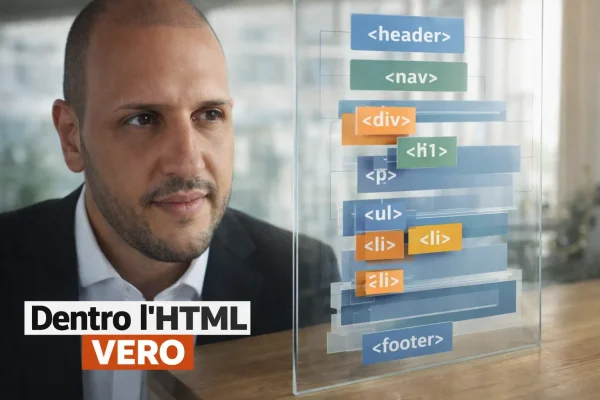
Is building an HTML website still worth it today? Yes, and here is why.
Build an HTML website with a free editor and browser. Learn the minimum structure, HTML tags, how CSS fits in, and the first mistakes to avoid.
When learning becomes transformation
Learning becomes transformation when you stop looking for shortcuts and start building verifiable skills, portfolio, technical reasoning, and a real work method. That is how training stops being content consumption and becomes a career lever.
Frequently asked questions
A valid course has: a clear program with measurable objectives, an instructor with real professional experience (not just teaching), practical exercises with feedback, and frequent updates to current framework versions. Avoid courses that promise 'developer in 3 months', that cover 20 technologies superficially, or that do not show the instructor's code in real contexts.
It depends on the stage. Those starting from zero benefit from a structured path that orders concepts and prevents gaps. Those with existing experience can advance independently on specific topics. The problem with pure self-learning is not the lack of resources, it is the lack of feedback: without someone correcting your approach, bad code is consolidated just as effectively as good code.
Microsoft certifications (AZ-900, AZ-204, AZ-305, exam 70-483 or its modern equivalent) have market value because they are recognizable, verifiable, and signal a minimum level of preparation. They do not replace experience but accelerate screening in selection processes. For junior or mid positions they are a concrete differentiator, especially when accompanied by a GitHub portfolio.
The most effective portfolio is not a collection of completed tutorials, but real projects with a declared problem, an implemented solution, and code publicly available on GitHub. Even a single well-built project (with a clear README, tests, CI/CD, and reasoned architecture) is worth more than ten YouTube clones. The goal is to show that you can build something, not that you followed something.
Sources and references
Cal Newport, Deep Work
Newport's Deep Work will change how you approach your study and technical work sessions. Newport distinguishes between deep work, high-concentration and high-cognitive-value, and shallow work that consumes time without building capability. I cite it because serious IT training requires intense, focused sessions, not passive accumulation of tutorials. It is a mindset shift before anything else.
The Pragmatic Programmer, Hunt and Thomas
The Pragmatic Programmer teaches the craft of programming with pragmatism and concreteness. It is not a book about a language or framework, it is a book about how to think, communicate and grow as a technical professional. I cite it among training resources because most courses teach syntax but not approach, and this book fills exactly that gap.