Visual Basic Course with the SVILUPPATORE MIGLIORE method
For teams working with Visual Basic who want to modernise applications and skills towards .NET and C#
1-on-1 Mentor On YOUR code Measurable results
Visual Basic is the language with which millions of business applications have been built. Many of these applications are still in production, generate revenue and must continue to work.
The problem is not the language. The problem is that the team's skills have not evolved with the rest of the Microsoft ecosystem: modern .NET, architectural patterns, Entity Framework, automated testing.
This path is for those who work with Visual Basic in production and want to bring their team and applications to the next level, without the trauma of a total rewrite in C#.
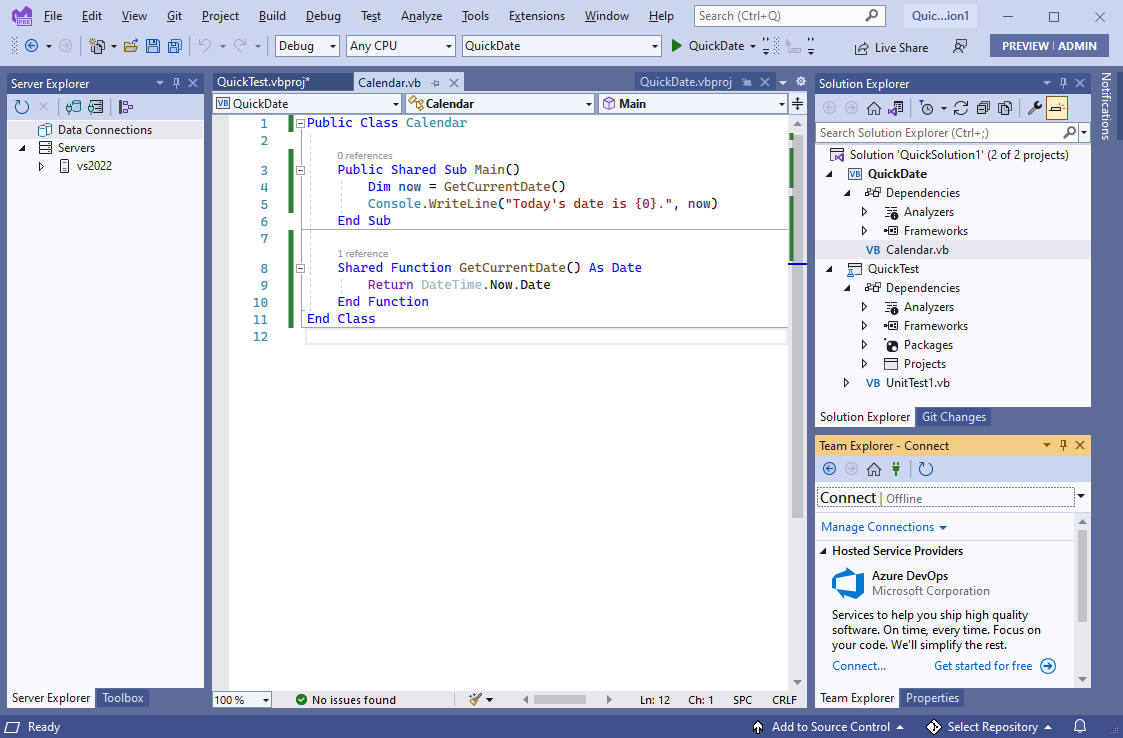
What you learn: the complete program
2 phases, 6 modules of intensive training on YOUR code.

2 phases, 6 modules of intensive training on YOUR code.
PHASE 1: Modern Visual Basic (Weeks 1-3)
- 1
Modern VB and .NET Features
Visual Basic has not stood still since 2005. The modern features of .NET are also available in VB. But almost no team actually uses them because the official documentation is written almost entirely in C#. Here we change that, starting from the code you write in production.
Programma
- Async/Await in VBHow to write asynchronous operations without blocking the interface and without unnecessary complexity
- Advanced LINQHow to use query expression and method syntax to replace for loops with readable code
- Nullable reference typesHow to enable Option Strict and annotate code to eliminate NullReferenceExceptions
- String interpolationHow to build messages and queries without fragile, hard-to-read concatenations
- Tuples and deconstructionHow to return multiple values from functions without redundant wrapper classes
- Modern operatorsHow to use NameOf, safe navigation and null conditional operator in everyday code
Risultato
Your VB code leverages the modern features of .NET. It is not code from the 2000s, it is professional, maintainable code.
- 2
OOP and Design Patterns
Many Visual Basic codebases are procedural code disguised as OOP. 5,000-line classes that do everything are the norm in applications inherited from years of development without architecture. Here you learn to design code with a clean structure, even in Visual Basic.
Programma
- SOLID in VBHow to apply the five principles with concrete examples drawn from real VB codebases
- Interfaces and abstractionHow to define clear contracts that make components replaceable and testable
- Dependency injectionHow to invert dependencies without a framework, using constructors and manual composition
- Factory and Strategy patternsHow to eliminate large If/Select Case blocks with polymorphism
- Refactoring from procedural to OOPHow to proceed gradually without breaking code in production
- Structured error handlingHow to build a useful exception hierarchy instead of using catch-all everywhere
Risultato
Clean architecture even in VB. The code is modular, testable and easy to evolve.
- 3
Advanced Windows Forms
Windows Forms is not dead. It is the UI framework of thousands of enterprise applications still in production. But most WinForms code is an untouchable monolith where UI, logic and database are fused together. Here you learn to separate the layers and make what you already have maintainable.
Programma
- Advanced data bindingHow to connect UI and data with BindingSource and INotifyPropertyChanged, reducing manual code
- MVP patternHow to separate presentation logic and UI to make both independently testable
- UI refactoringHow to extract business logic from code-behind into classes with a single responsibility
- Reusable custom controlsHow to build components that standardise the interface throughout the application
- Multi-threading in WinFormsHow to use Task and SynchronizationContext for long operations without freezing
- Progressive modernisationHow to update the interface form by form without halting development
Risultato
Professional desktop applications with UI separated from logic. Your WinForms is maintainable and testable.
PHASE 2: Professionalism and Evolution (Weeks 4-6)
- 4
Entity Framework and Data Access
Data access is often the most fragile point of Visual Basic applications. ADO.NET with manually concatenated SQL queries and unmanaged connections is the most expensive technical debt to maintain over time. Here we fix everything with Entity Framework and a structured approach.
Programma
- Entity Framework CoreHow to configure DbContext, models and relationships in a VB.NET project
- Database migrationsHow to version the schema and deploy changes in a controlled, repeatable way
- Performant queriesHow to use projections and Include to avoid the N+1 problem and poorly generated queries
- Repository patternWhen it makes sense to introduce it and when it adds complexity without real value
- From ADO.NET to EFHow to plan the gradual migration without interrupting production
- Connection managementHow to configure pooling and lifecycle correctly for production environments
Risultato
Database managed with method. Data access is type-safe, performant and the database is versioned.
- 5
Testing and Code Quality
Visual Basic code rarely has automated tests. Every change becomes a concrete risk because there is no safety net to signal regressions. Here we build that net starting from legacy code that was not designed to be tested.
Programma
- NUnit in VBHow to write unit tests with fixtures, assertions and parameterisation
- Code coverageHow to read the metrics that really matter and not the ones that only give false confidence
- Mocking dependenciesHow to isolate components from databases, external services and the filesystem
- Regression testsHow to cover legacy code before refactoring it to avoid introducing hidden bugs
- Safe refactoringHow to use tests as a safety net during code restructuring
- CI integrationHow to run tests automatically and block commits that break the expected behaviour
Risultato
The code is tested with confidence. You find regressions in the tests, not through the customer.
- 6
Evolution Strategy
VB is not receiving new language features. The future of the platform is .NET with C#. But the transition must be planned with method, not improvised on a production project that generates revenue. Here we build the realistic roadmap for your specific project.
Programma
- Migration to modern .NETHow to move from .NET Framework to .NET 10 with the least possible risk
- VB/C# interopHow to build mixed projects and shared libraries for a gradual codebase transition
- Transition strategyHow to choose which modules to migrate first and which to leave in VB for longer
- Personalised roadmapHow to build a plan with realistic milestones based on your real project
- .NET Upgrade AssistantHow to use the official Microsoft tool to analyse migration effort
- Cost/benefit assessmentHow to estimate the return on investment of the migration and present it to management
Risultato
Clear plan for the future. You know exactly how to evolve your VB codebase, with estimated timelines, costs and risks.
Who this path is for
CTO with a Visual Basic team
You have VB applications in production and a team that needs to modernise. You don't want (or can't afford) to rewrite everything in C# tomorrow, but you want a plan to evolve.
Senior VB developer who wants to stay competitive
You want to stay relevant in the job market and bring your skills to the next level, with or without transitioning to C#.
Company that must maintain VB applications
The Visual Basic applications work and generate revenue. You want the team to maintain them with modern best practices and evolve them without risk.
Who is Matteo Migliore
What professionals who have followed the path say
Investment and path
Paths are structured to measure based on the number of participants, duration and complexity of the project.
Fill in the form to receive the complete program and a personalised quote based on your specific needs.
Individual Path
1 participant, personalised mentoring
- 6 complete modules
- Live bi-weekly 1-on-1 sessions
- 12-month platform access
- Continuous chat support
Team Path
2-3 participants, department transformation
- 6 complete modules
- Work on company codebase
- VB modernisation plan
- 12-month platform access for everyone
Intensive Workshop
1-2 days on specific topics
- Focus on specific modules of your choice
- Up to 5 participants
- Complete teaching material
- Follow-up session at 30 days
Ready to modernise your Visual Basic skills?
Fill in the form and receive all the information about the Visual Basic course. We will analyse your current level and the most suitable path for your needs.
Free analysis We assess your team's current VB skills and modernisation goals
Talk to a mentor Not with a salesperson, but with a real expert who will guide you
Practical guidance Receive useful guidance even if you decide not to continue